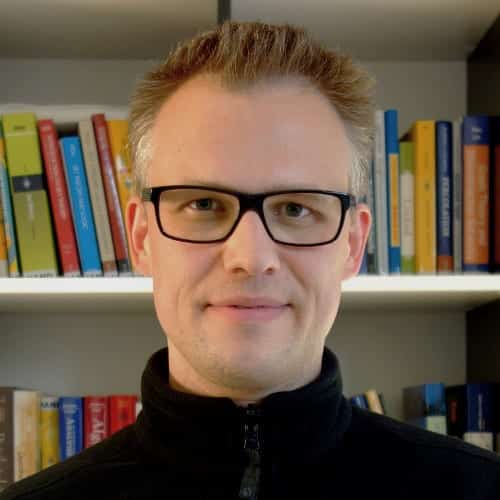
Mark Strembeckمشاهده پروفایل
دانشیار
Mark Strembeck is an Associate Professor at the New Media Lab, part of the Institute for Information Systems at the Vienna University of Economics and Business (WU). He is also a faculty member at the Complexity Science Hub and a key researcher at the Secure Business Austria research center, reflecting his interdisciplinary engagement in complex systems and information security. His research focuses on the analysis of complex systems, particularly in social media environments. Key interests include emotion detection, bot-human interactions, structural communication patterns during crises, and misinformation dynamics. His work combines network science, data analytics, and computational social science to understand human behavior in digital spaces. Mark's recent publications (2017–2024) reveal a strong trend in analyzing emotional motifs, community structures, and information diffusion during high-impact events such as wars, elections, and natural disasters. His studies often involve multiplex and temporal network models applied to platforms like Twitter, Facebook, and YouTube. He has collaborated extensively with researchers such as E. Kušen and M. Moser, contributing to journals like Computers in Human Behaviour , Applied Network Science , and IEEE Internet Computing . His methodological expertise spans sentiment analysis, motif detection, and network modeling. Mark Strembeck received his doctoral degree in business informatics from WU in 2003 and completed his habilitation in 2008. He holds two diploma degrees from the University of Essen, Germany. Prior to his academic career, he worked as a software developer and researcher in Germany and Austria. Scientific Contributions and Affiliations: Associate Professor, New Media Lab, WU Vienna Faculty Member, Complexity Science Hub Key Researcher, Secure Business Austria Active contributor to COMPLEXIS, ASONAM, and SNAMS conferences He has advised no students listed in the provided text and has not received any explicitly mentioned scientific awards. His work is supported by participation in national and international research projects, though specific grants are not detailed. He is involved in teams focusing on crisis informatics, bot detection, and emotional dynamics in social networks.