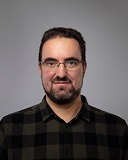
Frederik Ravn Klausen is a Guest Researcher at the Department of Mathematical Sciences, University of Copenhagen, and a postdoc in mathematical physics at Princeton University. His research focuses on mathematical physics, statistical mechanics, and quantum systems. His recent publications explore topics such as Anderson localization in open quantum systems, phase transitions in the Ising model, scalability challenges in analogue quantum simulators, and stochastic cellular automaton models of culture formation. Collaborative work spans interdisciplinary areas between physics, mathematics, and computational modeling.
Konstantinos Skitsas serves as an Assistant Lecturer and Visiting PhD Student at the Department of Computer Science, University of Copenhagen, affiliated with the Software, Data, People & Society (SDPS) section under Head of Section Dmitriy Traytel. His research focuses on data management systems and graph algorithms, specifically developing scalable techniques for subgraph matching and spectral filtering. This work addresses computational challenges in processing large-scale graph-structured data, with applications in social network analysis and pattern recognition. The SDPS section emphasizes interdisciplinary collaboration with industry to create software systems aligned with human and societal needs. His 2025 publication “Pilos” represents current work in graph processing efficiency, contributing to IEEE ICDE proceedings. The SDPS research environment actively explores topics like offline speech recognition and process discovery as indicated in section news. As part of the Department of Computer Science, he contributes to teaching while conducting PhD research within Copenhagen’s computational ecosystem, with office locations at Universitetsparken 1 (2100 Copenhagen Ø) and Sigurdsgade 41 (2200 Copenhagen N).
Marleen de Bruijne is Professor of AI in Medical Image Analysis jointly appointed at the University of Copenhagen, Denmark and Erasmus MC – University Medical Center Rotterdam, The Netherlands. Within the Department of Computer Science at Copenhagen she belongs to the Image Analysis, Computational Modelling and Geometry section, where she leads research at the intersection of machine learning and medical imaging. Education MSc in Physics, Utrecht University, 1997 PhD in Medical Imaging, Utrecht University, 2003 Research Interests Her work centers on developing and validating machine-learning algorithms for quantitative analysis of medical images. Key themes include: Transfer learning and domain adaptation across imaging centers Deep learning architectures for segmentation and classification of pulmonary, cardiovascular and neuro images Probabilistic graphical models and Bayesian approaches for robust airway and vessel extraction Computer-aided diagnosis systems for emphysema, bronchiectasis, COPD and calcification Her group translates these techniques into clinical workflows to improve early diagnosis and patient management. Scientific Awards NWO-VENI (Netherlands Organisation for Scientific Research) NWO-VIDI NWO-VICI DFF-YDUN (Danish Council for Independent Research) Advising & Grants She has (co-)supervised 30 PhD students to completion and served as principal investigator on several large personal grants. Her funding record demonstrates sustained support from both Dutch and Danish national science foundations. Labs & Teams She is actively involved in the SCIENCE AI Centre at the University of Copenhagen and maintains strong collaborative links with Erasmus MC Radiology and Pulmonology departments, fostering cross-institutional datasets and multicenter clinical validation studies.
Youseef Essam Mahmoud Al-Janabi is an instructor at the Department of Computer Science, University of Copenhagen, specializing in theoretical and applied aspects of algorithms and computational complexity. His role involves teaching and research contributions within one of Europe's leading academic institutions in computer science. University: University of Copenhagen Department: Department of Computer Science Rank: Lecturer His research interests align with the department's focus areas including algorithms, data structures, graph theory, and computational geometry, with applications extending to machine learning and big data analytics. The department's work bridges theoretical foundations with real-world implementations through initiatives like the Basic Algorithms Research Copenhagen (BARC) centre and Danish Center for Big Data Analytics driven Innovation (DABAI). Contact: yaj@di.ku.dk
Anton Wøldike Friis is a Lecturer affiliated with the Department of Computer Science and the Department of Mathematical Sciences at the University of Copenhagen. He also serves on the Study Board of Psychology. His contact details include multiple email addresses: anfr@di.ku.dk, awf@math.ku.dk, and scj896@psy.ku.dk. Department of Computer Science, University of Copenhagen Department of Mathematical Sciences, University of Copenhagen Study Board of Psychology As part of the Algorithms and Complexity (AC) section at DIKU, Anton contributes to research and teaching in theoretical computer science. The AC section explores fundamental computational limits through mathematical theory, with applications in algorithm design for massive data, optimization, and machine learning foundations. The section hosts the Basic Algorithms Research Copenhagen (BARC) center and collaborates on cutting-edge theoretical work. The AC section’s research spans data structures, graph algorithms, computational complexity, and algorithmic paradigms. Anton’s role involves teaching courses in both Bachelor and Master programs, covering topics like randomized algorithms, discrete mathematics, and computational geometry. His work supports the section’s mission to bridge theoretical rigor with real-world impact, particularly in machine learning and applied domains.
Nicolas Damgaard Frisch is an Instructor at the Department of Computer Science (DIKU), University of Copenhagen. He is affiliated with the Algorithms and Complexity (AC) section, which focuses on theoretical computer science and its practical applications in areas like machine learning and optimization. Research Interests : His work aligns with the AC section’s exploration of efficient computation, data structures, graph algorithms, and computational complexity. Labs & Centers : The AC section hosts the Basic Algorithms Research Copenhagen (BARC) center, supported by the VILLUM Foundation, and collaborates with the Danish Center for Big Data Analytics driven Innovation (DABAI). Contact : Reach Nicolas via email at nfri@di.ku.dk .
Max Bjørn Hofmann is an Instructor at the Department of Computer Science (DIKU) and Department of Mathematical Sciences at the University of Copenhagen , Denmark. He contributes to teaching and research within theoretical computer science. The Algorithms and Complexity (AC) section at DIKU, where he is affiliated, focuses on foundational research into computational efficiency, including data structures, graph algorithms, computational complexity, and algorithmic paradigms. Their work bridges mathematical theory with practical applications in machine learning and big data analytics. Contact details: Email: maho@di.ku.dk Email: mbh@math.ku.dk
Carsten Henrik Jørgensen is a PartTime Lecturer at the Department of Computer Science , University of Copenhagen. He is affiliated with the Algorithms and Complexity (AC) section , which focuses on theoretical computer science, including algorithmic paradigms, computational complexity, and mathematical foundations of machine learning. His work emphasizes bridging theoretical research with real-world applications. Contact: pcjor@di.ku.dk
Panagiotis Karras is a Professor at the Department of Computer Science , University of Copenhagen , with a faculty affiliate status at Aarhus University . His research focuses on robust and versatile methods for data access, mining, and representation. Education: MSc in Electrical and Computer Engineering from National Technical University of Athens , PhD in Computer Science from University of Hong Kong Research Interests: Spanning data management systems, graph algorithms, and privacy-preserving data publishing, his work addresses challenges in efficient query processing, influence propagation in networks, and semantic-aware data compression. Notable contributions include adaptive indexing techniques, graph alignment frameworks, and algorithms for fair stable marriage problems. Recent Publications (2024-2025): Focus on graph alignment, subgraph matching, and influence maximization, with applications to knowledge graphs, social networks, and time-series data analytics. Scientific Recognition: 2008 Young Scientist Award from the Hong Kong Institute of Science Keynote invitations at ACM SIGKDD and IEEE ICDE Professor Karras actively seeks motivated PhD students to collaborate on these research directions. His lab maintains a powerful compute cluster and modern facilities for data-intensive research.
David Rasmussen Lolck is a PhD Fellow at the University of Copenhagen's Department of Computer Science, specializing in the Algorithms and Complexity section. His research focuses on theoretical and applied aspects of computer science, particularly in algorithms, coding theory, and privacy-preserving data analysis. Current affiliation: Department of Computer Science (DIKU) , University of Copenhagen Research areas: Algorithms, complexity theory, differential privacy, and data management Recent publications address noise-robust coding and combinatorial clustering algorithms Contact: dalo@di.ku.dk | Phone: +45 3533 2122
Rikke Vesterbæk Nielsen is an Instructor at the Department of Computer Science (DIKU) at the University of Copenhagen. Her work is affiliated with the Algorithms and Complexity (AC) section, which focuses on theoretical computer science topics such as data structures, graph algorithms, computational complexity, and algorithmic paradigms, often intersecting with machine learning and applied areas. The AC section, led by Professor Mikkel Thorup, contributes to both foundational research and practical applications through centers like Basic Algorithms Research Copenhagen (BARC) and the Danish Center for Big Data Analytics driven Innovation (DABAI).
Jakob Nordström is a full-time Professor at the Department of Computer Science , University of Copenhagen , and holds a part-time affiliation with Lund University since 2020. His research lies at the intersection of theoretical computer science , proof complexity , and combinatorial optimization . His work focuses on SAT solving , Pseudo-Boolean optimization , and formal verification of algorithms. Recent research includes polynomial calculus lower bounds , dynamic programming certification , and MIP-based presolve techniques . Publications span journals like the Journal of the ACM and conferences including SAT and CADE . Scientific awards include the STOC '06 Best Student Paper Award and the Ackermann Award 2009 . He is a member of the Young Academy of Sweden (since 2018). Research funding comes from the Independent Research Fund Denmark and the Swedish Research Council . He has contributed to proof complexity , resolution trade-offs , and algebraic reasoning in combinatorial search. His work bridges theoretical lower bounds with practical Pseudo-Boolean solvers and certified algorithms .
Jacob Nørbjerg is a Part-time Lecturer at the Department of Computer Science (DIKU) , University of Copenhagen. His work focuses on foundational aspects of algorithms and computational complexity, aligning with DIKU's research in theoretical computer science and its applications in machine learning and data analysis. Ranks: Part-time Lecturer Location: Universitetsparken 1, 2100 København Ø The Algorithms and Complexity section at DIKU investigates the mathematical foundations of efficient computation, with research themes including data structures, graph algorithms, and computational complexity. This work often intersects with practical applications in optimization and machine learning.
Ole Emil Pedersen is an Instructor at the Department of Computer Science (DIKU), University of Copenhagen. He is affiliated with the Algorithms and Complexity (AC) section, which focuses on theoretical computer science, including data structures, graph algorithms, computational complexity, and algorithmic paradigms. His work intersects with practical applications in machine learning and large-scale data analysis, supported by research centers like Basic Algorithms Research Copenhagen (BARC) and Danish Center for Big Data Analytics driven Innovation (DABAI). For contact, his email is olpe@di.ku.dk .
Michele Coscia is an Associate Professor in the Department of Data Science at the IT University of Copenhagen. He also serves as the Head of Programme for the BSc in Data Science. His research focuses on network analysis, social networks, data mining, and their applications in understanding human mobility, complex systems, economic development, and memetics. He has contributed to projects such as the Pioneer Centre for Artificial Intelligence and leads initiatives like ROMNET (Past social network reconstruction from material culture data) and Work2Vec (exploring deep learning in healthcare and work hours analysis). His research interests encompass interdisciplinary network science, including misinformation dynamics, ideological polarization, and the impact of social media systems. He has developed methodologies like the generalized Euclidean measure for multilayer networks and explored cultural data analytics through case studies like Italian music history. His work also addresses real-world challenges, such as quantifying the effects of violence on migration patterns and optimizing network sampling strategies for cost efficiency. Michele Coscia has received the Årets Forskningsmiljø 2022 award, recognizing his contributions to fostering outstanding research environments. He actively engages with media, discussing topics like misinformation and data visualization. As a principal investigator, he oversees projects funded by institutions such as the Villum Foundation and Danish National Research Foundation. His research spans academic collaborations across countries, reflecting his global network and commitment to advancing network theory and its applications.