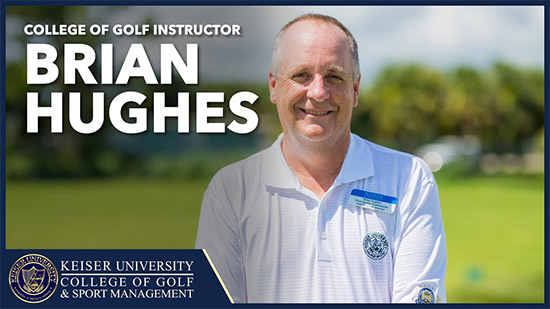
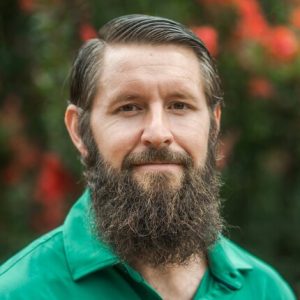
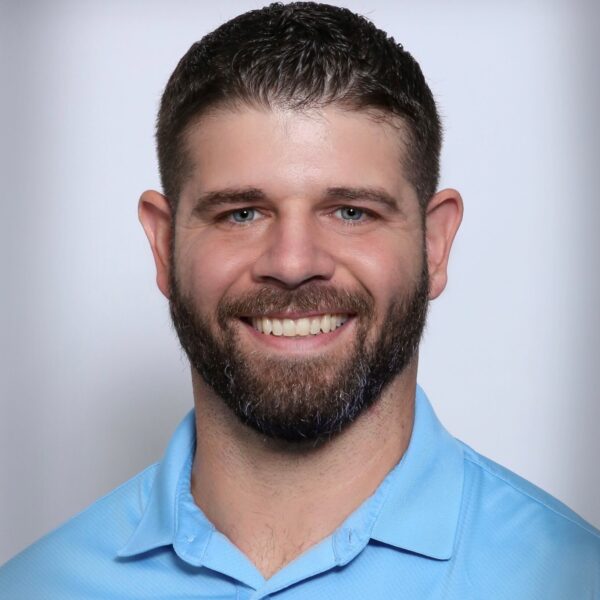
Brian Hughes is a PGA Master Professional in Instruction and the Golf Program Director at Keiser University College of Golf. With over 25 years in the golf industry, he has held roles as Head Golf Professional, General Manager, and instructor at prestigious facilities, contributing to award-winning programs like Golf Shop Operations Magazine’s top 100 Golf Shops. Academic Role : Professor at Keiser University College of Golf Expertise : Golf Instruction, Program Development, Rule Changes, Equipment Technology Research Interests : Brian specializes in golf education, focusing on swing fundamentals , mental game strategies , and rule simplification . His work emphasizes student-led goal setting , impact position analysis , and equipment-personalization to enhance performance. Article Trends : His publications bridge practical golf training (e.g., home practice techniques, elite coaching) with institutional knowledge (e.g., rule overhauls, PGA Tour analytics). Keywords include Golf Instruction, Sports Education, and Equipment Technology, with sub-fields like Indoor Practice, Turf Adaptation, and Mental Discipline. Leadership : Appointed as Chairman of the Martin County Golf Course Citizen’s Advisory Committee in 2024, Brian advises on course master planning and operations.
Frank Longabucco is a Professor at the Keiser University College of Golf , where he combines academic instruction with practical PGA-certified golf expertise. As a PGA Certified Professional in both Golf Operations (2006) and Instruction (2011), he emphasizes short game mastery, balance, and tempo in player development. His research interests include: Short game instruction Golf course hospitality Tournament organization Equipment optimization Historical golf techniques Student-athlete mentorship Longabucco's recent publications focus on practical golf skills (e.g., video swing analysis, regripping techniques) and operational insights, though no peer-reviewed scientific awards are documented. He actively coaches students in NCCGA tournaments and hosts clinics on topics like chipping and hickory golf experiences.
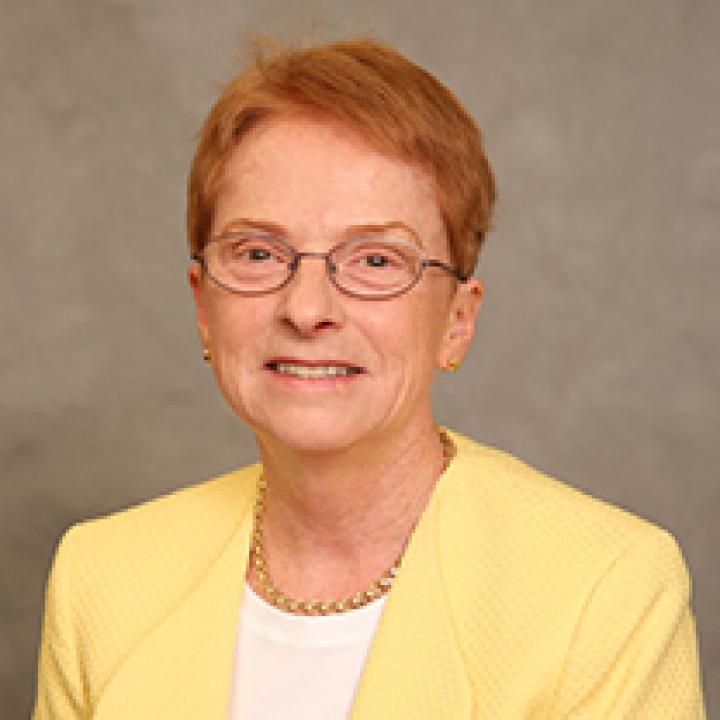
Mary Margaret Minnis is a Senior Lecturer in the Department of Chemistry and Physical Sciences at Pace University, affiliated with the Dyson College of Arts and Sciences. She teaches a wide range of courses in environmental science, chemistry, and Geographic Information Systems (GIS), both online and in person, with a strong emphasis on practical, community-oriented applications. Education: Ph.D. in Environmental Science, SUNY College of Environmental Science and Forestry and Syracuse University, 1982 M.S. in Environmental Chemistry, SUNY College of Environmental Science and Forestry, 1979 B.S. in Chemistry, Marywood University (formerly Marywood College), 1966 Her research interests span a broad range of environmental topics, with a strong focus on GIS education, watershed management, wastewater treatment, environmental assessment, and urban forestry. She is particularly known for her work using iTree tools to assess the value of urban forests and for her development of a free online GIS MOOC. Her teaching philosophy emphasizes experiential learning, service learning, and making science accessible to non-science students. The recent publications and presentations reflect a consistent trend in GIS education, environmental monitoring, and community-based applications. Her work centers on leveraging geospatial technologies for environmental problem-solving, particularly in urban and suburban settings. Themes include stormwater management, land use analysis, conservation planning, and environmental education outreach. Scientific Awards: No awards listed in the provided text. Mary Margaret Minnis has actively mentored numerous graduate students in environmental science, guiding theses on topics such as GIS applications, wastewater management, urban forestry, and environmental policy. She has also contributed to curriculum development and professional service, including serving on the Tenure and Promotion Committee and the Board of Trustees Operations Committee. While no specific grants are mentioned, her work with volunteer groups and community projects indicates strong engagement with public service and environmental outreach. Labs and Teams: She created and maintains the Pace Pleasantville weather station. She has led volunteer stream monitoring groups using the Save Our Streams program. She collaborates with organizations such as Audubon International and the US Peace Corps (through Darien Book Aid). She has trained golf courses for Audubon Cooperative Wildlife Sanctuary certification.
Ömer Çoban is an Associate Professor at the Faculty of Tourism, Nevşehir Hacı Bektaş Veli University. He holds a Doctorate in Tourism Management from Çanakkale Onsekiz Mart University and has served as Department Head at Batman University and Vice Dean at Nevşehir University. His academic journey includes roles as Research Assistant (2008), Lecturer (2014–2018), and Associate Professor since 2019. He has conducted research on tourism policy, event tourism, sustainable practices, and destination management. Education: PhD in Tourism Management (2014), MA in Tourist Guidance (2019), MSc in Tourism Management (2011), and multiple undergraduate degrees in Business Administration and Public Relations. He teaches courses such as International Promotion in Tourism, Event Management, and Tourism Theories at both undergraduate and postgraduate levels. Research interests focus on tourism’s socio-economic impacts, event-driven solutions to seasonality, gastronomy tourism, and environmental policies. His recent work includes studies on consumer behavior in gastronomy, service recovery in hospitality, and green event evaluation. He has supervised over 15 theses on topics like tourist behavior, destination management, and service quality. He has led projects such as the Bozcaada Tourism Master Plan and current initiatives on thermal tourism development and tour operator capacity building. His expertise is reflected in 20+ books and 30+ peer-reviewed articles addressing tourism innovation, cultural heritage preservation, and sustainable practices.
Riki Ichiho is a Lecturer in the Department of Business Administration at Whittier College, where he teaches Managerial Accounting, Tax Accounting, Small Business Operations and Management, and other courses. He previously held part-time teaching positions at Utah Tech University and has a diverse professional background in accounting, law, and corporate finance. His academic journey includes a B.B.A. from the University of Notre Dame, an M.B.T. from the University of Southern California, and a J.D. from Loyola Law School. Rik’s research and teaching interests focus on accounting practices, tax compliance, business ethics, and small enterprise management. He has developed innovative courses such as Personal Financial Literacy and Freedom of Innovation, and played a pivotal role in creating an accounting pathway program to prepare Whittier students for the Certified Public Accountant exam. Before academia, Rik worked as a Senior Tax Manager at Coopers & Lybrand (now PricewaterhouseCoopers), founded a forensic accounting practice, served as General Counsel and VP Finance at Grand American, Inc., and held corporate counsel and treasurer roles at American Golf Corporation. He later operated CR Financial, LLC, managing payday advance stores and other small businesses.
Patrick G. McKune is an Adjunct Professor of Accounting at the Graduate School of Business, Lewis University. He currently serves as Chief Financial Officer (CFO) for M. Holland Company, overseeing corporate finance, accounting, treasury, risk management, and human resources. McKune contributes to academic and professional communities through his advisory roles, including as Board President of Sarah’s Inn and a member of the Lewis University College of Business Executive Advisory Board. Education: BA in Accounting from Lewis University (1985), MBA from Loyola University Chicago (1991) McKune’s academic work intersects with his extensive professional experience in financial leadership and organizational management. His research interests likely align with practical applications in accounting, corporate finance, and talent development within business environments. McKune actively engages in community service, particularly in domestic violence advocacy, and balances his career with personal interests in golf, sports, travel, and outdoor activities.
Zachary Bingaman serves as an Adjunct Faculty member in the School of Business & Technology at Cairn University . He teaches courses in Finance and Asset Management while working full-time as a Financial Analyst at the Vanguard Group, where he ensures accuracy of securities information for mutual funds. Mr. Bingaman is pursuing the Chartered Financial Analyst (CFA) designation. Education : MBA from Drexel University; BA in Finance from Cedarville University Professional Background : Former roles at Vanguard Group (Brokerage Investment Professional, Client Relationship Associate); prior experience at Bucks First Federal Credit Union Research & Professional Focus : Zachary’s work bridges academic finance instruction with practical application in asset management and securities analysis. His career at Vanguard emphasizes operational precision in large-scale investment vehicles, while his academic role contributes to business education at Cairn University. Personal Interests : Enjoys Detroit Red Wings hockey and golf.
Ben Smith is the Director of the STEM Center and a Lecturer in the Department of Mathematics & Computer Science at McDaniel College. The STEM Center serves as an academic resource and community hub for students in science, technology, engineering, and mathematics, offering tutoring, workshops, and faculty development. Smith plays a dual role in both teaching and institutional leadership, focused on enhancing student success and quantitative literacy. His research and professional interests center on STEM education and pedagogical innovation, particularly in informal learning environments. He emphasizes one-on-one and small-group tutoring as powerful tools for conceptual understanding. His work supports first-generation and low-income students, reflecting his own background and commitment to equitable access in higher education. The STEM Center, under his direction, promotes interdisciplinary engagement in quantitatively rich disciplines and is physically located on the second floor of Hoover Library. It operates six days a week, offering both academic support and community-building opportunities for students and faculty. Smith is also actively involved in faculty development, helping instructors refine their courses to better support student learning. His experience at Hamilton College and the State University of New York has informed his holistic approach to education, blending direct student support with systemic academic improvement. Outside of his academic roles, he enjoys barbecuing, disc golf, and competitive West Coast Swing dancing with his wife, reflecting a well-rounded and engaged lifestyle.
James V Carnahan is an Adjunct Professor (10 % appointment) in the Department of Industrial and Enterprise Systems Engineering at the University of Illinois at Urbana-Champaign, a role he has held since December 2004. Previously he served as Lecturer and Adjunct Professor (50 %), Coordinator of Project Design Activity (100 %), Visiting Assistant Dean in the College of Engineering, and Assistant Professor in what was then the Department of General Engineering. Education Ph.D., Engineering Sciences, Purdue University (1973) M.S., Engineering Sciences, Purdue University (1970) B.S., Engineering Sciences, Purdue University (1968) Research Interests Carnahan’s scholarship is notable for its breadth. Core themes include probabilistic modeling and maximum-likelihood estimation—especially for Beta distributions—reliability engineering, and life-cycle cost analysis of infrastructure systems. He has applied these tools to pavement management, underground heat distribution networks, bulk-material conveyor design, and vehicular-accident injury analysis. Additional curiosity-driven projects span human factors in speed/distance perception, pedestrian-flow congestion, optimization of flavor manufacturing, and even statistical analysis of golf-putting performance. Publications & Trends Across more than three decades Carnahan has published extensively in journals such as Management Science , Accident Analysis & Prevention , ASCE Journal of Transportation Engineering , Decision Sciences , and ASME Journal of Mechanical Design . Early work focused on transportation safety and pavement maintenance optimization; mid-career contributions advanced fuzzy multi-attribute decision making and environmentally conscious design; recent studies shift toward medical and sports analytics, illustrating an evolving interdisciplinary trajectory grounded in rigorous statistical methods. Scientific Awards & Recognition Engineering Council (Accenture) Award for Excellence in Advising, UIUC College of Engineering (2001, 2002) Anderson Consulting Award for Excellence in Advising, UIUC College of Engineering (1990–93, 1999–2000) Department of General Engineering Outstanding Professor (1986, 1991, 2003) Finalist, All-Campus Award for Excellence in Undergraduate Teaching (1990) Everitt Award for Undergraduate Engineering Teaching Excellence (1989) Advising, Grants & Senior Design Leadership Carnahan has coordinated large-scale multidisciplinary senior design projects since 1993, guiding student teams working with industry partners such as Harger International, NTN-Bower, Marmon Industries, Magnetrol, and FONA International. These efforts have garnered multiple James F. Lincoln Engineering Awards and continuous corporate sponsorship, providing students with authentic design-build experiences in reliability, process optimization, and product redesign. Laboratory & Consulting Activity While no dedicated lab is explicitly named, Carnahan maintains active consulting practices through Carnahan Engineering and Surveying (principal, 1979-1983) and ongoing advisory roles with The PERTAN Group, FONA International, Ruhl Forensic, Inc., and the U.S. Army Construction Engineering Research Laboratory, focusing on reliability, forensic accident investigation, and energy-system life-cycle analysis.
Timothy Carlson is a Lecturer at Methodist University's PGA Golf Management, PTM & Sport Management department within the Reeves School of Business . He holds a B.S. in Criminal Justice from Bob Jones University (2008) and another from Methodist University. His teaching philosophy integrates mental strengthening exercises and emotional control techniques with advanced technology to foster holistic golf development. Education: B.S. in Criminal Justice, Bob Jones University (2008) B.S., Methodist University Research and Professional Focus: While not explicitly tied to traditional academic research, Carlson's work centers on golf instruction, veteran rehabilitation through sports, and the intersection of physical and mental training in athletics. He pioneered efforts to establish PGA HOPE programs for veterans and emphasizes club fitting/repair operations in golf education. Affiliation and Career: At Methodist University, he serves as Director of Instruction and Head Golf Professional. Previously, he worked as an Assistant Golf Professional at Highland Country Club, teaching clinics and managing club fittings, and founded his own coaching business, Dynamic Golf Solutions . His career transition from Army service to golf instruction highlights his commitment to therapeutic physical activity and veteran support.
Mehrdad Zarafshar is a Senior Lecturer in Forest Regeneration at the Department of Forestry and Wood Technology, Faculty of Technology, Linnaeus University. His research focuses on integrating cutting-edge techniques such as seedling fertilization and plant-microbe interactions to enhance seedling vitality and resilience in plantation settings, establishing foundations for sustainable forest ecosystems. Dr. Zarafshar's primary research interests include: Forest regeneration techniques and optimization Seed and seedling biology, particularly stress physiology Plant-microbe interactions in forest ecosystems Soil biology and its relationship with forest management practices The impact of forest fertilization on soil microbial communities Soil health indicators in semi-arid environments His extensive publication record reveals a research trajectory deeply engaged with understanding soil-forest interactions across diverse ecosystems. Recent work spans semi-arid woodlands with wild pistachio trees, mangrove ecosystems along the Persian Gulf, and managed forest stands in Sweden. His research consistently examines how tree density, stand composition, and human interventions affect soil characteristics and microbial activities. Notably, his innovative work on Trichoderma applications bridges forest microbiology with practical turfgrass management solutions. Dr. Zarafshar currently leads two significant research projects: 'Soil microbes as key players – decoding the impact of forest fertilisation on their communities' investigating microbial responses to fertilization practices 'Decomposition, respiration and nitrogen mineralization in response to forest thinning – a Tranemåla perspective' examining short-term soil biogeochemical responses to thinning operations He is actively involved with the Forest Management research group at Linnaeus University, which addresses sustainable forest use considering economic, social, and ecological dimensions. Additionally, he participates in 'The Bridge,' a strategic partnership between Södra, IKEA, and Linnaeus University that unites academic research with industry applications to drive innovation in forestry and wood sustainability.
Chris Leonardi serves as a Clinical Educator and Instructor at the Cleveland University-Kansas City Chiropractic Health Center since 2017. Education: Bachelor of Arts from the University of Kansas Doctor of Chiropractic from Cleveland Chiropractic College-Kansas City His clinical expertise centers on sports injuries and herniated disc cases, with specialized focus on athlete rehabilitation—particularly golfers. He is certified in Selective Functional Movement Assessment (SFMA Levels 1 and 2), which guides his diagnostic and treatment methodologies for movement dysfunctions. Prior to his university role, he operated a family-based private practice in Lawrence and Overland Park, Kansas for over two decades (1996–2017), treating diverse orthopedic conditions with emphasis on sports medicine applications.
Dr. Jeff Spoonemore is a Medical Educator and Instructor with 25 years of clinical experience in private chiropractic practice based in Olathe, Kansas. He previously served as a clinic director for a decade at one of the largest chiropractic practices in the Kansas City metropolitan area, overseeing operational management and protocol development. Education D.C. from Life Chiropractic College West Research and Clinical Focus His expertise centers on chiropractic applications for chronic conditions, particularly the development and refinement of Acoustic Wave Therapy protocols targeting spinal and extremity disorders. This work emphasizes non-invasive approaches to musculoskeletal rehabilitation and long-term pain management within clinical practice settings. Professional Background Early in his career, Dr. Spoonemore participated in U.S. Air Force training programs conducted annually in Germany. His clinical leadership extended to managing treatment innovations for complex cases, integrating evidence-based therapies into large-practice workflows. Outside professional commitments, he maintains an active interest in golf, frequently vacationing with his wife and daughter around the sport.
Cody Dimak serves as an Associate Professor at Parker University in Dallas, Texas, where he leads the active rehabilitation course for the Doctor of Chiropractic (DC) program and participates in Parker Seminars initiatives. His professional focus centers on active rehabilitation methodologies, strength and conditioning protocols, and motor skill learning techniques. Dr. Dimak advocates for patient-centered rehabilitation strategies that transition patients into strength-focused environments, emphasizing external cueing for optimal motor learning outcomes. Prior to relocating to Dallas, he co-owned and operated an active-care chiropractic practice in Orange County, California for seven years. He maintains active involvement in chiropractic education while balancing family life with his two daughters and personal interests in golf.
Professor Regina Belski is a senior faculty member and Associate Dean, Partnerships in the School of Allied Health, Human Services and Sport at La Trobe University. She serves as Professor in the Discipline of Food, Nutrition and Dietetics and holds credentials as an Advanced Accredited Practising Dietitian, Registered Nutritionist, and Advanced Sports Dietitian. Her research spans sports and performance nutrition for athletes and tactical operators, food systems and security, functional food development, metabolic health, scholarship of teaching and learning, and maternal/foetal nutrition. This interdisciplinary work integrates clinical practice with academic rigor across multiple domains of nutrition science. Recent publications demonstrate consistent focus on sports nutrition applications, dietary interventions for metabolic health, and educational innovations in dietetics training. Her work frequently employs mixed-methods approaches and addresses critical gaps in athlete nutrition, refugee health literacy, and obesity prevention strategies. Scientific recognition includes: Australian Government Office of Learning and Teaching Citation for outstanding contribution to student learning (2014) Professor Belski has established herself as a leading educator through practice-oriented learning environments that foster self-reflective, independent learners. Her collaborative research program engages with tactical operators, athletes, refugees, and clinical populations while advancing scholarship in nutrition education. Current leadership as Associate Dean focuses on strategic partnerships that bridge academic and professional practice in dietetics.