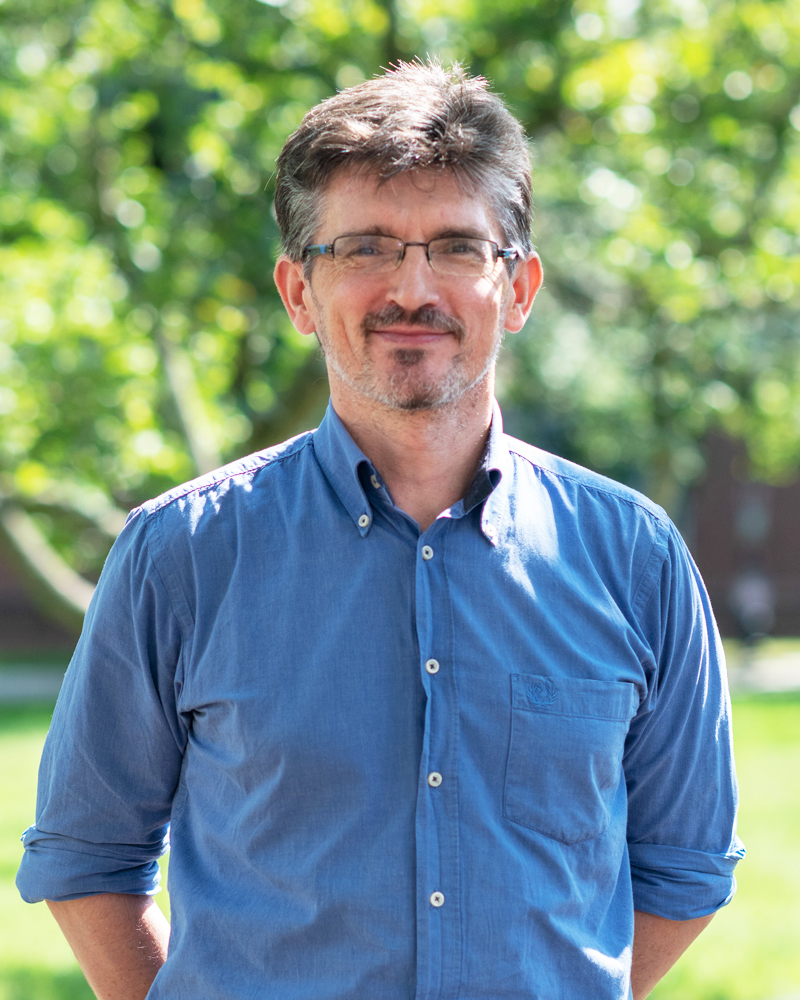
Amilcare Porporato is the Thomas J. Wu '94 Professor of Civil and Environmental Engineering at Princeton University, with joint appointment at High Meadows Environmental Institute. His research integrates hydrology, ecology, and thermodynamics to study soil-water interactions and sustainable resource management. Education includes: Ph.D. Polytechnic of Milan (1996) M.S. Civil Engineering, Polytechnic of Milan (1992) Research explores nonlinear hydrologic systems, soil moisture dynamics, ecohydrology, and environmental complexity using theoretical and experimental approaches. His work advances understanding of water-biota interactions across scales from pore-level processes to landscape evolution. Honors and Awards: Hydrologic Sciences Award, AGU Borland Lecturer American Geophysical Union Fellow Inaugural Landolt Chair, EPFL Teaches courses on Environmental Thermodynamics (ENV 385/CEE 385) and Ecohydrology (CEE 587/ENV 587).
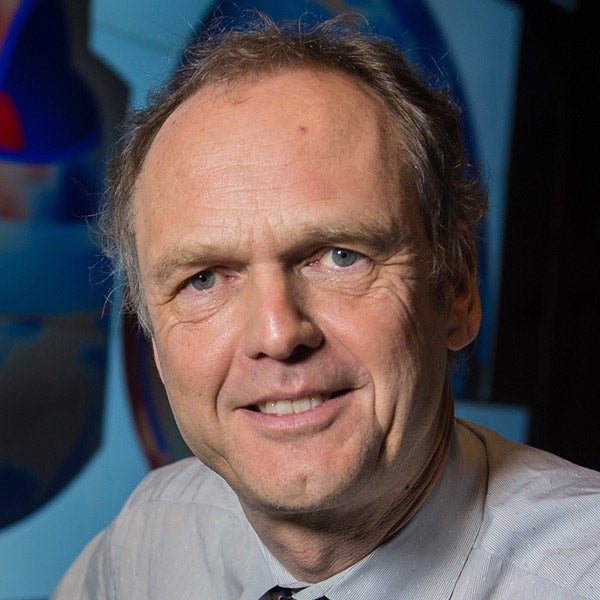
Andreas Rietbrock is Professor and Director of the Geophysical Institute (GPI) at the Karlsruhe Institute of Technology (KIT) , Germany, where he also serves as Dean of Studies for Geophysics . He is a leading expert in earthquake seismology, seismic tomography, and subduction zone dynamics, with a strong focus on integrating advanced observational techniques and computational methods. Education: While specific degrees are not listed in the provided text, his extensive publication record and leadership roles indicate advanced academic training in geophysics and seismology. Research Interests: His work spans a wide range of topics including: Seismic imaging of subduction zones (e.g., Nazca, Lesser Antilles) Earthquake rupture dynamics and fault mechanics Volcanic seismology and magma transport Full waveform inversion and AI-enhanced seismic analysis Distributed Acoustic Sensing (DAS) applications Induced seismicity and reservoir monitoring Research Trends: His recent publications (2022–2025) emphasize the use of dense seismic arrays, AI-based data processing, and multi-method tomography to study complex tectonic environments. Key themes include high-resolution imaging of slab structures, fluid migration in subduction zones, and the integration of DAS and machine learning for seismic monitoring. Scientific Contributions: Andreas has led major international projects such as the ANTICS Large-N deployment in Albania and the VoiLA project in the Lesser Antilles. He has published extensively in top-tier journals like Nature , Geophysical Research Letters , and Journal of Geophysical Research , with over 200 peer-reviewed articles. Teaching and Supervision: He teaches courses such as "Introduction to Geophysics II", "Seismology", and "Current Topics in Seismology and Risk". While specific student names are not listed, his role as Dean and principal investigator on numerous projects indicates active supervision of graduate students and postdocs. Labs and Teams: He leads the seismology group at GPI, coordinating large-scale deployments of seismic instruments, including ocean-bottom seismometers and fiber-optic DAS systems. His team collaborates globally with institutions in Europe, South America, and Asia.
Xiaojing (Ruby) Fu is an Assistant Professor of Mechanical and Civil Engineering at the California Institute of Technology and a William H. Hurt Scholar (2024-present). Her research focuses on multiphase fluid mechanics in porous media, integrating theory, computation, experiments, and field observations to address geoscience and engineering challenges. Her educational background includes: B.S. in Engineering from Clarkson University (2011) M.S. from Massachusetts Institute of Technology (2015) Ph.D. from Massachusetts Institute of Technology (2017) Professor Fu's research centers on cryosphere hydrology, subsurface engineering, and phase transitions in porous media. She investigates multiphase flow dynamics in contexts like permafrost thaw, snow metamorphism, and carbon sequestration using phase-field modeling and experimental techniques. Her work bridges fundamental physics with applications in environmental resilience and energy systems, emphasizing predictive capabilities for large-scale phenomena through simplified multiscale theories. Analysis of her 15 most recent publications reveals intense focus on cryosphere processes (snow, permafrost) using advanced phase-field modeling and fiber-optic sensing. Key trends include freezing infiltration patterns, meltwater transport in layered snow, and seismic monitoring of soil moisture. Her work increasingly integrates field validation with computational models for environmental applications like drought monitoring and carbon sequestration. Her scientific recognition includes: William H. Hurt Scholar (2024) Professor Fu actively mentors graduate students, as evidenced by qualified students in her research group. She teaches core courses including Thermal Science (ME 11 abc) and Computational Methods for Flow in Porous Media (ME/CE/Ge/ESE 146), training students in both theoretical foundations and applied techniques for subsurface flow problems. She leads the Fu Research Group on Mechanics and Physics of Porous Media Flow, which develops multiscale theories to predict large-scale environmental and energy system behaviors. The group combines mathematical modeling, laboratory experiments, and field observations to address problems in geologic carbon storage, cryosphere dynamics, and subsurface resource management, with recent emphasis on climate change impacts and monitoring technologies.
Dr. Jean-Christophe Nave is an Associate Professor in the Department of Mathematics and Statistics at McGill University, specializing in applied mathematics, numerical analysis, and computational methods. His research focuses on numerical methods for partial differential equations, fluid mechanics, interface problems, and computer graphics. He holds a PhD from UCSB (2004) and has held academic positions at MIT and McGill since 2005. Currently, he serves on committees such as the Steering Committee of the Institut des Sciences Mathematiques and the CRM Applied Mathematics Lab. His educational background includes a PhD under Professors Xu-Dong Liu and Sanjoy Banerjee. Key research areas include level set methods, fluid-structure interaction, and invariant numerical methods. Notable works include the Correction Function Method for interface problems and the Characteristic Mapping Method for advection problems. Nave’s publications span topics like Poisson equations with discontinuous coefficients, fluid dynamics simulations, and high-order numerical schemes. He has advised numerous graduate and undergraduate students, contributing to their research in applied mathematics and computational science. His work bridges theoretical rigor and practical applications in engineering and physics. He teaches advanced courses such as Numerical Analysis I/II and Computational Methods in Applied Mathematics. His research group collaborates on projects involving fluid dynamics, elasticity, and geometric algorithms, with a focus on developing robust numerical tools for complex systems.
Dr Olly Bartlett is a Senior Lecturer in Remote Sensing and Geography at the University of Hertfordshire , affiliated with the Department of Psychology, Sport and Geography within the School of Life and Medical Sciences. His work focuses on planetary-scale remote sensing analysis of the cryosphere, with field campaigns in Greenland, Nepal, Svalbard, and the Peruvian Andes. Education: PhD in Physical Geography (University of Exeter, 2020); MSc in Polar and Alpine Change (University of Sheffield, 2016); BSc in Physical Geography (University of Sheffield, 2015) Dr Bartlett specializes in UAV-based remote sensing and Google Earth Engine , holding a UK GVC for UAV operations. His research tracks environmental changes in polar and alpine regions, including quantifying Antarctic Peninsula greening (1986–2021) and glacier dynamics in the Himalayas and Canadian Arctic. Recent publications highlight his methodological innovations in radar surveying and supraglacial hummock morphology studies. His work bridges glaciology and geospatial analysis , focusing on climate-induced glacial retreat impacts. He supervises PhD student Lottie Pearson on pan-Arctic permafrost thaw projects and collaborates internationally on cryospheric studies.
Adrian Lew is a Professor of Mechanical Engineering at Stanford University, specializing in computational solid mechanics and numerical algorithms. His research focuses on hydraulic fracturing simulation, embedded boundary methods, and material model design. He holds a PhD in Mechanical Engineering from Caltech (2003). His work bridges advanced numerical techniques with real-world applications in geophysics, material science, and structural engineering. Education: PhD, Mechanical Engineering, California Institute of Technology, 2003 Research Interests: Lew's group develops algorithms for time-integration embedded boundary methods and hydraulic fracturing simulations. Key areas include curvilinear crack propagation, universal meshing for complex geometries, and high-fidelity fracture mechanics. His work on variational integrators and discontinuous Galerkin methods has advanced computational efficiency in nonlinear elasticity and thermodynamics. Publications: Recent articles emphasize mesh optimization (DVRlib), fracture path instabilities, and magma chamber dynamics. His methodologies address challenges in 3D crack modeling, fluid-structure interaction, and high-order approximations in domains with singularities. Advising & Grants: Lew's research is supported by projects in computational geophysics and material science. Though no advisees are listed, his work involves collaborative teams focused on algorithmic innovation and high-performance computing.
Leif Eriksson is a Professor at Chalmers University of Technology , specializing in Radar Remote Sensing within the Department of Space, Earth and Environment . His career at Chalmers began in 2004, and he was promoted to Professor in 2022 after serving as Group Leader (2012–2017) and Head of Faculty Assembly (2017–2020). His research focuses on developing advanced methods for environmental monitoring using radar data, particularly synthetic aperture radar (SAR) from satellites and aircraft. Leadership Roles: Group Leader (Radar Remote Sensing), Faculty Assembly Head Key Collaborations: Rymdstyrelsen, EU Horizon, VINNOVA, European Space Agency Research Interests : Dr. Eriksson’s work spans forest biomass estimation , sea ice dynamics , and ocean surface current/wind retrieval . He integrates SAR data with in situ observations and climate models to study: Forest degradation (clear cuts, storm damage) via multi-temporal SAR Sea ice concentration, drift patterns, and thickness in Arctic regions Wind vectors and surface currents using interferometric SAR techniques Applications for maritime navigation safety and polar shipping optimization Article Trends : His recent publications emphasize SAR’s role in transport infrastructure monitoring (e.g., Iron Ore Line degradation), pan-Arctic landfast ice stability , and multi-frequency SAR fusion for enhanced sea ice observations. Collaborative work with teams across Europe and the U.S. highlights interdisciplinary approaches to climate and marine research. Projects & Grants : Dr. Eriksson leads or contributes to projects such as: CAISA (2022–2024): Air-ice-sea data assimilation EONav (2016–2019): Copernicus data for maritime navigation SEDNA (2017–2020): Safe Arctic shipping Forest Biomass Monitoring (2017–2018): Spaceborne SAR applications His work is supported by Rymdstyrelsen, EU Horizon, and industry partners like Trafikverket. Labs & Teams : He is central to the Radar Remote Sensing Group at Chalmers, collaborating with institutions like Lund University and international bodies such as ESA. His research often involves satellite campaigns (e.g., TanDEM-X, Sentinel) and field studies in polar regions.
Paul D. Asimow is the Eleanor and John R. McMillan Professor of Geology and Geochemistry at the California Institute of Technology (Caltech), part of the Division of Geological and Planetary Sciences. He holds a B.A. from Harvard University (1991), an M.S. (1993), and a Ph.D. (1997) from Caltech. His career progression includes roles as Assistant Professor (1999–2005), Associate Professor (2005–2010), and Professor (2010–present), with the McMillan Professorship since 2016. Education: A.B. in Geology, Harvard University, 1991 M.S. in Geology, Caltech, 1993 Ph.D. in Geology, Caltech, 1997 Research Interests: Focuses on computational, experimental, and observational approaches to igneous petrology and mineral physics. Key areas include adiabatic mantle melting, water's role in mantle dynamics, high-pressure mineral physics, and processes at mid-ocean ridges. His research utilizes advanced facilities like the Lindhurst Laboratory of Experimental Geophysics and the alphaMELTS software package for thermodynamic modeling. Articles Overview: Recent work spans planetary crust formation, Martian petrogenesis, and high-pressure mineral behavior. Themes include experimental techniques, computational modeling, and cosmochemical studies of meteorites. Awards and Honors: James B. Macelwane Medal (AGU) Frank Wigglesworth Clarke Medal (Geochemical Society) Richard P. Feynman Prize for Teaching Excellence (Caltech) Fellow of the American Geophysical Union Fellow of the Mineralogical Society of America Grants and Labs: Received NSF funding for developing an interactive phase equilibria curriculum. Leads the Lindhurst Laboratory, focusing on shock-wave experiments and high-pressure mineral physics. Collaborates on software tools like alphaMELTS and MAGMASOURCE. Labs and Teams: Active in the Caltech Shock Wave Laboratory, advancing experimental methods for planetary material studies. Engages in interdisciplinary projects on Mars geology and terrestrial planet formation.
Rahul Sarkar is a Postdoctoral Fellow at the University of California, Berkeley, affiliated with the Department of Mathematics . He was previously a Ph.D. student in the Institute for Computational and Mathematical Engineering (ICME) at Stanford University, graduating in 2022 under the advisement of Biondo Biondi and András Vasy. Research Interests : Quantum information theory, inverse problems, machine learning, microlocal analysis, and numerical methods for PDEs. Scientific Contributions : Developed novel quantum computing algorithms and numerical schemes for geophysical imaging, with applications in seismic tomography and quantum signal processing. Teaching : Taught courses at Stanford including Introduction to Quantum Computing and 3D Seismic Imaging , with roles as instructor and course assistant. Awards : Schlumberger Innovation Fellowship (2019-2020). His work bridges mathematical analysis and quantum computation , with a focus on solving real-world problems through interdisciplinary approaches. He has collaborated with institutions like IBM and Schlumberger to apply quantum algorithms to geoscience and financial optimization.
Jeroen Tromp serves as the Blair Professor of Geology and Professor of Geosciences and Applied and Computational Mathematics at Princeton University, where he also directs the Princeton Institute for Computational Science and Engineering (PICSciE). His work centers on theoretical and computational seismology with applications across Earth and planetary sciences. His research interests focus on imaging Earth's interior through advanced computational techniques. Key areas include surface waves, free oscillations, body waves, seismic tomography, numerical simulations of 3-D wave propagation, and seismic hazard assessment. His group develops open-source software for acoustic, elastic and poroelastic wave propagation, addressing problems in exploration geophysics, regional and global seismology, and helioseismology. Current research trends show strong emphasis on Mars seismology (InSight mission), iron spin crossover in the lower mantle, tilted transverse isotropy in Earth's inner core, and crosstalk-free waveform inversion techniques across multiple scales. Tromp actively mentors graduate students and leads collaborative projects involving seismic wavefield imaging across planetary bodies. His group maintains strong connections with NASA's InSight mission and develops computational frameworks for global centroid moment tensor inversions. The research team operates within the Department of Geosciences, leveraging high-performance computing resources through PICSciE to tackle large-scale inverse problems in seismology.
Mary K. Firestone is Professor of the Graduate School in the Department of Environmental Science, Policy and Management at UC Berkeley. Her research revolutionized understanding of soil microbial processes, particularly oak regeneration techniques and microbial mediation of carbon/nitrogen cycling in terrestrial ecosystems. Firestone's work examines microbial responses to environmental change, including drought, rewetting, and warming scenarios. Her lab develops innovative methods like quantitative stable isotope probing (qSIP) to trace microbial activity in complex soil environments. Research spans grassland, rangeland, and agricultural ecosystems. Honors include election to the National Academy of Sciences (2017), Soil Ecology Society Career Achievement Award (2017), and American Geophysical Union Fellowship (2016). She holds the Betty and Isaac Barshad Chair in Soil Sciences. Current PhD candidates and postdoctoral researchers in the Firestone Lab investigate viral-bacterial interactions in soil, mycorrhizal carbon transfer, and drought impacts on soil carbon persistence. Field studies at California's Hopland Research Center examine grassland responses to climate variability.
Angelo Peccerillo is a distinguished Full Professor of Petrology at the University of Perugia, Italy, with an extensive academic career spanning multiple Italian universities. He previously served as Full Professor of Petrology at the Universities of Calabria (1993-1997) and Messina (1985-1993), and as Associate Professor of Volcanology (1982-1985) and Assistant Professor (1971-1982) at the University of Florence. He earned his Laurea Degree in Geology from the University of Florence in 1970 and has been a member of Academia Europaea since his election. Peccerillo's research focuses on the petrology and geochemistry of magmatic processes, with particular expertise in igneous petrology, geochemistry, volcanology, orogenic volcanism, and continental rift magmatism. His scholarly work has established him as a leading expert in understanding the complex relationships between mantle processes, crustal interactions, and volcanic activity in the Mediterranean region and beyond. His research methodology integrates petrological, geochemical, and geophysical approaches to develop comprehensive models of magmatic systems. Analysis of Peccerillo's recent publications reveals a consistent focus on magmatic processes across diverse geological settings. His work spans from detailed studies of specific volcanic systems like the Aeolian Islands and Ethiopian Rift to broader investigations of mantle structure and geodynamic processes in the Mediterranean region. A recurring theme is the integration of multiple analytical approaches to model magma plumbing systems, understand mantle composition, and elucidate the geodynamic evolution of volcanic regions, particularly examining the relationships between deep and shallow mantle processes. Antonio Feltrinelli Price 2006 for Earth Sciences, awarded by the National Academy of Lincei, Italy Professor Peccerillo has supervised numerous MSc and PhD students both at his home institution and abroad. His editorial leadership includes serving as Chief Editor of the "European Journal of Mineralogy" from 2006 to 2008 and membership on the editorial boards of several prestigious journals including "Lithos," "Journal of Volcanology and Geothermal Research," "Geological Society of Italy Bulletin," and "Open Mineralogy Journal." He has been actively involved in research evaluation, serving on national and international panels for organizations such as NSF, ESF, CNR, MIUR, and NATO. Peccerillo maintains strong international scientific connections through visiting positions at institutions like the Australian National University, University of Gottingen, and University of Paris XI at Orsay. His leadership extends to professional organizations, having served as President of the Italian Petrology Group and currently as a Member of Academia Europaea. His administrative experience includes serving as Department Head and Coordinator of PhD programs at the Universities of Messina, Cosenza, and Perugia.
Maarten de Hoop is the Simons Chair and Professor of Computational and Applied Mathematics at Rice University, part of the George R. Brown School of Engineering. He holds visiting roles at MIT and the Chinese Academy of Sciences. His research spans seismic wave analysis, inverse problems, deep learning, and planetary seismology. He earned his Ph.D. in Technical Sciences from Delft University of Technology (1992), and earlier degrees from Utrecht University. Notable awards include the 1996 J. Clarence Karcher Award and 2001 Fellowship from the Institute of Physics. His work integrates computational mathematics with geophysics, focusing on extracting signal information from large datasets, developing novel inverse scattering methods, and applying deep learning to geoscience challenges. Recent studies include transformer models for in-context learning, semialgebraic neural networks, and seismic waveform foundation models like SeisLM. He leads the Geo-Mathematical Imaging Group, fostering interdisciplinary projects in planetary missions and data-driven discovery.
Howard Elman is a Professor in the Department of Computer Science at the University of Maryland, with affiliations to the Institute for Advanced Computer Studies (UMIACS) and as an Affiliate Professor in the Department of Mathematics. His research spans numerical analysis, computational fluid dynamics, and uncertainty quantification, focusing on iterative solvers for partial differential equations. Education: PhD in Computer Science, Yale University (1982); BA in Mathematics, Columbia University (1975); Stuyvesant High School (1971) Elman's research integrates Scientific Computing with Numerical Linear Algebra , Computational Fluid Dynamics , and Uncertainty Quantification . His work addresses Stochastic Galerkin Methods , Reduced-Order Modeling , and Low-Rank Approximations for PDEs with random data. Recent publications emphasize Surrogate Models and Deep Learning in Bayesian inverse problems. His scientific awards include SIAM Fellowship (2009) and roles as Associate Editor for journals like Mathematics of Computation and SIAM Journal on Scientific Computing . He served as SIAM Editor-in-Chief (1998-2004) and Vice President for Publications. Contact: helman@umd.edu | Office: 4210 Iribe Center | Courses: AMSC/CMSC 460 Computational Methods
Christophe Ancey is an Associate Professor at the École Polytechnique Fédérale de Lausanne (EPFL), where he serves in the School of Architecture, Civil and Environmental Engineering (ENAC), specifically in the Institute of Civil Engineering (IIC) and the Environmental Hydraulics Laboratory (LHE). He also holds teaching appointments in SGC-Teaching and EDME-Teaching departments at EPFL. His office is located at GC A1 401, Station 18, 1015 Lausanne, Switzerland. Dr. Ancey holds both a PhD and engineering degree from Ecole Centrale de Paris and Grenoble National Polytechnic Institute. After completing his doctoral work (1994-1997) on rheology of granular flows under Pierre Evesque, he worked as a researcher at Cemagref before joining EPFL in 2004. He directs the Environmental Hydraulics Laboratory and serves as associate editor for Water Resources Research, a leading journal in hydrology. Dr. Ancey's research spans fluid dynamics, rheology, and hydraulics with emphasis on geophysical flows and natural hazards. His work focuses on three interconnected themes: rheology of concentrated suspensions (particularly granular flows in avalanches and mudflows), inverse problems in rheology (determining microscopic behavior from macroscopic measurements), and particle entrainment in turbulent suspensions (erosion and sediment transport processes). His recent publications (2022-2025) demonstrate continued innovation in sediment transport modeling, experimental techniques like PIV for complex flows, and integration of machine learning approaches. The research shows progression from fundamental fluid mechanics to practical applications in natural hazard assessment and river engineering, with particular attention to granular segregation, avalanche-obstacle interactions, and river morphodynamics. Associate Editor, Water Resources Research Co-founder of Toraval, an engineering consulting firm specializing in avalanche risk management Dr. Ancey teaches courses on Fluid Mechanics, Flood and Dam Break Waves, Hydrological Risks and Structures, and Similarity and Transport Phenomena in Fluids. He has supervised numerous PhD students whose work spans environmental hydraulics, granular flows, and sediment transport, with current students including Chen Yanan, Farazande Sofi, and Giboulot Axel Loïc among others.