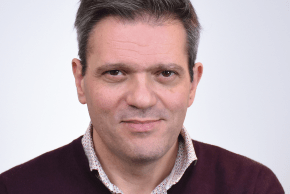
David Bourne is an Associate Professor at Heriot-Watt University specializing in applied mathematics and computational modelling. His research focuses on optimal transport theory with applications in materials science, atmospheric dynamics, and geometric modelling. Recent publications develop innovative methods for polycrystal microstructure modelling using Laguerre tessellations and optimal transport techniques. Applications extend to atmospheric state definitions and geophysical fluid dynamics through semi-discrete transport frameworks. Mathematical contributions include anisotropic material modelling and quantization methods. He regularly presents at international conferences on mathematical materials science and optimal transport theory, with invited lectures at LMS Durham and Münster Applied Mathematics Symposium.
Luca TERRAY is a volcanology researcher at the University of Clermont Auvergne, affiliated with the Laboratoire Magmas et Volcans (LMV). His work focuses on developing instrumentation and methodologies for measuring radon and its decay products in volcanic environments, particularly at Mount Etna in Sicily. He completed his PhD in 2021 with a thesis on radon measurement in volcanic gas plumes and has maintained an active research trajectory with publications extending through 2025. Dr. TERRAY's research interests center on the application of nuclear physics techniques to volcanic monitoring. His primary focus is on understanding magmatic degassing processes through precise measurement of radon emissions. He has developed several innovative instruments including the RAVIOLI field α-β-γ nuclear spectrometer for in-situ measurement of volcanic plume filters. His work bridges geosciences, nuclear physics, and environmental monitoring, with significant contributions to understanding the behavior of radon during volcanic activity. His publications demonstrate a strong emphasis on instrumental development and methodological innovation. TERRAY has pioneered approaches for measuring radon in volcanic plumes using both passive dosimetry and electronic monitoring systems with high temporal resolution. His work has established detection limits for magmatic excess of short-lived radon daughters and developed mathematical methods based on linear inverse problem theory for comprehensive uncertainty treatment in measurements. As a member of the Laboratoire Magmas et Volcans, TERRAY collaborates with researchers across multiple disciplines including geophysics, atmospheric chemistry, and computational physics. His recent work extends into satellite IoT technology for volcanic monitoring and Monte Carlo simulations for radiation dose assessment. His research provides critical insights into the connections between radon degassing and short-lived radioactive disequilibria in both lavas and volcanic gases.
Pedro Diez is a researcher specializing in computational methods for geotechnical and geophysical applications. His work focuses on developing data-driven models, particularly Reduced-Order Models (ROM) and Bayesian solvers for inverse problems. He explores advanced techniques like kernel Principal Component Analysis (kPCA) combined with Proper Orthogonal Decomposition (POD) to optimize dimensionality reduction in parametric forward problems. His research emphasizes uncertainty quantification using Markov-Chain Monte Carlo (MCMC) strategies, addressing challenges in geophysical crust dynamics and large-scale parameter identification.
Achim Schroll is a Professor of Computational Science at the University of Southern Denmark's Department of Mathematics and Computer Science. He holds a Dr.sc.math.habil. from ETH Zurich and RWTH Aachen, with postdoctoral experience at the University of Oslo. His academic career includes professorships at RWTH Aachen, NTNU Trondheim, and Lund University. He has been a guest professor at renowned institutions like the Research Institute Oberwolfach and the Isaac Newton Institute. His research focuses on mathematical modeling, numerical analysis, and partial differential equations, with applications in biophysics and computational fluid dynamics. Key contributions include discontinuous Galerkin methods for fluorescence loss in photobleaching (FLIP) and adaptive numerical schemes for conservation laws. His work bridges computational science with biological systems, particularly protein aggregation dynamics. Publications (32 total) highlight interdisciplinary collaborations, such as modeling protein transport in cells and calibrating geological deposition models. He has delivered over 80 academic activities, including guest lectures at universities globally and committee roles like the University of Oslo PhD evaluation committee. Honors include participation in the 29th Lindau Nobel Laureate Meeting as an invited young scientist. Beyond academia, he is an alpin skier and yacht skipper.
Tom Horrocks is a Senior Research Fellow at the School of Earth and Oceans, University of Western Australia (UWA). He holds a dual degree in Engineering (Software) and Science (Physics/Applied Mathematics) from UWA, complemented by a research-focused doctoral program supported by the Robert and Maude Gledden Scholarship. His work bridges machine learning with geoscience challenges, focusing on predictive modeling, data mining, and software engineering solutions for resource exploration. Key research areas include machine learning applications in geophysics (e.g., neural networks for potential field modeling), hyperspectral imaging for mineral identification, and automated geological logging using FTIR spectra. His interdisciplinary approach often results in deployable software tools addressing real-world problems, such as the Rio Tinto Data Fusion project. Education : Bachelor of Engineering (Hons) in Software, UWA Bachelor of Science in Physics & Applied Mathematics, UWA Awards : Nick Rock Memorial Prize (2018) ASEG WA Branch Student Award (2015) UWA Vice Chancellor’s Impact & Innovation Award (2015) Current projects include the ChatGEO initiative for semantic document retrieval and collaboration with the Geodata Algorithms Team on predictive logging techniques. His research outputs span geostatistics, mineral exploration, and AI-driven geoscience solutions. Tom has contributed to major grants totaling over 5 years, including partnerships with industry leaders like Fortescue Metals Group and the Geological Survey of Western Australia. His work is disseminated through high-impact journals like Scientific Reports and Ore Geology Reviews , reflecting a strong focus on both theoretical innovation and practical application.
Ray Nagem is an Associate Professor of Mechanical Engineering at Boston University, with affiliations in the Department of Astronomy and Department of Electrical and Computer Engineering. He holds a Ph.D. from MIT. His research focuses on structural dynamics, wave propagation, and inverse problems, with applications to ocean environments, sonar systems, and space habitation structures. Professor Nagem has conducted collaborative work as a visiting scientist at the Naval Undersea Warfare Center, developing computational models for fluid-elastic systems. His expertise spans acoustic scattering, molecular dynamics, and vibration analysis in composite materials. His research integrates theoretical frameworks with practical applications, such as detecting submerged objects and modeling elastic wave interactions in complex systems. Notable contributions include studies on coupled fluid-elastic interfaces, Bragg mode interactions, and vibration damping mechanisms. His work bridges mechanical engineering with interdisciplinary fields like astronomy and oceanography, reflecting his broad academic influence. Publications highlight advancements in wave dynamics, top motion analysis, and acoustics across diverse media. While no awards are explicitly mentioned, his extensive publication record and interdisciplinary projects underscore his scholarly impact. Nagem's advising and grant activities are not detailed here, though his research aligns with cutting-edge topics in structural integrity and space habitat design.
Dr. Stefano Maffei is a Lecturer at ETH Zurich's Department of Earth and Planetary Sciences, affiliated with the Institute of Geophysics. He specializes in geomagnetism, geophysical fluid dynamics, and space weather, with a focus on Earth's core dynamics and their observable effects. His work includes developing novel models like Plesio-Geostrophy to study rapid core motions and forecasting geomagnetic field changes. Education includes a PhD (2016) and master's (2012) from ETH Zurich and University of Bologna, respectively. Research highlights include investigating core convection, auroral zone evolution under space weather, and paleomagnetic directional changes during geomagnetic transitions. Key contributions span core-mantle interactions, magnetoconvection regimes, and interdisciplinary space climate studies. Collaborative projects include the SWIGS initiative (UK space weather risk analysis) and grants from the EU and Swiss National Science Foundation. No formal awards are listed, but his work has been cited in high-impact journals.
Dr. Dieter Werthmüller is a Lecturer at the Department of Earth and Planetary Sciences (D-EAPS) at ETH Zurich, affiliated with the Institute of Geophysics. His research focuses on geophysical methods, particularly electromagnetic induction, data assimilation in geosciences, and applications to geothermal energy and environmental monitoring. He specializes in near-surface geophysics, geothermal reservoir modeling, and the integration of geophysical datasets for subsurface characterization. His work emphasizes open-source software development for geophysical modeling, such as the emg3d and empymod tools. He has contributed to studies on electromagnetic monitoring of geothermal systems, rainwater lenses in polders, and temperature changes in near-surface environments. His recent articles highlight advancements in joint inversion techniques, CSEM applications for gas hydrates, and ocean-bottom seismometer calibration. Dr. Werthmüller collaborates on projects involving geothermal energy systems, environmental hydrology, and marine geophysics. His research addresses challenges in subsurface imaging, parameter sensitivity analysis, and the development of modular frameworks for geophysical data interpretation.
Dr. Andrea Zunino is a Lecturer at the Institute of Geophysics, ETH Zurich, within the Department of Earth and Planetary Sciences. His research focuses on developing methodologies to infer subsurface Earth properties using probabilistic approaches, including Monte Carlo methods. Key areas include inverse problems, seismology, and computational geoscience. He previously collaborated with Klaus Mosegaard on probabilistic inverse problems and geostatistics. Current work involves ambient noise seismic tomography and Hamiltonian Monte Carlo (HMC) strategies for geophysical problems. Research interests emphasize nonlinear inverse problem solutions, particularly through HMC frameworks like HMCLab, an open-source tool for diverse geophysical applications. His work integrates adjoint methods for efficient sampling and uncertainty quantification. Notable projects include borehole fiber-optic seismology in Greenland, aeromagnetic studies of Antarctic volcanic fields, and joint gravity-magnetic inversion using HMC. Publications highlight contributions to geophysical inversion techniques, seismic data analysis, and computational frameworks. He leads the Seismology and Wave Physics group, advancing probabilistic methodologies for Earth structure imaging and subsurface characterization.
Florian Haslinger is a Lecturer at ETH Zürich's Department of Earth and Planetary Sciences and Deputy Director of the Swiss Seismological Service (SED). He leads finance, controlling, and administration at SED, representing it in LAINAT and other federal bodies. His career includes key roles in establishing the European Plate Observing System (EPOS) and Swiss representation in the CTBTO Preparatory Commission since 2017. Education: PhD in Natural Sciences (ETH Zürich, 1999) with research on seismicity in northwestern Greece. Earlier studies at the University of Munich (Diploma in Geophysics) and exchange at ETH Zürich. Professional experience spans seismic monitoring, international projects, and academic teaching. Research Interests: Focus on seismic tomography, earthquake hazard assessment, and global seismological infrastructure. Contributions to FAIR data practices, risk modeling (e.g., ERM-CH23), and international collaborations like EPOS and EMSC. Teaching: Inverse Theory for Applied Geophysics (Master’s level) and Geophysics Bachelor courses on time series analysis. Leadership: Chair roles in FDSN-WGIV, member of IRIS-GSN Standing Committee, and president of EMSC-CSEM. Active in GFZ's GEOFON Advisory Group. Key Projects: EPOS Seismology, ShakeMap-EU, and GANSSER seismological networks in Bhutan. Contributions to Switzerland's seismic hazard models and induced seismicity studies in St. Gallen.
Jonas Köpping is a Researcher at the Institute of Geochemistry and Petrology (ETH Zurich), part of the D-EAPS (Earth and Planetary Sciences) school under Prof. Thomas Driesner's group. His work focuses on magma emplacement dynamics, volcanic processes, and structural analysis of igneous systems. Key research areas include sheet intrusion mechanics, phreatic eruptions, and paleostress reconstruction in carbonate rocks. His research integrates field observations, laboratory experiments, and numerical modeling to address questions about magma transport, crustal deformation, and tectonic influences on igneous systems. Notable contributions include studies on magma finger dynamics, sill emplacement mechanisms, and the impact of igneous intrusions on stratigraphic records. Publications span experimental petrology, structural geology, and volcanology, with a focus on advancing understanding of shallow crustal processes. His work has implications for volcanic hazard assessment and subsurface imaging techniques. Köpping collaborates closely with the ETH Zurich GeoPetro group and utilizes advanced analytical methods such as 3D seismic reflection data and automated paleostress analysis.
Jochen Braunmiller is a Research Assistant Professor in the School of Geosciences at the University of South Florida, within the College of Arts and Sciences. His research focuses on seismology, earthquake source processes, tectonic dynamics, and Earth structure. He holds a Ph.D. from Oregon State University (1992–1998), an M.S. from the same institution (1988–1991), and a Vordiplom from the University of Karlsruhe (1985–1988). His work spans diverse tectonic settings, including oceanic transform faults, volcanic systems, and continental intraplate regions. Key areas of investigation include moment tensor analysis, seismic swarm mechanisms, and post-seismic deformation. Braunmiller has contributed to projects like the Gorkha Earthquake Nepal Aftershock Study (NAMASTE) and the Montserrat Volcano Observatory data preservation initiative. Research highlights include studies on the 2020 Nevada M 6.5 earthquake, magma intrusions in Iceland’s Reykjanes Peninsula, and crustal structure in Iran’s Central Alborz. He also emphasizes education, developing computational tools for seismologists and integrating fieldwork into student training. His publications often bridge seismology with geodesy, geophysics, and applied geology. Braunmiller collaborates internationally, with contributions to the Middle East Moment Tensor Database and the Blanco Transform Fault OBS Experiment. Despite no explicitly listed scientific awards, his extensive peer-reviewed output reflects sustained recognition in the field. His advising record remains unspecified, though his involvement in student-led field studies (e.g., Idaho’s Lost River Valley) suggests mentorship in field methodologies. Grants or lab affiliations are not detailed in the provided texts.
Peter Betts is a Professor at Monash University's School of Earth Atmosphere and Environment. His research focuses on Red Sea tectonics, structural geophysics, Precambrian evolution of Australia, and subduction zone geodynamics. He leads major projects like the Three-dimensional Bayesian Modelling of Geological and Geophysical data (ARC-funded) and investigates mineral resource exploration through geophysical studies. Research Interests: Red Sea Tectonics Structural Geophysics (magnetic/gravity field analysis) Australian Precambrian Evolution Subduction Zone Dynamics Rare Earth Element (REE) Exploration Mineral System Analysis Recent Work: His 2024 studies include machine learning applications in geophysical data analysis and Red Sea lithospheric structure. Articles span topics from Afar Triple Junction dynamics to Antarctic crustal mapping. He has contributed to over 180 publications and 29 research projects. Recognition: Recipient of the Bruce Hobbs Medal (2015) and multiple teaching excellence awards. Active in editorial roles for journals like Earth-Science Reviews and Tectonophysics . Service: Served as Geological Society of Australia President (2021-2023) and currently chairs the Tectonics and Structural Geology group. Engages in community initiatives like junior basketball coaching (2015-2021).
Shubham Jaiswal is a Doctoral Researcher in the Inverse Problems group at the Department of Mathematics and Statistics, University of Jyväskylä, Finland. He focuses on the mathematical theory and practical implementation of inverse problems, a field central to analyzing indirect measurements. His current position is supported by the Finnish Inverse Problems Society, and he is affiliated with the Faculty of Mathematics and Science. Contact details include emails shubham.s.jaiswal@jyu.fi and s.jaiswal.271801@gmail.com , and phone numbers +917007336576 and +358415753498. Shubham's research bridges theoretical and applied mathematics, particularly in inverse problems, which involve reconstructing unknown parameters from indirect observations. His work has implications in fields requiring precise modeling of inaccessible systems, such as geophysics and medical imaging. Contact Information: Room MaD234, Department of Mathematics and Statistics, University of Jyväskylä, PO Box 35 (MaD), 40014 Jyväskylä, Finland.
Jowan Barnes is a Research Fellow at Northumbria University affiliated with the PRECISE project, collaborating with institutions like the National Oceanography Centre and Copenhagen University. His research focuses on mathematical modeling of ice dynamics, particularly in Greenland and Antarctica, with emphasis on inversion procedures, basal sliding laws, calving processes, and ice-ocean interactions. He holds a PhD in oceanography from Newcastle University (2019) and an MMath from the University of Reading (2014). Research interests include geothermal heating effects on abyssal oceans, hydrothermal vent systems, and glaciological processes such as ice shelf basal melt and ice-cliff instability. He has contributed to major projects like PROPHET (part of the International Thwaites Glacier Collaboration) and PROTECT, advancing understanding of Antarctic ice sheet stability and climate change impacts. Publications highlight sensitivity studies of ice loss mechanisms, model parameterization challenges, and feedback loops affecting ice shelf stability. His work bridges computational modeling with observational data, contributing to improved climate change predictions and sea level rise assessments.