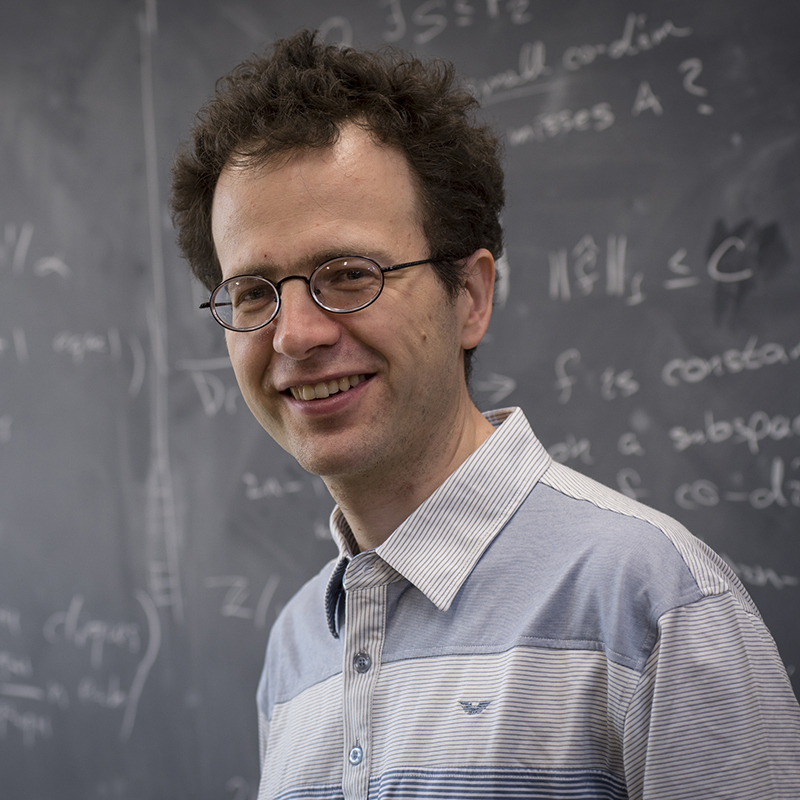
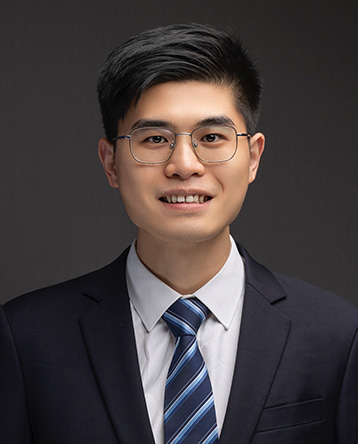
Boris Bukh is a Professor of Mathematics at Carnegie Mellon University (CMU), affiliated with the Department of Mathematical Sciences within the Mellon College of Science. He holds a Ph.D. from Princeton University and has held postdoctoral positions at the University of Cambridge and Churchill College. His research focuses on combinatorics, discrete geometry, extremal graph theory, and geometric selection theorems. He has received prestigious awards such as the Sloan Research Fellowship and the NSF CAREER Award. His work spans topics like Turán problems, geometric configurations, and algebraic methods in combinatorics. Recent publications explore extremal graph structures, convex polytopes in restricted point sets, and applications of random algebraic constructions to computational complexity. Bukh organizes events like the Math Kangaroo competition, fostering mathematics engagement among students. Key contributions include advancements in Ramsey theory, coding theory, and the intersection of combinatorics with geometry. His research often bridges theoretical insights with computational techniques, addressing problems in graph density, geometric incidences, and discrete optimization.
Christopher McComb is an Associate Professor in the Department of Mechanical Engineering at Carnegie Mellon University's College of Engineering. He leads research in sociotechnical systems, machine learning for engineering design, and human-AI collaboration. He is affiliated with the Block Center for Technology and Society, Manufacturing Futures Institute, NextManufacturing Center, and Wilton E. Scott Institute for Energy Innovation. Previously, he was an assistant professor at Penn State, where he directed the Center for Research in Design and Innovation and led the Technology and Human Research in Engineering Design Group. Ph.D., Mechanical Engineering, Carnegie Mellon University M.S., Mechanical Engineering, Carnegie Mellon University B.S., Civil Engineering and Mechanical Engineering, California State University-Fresno His research centers on human-AI teaming , sociotechnical systems , and computational design , with applications in additive manufacturing, STEM education, and energy systems. He explores how machine learning can enhance engineering design processes, particularly through human-centered AI, generative design, and agent-based modeling. His work emphasizes the integration of human cognition and behavior into AI systems to improve collaboration and innovation. The 15 most recent publications (2025) demonstrate a strong trend in AI-driven design automation , neural surrogate modeling , human-AI interaction , and data generation for engineering simulations . Topics span from using large language models for material selection and design concept generation to developing datasets and benchmarks for advanced manufacturing and CAD systems. There is a clear emphasis on real-world applications in aerospace, finance, and global manufacturing, particularly in Africa. National Science Foundation Graduate Research Fellow McComb has received research funding from NSF, DARPA, and private corporations, and has collaborated with Boeing through their Visiting Professorship Program. He advises students in mechanical engineering and design, and leads the Human+AI Design Initiative and the Design Research Collective. His research has been applied in partnerships with NASA and in addressing manufacturing challenges in Africa. He leads or contributes to interdisciplinary research teams focused on AI in design, additive manufacturing, and energy systems. His labs and initiatives include the Human+AI Design Initiative and the Design Research Collective, which foster collaboration between human-centered design and artificial intelligence.
Liwei Wang is an Assistant Professor in the Department of Mechanical Engineering at Carnegie Mellon University's College of Engineering, where he leads the Computational and Physical Intelligence Laboratory (CPhI Lab). His research integrates computational modeling, machine learning, and mechanics to design advanced materials and smart systems. Education: Ph.D., Mechanical Engineering, Shanghai Jiao Tong University (2022, Honors) B.S., Mechanical Engineering, Shanghai Jiao Tong University (2017, Honors) Liwei Wang's research interests lie at the intersection of machine learning, computational engineering, and advanced materials . He develops data-driven and physics-informed frameworks for topology optimization, metamaterials, 3D/4D printing, soft robotics, and programmable materials systems . His work emphasizes physical intelligence —designing materials that can sense, adapt, and respond to their environments. Applications span mechanical protective cloaks, flexible electronics, minimally invasive surgery, and mechanical computing . His recent publications reveal a strong trend toward multi-scale, data-efficient design of metamaterials using advanced machine learning techniques such as Gaussian processes, latent variable models, and neural networks. He focuses on scalable, differentiable, and task-aware optimization methods that enable rapid discovery and deployment of functional material systems. Scientific Awards: ASME Design Automation Dissertation Award ASME Design Automation Conference Best Paper Award Institution-level Outstanding Ph.D. Dissertation Award Dr. Wang advises a growing research group at CMU and leads the CPhI Lab, where his team develops next-generation computational tools for materials innovation. While specific grants are not listed, his research is likely supported by federal and private funding given the scope and impact of his work. His lab emphasizes interdisciplinary collaboration and translation of computational designs into physical prototypes via additive manufacturing. Laboratory & Team: The Computational and Physical Intelligence Laboratory (CPhI Lab) focuses on co-designing materials and structures with embedded intelligence, combining simulation, data science, and experimental validation to push the boundaries of what engineered materials can achieve.
Jonathan Cagan is the George Tallman and Florence Barrett Ladd Professor in Engineering at Carnegie Mellon University's College of Engineering. His work bridges AI, machine learning, and cognitive science to enhance engineering design and decision-making. He co-founded CMU's Integrated Innovation Institute and held leadership roles including Associate Dean and Interim Dean. Research focuses on computational modeling of designer processes, biomechanical systems, and human-AI collaboration. Collaborations span psychology, neuroscience, computer science, and architecture. Recent publications highlight AI integration in design automation, additive manufacturing, and mixed reality systems. His work explores trust dynamics, confidence modeling, and optimization algorithms in human-AI teams. Scientific awards include the Robert A. Doherty Award for Excellence in Education and the ASME Design Theory and Methodology Award. He is a Fellow of ASME.
Gautam Iyer is a Professor in the Department of Mathematical Sciences at Carnegie Mellon University. His research intersects partial differential equations and probability theory , with applications to fluid mechanics, mixing phenomena, and mathematical finance. Current research focuses on mixing-diffusion interactions , high-dimensional sampling , and anomalous diffusion in various flow models. He has worked on diverse topics including Bose-Einstein condensation , Q-tensor models for liquid crystals , and stochastic-Lagrangian formulations of Navier-Stokes equations. His recent publications (2023-2025) analyze: Dissipation enhancement in cellular flows and advective systems Residual diffusivity in Bernoulli map models Enhanced mixing in Langevin dynamics and nonlinear PDEs Anomalous diffusion in comb-like structures and random flows Major awards include: NSF CAREER Award (2013-18) Alfred P. Sloan Research Fellowship (2013-15) Simons Fellowship (2016-17) NSF RTG Grant (2024-29) and multiple collaborative NSF grants He has advised students in topics ranging from heat transfer dynamics to financial stochastic calculus , with their work often appearing in journals like SIAM Journal on Mathematical Analysis and Nonlinearity . His teaching spans advanced mathematics courses including Stochastic Calculus , Partial Differential Equations , and Markov Chains .
Takeo Kanade is the U.A. and Helen Whitaker University Professor of Robotics and Computer Science at Carnegie Mellon University (CMU). He serves as director of the Quality of Life Technology Engineering Research Center and previously led the Robotics Institute (1992-2001). His work spans computer vision, robotics, and multimedia technology, emphasizing mathematical modeling of vision processes and system development. Education: Doctoral degree in Electrical Engineering from Kyoto University (1974) Kanade's research focuses on foundational computer vision (factorization methods, multi-baseline stereo, facial recognition), virtualized reality systems for immersive media applications, and robotics innovations in medical surgery (HipNav) and autonomous helicopters. He pioneered computational sensors integrating VLSI technology. Recent publications emphasize 3D vision, pose estimation, and real-time facial alignment, reflecting his work in social motion capture and scene-specific object recognition. His projects include Informedia (NSF/ARPA/NASA-funded digital video libraries) and EyeVision for immersive sports broadcasting. Scientific Awards: Kyoto Prize (2016), Benjamin Franklin Medal, Bower Prize, IEEE Pioneer Award, ACM/AAAI Allen Newell Award, Joseph Engelberger Award He advises past PhD and Master's students like Omead Amidi, Vladimir Brajovic, and Richard LaBarca. He founded the Digital Human Research Center and leads the Human Sensing Lab at CMU.