Amir Vaxmanمشاهده پروفایل
دانشیار
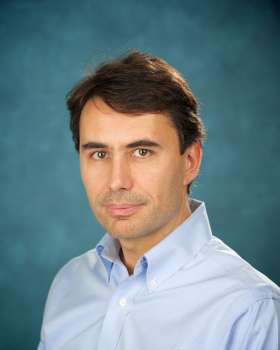
Amir Vaxman is a Reader in Graphics, Simulation and Visual Computing at the School of Informatics, The University of Edinburgh, where he leads the Geometry Processing Group within the Institute of Perception, Action and Behaviour. Previously, he was an assistant professor at Utrecht University in the Netherlands and a postdoctoral fellow at TU Wien (Vienna) where he received the Lise-Meitner fellowship. Ph.D. in Computer Science, Technion-IIT, 2011 M.Sc. in Computer Science, Technion-IIT, 2006 B.Sc. in Computer Engineering, Technion-IIT, 2002 Dr. Vaxman's research focuses on geometry processing and discrete differential geometry , with particular interests in directional-field design, unconventional meshes, constrained shape spaces, architectural geometry, and medical applications. His work bridges theoretical mathematics with practical applications in computer graphics, visualization, and fabrication. His recent publications (2023-2025) demonstrate a strong focus on geometric modeling, neural surface reconstruction, and directional field synthesis. Key trends include the development of novel algorithms for mesh processing, integration of deep learning with geometric modeling, and applications to medical imaging and architectural design. Best Paper Award (Honorable Mention) at SIGGRAPH 2024 for "Fabric Tessellation: Realizing Freeform Surfaces by Smocking" Runner-Up Best Paper Award at Symposium on Geometry Processing (SGP) 2023 for "BPM: Blended Piecewise Möbius Maps" Software Award at Symposium on Geometry Processing 2021 for libhedra Dr. Vaxman has supervised numerous graduate students including 5 current PhD candidates and over 20 graduated students. He serves in editorial roles for ACM Transactions on Graphics and has been program co-chair for multiple major conferences including Shape and Physical Modeling (SPM) 2026. He leads the Geometry Processing Group at the University of Edinburgh, which focuses on developing cutting-edge algorithms for geometry processing, with applications ranging from computer graphics to architectural design and medical imaging.