Jacob Fox is a Professor at Stanford University, specializing in Combinatorics and Probability. His research focuses on extremal combinatorics, Ramsey theory, graph theory, and additive combinatorics. He advises students like Maya Sankar. His work explores structural and enumerative aspects of graphs, hypergraphs, and combinatorial configurations. Recent studies include advancements in Ramsey numbers, sumset theory, and probabilistic methods in discrete mathematics. Key research areas include Ramsey numbers for sparse structures, hypergraph properties, and applications of combinatorial geometry. His publications often bridge theoretical insights with algorithmic applications. No scientific awards are listed in the provided text. His advising includes Maya Sankar, with research aligned to combinatorial problems. Collaborative projects involve extremal graph theory and probabilistic combinatorics. No labs or dedicated research groups are explicitly mentioned.
Afonso S. Bandeira is a Professor in the Department of Mathematics (D-MATH) at ETH Zurich, where he conducts research at the intersection of mathematics, statistics, and computer science. He maintains strong affiliations with several interdisciplinary research centers including the Institute For Operations Research (IFOR), the Max Planck ETH Center for Learning Systems, the ETH Foundations of Data Science, and the ETH AI Center, with a courtesy appointment at D-ITET. Bandeira actively teaches courses including Mathematics of Signals, Networks, and Learning, and Mathematics of Data Science. His research focuses on High Dimensional Probability, Random Matrices, Mathematical Statistics, Theoretical Computer Science, Combinatorics, and Mathematical Optimization. Bandeira's work often explores the theoretical foundations of data science, examining phase transitions in statistical problems, computational barriers, and the geometry of high-dimensional spaces. He maintains a research group blog called Randomstrasse101 that emphasizes open problems in his field. Analysis of his recent publications reveals a strong focus on matrix and tensor concentration inequalities, synchronization problems, nonconvex optimization landscapes, and computational-statistical tradeoffs in high-dimensional inference. His work bridges theoretical mathematics with practical applications in machine learning and data analysis, particularly examining where computational limitations arise in statistical problems. Bandeira actively mentors students and researchers, currently supervising several doctoral candidates including Daniil Dmitriev, Konstantin Donhauser, Anastasia Kireeva, Kevin Lucca, Chiara Meroni, Gil Kur, Petar Nizic-Nikolac, and Almut Roedder. He emphasizes that students working with him should participate in the DACO seminar and group meetings, and encourages prospective students to have completed his Mathematics of Signals, Networks, and Learning or Mathematics of Data Science courses. He leads a research group focused on the mathematics of data science, with regular group meetings and seminars. Bandeira has developed comprehensive lecture notes including 'A Tour Through the Mathematics of Signals, Learning, and Networks' (2025) and 'Mathematics of Machine Learning' (2021), and previously authored 'Ten Lectures and Forty-Two Open Problems in the Mathematics of Data Science' (2015).
Brandon Seward is an Associate Professor of Mathematics at the University of California San Diego (UC San Diego), where they conduct research and teach in the Department of Mathematics. They use the pronouns they/them or he/him . Education Ph.D. in Mathematics, University of Michigan , 2015 Research Interests Their work lies at the intersection of ergodic theory, topological dynamics, descriptive set theory, and group theory . They investigate geometric, combinatorial, and entropic properties of actions of countable groups, with special emphasis on the divide between amenable and non-amenable groups. Publications & Research Impact Across 27 refereed papers (2014-2024), Seward has advanced entropy theory for non-amenable groups, Borel combinatorics of group actions, and structure theorems for measure-preserving actions. Their work has appeared in top journals such as Inventiones Mathematicae , Journal of the American Mathematical Society , and Duke Mathematical Journal . Scientific Awards Michael Brin Dynamical Systems Prize for Young Mathematicians (2018) – awarded for outstanding contributions to dynamical systems. Teaching & Mentorship Seward regularly teaches core undergraduate courses (e.g., Math 142A Introduction to Analysis) and organizes the UC San Diego Group Actions Seminar , a weekly research forum featuring international speakers. They serve as a faculty mentor and are actively involved in graduate student supervision and seminar coordination. Contact & Office Email: bseward@ucsd.edu Office: AP&M 5739, 9500 Gilman Drive, La Jolla, CA 92093-0112
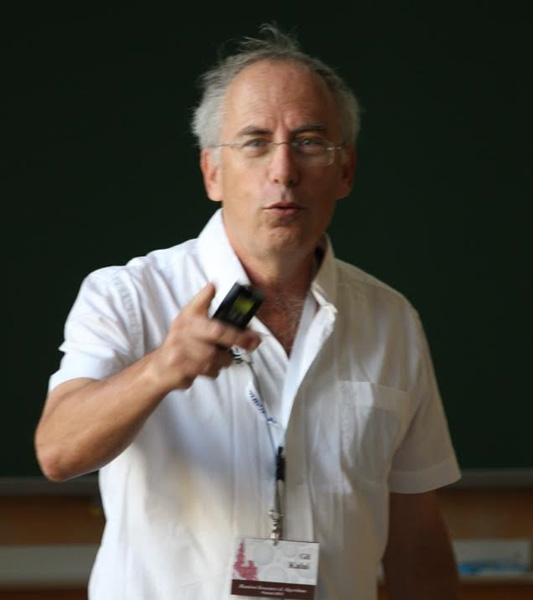
Gil Kalai is a Professor of Mathematics at the Hebrew University of Jerusalem since 1992, where he holds the Henry and Manya Noskwith Chair. He also serves as an Adjunct Professor of Mathematics and Computer Science at Yale University since 2004 in a long-term part-time visiting position. His academic career includes visiting positions at prestigious institutions including MIT, Cornell, IAS Princeton, Berkeley, Bell-labs, IBM, and Microsoft. Professor Kalai's research spans multiple areas within mathematics and theoretical computer science. His work in combinatorics encompasses geometric, probabilistic, and topological approaches. He has made significant contributions to the study of convex sets and polytopes, linear programming, and theoretical computer science. His influential 1988 paper with Kahn and Linial on Boolean functions pioneered applications of Fourier analysis in theoretical computer science. Kalai's research has evolved to include the application of Fourier analysis to thresholds, influences, symmetries, noise, percolation, and social choice. He has developed theories in algebraic shifting and studied face-numbers and other combinatorial invariants of polytopes. His work on the diameter of polytopes and randomized simplex algorithms has been influential in optimization theory. In 1993, his collaboration with Kahn produced a groundbreaking counterexample to Borsuk's Conjecture in 1325 dimensions. Professor Kalai's publications reveal a consistent focus on the intersection of combinatorics, geometry, and theoretical computer science. His work shows a progression from foundational combinatorial geometry to increasingly sophisticated applications of harmonic analysis in discrete mathematics. The recurring themes across his 30+ year career include Boolean functions, polytope theory, and probabilistic methods in combinatorics, demonstrating remarkable coherence in his research trajectory. 2016 European congress of Mathematics, plenary speaker 2013 ERC advanced grant 2012 Rothschild Prize 1994 International Congress of Mathematicians invited section talk, Zurich 1994 Fulkerson Prize 1993 Erdos Prize 1992 Polya Prize Though specific details of his advising are not provided in the source material, Kalai has written over 70 scientific papers and maintains an active research blog entitled "Combinatorics and More." His 2013 ERC advanced grant indicates significant research funding for his work. His extensive collaborations with researchers across multiple institutions suggest a robust research program with numerous PhD students and postdoctoral researchers, though specific names are not mentioned in the provided texts. Professor Kalai maintains active research connections across multiple institutions including Hebrew University, Yale, and various research centers worldwide. His work bridges pure mathematics and theoretical computer science, creating a unique interdisciplinary research environment that influences both fields.
Warut Suksompong is an Assistant Professor in the School of Computing at the National University of Singapore (NUS), where he holds the NUS Presidential Young Professorship. Previously, he was a postdoctoral researcher at the University of Oxford, hosted by Edith Elkind, and completed his PhD at Stanford University under Tim Roughgarden. He holds bachelor's and master's degrees from MIT. His research focuses on algorithmic game theory, computational social choice, mechanism design, and interdisciplinary problems at the intersection of computer science, economics, mathematics, and operations research. He is particularly known for contributions to fair division, including envy-freeness, proportionality, and maximin fairness in both divisible and indivisible resource allocation contexts. Key awards include the IJCAI 2021 Distinguished Paper Award for work on dividing land with geometric constraints and the WINE 2021 Best Student Paper Award for research on funding public projects via the Nash product rule. His work bridges theoretical foundations with practical applications, addressing challenges such as connectivity constraints, budget allocation, and social choice mechanisms. He has authored over 100 publications in top conferences and journals, including SIAM Journal on Discrete Mathematics, Artificial Intelligence, and Games and Economic Behavior. His research has been supported by grants from NUS and international collaborations.
Thomas Lam is a professor of mathematics at the University of Michigan , specializing in algebraic combinatorics, total positivity, and connections to mathematical physics. His work bridges cluster algebras, positive geometry, and integrable systems, with applications to scattering amplitudes in quantum field theory. Lam has collaborated extensively with physicists such as Nima Arkani-Hamed and mathematicians like Pavlo Pylyavskyy and Mark Shimozono. Key research areas: Cluster algebras, total positivity, electrical networks, positroid varieties, and quantum cohomology. Notable contributions: Defining polypositroids, proving regularity theorems for totally nonnegative flag varieties, and establishing cluster structures in braid varieties. Recent work focuses on positive geometries , including the amplituhedron and moduli spaces of points on projective lines, with implications for particle physics. His articles often explore dual graded graphs, K-theoretic Schubert calculus, and the interplay between combinatorics and algebraic structures. Lam's research has been supported by NSF grants, including DMS-0748636 and DMS-1249708 .
Steven Sivek is a Reader in Pure Mathematics at Imperial College London, affiliated with the Geometry group within the Department of Mathematics. His research focuses on contact and symplectic geometry, knot theory, gauge theory, and low-dimensional topology. He has taught courses on contact geometry, symplectic geometry, mapping class groups, and Morse theory at institutions including Imperial College London, Harvard University, and the University of Bonn. His work includes advanced topics such as Floer homology, Legendrian knots, and the interplay between contact structures and 3-manifolds. Sivek's contributions bridge geometric topology with algebraic structures, addressing questions about knot invariants, representation varieties, and topological field theories. His courses emphasize foundational texts and advanced research topics, such as the classification of tight contact structures, Morse theory applications, and symplectic fiber bundles. He has organized seminars on mapping class groups and taught graduate-level material on advanced geometry and topology. Sivek's research has been published in numerous high-impact papers, exploring themes like Khovanov homology, instanton Floer homology, and the geometry of 3- and 4-manifolds. His academic profile reflects a commitment to both teaching and cutting-edge research, with a focus on geometric and topological questions that intersect algebraic and differential structures.
Andre Berger is an Associate Professor of Operations Research at Maastricht University, affiliated with the QE Operations Research department within the School of Business and Economics. He holds a PhD in Mathematics from Emory University (2006) and completed a postdoc at Technical University Berlin. His research focuses on optimization algorithms, combinatorial optimization, and their applications in scheduling, network design, and operations research. Notable contributions include work on the many-visits Traveling Salesman Problem and cluster editing algorithms. Berger’s recent publications span scheduling theory, MRI-based clinical research collaborations, and theoretical advancements in facility location models. He is based at Tongersestraat 53, Maastricht, and can be reached via a.berger@maastrichtuniversity.nl. Education: MSc in Mathematics, Emory University (2003) PhD in Mathematics, Emory University (2006) Research Interests: Berger’s work bridges theoretical computer science and practical applications in operations research, emphasizing algorithm design for complex optimization problems. Key areas include scheduling algorithms, network flow optimization, and geometric optimization challenges such as the Apollonius problem in facility location. His interdisciplinary approach integrates mathematical programming with real-world scenarios in telecommunications and healthcare.
Yulan Qing is an Assistant Professor in the Department of Mathematics at the University of Tennessee, Knoxville (UTK), part of the College of Arts and Sciences. She holds a Ph.D. in Mathematics from Tufts University. Her research focuses on low-dimensional topology, geometric group theory, asymptotic properties of groups, and big mapping class groups. Notable projects include studies on Gromov boundaries, genericity in groups, and curve graphs. She has published extensively in journals like Geometry & Topology and the Journal of the London Mathematical Society. Dr. Qing has organized conferences such as the 53rd Barrett Memorial Lectures and the GGTea Webinar, fostering collaboration in geometric group theory. She has taught courses like Honors Topology at UTK and supervised graduate students including Sagnik Jana and Alex Squires. Her work bridges theoretical foundations with applications in topology and geometry. Recent invited talks include presentations at the University of Virginia, Caltech, and the 2nd China-Russia Conference on Topology. She actively mentors undergraduate and graduate students, contributing to initiatives like the Math Circle programs at Tufts and MIT's RSI Summer Program.
Chris De Sa is an Associate Professor in the Department of Computer Science at Cornell University, affiliated with the Cornell Machine Learning Group and leading the Relax ML Lab. His research focuses on algorithmic, software, and hardware techniques for high-performance machine learning, particularly relaxed-consistency stochastic algorithms like asynchronous and low-precision stochastic gradient descent (SGD). He earned his Ph.D. from Stanford University under advisors Kunle Olukotun and Chris Ré. His work emphasizes constructing efficient, parallel, and distributed machine learning frameworks for deep learning and data analytics. Education: Ph.D. in Computer Science, Stanford University (2017) Research Interests: Algorithmic techniques for scalable ML, quantization, distributed optimization, hyperbolic geometry in ML, and reliable measurement of ML systems. His group develops frameworks for efficient inference/training and explores the intersection of ML with domains like agriculture and plant science through courses like PLSCI 7202. Recent Highlights: DARPA YFA Grant (2024), NSF CAREER Award, Google Research Scholar Award, and multiple best paper recognitions. Key contributions include QuIP quantization methods, Coneheads attention mechanisms, and theoretical advances in decentralized training. Awards: NSF CAREER Award DARPA YFA Grant (2024) Google Research Scholar Award Mr. & Mrs. Richard F. Tucker Teaching Award Grants & Advising: Advises 8 Ph.D. students (including Ruqi Zhang, Yucheng Lu, A. Feder Cooper) and holds leadership roles in MLSys conferences. Active in grant-funded research (e.g., NSF Robust Intelligence). Labs/Teams: Leads the Relax ML Lab and participates in Cornell’s Institute for Digital Agriculture (CIDA).
Dongwoo Kim is a researcher affiliated with Hanyang University, ERICA Campus (Department of Electronics and Communication Engineering) and has previously collaborated with institutions like POSTECH , Chungnam National University , and Microsoft . His work spans interdisciplinary domains in Computer Science and Engineering . Hanyang University, ERICA Campus - Department of Electronics and Communication Engineering POSTECH - Power Analog Electronics & Semiconductor Devices Lab Microsoft Chungnam National University Kim's research focuses on formal verification of automotive control software, deep learning applications in environmental monitoring, 3D modeling for indoor positioning, and machine learning for signal processing. His recent publications highlight advancements in graph neural networks (GNNs), including analyzing oversmoothing and gradient dynamics, as well as developing geometric vision-language models with domain-agnostic encoders. His 15 most recent articles (2023-2025) address topics like: Optimizing hybrid electric vehicle engine performance 3D modeling for indoor localization GNN training stability UAV-based environmental monitoring Algorithm difficulty prediction for programming problems Millimeter-wave antenna design Kim collaborates with researchers in software engineering , signal processing , and environmental science domains. His work intersects formal methods , applied machine learning , and embedded systems research.
Nathan Reading is a Professor in the Department of Mathematics at North Carolina State University (NCSU). He holds a Ph.D. in Mathematics from the University of Minnesota (2002) and a B.S. in Physics from Stanford University (1995). His research focuses on algebraic and geometric combinatorics, particularly in Coxeter groups, cluster algebras, and lattice-theoretic approaches. He has been actively involved in organizing the Triangle Lectures in Combinatorics, a biannual research conference. His research interests include noncrossing partitions, cluster scattering diagrams, and the lattice theory of torsion classes. Recent work explores connections between Coxeter groups and combinatorial structures on surfaces. Reading has authored numerous papers on topics such as semidistributive lattices, scattering diagrams, and Cambrian frameworks. He teaches advanced combinatorics courses (e.g., MA 724: Combinatorics II) and has advised graduate students. His work has been supported by grants from the National Science Foundation (NSF), including DMS-1500949. Reading maintains an active presence in the mathematics community through publications, conference organization, and pedagogical contributions.
Fernando De la Torre is a Courtesy Professor in the Department of Electrical and Computer Engineering at Carnegie Mellon University, with an affiliation to the Robotics Institute where he has been a research faculty member since 2005. He holds a Ph.D. in Electronic Engineering from Ramon Llull University (2002). His research focuses on machine learning and computer vision, with applications in human health, augmented/virtual reality, generative models, and data-centric methodologies. He directs the Human Sensing Laboratory, which explores technologies for human behavior analysis and health monitoring. Notable contributions include founding FacioMetrics LLC (acquired by Meta), advancing facial recognition and 3D human digitization, and developing frameworks for robust visual models. His work bridges theory and practice, with over 225 peer-reviewed publications and editorial roles, including Associate Editor for IEEE Transactions on Pattern Analysis and Machine Intelligence. Recent research trends emphasize generative AI applications in satellite imagery analysis, VR/AR rendering optimizations (e.g., Gaussian splatting), and clinical motion recognition for healthcare. His projects often intersect with industry, addressing challenges in wearable health monitoring and immersive technologies. His lab collaborations span academia and industry, focusing on scalable solutions for 3D human modeling, adversarial robustness, and multimodal data fusion. Key achievements include pioneering work on 3D face animation from speech and garment reconstruction from single images.
Maxim Kontsevich is a permanent professor at the Institut des Hautes Études Scientifiques (IHÉS), holding the AXA Chair for Mathematics since 1995 and a visiting chair at Rutgers University (one month annually since 1997). Born in 1964 in Khimki, USSR, he earned his PhD from Bonn University in 1992. His career includes visiting positions at Harvard, the Institute for Advanced Study, and Berkeley, where he was a professor from 1993 to 1995. His research spans mathematical physics, algebraic geometry, and non-commutative geometry. Notable contributions include deformation quantization, mirror symmetry, and motivic integration. His work bridges algebraic structures with geometric and physical concepts, influencing areas like topological field theories, string theory, and integrable systems. Awardees of Fields Medal (1998), Crafoord Prize (2008), and Breakthrough Prize (2014), he also holds editorial roles at Compositio Mathematica and Publications Mathématiques IHÉS. His over 50 publications explore advanced topics such as quantum cohomology, Hodge theory, and categorical structures in geometry.
Antonio De Rosa is an Associate Professor in the Department of Decision Sciences at Bocconi University, Italy. Previously, he held positions at the University of Maryland, College Park (2020–2024), and the Courant Institute of Mathematical Sciences, New York University (2017–2020). He earned his Ph.D. in Mathematics from the University of Zurich in 2017 under Camillo De Lellis and Guido De Philippis. Education: Ph.D. in Mathematics, University of Zurich (2017). His research spans Geometric Analysis , Partial Differential Equations , Calculus of Variations , Geometric Measure Theory , Optimal Transport , and Non-convex Optimization . Recent work focuses on anisotropic geometric variational problems, including existence, regularity, and uniqueness of anisotropic minimal surfaces and CMC (constant mean curvature) surfaces. He has also contributed to interdisciplinary applications in Explainable Risk Assessment and Data Analysis . The 15 most recent articles highlight advancements in anisotropic surfaces , min-max theory , optimal transport , and mathematical programming (e.g., K-means clustering, linear programming). Key trends include the intersection of geometric measure theory with nonlinear PDEs and applications in machine learning and transportation networks . Scientific Awards and Grants: 2023 Maryland Research Excellence Carlo Ciliberto Prize (2019) ERC Starting Grant ANGEVA (101076411, 2023–2028) Air Force Office of Scientific Research (AFOSR) grant (FA9550-23-1-0123) NSF CAREER Award (DMS-2143124) NSF DMS Awards (DMS-1906451, DMS-2112311) AMS Simons Travel Grant Antonio actively supervises research and teaches courses such as Optimization and Introduction to Partial Differential Equations . His work is supported by significant funding totaling approximately €3 million.




.jpg)
