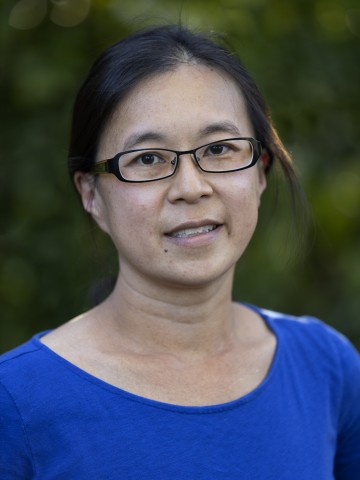
William L. Pardon is a Professor in the Department of Mathematics at Duke University. He holds a B.A. from the University of Michigan and a Ph.D. from Princeton University. His research focuses on the Algebra and Geometry of Varieties, with particular emphasis on topics such as Hodge structures, Chern classes, and cohomological studies of singular varieties. His recent work includes studies on modular varieties, Hodge theory in singular spaces, and filtered resolutions in algebraic geometry. Though no specific awards or grants are listed, his contributions to geometric and algebraic research are evident through his publications. Teaching includes advanced mathematics courses such as Math 221. No current students or labs are mentioned in the provided data.
Hao Zhang is a Distinguished Professor and IEEE Fellow at Simon Fraser University's School of Computing Science, leading the GrUVi (Graphics & Vision) Lab. He holds a Ph.D. from the University of Toronto's Dynamic Graphics Project and degrees from the University of Waterloo. His research focuses on computer graphics, geometric modeling, and visual computing, with over 200 publications, including 70+ in SIGGRAPH/TOG. He directs research in 3D representation learning, generative models, and fabrication-aware design. Awards include the ACM SIGGRAPH Academy induction (2025) and IEEE Fellow (2024). He advises numerous students, many of whom have become professors or industry leaders. His work spans theoretical contributions (e.g., Test of Time Award for 2013 paper) and applied innovations like Slice3D and ArcPro. He is Technical Papers Chair for SIGGRAPH 2025 and has held roles at Amazon as an Amazon Scholar. Education: Ph.D., Dynamic Graphics Project, University of Toronto MMath and BMath, University of Waterloo Research Interests: Geometric deep learning, 3D vision, CAD representation, spatial AI, computational fabrication. Key projects include neural implicit fields (IM-Net), structured 3D synthesis (BSP-Net), and generative models (LOGAN). Collaborations include Adobe, Autodesk, and Amazon.
Kjell Gunnar Robbersmyr is a Professor at the University of Agder's Department of Engineering Sciences and director of the Top Research Center in Mechatronics. With a Ph.D. in mechanical engineering from NTNU (1992), his career spans academic leadership, research management at Agder Research, and active contributions to IEEE. His work focuses on mechatronics, machine design, and condition monitoring, with special emphasis on fault diagnosis in electric motors and vehicle crash modeling. Senior Member of IEEE Member of Norwegian Academy of Technical Sciences Member of Agder Academy of Sciences Research interests include: Advanced fault diagnosis in electric drives using AI and signal processing Vehicle crashworthiness modeling with lumped parameter and finite element methods Optical measurement technology for machine monitoring Digital twin applications for infrastructure and wind energy systems Condition monitoring of low-speed bearings and rotating machinery Recent publications demonstrate expertise in: Deep learning for imbalanced motor fault datasets Transformer networks in power electronics diagnostics 3D reconstruction techniques for mechanical systems Multi-classifier decision fusion in power systems Dynamic operations modeling for electric vehicles Scientific contributions include: Over 50 peer-reviewed articles Leadership in the Intelligent Monitoring research group Development of novel inverter topologies Innovations in wind turbine condition monitoring Advancements in laser-based mechanical diagnostics
Gleb Pogudin is an Assistant Professor at École Polytechnique, Institute Polytechnique de Paris, where he is a member of the MAX team within the Laboratoire d'informatique. His research focuses on the intersection of symbolic computation, differential equations, and algebraic methods with applications across multiple scientific domains. Dr. Pogudin's primary research interests span several interconnected areas: Symbolic computation and computer algebra algorithms Theory and applications of differential and difference equations Nonlinear algebra and polynomial systems Structural identifiability of dynamical models Model reduction techniques for complex systems His recent publications (2024-2025) demonstrate a strong focus on developing theoretical foundations for differential elimination, structural identifiability analysis, and model reduction. These works span applications in systems biology, epidemiology, pharmacology, and optics. Notably, his research bridges pure mathematical theory with practical computational implementations, creating tools that address real-world scientific challenges. Dr. Pogudin has developed several significant software tools that implement his theoretical advances: StructuralIdentifiability.jl: A Julia package for assessing structural identifiability CLUE: Software for exact model reduction of ODE models via constrained lumping SIAN: Software for structural identifiability analysis of ODE models His GitHub repositories contain numerous implementations of algorithms from his papers on differential elimination and related topics, demonstrating his commitment to making theoretical advances practically accessible to researchers across disciplines.
Steve Oudot is a Senior Researcher (Directeur de Recherche) at Inria where he leads the GeomeriX research group, and serves as an Adjunct Professor at École Polytechnique. His research focuses on topological and geometric approaches to data analysis. Research Interests: Primarily works on persistence theory and its connections to homological algebra and representation theory, topological data analysis with applications to statistics and machine learning, multimodal time series analysis, and manifold learning/sampling theory. His research bridges theoretical mathematics with computational applications in data science. Publication Trends: Recent works (2024-2025) focus on multiparameter persistence theory, stability analysis of topological descriptors, and computational methods for persistence module decomposition. His publications demonstrate strong emphasis on theoretical foundations with algorithmic implementations for geometric data analysis. Student Advising: Currently supervising 3 PhD students (Michel, Li, Mordacq) and has graduated 7 doctoral students since 2014. Alumni now hold positions in academia (Lacombe at LIGM, Carrière at Inria) and industry (Berkouk at CNIL, Solomon at Deep Detection). Teaching: At École Polytechnique, teaches courses on topological data analysis (INF556), algorithms for data analysis (INF442), and computational geometry/topology (MPRI). Also taught at international schools in Luxembourg (2018), TUM (2016), and La Marsa (2016).
Andreas Herz is a Professor and Senior Scientist at the Division of Neurobiology, Faculty of Biology, Ludwig-Maximilians-Universität München (LMU). He is a Board Member and Speaker of the Bernstein Center Munich, a leading institution in computational neuroscience. His research integrates theoretical modeling with experimental data to explore neural dynamics, information processing, and spatial navigation. Institution: Ludwig-Maximilians-Universität München School: Faculty of Biology Department: Division of Neurobiology Leadership: Speaker, Bernstein Center Munich Email: herz@bio.lmu.de Herz’s research focuses on computational and theoretical neuroscience, particularly the neural basis of spatial navigation, population coding in grid cells, dendritic spine biophysics, and sensory information processing. He employs methods from dynamical systems, probability theory, and information theory to model single neurons and large-scale networks. His work spans model systems from grasshoppers to rodents and zebrafish, aiming to uncover general principles of neural computation. The recent publications highlight a strong trend in understanding grid cell dynamics, spatial memory, and dendritic computation. His work frequently involves decoding neural population activity, analyzing in vivo electrophysiological data, and developing theoretical frameworks for neural coding. Themes include burst firing, phase precession, remapping, and energy-efficient neural coding. He has mentored numerous PhD and MSc students through the Graduate School of Systemic Neurosciences (GSN), including Alexander Mathis, Johannes Nagele, and Michaela Poth. His group actively collaborates with experimental labs, contributing to interdisciplinary advances in neuroscience.
Professor Melanie Schmidt is a faculty member in the Department of Computer Science at Heinrich-Heine-Universität Düsseldorf, where she leads the Algorithms and Data Structures research group. Previously, she was affiliated with the University of Bonn's Institute of Computer Science, where she completed her PhD under Prof. Dr. Heiko Röglin and headed a subgroup on "clustering for big data" within his research group. Current Position: Professor at Heinrich-Heine-Universität Düsseldorf Previous Position: Researcher and lecturer at University of Bonn PhD Advisor: Prof. Dr. Heiko Röglin Her research focuses on geometric data analysis, particularly k-means clustering in data streams, combinatorial optimization, and approximation algorithms. Her work bridges theoretical computer science with practical applications in big data processing. She has made significant contributions to understanding the theoretical foundations of clustering algorithms while developing efficient implementations for real-world applications. Professor Schmidt's publication record shows a consistent evolution from theoretical analysis of k-means to practical implementations for big data environments. Her recent work explores fairness in clustering, privacy-preserving techniques, and efficient algorithms for high-dimensional data. She has published in top-tier conferences including SODA, ICALP, ESA, and ITCS, demonstrating both theoretical rigor and practical relevance. Best Student Paper Award at ESA 2012 (joint work with Martin Groß, Jan-Philipp W. Kappmeier, and Daniel Schmidt) She actively supervises numerous Master's and Bachelor's students, with current advisees including Lena Carta, Lukas Drexler, and Anna Arutyunova. Her research group includes members such as Anja Rey, Julian Wargalla, and Annika Hennes. She teaches advanced courses in algorithms and data structures, with a focus on randomized algorithms and efficient algorithm design for big data problems. Professor Schmidt leads the Algorithms and Data Structures research group at Heinrich-Heine-Universität Düsseldorf, which focuses on developing and analyzing efficient algorithms for fundamental computational problems, with particular emphasis on clustering, geometric data analysis, and big data applications.
Dr Richard Hepworth-Young is a Reader in the School of Natural and Computing Sciences at the University of Aberdeen, where he has been a faculty member since 2011. His research is centered in algebraic topology, with significant contributions to homological stability and magnitude homology. He teaches advanced courses such as MX4540 Knots and MX4546 Algebraic Topology, employing a flipped classroom model. He is an active member of the mathematical community, organizing the Scottish Topology Seminar. His research interests include: Algebraic Topology Homological Stability Magnitude Homology String Topology Diagram Algebras (Temperley-Lieb, Brauer, Partition) Orbifolds and Stacks His recent publications demonstrate a strong trend in applying homological methods to algebraic and combinatorial structures, particularly diagram algebras and directed graphs. He has pioneered work on magnitude homology—a categorification of Tom Leinster's magnitude—with applications in metric geometry and curvature. His work often involves deep collaborations with researchers such as Simon Willerton, Rachael Boyd, and Emily Roff. Richard Hepworth-Young has not received any explicitly mentioned scientific awards in the provided text. He has supervised or collaborated with several researchers, though no formal list of PhD or Master’s students is provided. He has been involved in multiple research grants through his publications and collaborations, though specific grant details are not listed. He is not known to lead a formal lab or research team, but his collaborative network includes prominent figures in topology.
Helen Wong is a Professor of Mathematics in the Department of Mathematical Sciences. Her research focuses on quantum topology, hyperbolic geometry, and applications of topology to molecular biology, data analysis, and quantum computation. Education: BA from Pomona College; PhD from Yale University. She has held notable fellowships including the Simons Fellowship (2021-22), Joan and Joseph Birman Fellowship (2021-22), and von Neumann Fellowship (2017-18). She also received the Prize Teaching Award at Yale University and a Fulbright Research Award in Budapest. Her research explores quantum invariants' connections with hyperbolic geometry, applications in molecular biology (e.g., protein folding), and quantum computing. Recent work includes studies on skein algebras, knot theory in 3D manifolds, and topological models for biopolymers. Helen has secured multiple NSF grants: RUI: Pure and Applied Knot Theory (2023-2026) RUI: Knots in Three-Dimensional Manifolds (2019-2023) RUI: Skeins on Surfaces (2015-2019) Her work bridges pure mathematics with interdisciplinary applications, particularly in biology and quantum technologies.
Stefan Funke is a researcher at the University of Stuttgart, Germany, with a focus on algorithms and computational geometry. His work spans wireless communication, route planning, and trajectory analysis. Research Interests: Algorithms, Computational Geometry, Wireless Communication, Route Planning, Trajectory Segmentation His recent publications (2024-2025) explore topics like 3D epithelial cell dynamics, graph radius computation, and polyline simplification, emphasizing scalability and efficiency. Earlier works (2017-2019) investigate contraction hierarchies, energy-efficient routing, and trajectory storage systems. Stefan collaborates frequently with Sabine Storandt, Claudius Proissl, and Tobias Rupp. He applies geometric methods to problems in wireless networks, road systems, and data structures, with a recurring emphasis on optimization and robustness.
Eleonora Anna Romano is a Researcher at the Department of Mathematics (DIMA) of the University of Genoa . She teaches Geometry and Linear Algebra courses for degree programs in Mechanical Engineering, Mathematics, and Mathematical Statistics and Computer Data Processing. Her research focuses on algebraic geometry, particularly in the study of Fano manifolds, C*-actions, and birational geometry. Her recent publications (all from 2022) explore topics such as the classification of Fano 4-folds with specific Lefschetz defects and Picard numbers, small modifications of Mori dream spaces, and manifold structures with multiple projective bundles. She can be contacted at eleonoraanna.romano@unige.it or romano@dima.unige.it to arrange office hours.
Dr. Toros Arikan is an Assistant Professor in the Department of Electrical Engineering at the University of Notre Dame's College of Engineering. His research focuses on signal processing for remote sensing applications, with particular emphasis on underwater acoustics and indoor radio frequency systems. He applies deep learning techniques to solve complex problems in environmental mapping, localization, and tracking. B.S., M.S., and Ph.D. in Electrical and Electronics Engineering from University of Illinois Urbana-Champaign and Massachusetts Institute of Technology Professor Arikan's work addresses fundamental challenges in underwater acoustic localization, reverberant environment modeling, and challenging-environment communications. His recent publications highlight neural network-based solutions for Steiner minimum trees and boundary estimation problems. His research on HF communications systems spans topics including low-latency transmission, Doppler tolerance, and modem design for underwater applications. Earlier work includes biomedical ultrasound signal processing for blood velocity estimation.
Kyra E. Stull is an Associate Professor in the Department of Anthropology at the University of Nevada, Reno and a Faculty Member at Idaho State University . Her research bridges biological anthropology, forensic anthropology, and quantitative methods, with a focus on subadult age and sex estimation, modern human variation, and skeletal trauma analysis. She earned her Ph.D. from the University of Pretoria, South Africa, in 2014 , under the supervision of Dr. Ericka L'Abbé and Dr. Stephen Ousley. Her work is supported by federal grants from the National Institute of Justice (NIJ) and National Science Foundation (NSF) . Key Research Areas Forensic identification of subadults Craniofacial and postcranial sexual dimorphism Impact of population history on skeletal variation Development of virtual anthropology databases Blunt force trauma analysis 3D imaging for forensic reference data Stull leads the Stull Lab @ UNR , which created the Subadult Virtual Anthropology Database (SVAD) and tools like KidStats and KSCollect for age/sex estimation. She consults on forensic anthropological cases and is a member of the American Association of Forensic Sciences , American Association of Physical Anthropologists , and Anatomical Society of Southern Africa .
Oguzhan Tuysuz is an Assistant Professor in the Department of Mechanical Engineering at Polytechnique Montréal since November 2021. He holds a Ph.D. and MASc in Mechanical Engineering from the University of British Columbia (UBC) under Professor Yusuf Altintas, with prior industrial experience at Pratt & Whitney Canada (P&WC) as a Machining Technologies Development Specialist. B.Sc. Mechanical Engineering, Istanbul Technical University (ITU), 2011 B.Sc. Manufacturing Engineering, ITU, 2011 M.A.Sc. Mechanical Engineering, UBC, 2017 Ph.D. Mechanical Engineering, UBC, 2019 His research focuses on physics-based interdisciplinary approaches to digitize manufacturing processes while minimizing physical testing. Key areas include machine tool dynamics , vibration stability in thin-walled part machining , hybrid manufacturing , process damping modeling , and Industry 4.0 integration . He combines analytical, numerical, and experimental methods. Recent publications (2024-2025) demonstrate his expertise in non-contact vibration measurement , acoustic monitoring , tool wear thermal modeling , and nonlinear dynamics in aerospace manufacturing . His work bridges virtual manufacturing with real-time process control , emphasizing data assimilation and reduced-order modeling . Scientific Awards: NSERC Research Grant recipient (2023, part of $2.6 million funding to Polytechnique Montréal researchers) He supervises graduate students in projects related to machining process optimization and dynamic stability analysis , with completed theses on in-process machine tool dynamics and process damping modeling . His affiliations include the Product Development and Manufacturing Research Group (GRDFP) and Virtual Manufacturing Research Laboratory (LRFV) . Teaching includes specialized courses on Machining of Aerospace Alloys (MEC6619) , Advanced Mechanical Manufacturing (MEC8554) , and Aerospace Manufacturing Processes (AER8505) .
Marija Paunović serves as an Assistant Professor at the Department of Natural Sciences within the Faculty of Hospitality and Tourism at the University of Kragujevac. She was elected to this academic position on July 14, 2021, and maintains regular consultation hours on Mondays from 10:00-12:00 AM. Despite working in a faculty primarily focused on hospitality and tourism, her expertise lies in advanced mathematical disciplines with applications across multiple fields. Her educational background includes basic academic studies at the Faculty of Mathematics in Belgrade, Master's studies at the Faculty of Economics in Belgrade, and dual Doctorates of Science from the Faculty of Technical Sciences in Novi Sad and the Faculty of Computer Sciences in Belgrade. This diverse academic foundation enables her to bridge theoretical mathematics with practical business applications. Dr. Paunović's research centers on Applied Mathematics with specializations in Fixed Point Theory, Uncertainty Theory, and Phases of Mathematics. Her work demonstrates how abstract mathematical concepts can solve concrete problems in image processing, fractional calculus, and business analytics. She has developed innovative approaches to fuzzy metrics and credibility measures that have practical applications in data analysis and decision-making under uncertainty. An analysis of her recent publications (2019-2024) reveals a strong focus on extending fixed point theorems with applications to fractional differential equations and integral systems. Her research consistently bridges pure mathematics with practical applications, particularly in image processing and uncertainty modeling. She frequently collaborates with an international network of researchers, most notably V. Parvaneh, producing high-impact work published in reputable mathematics journals. Member, secretary and founder of the Serbian Actors' Association Member of the Serbian Mathematician Society Delegate member of International Actuarial Association committees (Supranational Relations and Advice & Assistance) Dr. Paunović has secured significant research funding including the 'Mathematical Methods in Image Processing under Uncertainty – MaMIPU' grant (No 7632) through Serbia's PRIZMA program. She has also contributed to projects supporting rural development programming and payment systems, actuarial assessments for insurance companies, and digital learning games for mathematics education. Her interdisciplinary approach connects mathematical theory with applications in economics, medicine, engineering, and education.