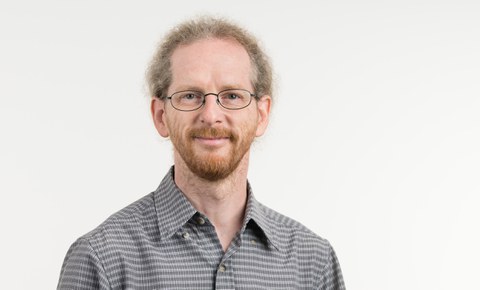
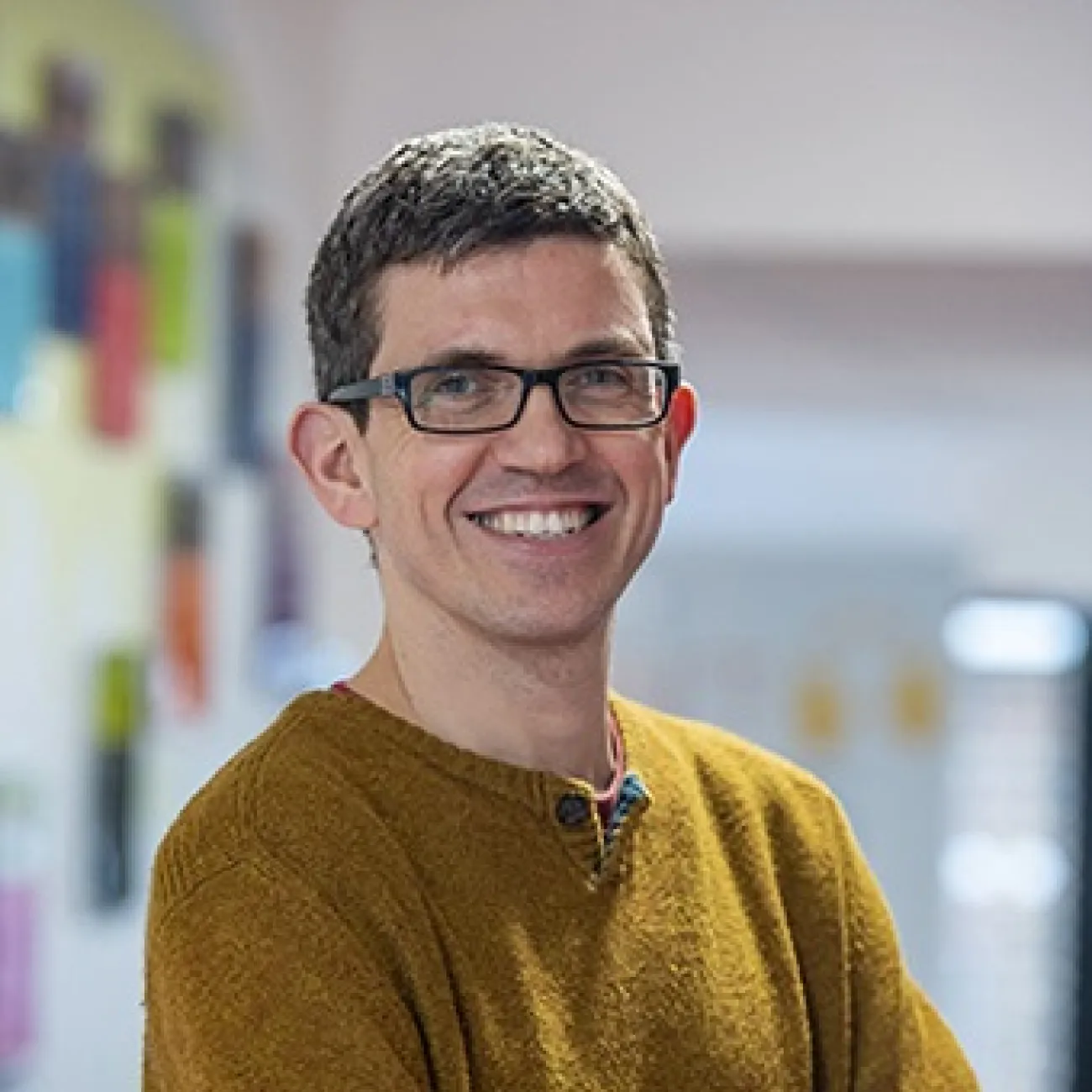
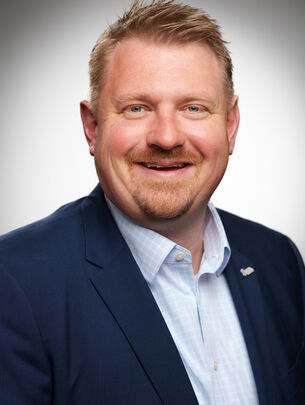
Ralph Müller-Pfefferkorn is Head of the Department of Distributed and Data Intensive Computing at the Center for Information Services and High Performance Computing, Technische Universität Dresden. His work focuses on data management, metadata systems, and high-performance computing infrastructure. He holds a PhD in Physics from TU Dresden (2001) and has extensive experience in research data infrastructure development, spanning roles from 1996 to present across physics and computational science domains. Education: 2001: Dr. rer. nat., Physics, TU Dresden (Thesis on BABAR detector calibration) 1996: Diploma in Physics, TU Dresden 1992–1996: Studies in Physics at TU Dresden 1990–1992: Studies at TU Chemnitz Research interests emphasize distributed data management, long-term archiving, and FAIR data principles. He contributes to initiatives like the Research Data Alliance (IG Co-Chair) and UNICORE Forum board. His publications address challenges in big data workflows, metadata standards, and interdisciplinary infrastructure integration. Labs/Teams: Leads the Distributed and Data Intensive Computing team within TU Dresden's HPC center, collaborating on projects like MoSGrid and MASi repository systems.
Dr. Martin Petkovich is Professor in Biomedical and Molecular Sciences at Queen's University School of Medicine. His research focuses on nuclear receptor signaling pathways, particularly vitamin A and D metabolism in health and disease contexts including bone development, kidney disorders, and cancer. Education includes a Ph.D. in Biochemistry from the University of Toronto (1986) and BSc from McMaster University. Postdoctoral training was completed at Pierre Chambon's laboratory in Strasbourg. Key research areas encompass vitamin signaling mechanisms, nuclear receptor function, metabolic regulation in renal pathology, and therapeutic targeting of retinoid pathways. Current investigations examine megalin-mediated vitamin transport and CYP24A1 enzymatic regulation. Publications demonstrate consistent focus on retinoic acid receptor biology and cytochrome P450 enzymes across developmental, metabolic, and disease contexts. Recent works integrate molecular biology with clinical applications in nephrology and oncology. Dr. Petkovich co-founded Cytochroma Inc. and serves as scientific advisor. He directs laboratory research at Queen's University with collaborations spanning multiple institutions, though no specific students or awards are detailed in available records.
Graeme Hornby serves as a Senior Enterprise Fellow at the University of Southampton's GeoData Institute. Since September 2018, he has been seconded to the GRID3 overseas development programme as Lead for Training and Capacity Strengthening. GRID3 is an ambitious initiative co-founded by the Centre for International Earth Science Information Network (CIESIN), WorldPop (at the University of Southampton), Flowminder, and the United Nations Population Fund (UNFPA). Hornby specializes in geospatial data applications for development contexts, with research interests spanning geospatial data science, GIS methodologies, population distribution mapping, demographic analysis, and training capacity development. His work focuses on creating and implementing innovative geospatial data products that support the UN Sustainable Development Goals, particularly in health, education, and census planning for low- and middle-income countries. The core data products he works with include high-resolution population distribution/density metrics, demographic characteristics, settlement extents, and local infrastructure mapping. Hornby's publication portfolio demonstrates consistent output in high-impact journals from 2016-2025, with a clear thematic focus on spatial demographic analysis, particularly in resource-constrained settings. His work shows increasing sophistication in integrating multiple data sources and developing methodological approaches for population mapping at subnational levels. The research spans applications in public health, urban planning, transportation safety, and gender-disaggregated development indicators, reflecting a strong commitment to using geospatial science for practical development applications. As GRID3 training lead, Hornby coordinates all aspects of planning, development, and implementation of training and capacity development for GIS and related subjects. He delivers training events across multiple countries through both classroom settings and online via a Moodle-based learning management system, leading a team that meets growing demand for geospatial training opportunities in development contexts.
M. Schorcht is a Researcher at the Leibniz Institute of Ecological Urban and Regional Development (IOER) since 2015, working in the research group for Spatial Information and Modelling. His expertise includes programming website applications and databases, automated geodata processing, and method development for settlement development analysis such as new land use, building change detection, and densification indicators. His educational background includes: Doctoral thesis (2016-2023) at the Faculty of Forestry, Geosciences and Hydrosciences, TU Dresden, on "Spatial analysis, quantification and evaluation of developments in settlement structure based on topographic geodata". Diploma in Cartography (2007-2015) at TU Dresden. Internship (2011) at the Leibniz Institute for Regional Geography in Leipzig. Internship (2010) at ETH Zurich, Institute for Geodesy and Photogrammetry. His research focuses on geospatial methodologies for urban monitoring, combining cartographic principles with computational analysis of settlement patterns. He develops technical frameworks for processing topographic geodata to quantify urban densification and land-use transitions, contributing to ecological urban planning through empirical spatial modeling. Key projects he contributes to include: IÖR-Monitor: Foundational system for tracking settlement and open space development. ENOB DataNWG: National data collection on non-residential building stock structure and energy quality. meinGrün: Interactive application for urban green space navigation and information access. Deutsche Gesellschaft für Kartographie (DGfK): Professional society for cartography and geomatics. His work operates within IOER's Spatial Information and Modelling group, funded jointly by German federal and state governments with specific projects co-financed by Saxon State Parliament tax allocations.
Dr. Sibylle Künzler is a senior assistant professor, researcher, and mobility coordinator at the Department of Cultural Studies and European Ethnology within the Faculty of Humanities at the University of Basel, where she has been employed since 2019. She remains authorized to administer examinations until HS25 (end of January 2026), allowing students to write papers and take exams with her during this period. Dr. Künzler's academic background includes studies at the Universities of Zurich and Vienna in Empirical Cultural Studies, Sociology, Popular Literature and Media, Cultural Studies, and Geography. Prior to her position at Basel, she served as an assistant professor at the Institute for Social Anthropology and Empirical Cultural Studies at the University of Zurich (UZH), where she completed her dissertation on the perception of augmented spaces using Google Maps and Street View, and specialized in digital teaching. Her research program spans epistemological questions in cultural studies as teaching and learning practice, Science and Technology Studies, cultural spatial research, technology research, sensory ethnography, media and visual studies, post-digitality, and cultural theory. She approaches her work with a transdisciplinary-integrative perspective, exploring the connections between perception and the design of everyday life environments, particularly in relation to digital technologies. With over 25 publications since 2010, Dr. Künzler's scholarly output demonstrates a consistent evolution from examining digital mapping technologies (particularly Google Maps and Street View) to increasingly focusing on teaching and learning practices within cultural studies. Her 2023 monograph 'Moving Topology: Cultural Studies Explorations of Augmented Spaces' represents a significant contribution to understanding how digital technologies reshape our spatial experiences and cultural practices. Teaching Commission of the University of Basel, Representation of Group III German Society for Empirical Cultural Studies (DGEKW) Swiss Society for Folklore (SGV) DGEKW Commission, Digital Anthropology (founding member) Network B – independent think tank (founding member) Cultural Studies Network 'Everyday Life and Technology' Dr. Künzler has taught numerous courses at both the University of Basel and University of Zurich, covering diverse topics including biographical research, play and toys, space, mindfulness, power, and artistic knowledge practices. Her teaching expertise includes digital teaching methods, and she completed a Teaching Skills Certificate at UZH. Her current cumulative habilitation project 'Empirical Cultural Studies as Teaching and Learning Practice' explores how the subject, its perspectives, and content are produced, performed, and shaped in teaching and learning practices, and which hegemonic, socio-technical negotiations accompany these multisensorial, collective epistemic processes.
Sebastian Janßen is a Professor of General Surveying at the Technische Hochschule Georg Agricola (THGA) , specializing in geodata management, mine surveying, and photogrammetry. He also serves as a lecturer for 'Strata and Ground Movement' at TU Clausthal since 2020. His career spans academic research and industry roles in mining engineering, with affiliations to institutions like RWTH Aachen University and EON SE. Education: Studied mine surveying at RWTH Aachen University (2001–2008), with international stations at TU Helsinki, University of Exeter, and TU Delft. Degree: Promoted to Dr.-Ing. (PhD equivalent) in 2017. His research focuses on geodata collection using classical methods, remote sensing, and mine surveying, with applications in project management and post-mining sustainability. His publications since 2010 highlight expertise in longwall mining innovation, coal supply risk analysis, and environmental reclamation in ore mining. He participates in academic governance as Chairman of the Electoral Board (2022–present) and Senate Commission for Teaching (2024–present). Janßen is a member of professional organizations including the German Mine Surveyors Association (DMV), Society of German Metallurgists and Miners (GDMB), and DVW e.V. Society for Geodesy, Geoinformation, and Land Management. He contributes to standardization in the NABau working committee for mine surveying.