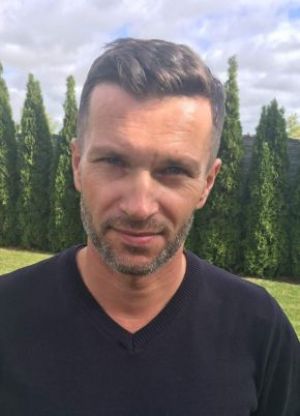
Dr. Anna Prażmowska is an Assistant at the Department of Theoretical Linguistics, Institute of Linguistics, Faculty of Humanities, John Paul II Catholic University of Lublin. Her work bridges theoretical (generative) linguistics, contrastive linguistics, and translation studies, focusing on syntactic structures in English and Polish. Research Highlights: Specializes in comparative syntax of English and Polish, particularly coordination structures and dative possessors. Active in conference organization as co-organizer of the annual international Linguistics Beyond and Within conference. Editorial assistant for the peer-reviewed journal LingBaW . Publications: 2024: Peer-reviewed article on dative possessors in Polish. 2020: Peer-reviewed monograph on English-Polish coordination. 2016-2013: Articles on agreement rules and coordination-as-adjunction in Polish. Conference Engagement: Presented at international conferences (2012-2024) on topics like dative possessors and gender resolution. Co-organized annual Linguistics Beyond and Within conferences (2014-2024).
Katarzyna Maria Maniowska is an Adjunct Professor at the Faculty of Languages, Literatures and Cultures, Maria Curie-Skłodowska University (UMCS). With a PhD in Italian Studies from Jagiellonian University (2014), her academic career spans teaching, translation research, and international collaborations. PhD in Italian Studies (2014, Jagiellonian University) MA in Italian Philology (2008, Jagiellonian University) BA in Italian Philology (2006, University of Silesia) Postgraduate translator training (2019, UMCS) Postgraduate Master in Italian L2 (2016, Università Cattolica del Sacro Cuore) Her research focuses on linguistic interfaces between Italian and Polish, particularly in medical terminology and literary translation . Key interests include phraseology, specialized language teaching (Italian as third language), and metaphor analysis in medical contexts. Recent publications examine: historical disease narratives , Umberto Eco's theory of stupidity , medical term synonymy , and prepositional semantics in clinical reports . These works demonstrate her expertise in cross-linguistic medical communication. Rector's award for outstanding scientific work (2023) Scuola Dante Alighieri scholarship (2023) Università per Stranieri di Perugia scholarships (2021, 2015) Dote Unica Lavoro grant (2016) She has conducted 15+ teaching workshops on Italian L2 pedagogy, including: Dante's pedagogical interpretation , medical terminology teaching , and literature instruction for Generation Z . Active in professional associations since 2013, she collaborates on European translation initiatives.
Dr. Beata Kasperowicz-Stażka is an Adjunct Professor at the Department of German Studies , Institute of German and Applied Linguistics, Faculty of Languages, Literatures and Cultures at Maria Curie-Skłodowska University (UMCS) in Lublin, Poland. She has held this position since 2019 and previously worked at institutions including the Higher School of Technology and Economics in Chełm (2003-2009) and Radom University of Technology (2009-2011). Linguistics researcher specializing in German syntax DAAD scholarship recipient Academic administrator in Bologna Process implementation Research Focus : Her work centers on German reference adjectives , exploring their semantic interpretation , cognitive profiling , and substitution possibilities with substantival attributes. She investigates metaphorical representation in nominal constructions and linguistic worldview formation through comparative analysis of German-Polish texts. Her research intersects general linguistics , cognitive science , and pragmatics , with applications in translation studies and language education. Academic Contributions : Co-founder of Reflections. Students' Scientific Papers UMCS (2020) Scientific coordinator for Polish-German educational programs Active participant in international conferences (Wrocław, Kraków, Budapest, Prague) Contributor to European Social Fund projects on education quality Key Activities : Organizer of student conferences Academic exchange coordinator Developer of practical-oriented philology curricula Program creator for business German studies
Jacek Mazurkiewicz is an academic researcher at Wrocław University of Science and Technology, affiliated with the Faculty of Information and Communication Technology and Department of Computer Engineering . His work spans artificial neural networks, network systems dependability, and transport safety applications. PhD in Computer Engineering Active participation in DepCoS-RELCOMEX conferences Research focuses on: Hardware implementation of neural networks Soft computing for safety improvements Critical situation analysis in network systems Intelligent transport systems development Recent publications highlight his interdisciplinary approach combining AI with transportation safety, creative AI applications in music/art, and dependability engineering. He has contributed to conference proceedings editing and collaborative research projects. Contact: jacek.mazurkiewicz@pwr.edu.pl
Przemysław Tajsner is a Professor at the Faculty of English, Adam Mickiewicz University in Poznań, Poland. He holds a D.Litt. in English linguistics and has been a long-standing member of the academic staff, contributing significantly to research and administration within the School of English. His contact information includes an office in Collegium Heliodori, room 342, and the email tprzemek@amu.edu.pl. M.A. in English, Adam Mickiewicz University, Poznań, 1982 Ph.D. in English, Adam Mickiewicz University, Poznań, 1990 D.Litt. in English Linguistics, Adam Mickiewicz University, Poznań, 1998 His primary research interests lie in generative syntax and its interfaces, with a strong focus on cross-linguistic analysis and the interplay between syntax and phonology. He also investigates functional syntax and pragmatic aspects of language, contributing to theoretical debates in formal linguistics. His work often engages with foundational questions in linguistic methodology, as evidenced by his plenary talk on the validity of armchair linguistics. Although no publications are listed in the provided text, his conference participation and editorial roles suggest sustained scholarly output in theoretical and contrastive linguistics, particularly within generative frameworks. His involvement in international meetings indicates a broad academic network and influence in European and global linguistics communities. He has held key administrative roles, including Deputy Head of the School of English (2008–2012) and Head of the Ph.D. Programme (2004–2012), demonstrating leadership in academic governance and graduate education. He served as the Socrates Programme Co-ordinator for the Faculty of Modern Languages and Literature between 1998 and 2000, facilitating international academic exchange. Przemysław Tajsner has been a visiting lecturer at Michigan State University (1992–1993) and the University of Vienna (1997–1998), and has delivered guest lectures and conference papers across Europe and North America. He has participated in major linguistics conferences such as the Poznań Linguistic Meeting, GLOW in Asia, and the Annual Meeting of the Societas Linguistica Europaea, where he also convened sessions. He is a member of the editorial board of Poznan Studies in Contemporary Linguistics and previously served as Editorial Assistant for Papers and Studies in Contrastive Linguistics .
Adam Biały serves as an Assistant Professor in the Department of English and Comparative Linguistics at the Faculty of Philology, University of Wrocław, where he also earned his PhD in English Linguistics in 2004. His institutional affiliation demonstrates long-term commitment to linguistic research and education within this Polish academic framework. Education: PhD in English Linguistics (2004), Faculty of Philology, University of Wrocław Research Focus: Dr. Biały's scholarly work centers on theoretical linguistics and general linguistics , with particular emphasis on language evolution and cognitive underpinnings of linguistic structures . His investigations bridge syntactic theory with psychological processes, examining how cognitive mechanisms shape grammatical phenomena in natural language systems. This interdisciplinary approach integrates historical linguistics with contemporary cognitive science frameworks. Publication Trajectory: Between 1998-2009, Dr. Biały produced 11 significant publications analyzing Polish linguistic structures, predominantly focusing on psychological predicates, reflexive constructions, and verbal-nominal interfaces. His methodological evolution shows progression from generative grammar analyses toward constructionist perspectives, while maintaining consistent focus on Polish as a case study for universal linguistic principles. Key recurring themes include argument structure, lexical semantics, and morphosyntactic interfaces across multiple subdomains. Scientific Recognition: No formal awards, fellowships, or medals are documented in the provided materials. Academic Contributions: While conference presentations at venues like PASE Annual Conferences and Poznań Linguistic Meetings indicate active scholarly engagement, the text provides no details regarding graduate student mentorship or externally funded research projects. His involvement in the university's "Integrated Development Programme 2018-2022" remains unspecified beyond institutional context.
Edyta Błachut is an Assistant Professor and Head of the Department of General and Comparative Linguistics at the Institute of German Philology, University of Wrocław. Her primary affiliation includes teaching and research responsibilities in Germanic and comparative linguistics. Education: MA in Dutch Philology, Faculty of Philology, University of Wrocław (1998) MA in German Philology, Faculty of Philology, University of Wrocław (1999) Pedagogical Training Studies, Faculty of Philology, University of Wrocław (1999) PhD in Linguistics, Faculty of Philology, University of Wrocław (2003) Research Focus: Her work spans Germanic linguistics, general linguistics, and comparative linguistics, with emphasis on structural and historical aspects of the German language. Professional Experience: 2004–present: University of Wrocław (Assistant→Assistant Professor & Head of Department) 2005–2009: State Higher Vocational School (Lecturer in Modern Languages) Teaching: Courses include German morphological grammar, syntax, and history of the German language.
Dr hab. Daria Magdalena Bębeniec is Assistant Professor (adiunkt) in the Department of English and General Linguistics at the Faculty of Languages, Literatures and Cultures , Maria Curie-Skłodowska University, Lublin, Poland. She teaches courses in cognitive linguistics and grammar at BA and MA levels and maintains an active research profile combining corpus methods with construction-grammar approaches. Research Interests Cognitive Linguistics and Construction Grammar Polysemy, synonymy and semantic variation Corpus-based and quantitative methods in semantics Temporal and spatial semantics in Polish and English Her work often integrates advanced statistical techniques (cluster analysis, probabilistic grammar) with theoretically grounded cognitive-semantic questions, aiming to uncover usage-driven patterns in large-scale language data. Scientific Output & Trends Across her nine recent publications (2015-2025) Bębeniec explores two major strands: (1) methodological refinement in corpus-based cognitive semantics, particularly via Behavioral Profiles and clustering techniques, and (2) applied semantics at the intersection of language and law, exemplified by her collaborative analyses of Article 9 ECHR. The temporal semantics of Polish prepositions and the polysemy of Polish path constructions provide additional empirical foci, demonstrating a consistent integration of Slavic data within international theoretical debates. Professional Development & Grants She has completed specialized training at leading international centres, including: Corpus Linguistics Summer School, University of Birmingham (2016) Statistics for Linguists with R bootcamps, Université catholique de Louvain & UMCS (2017 & 2018) Digital Humanities Summer School, Pedagogical University Kraków (2015) EMCL Open Science Methods, University of Tartu (2019) These activities were supported by university grants and CLARIN-PL infrastructure, fostering both her quantitative expertise and international collaboration network. Labs & Teams Bębeniec is an active member of the Cognitive Linguistics Research Group at UMCS, where she co-organised the 2018 edition of the “Statistics for Linguists with R” bootcamp. She collaborates closely with Małgorzata Cudna on constructional polysemy studies and participates in CLARIN-PL initiatives that advance digital methods in the humanities.
Dr. Piotr H. Lewiński is an Assistant Professor at the Department of Applied Linguistics, University of Wrocław’s Faculty of Philology. His research focuses on glottodidactics, persuasion language, pragma-dialectics, rhetoric, and argumentation theory. He teaches courses in communication science, general linguistics, and Contemporary Polish Culture, with international experience including lectures at Italy’s L’Orientale University and EU projects COM-IN-EUROPE and INTI Citizenship. He has held prestigious fellowships at DePaul University (Kościuszko Foundation) and the University of Washington (Fulbright Program). His research interests span theoretical and applied linguistics, with emphasis on argumentation structures, rhetorical strategies in advertising, and language pedagogy. Key publications explore ambiguous communication, pragmatics origins, and Polish language instruction methodologies. He actively contributes to academic discourse through ISSA membership and peer-reviewed articles across rhetoric, linguistics, and communication studies. Education: Doctorate (habilitation) from the University of Wrocław Grants/Projects: EU-funded COM-IN-EUROPE (2004–2006), INTI Citizenship (2004–2006) Awards: Kościuszko Foundation Scholarship (1997/98), Fulbright Scholarship (2006/2007) His teaching portfolio includes advanced courses like rhetoric post-WWII analysis and functional grammar seminars. Collaborations with institutions like the Wrocław University of Environmental and Life Sciences highlight his interdisciplinary reach.
Aveen Mohammed Hasan is an Assistant Professor in the Department of English Language at the Iraqi College of Humanities, University of Zakho. She holds a PhD in Linguistics from Ulster University (2012) and has been actively involved in academic leadership roles, including serving as Head of Department and Head Assistant. Her research focuses on Kurdish linguistics, with specializations in phonetics, phonology, and sociolinguistics. Education: Doctor of Philosophy (2012), Master of Arts (2005), Bachelor of Arts (2001) in English Language from University of Duhok. Professional experience includes roles as Assistant Professor (2018–present), Lecturer (2013–2018), and Assistant Lecturer (2005–2013). She has conducted training programs on TESOL methodology, higher education leadership, and ELT pedagogy. Research interests include Kurdish intonation patterns, phonological processes (e.g., glide insertion, stress shifts), loanword variation, and language acquisition in Kurdish-speaking children. She has organized academic workshops and serves on editorial committees for journals like Humanities Journal of University of Zakho and Journal of Comparative Studies. Recent work includes developing articulation tests for Kurdish children, analyzing e-learning challenges during the pandemic, and studying loanword usage in Kurdish dialects. Her contributions to phonetics and sociolinguistics have been presented at international conferences, including the International Conference on Kurdish Linguistics and the University of Daugavpils’ Human: Language, Society, Culture conference.
Dr. Ewelina Mokrosz is an Assistant Professor at the Department of Theoretical Linguistics (Faculty of Humanities) at John Paul II Catholic University of Lublin. Her research focuses on generative syntax, information structure, comparative linguistics, historical linguistics, and conference interpreting, with particular emphasis on Polish language phenomena. PhD (2013) on Clefting strategies in English and Polish MA (2009) on OV/VO variation in Old English Research highlights include: Comparative constructions and relative clauses in Polish Frequency adjectives and their interpretations Functional particles like 'samo' and 'tak' Agreement patterns in cleft constructions Recent publications examine: Topic dislocations NPI licensing Reduced relative clauses Contrastive historical linguistics Her work bridges theoretical analysis with empirical investigations across English and Polish languages. Teaching Activities : Involved in phonetics instruction and supervised numerous diploma theses on comparative syntax, coordination constructions, idiom analysis, and translation studies.
Izabela Jarosz is an Adjunct Professor at the Department of English and General Linguistics , Faculty of Languages, Literatures and Cultures, Maria Curie-Skłodowska University in Lublin. She holds a Master’s degree in English Philology from Jagiellonian University in Kraków and a PhD in English Linguistics from UMCS. Specializes in linguistic and literary analysis, with a focus on James Joyce’s Dubliners Research areas include cognitive linguistics, intercultural communication, and English language teaching methodologies Published a monograph (2020) and multiple articles on cultural motivation in language, phrasal verbs, and gender-neutral terminology Teaches courses in English didactics, intercultural communication, and second language acquisition Her recent publications demonstrate interdisciplinary engagement with literary analysis, cognitive linguistics, and educational practices. Key themes include the intersection of language, culture, and personal experience in Joyce’s works, as well as empirical studies on intercultural competence development in EFL classrooms. She holds teaching qualifications from ACELS (Ireland) and the Kielce Voivodeship Office.
Dr hab. Przemysław Łozowski is a Professor at the Chair of English and General Linguistics within the Faculty of Languages, Literatures and Cultures at Maria Curie-Skłodowska University (UMCS). His academic career spans multiple decades, with significant contributions to linguistics, particularly in cognitive linguistics, ethnolinguistics, and panchronic analysis. Research Focus: Language as a symbol of experience, cognitive mechanisms in linguistic constructions, and the interface between language and culture. Key Themes: Metaphor, terminology, grammaticalization, and historical continuity in linguistic systems. His recent publications explore topics such as the will and be going to constructions through panchronic inferences, cognitive equivalence in grammaticalization processes, and the role of terminology in defining linguistic disciplines. He has co-edited volumes like Words in Contexts and The Linguistic Worldview , emphasizing interdisciplinary approaches to language study. Łozowski’s work bridges theoretical frameworks—from Saussurean semiotics to modern cognitive linguistics—while maintaining a focus on empirical validation through textual evidence. His research also intersects with cultural studies, examining concepts like collective memory, identity, and cultural symbolism in language.
Dr. hab. Artur Bartnik is an Assistant Professor at the Department of the History of English and Translation Studies , Institute of Linguistics , within the Faculty of Humanities at the John Paul II Catholic University of Lublin . With a focus on generative grammar , historical syntax , and contrastive grammar , his work examines syntactic structures in Old English and Polish, including resumption , left-dislocated structures , and language acquisition . Education: Master of Didactics (Part 1-3) , study visits to University College London (UCL) and University of Oxford His research spans Old English syntax , nominal phrases , and bilingualism , with a corpus-based approach to left-dislocation and quantifiers . Publications highlight trends in resumptive pronouns , asymmetric coordination , and relativization strategies . Awards include the Prime Minister's Award (2009) and Rector's Inner Reward (2021) , alongside multiple Erasmus scholarships for academic mobility. He has served on doctoral committees , Erasmus+ projects , and organized international humanities competitions and the Lublin Science Festival . Scientific Awards Prime Minister's Award for outstanding doctoral dissertation (2009) Rector's Award for outstanding habilitation thesis (2021) Erasmus scholarship (multiple years: 2017–2025) Grants SCOPES 2009–2012 Grant (SNSF & SDC)
Piotr Cegłowski is a Professor at the Faculty of English, Adam Mickiewicz University in Poznań. His research focuses on comparative linguistics, minimalist syntax, and the morphosyntax of Slavic languages, with an additional interest in language evolution. He holds a D. Litt. in English Linguistics and has been actively involved in academic organizing and presentations. Education: M.A. in English Linguistics (AMU, 2002) Ph.D. in English Linguistics (AMU, 2006) D. Litt. in English Linguistics (AMU, 2018) Research interests center on formal analysis of nominal expressions, subject properties in infinitival constructions, and interdisciplinary approaches to language structure. His work bridges generative syntax with Slavic linguistics. Scientific awards 2nd prize for best poster presentation at SLE 2017 Professional roles include organizing international conferences like "Information Structure meets Generative Syntax" (SLE 2014) and serving as head of part-time studies at the Faculty of English (since 2020). He has participated in over 20 academic events across Europe and the US since 2004.