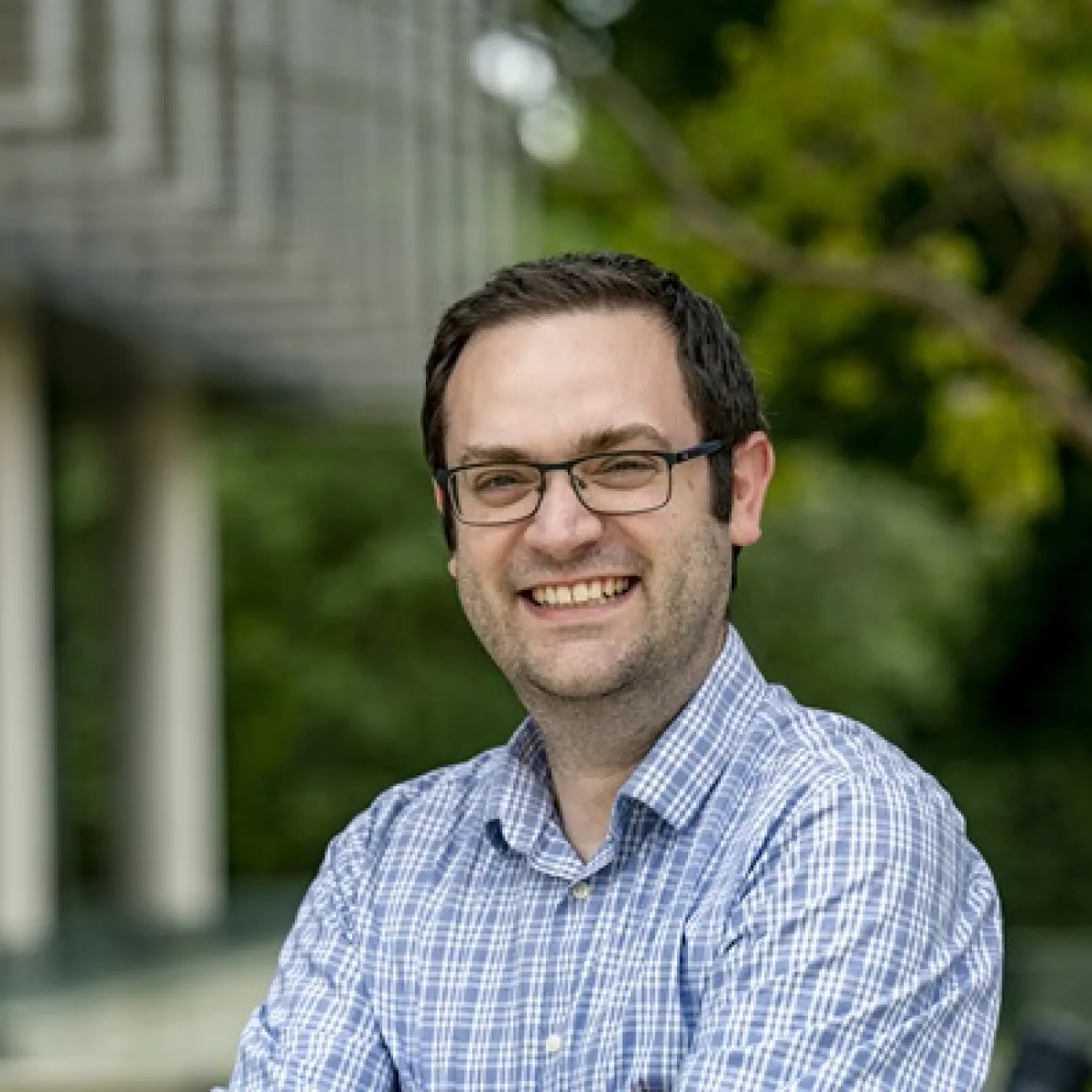
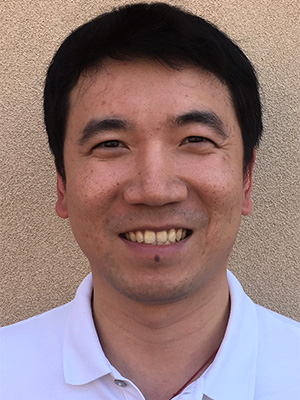
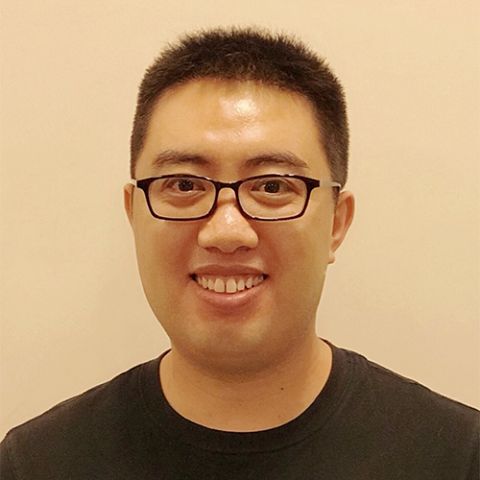
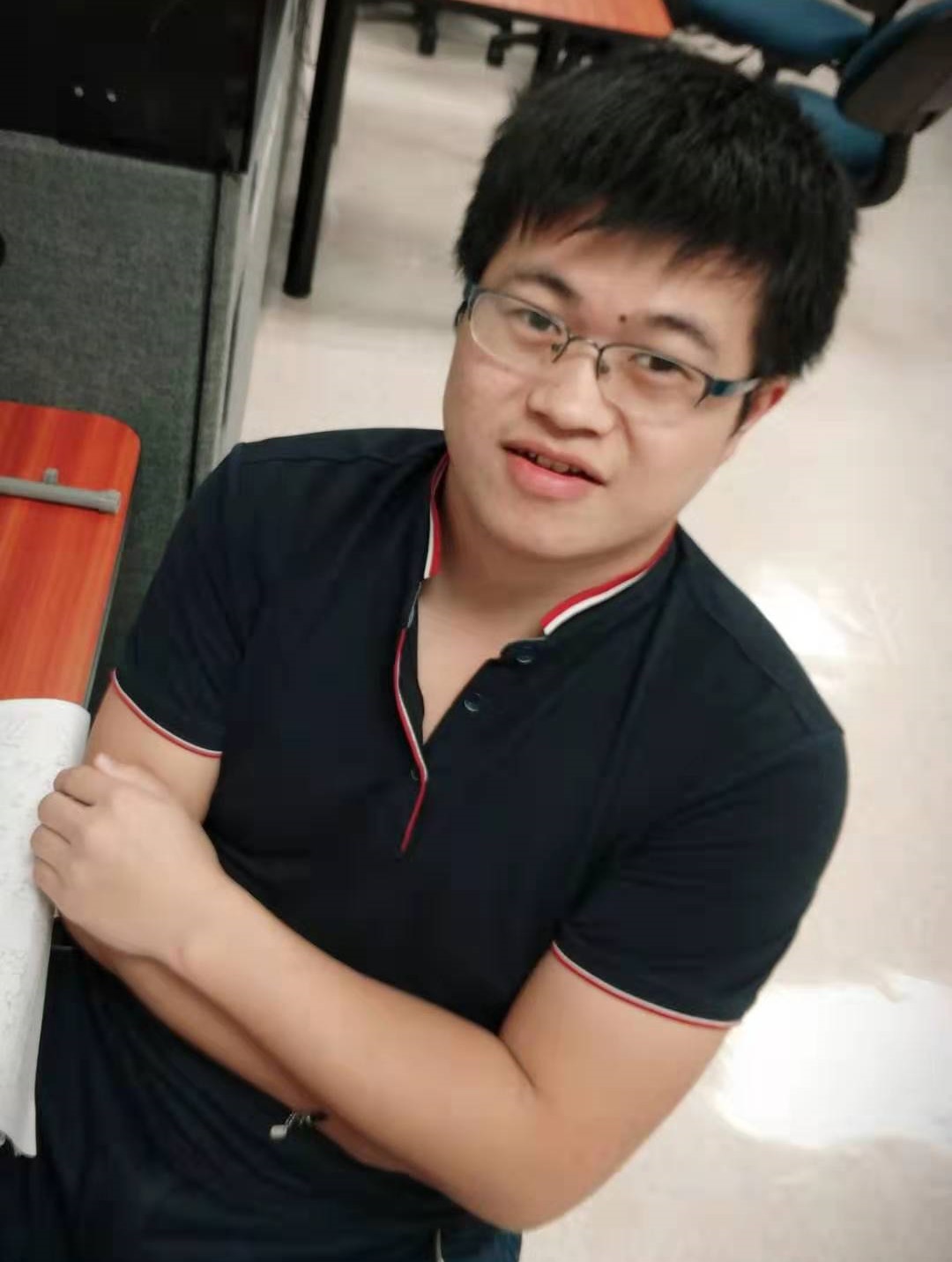
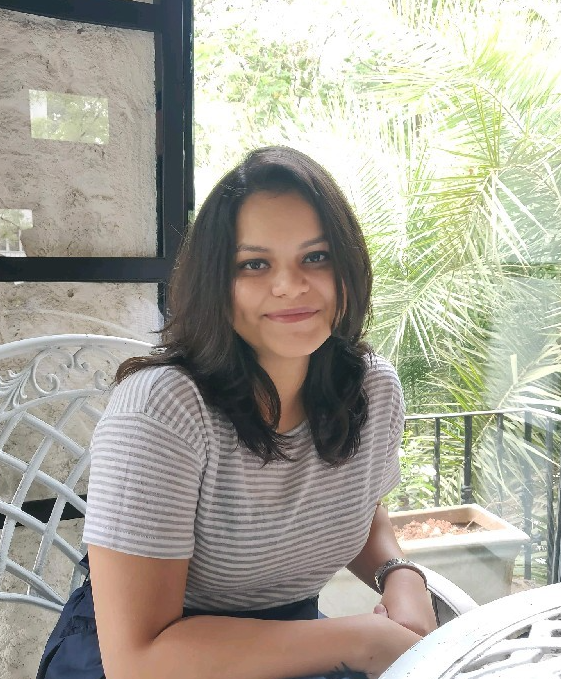
Dr. Gözde Damla Turhan is a Researcher at the Department of Architecture within the Faculty of Fine Arts and Design at İzmir University of Economics, a position she has held since September 2017. She holds a B.Sc. in Architecture from İzmir Ekonomi Üniversitesi (2014), followed by dual Master's degrees: M.Arch in Advanced Architectural Design (2016) and M.Sc. in Architecture (2016). Her Ph.D. in Design Studies (2022) focused on biobased materials, computational design, and digital fabrication. Current research interests include AI applications in design (machine learning, diffusion models, LLMs), and sustainable material innovation. Her work bridges architecture and computational technologies, emphasizing bio-based materials (e.g., bacterial cellulose), digital fabrication methods, and AI-driven design processes. She has explored topics like urban rehabilitation via GANs, NFT art hybrid experiences, and life cycle assessments of unconventional construction materials. Publications (2016–2023) span computational form-finding, material science, and digital tools in architecture. She actively contributes to design pedagogy, investigating how AI tools like diffusion models can reshape educational frameworks.
Dr. Harshala Gammulle is a Research Fellow at Queensland University of Technology (QUT), School of Electrical Engineering & Robotics. She holds a PhD in Computer Vision from QUT (2019), receiving the QUT Executive Dean's Commendation for Outstanding Doctoral Thesis. Her expertise spans machine learning, computer vision, and spatio-temporal modeling for human behavior understanding. She leads interdisciplinary projects with funding from DST Group, SmartSat CRC, QLD DESI, and others. Research focuses include: human action recognition, medical anomaly detection, satellite image analysis, and AI for environmental monitoring. Key projects involve quantum-classical hybrid ML for biomedical signal analysis, disaster forecasting via hyperspectral data, and autonomous combat vision systems. She has supervised PhD/MPhil candidates in ML and quantum hybrid ML. Education: PhD (Computer Vision, QUT 2019), BSc (University of Peradeniya, Sri Lanka). Awards: WiT Emerging Achiever Technology Award finalist (2021), University Award for Academic Excellence (2015). Teaching includes units like Digital Signals and Image Processing (EGH444), and Computing & Data for Engineers (EGB103). Current grants involve QLD DESI, SmartSat CRC, and Rheinmetall Defence Australia collaborations. Active in labs like SAIVT and QUT's Early Career Research schemes.
Rémi Flamary is a Professor in the Applied Mathematics department at École Polytechnique, France, and a member of the CMAP Laboratory. Previously, he held an Associate Professor position at Université Côte d'Azur in the Department of Electronics and Lagrange Laboratory. He completed his PhD at Rouen University under Alain Rakotomamonjy, focusing on statistical signal processing and optimization. His research interests span machine learning, optimal transport, domain adaptation, and their applications in biomedical engineering, energy, and remote sensing. He leads the development of the POT (Python Optimal Transport) library and contributes to projects like SKADA for domain adaptation. Education: PhD in Applied Mathematics, Rouen University (LITIS Laboratory) Research Focus: Flamary's work emphasizes leveraging optimal transport theory for machine learning tasks such as graph prediction, signal normalization, and cross-domain adaptation. His contributions include novel algorithms for unbalanced transport, semi-relaxed Gromov-Wasserstein distances, and end-to-end graph generation frameworks. He actively collaborates on applications in neuroscience, astronomy, and energy systems. Professional Activities: He has presented at NeurIPS and other top conferences, supervised PhD students like Cédric Vincent-Cuaz, and contributed to open-source software. His teaching includes courses on signal processing and machine learning at École Polytechnique.
Dr. David Toal is an Associate Professor at the University of Southampton, specializing in the application of machine learning techniques to aerospace system design optimization. His research focuses on automated geometry creation, prediction of simulation outputs, and fundamental machine learning advancements. He is affiliated with the Computational Engineering and Design Group and the Institute for Life Sciences. His teaching interests include engineering design methods, optimization, reliability, and CAD integration. He supervises multiple PhD students in areas such as aerodynamic geometry generation and structural design automation. Dr. Toal has led projects funded by the European Union and EPSRC, including E-Break (FP7) and equipment grants for advanced computational tools. His work emphasizes multidisciplinary collaboration, leveraging CAD systems and deep learning for applications in advanced aerial mobility and turbine optimization. Recent publications highlight advancements in Kriging models, adversarial auto-encoders, and semantic segmentation for engineering design. Dr. Toal's research bridges computational methods with practical aerospace challenges, aiming to accelerate design processes through data-driven and AI-enhanced approaches.
Professor Zhifeng Bao is a faculty member at RMIT University's School of Computing Technologies. His research focuses on enhancing data usability across heterogeneous domains, including structured, unstructured, and spatial-temporal data. His work spans database management, keyword search optimization, social network analysis, and spatio-textual data processing. He coordinates the course COSC1169: Intranet and Internet Data Engineering and supervises PhD/Masters students in projects such as trajectory data processing, data asset valuation, and edge computing optimization. Research interests emphasize improving data accessibility and efficiency through methodologies like query relaxation, visual analytics, and provenance tracking. His recent projects include cost-effective edge node placement, traffic accident risk prediction, and differentially private federated learning. Teaching and supervision activities highlight a commitment to bridging theory and practical data engineering challenges.
Dr. Xiang Sun is an Assistant Professor in the Department of Electrical and Computer Engineering at the University of New Mexico (UNM). He holds a Ph.D. in Electrical Engineering from New Jersey Institute of Technology (2018), and M.E. and B.E. degrees from Hebei University of Engineering (2011 and 2008). His research focuses on Mobile Edge Computing, IoT, Drone-assisted Networks, Green Computing, and Data Center Optimization. Dr. Sun has been recognized with awards such as the 2018 InterDigital Innovation Award and NJIT Hashimoto Prize. Education: Ph.D., Electrical Engineering, NJIT (2018) M.E., Computer Applications Technology, Hebei University (2011) B.E., Electronic Information, Hebei University (2008) Research Interests: His work emphasizes IoT resource caching, semantic discovery, green communications, and drone-based mobile access networks. He also explores machine learning applications in edge computing and cybersecurity. Publications & Contributions: Dr. Sun has authored over 40 journal/conference papers, including impactful work on cloudlet networks and IoT semantic mashup. His research has been published in IEEE Transactions, Communications Letters, and top-tier conferences like ICC and GLOBECOM. Awards: 2018 InterDigital Innovation Award 2018 NJIT Hashimoto Prize 2017 IEEE Communications Letters Exemplary Reviewer 2016 IEEE ICC Best Paper Award Professional Activities: He serves as a TPC member for IEEE CCNC and MobiEdge, and reviewer for top journals like IEEE Transactions on Cloud Computing and IEEE Internet of Things Journal. He co-chairs the Social Computing and Semantic Data Mining symposium at IEEE ICNC 2019. Labs & Teams: Active in UNM's Electrical & Computer Engineering labs, focusing on mobile edge computing and IoT innovation. Collaborates with industry partners like InterDigital Communications.
Paul Siebert is a Reader in Computing Science at the University of Glasgow, specializing in computer vision and robotics. He leads the Computer Vision and Graphics research group and teaches Digital Image Processing and Computer Systems. His research focuses on 3D vision systems, biologically inspired vision, and cognitive robot vision, with applications in clinical and media domains. He has pioneered commercial 3D surface scanning technology and collaborated with clinical groups such as Glasgow Dental School. Affiliations: University of Glasgow (Computing Science Department) Roles: Reader, Group Leader (Computer Vision and Graphics) Research interests include active binocular robot vision, 2D/3D sensing, and visual perception for robotics. Notable projects include work on driver attention monitoring, virtual character creation, and clinical anatomical imaging. Siebert previously directed the 3D-MATIC Faraday Partnership and served as Chief Executive of the Turing Institute, developing commercial vision systems. Publications span over 140 works, emphasizing applications like rain removal algorithms, continual learning in robotics, and foveated imaging. His work integrates deep learning, biological vision models, and real-world robotics challenges. Awards and recognitions are not explicitly listed, but his contributions to 3D vision commercialization and robotics research highlight significant impact in the field.
Fenglong Ma is an Associate Professor at Pennsylvania State University, affiliated with the Institute for Computational and Data Sciences and the Center for Socially Responsible Artificial Intelligence. His research focuses on data mining, healthcare informatics, machine learning, natural language processing, and multimodal learning. He holds a Ph.D. from the University at Buffalo (2019) and degrees from Dalian University of Technology. His work addresses challenges in federated learning, medical AI, adversarial robustness, and multimodal systems. Key contributions include innovations in quantization for large language models, federated knowledge injection, and medical vision-language benchmarking. Recent publications explore topics like collaborative fairness in federated learning, robust medical vision-language models, and adversarial attack mitigation. His research bridges theory and practical applications in healthcare, cybersecurity, and personalized recommendation systems. He leads the PSU Data Science Lab and collaborates on projects involving AI ethics, multimodal data integration, and scalable medical foundation models.
Alessandra Buonanno is a Research Professor at the University of Maryland, College Park, and Director at the Max Planck Institute for Gravitational Physics (Albert Einstein Institute) in Potsdam. Her primary affiliation is with the Department of Physics at UMD, and she holds honorary professorships at Humboldt University and Potsdam University. She leads the Astrophysical and Cosmological Relativity department at the Max Planck Institute. Education: PhD in Physics from the University of Pisa (1996), following a Master's in Physics (Laurea, 1993). Postdoctoral work included stints at the Institut des Hautes Études Scientifiques (France), Caltech, and CNRS institutes in Paris. Research focuses on gravitational physics, including theoretical and phenomenological aspects of gravitational waves, general relativity, and astrophysical applications. She contributed to the LIGO Scientific Collaboration's groundbreaking detection of gravitational waves, earning numerous accolades such as the Balzan Prize (2021), Dirac Medal (2021), and Gottfried Wilhelm Leibniz Prize (2018). Publications emphasize high-field superconducting magnets for particle colliders, quantum gravity, and gravitational wave modeling. She leads projects like the Muon Collider's magnet design and coordinates international collaborations in particle physics and cosmology. Awards include the European Research Council's Synergy Grant (2024), Oskar Klein Medal (2023), and membership in prestigious academies like the US National Academy of Sciences and Leopoldina. Service roles include roles on the Kavli Prize Committee, the LISA Consortium Board, and the European Space Agency's Voyage 2050 committee. She is a Principal Investigator for the LIGO collaboration and actively contributes to advancing quantum-resistant cryptography and superconducting technologies.
Ruihui Li - Academic Summary Professional Overview Prof. Ruihui Li is a faculty member at the College of Computer Science and Electronic Engineering, Hunan University , specializing in Deep Geometry Learning , Generative Modeling , and 3D Vision . His work focuses on advancing 3D reconstruction and generation with high controllability, particularly in applications like point cloud upsampling and neural rendering. Education & Career Dr. Li earned his Ph.D. in 2021 (oral defense passed in June 2021). His career includes significant contributions to research in geometric deep learning and 3D computer graphics. He actively collaborates with institutions like the Chinese University of Hong Kong and Tel Aviv University on projects such as PU-GAN and SP-GAN . Research Interests His research spans cutting-edge topics in: Neural Wavelet-Domain Diffusion for 3D Shape Generation Topology-Aware 3D Mesh Reconstruction Camera-Based 3D Scene Completion Point Cloud Analysis and Upsampling Professional Activities Dr. Li has delivered invited talks at prestigious events such as the Asia Graphics Webinar and Peking University . He serves as a reviewer for top conferences (CVPR, ICCV, ECCV) and journals (TPAMI, TVCG). His research is supported by grants from the National Natural Science Foundation of China and the Chinese Academy of Sciences. Technical Contributions Key projects include: PU-GAN : A point cloud upsampling adversarial network (ICCV 2019). SP-GAN : Sphere-guided 3D shape generation (SIGGRAPH 2021). Neural Wavelet-domain Diffusion : 3D shape generation and manipulation (TOG 2024). Labs & Teams He leads a research group at Hunan University, mentoring Ph.D./MPhil students, RAs, and postdocs. His team focuses on interdisciplinary projects combining AI, computer graphics, and geometric deep learning.
Dr. Ding Ze Yang is a Lecturer in the Department of Electrical and Robotics Engineering at Monash University Malaysia. He holds a PhD (2023) and Bachelor's degree (2019) in Engineering from the same institution. His research focuses on Industrial AI, emphasizing data-driven soft sensors for industrial process monitoring, with applications in manufacturing, energy, and logistics. He has published in journals like IEEE Transactions on Industrial Informatics and Soft Robotics. Education: PhD in Engineering, Monash University Malaysia (2019–2023) Bachelor of Engineering (Honours) in Electrical and Computer Systems Engineering, Monash University Malaysia (2015–2019) Research Interests: Industrial AI, deep learning, data-driven modeling, process monitoring, autonomous systems, and soft sensor development. His work addresses challenges in predictive maintenance, process optimization, and sustainable manufacturing through AI-driven solutions. Publications: Recent work includes contributions to soft sensor modeling, transfer learning for multi-agent systems, and Kalman filter optimization. These publications highlight advancements in industrial AI applications. Collaborations: Active collaborations include projects on soft robotics, energy storage systems, and autonomous transportation. He is open to supervising PhD students in these areas.
Martin Diehl is a computational materials scientist affiliated with KU Leuven (Departments of Computer Science and Materials Engineering) and the Max-Planck-Institut für Eisenforschung GmbH in Germany. His work focuses on crystal plasticity simulations, computational materials engineering, and multi-physics modeling of metallic systems. Research interests include: Crystal plasticity finite element method (CPFEM) and spectral solvers Microstructure evolution and damage mechanics Machine learning applications in materials design Development of the DAMASK simulation toolkit Multi-phase steel alloys and heterogeneous deformation Integrated computational materials engineering (ICME) Key trends in his publications since 2021 highlight advancements in: Multi-physics DAMASK framework for coupled chemo-mechanical and thermal simulations AI-driven inverse design of steel microstructures Damage modeling in dual-phase steels Collaborative software development for materials science Experimental-simulation integration for stress-strain partitioning High-resolution spectral methods for finite strain analysis He actively collaborates with institutions like Harbin Institute of Technology, University of Oxford, and research groups across Europe and Asia.
Dr. Liang (Leon) Dong is an Associate Professor in the Department of Electrical and Computer Engineering at Baylor University, where he conducts research and teaches in the areas of signal processing, wireless communications, and artificial intelligence. He leads the Laboratory of Signal Processing, Communications, and Artificial Intelligence, fostering innovation in next-generation communication systems, IoT, and AI-driven applications. PhD, Electrical & Computer Engineering, The University of Texas at Austin (2002) MS, Electrical & Computer Engineering, The University of Texas at Austin (1998) BS, Applied Physics with Minor in Computer Engineering, Shanghai Jiao Tong University (1996) Dr. Dong's research focuses on advancing digital signal processing and wireless communications, with strong emphasis on artificial intelligence applications. His work spans NextG wireless systems , IoT and smart cities , cyber-physical system security , and AI in healthcare and industrial automation . He applies deep learning to domains such as autonomous driving and drug discovery, and investigates energy-efficient, secure, and reliable communication protocols. The recent publications highlight a strong trend toward integrating AI into traditional signal processing and communications. Topics include mRNA vaccine stability prediction , smart city infrastructures , secure cyber-physical systems , and deep learning for biomedical and industrial applications . His work bridges theoretical innovation with real-world impact in defense, transportation, and public health. Dr. Dong has earned recognition as a Senior Member of IEEE and a Member of the American Physical Society. He has also served as Faculty Advisor for Baylor University's InterVarsity chapter. Senior Member, Institute of Electrical and Electronics Engineers (IEEE) Member, American Physical Society (APS) He has successfully advised numerous graduate and undergraduate students, many of whom now hold academic and industry positions at institutions like Stanford, Intel, NASA, L3Harris, and Cummins. His research is generously supported by Baylor's VP for Research, the National Science Foundation, NASA, the Department of Defense (TARDEC), the Michigan Department of Transportation, and industry leaders including Intel, L3Harris, ExxonMobil, and Denso. He actively mentors students through research assistantships and senior design projects. Dr. Dong leads the Laboratory of Signal Processing, Communications, and Artificial Intelligence, which provides a collaborative environment for advancing research in signal processing, communications, and AI. The lab supports graduate and post-doctoral researchers and offers opportunities for undergraduate involvement in AI programming, circuit design, and embedded systems.
Dr. Haibo He is the Robert Haas Endowed Professor in the Department of Electrical, Computer, and Biomedical Engineering at the University of Rhode Island (URI). As an IEEE Fellow and NSF CAREER awardee, his research focuses on computational intelligence, neural networks, and reinforcement learning with applications to smart grids and microgrid systems. Ph.D. in Electrical Engineering, Ohio University, 2006 M.S. in Electrical Engineering, Huazhong University of Science and Technology, 2002 B.S. in Electrical Engineering, Huazhong University of Science and Technology, 1999 His research interests include: Computational Intelligence Adaptive Dynamic Programming Reinforcement Learning Deep Learning for Power Systems Distributed Control in Microgrids Imbalanced Data Learning Recent research trends from publications (2018-2025) show a focus on: Multi-agent reinforcement learning for energy systems Digital twin frameworks for grid security Event-triggered control mechanisms Finite-time convergence algorithms Cyber-attack resilient control systems Evolutionary computation in power networks Awards: IEEE Fellow (2018) NSF CAREER Award (2017) Dr. He leads the Computational Intelligence and Self-Adaptive Systems (CISA) Laboratory at URI, which conducts fundamental research on computational intelligence methods with applications to power systems, data mining, and neural networks.
Anantaa Kotal is an Assistant Professor of Computer Science at The University of Texas at El Paso (UTEP), commencing her position in Fall 2024. Previously, she completed her PhD at the University of Maryland, Baltimore County (UMBC) and gained industry experience at Amazon and IBM. Her academic credentials include: PhD in Computer Science, University of Maryland Baltimore County (UMBC), 2024 B.E. in Computer Science and Engineering, Jadavpur University, 2017 Dr. Kotal's research centers on Generative AI applications for privacy and security, with emphasis on privacy-preserving data sharing, synthetic data generation, and policy compliance verification. She integrates knowledge graphs, reinforcement learning, and neurosymbolic approaches to develop frameworks for secure data synthesis in healthcare, agriculture, and cybersecurity domains. Her work addresses critical challenges like policy ambiguity resolution and trustworthy AI code generation. Analysis of her 15 most recent publications (2021-2025) reveals a strong trajectory toward knowledge-infused generative models for privacy preservation, with increasing focus on large language models (LLMs) and real-world applications in distributed systems. Key thematic clusters include policy-aware data synthesis (12 publications), healthcare data security (7 publications), and knowledge-graph-enhanced cybersecurity (5 publications). Dr. Kotal is actively recruiting graduate students for her research lab at UTEP and currently teaches Data Mining (CS 5362/6362) in Fall 2024. She maintains active research collaborations with her doctoral advisor Dr. Anupam Joshi at UMBC and industry partners including IBM. She leads a research laboratory at UTEP focused on developing next-generation privacy-preserving AI systems, with current projects spanning healthcare data anonymization, agricultural data sharing frameworks, and policy-compliant synthetic data generation for cybersecurity applications.