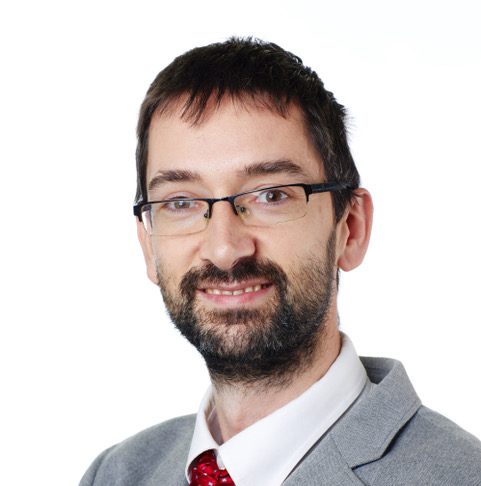
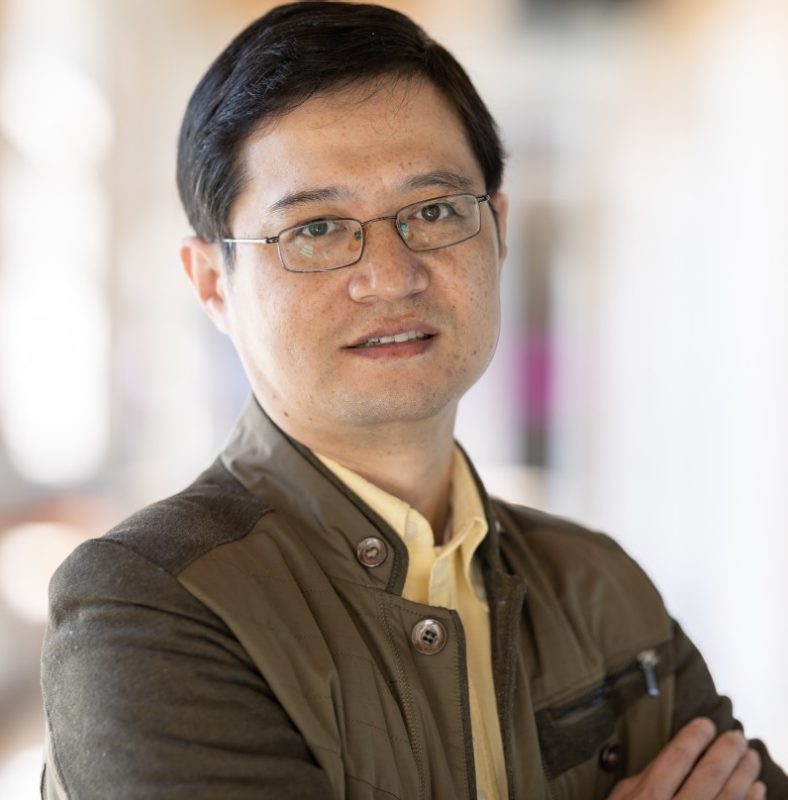
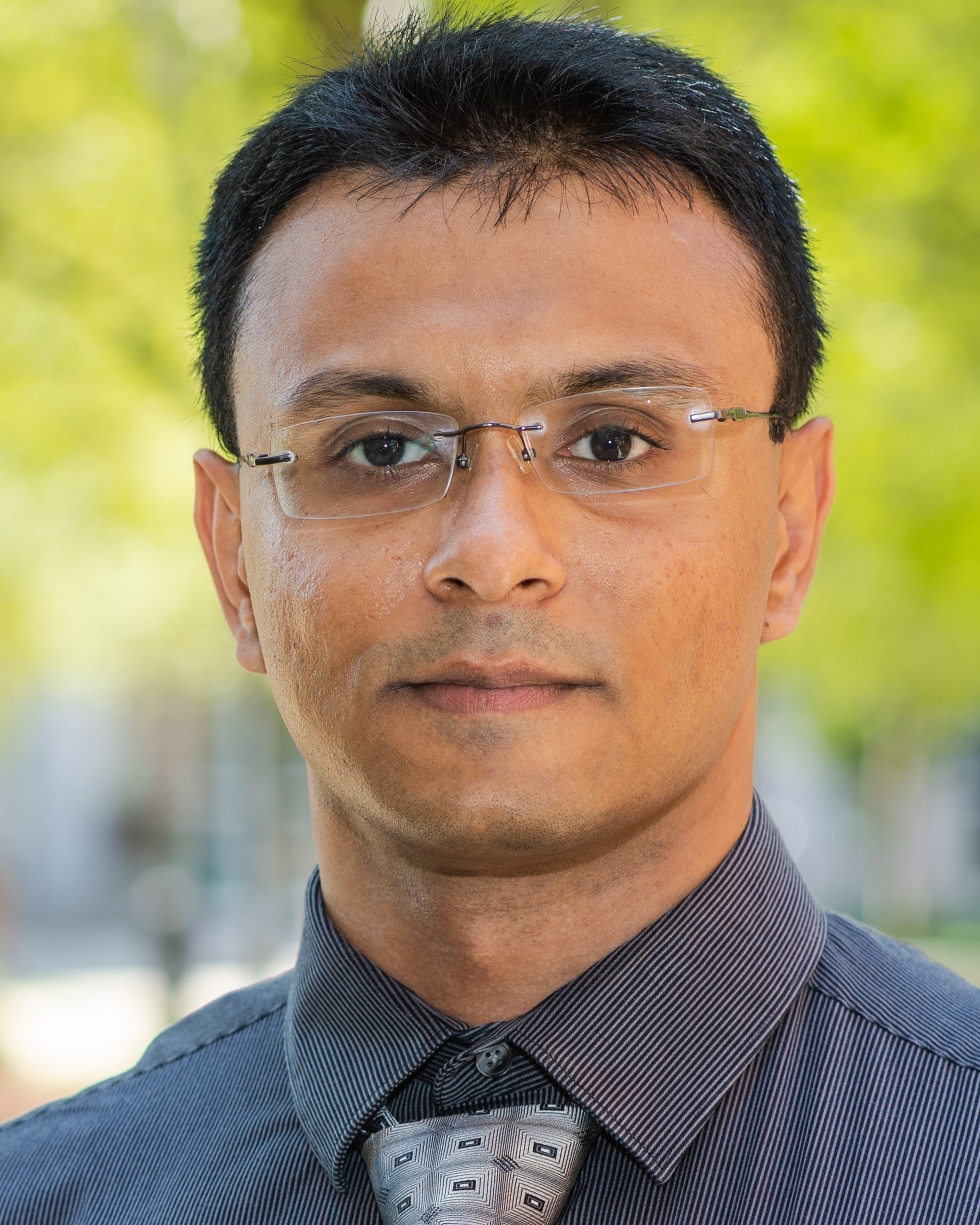
Roberto Tron is an Assistant Professor in the Mechanical Engineering and Systems Engineering departments at the Boston University College of Engineering , with his office located at 110 Cummington Mall. His research integrates control theory, robotics, and computer vision to solve complex multi-agent coordination problems. His primary research interests focus on Riemannian geometry applications , distributed multi-agent systems , and safety-critical control . Key methodologies include Control Barrier Functions (CBFs), Riemannian optimization, and distributed consensus algorithms, with applications spanning autonomous aerial vehicles, robotic manipulation, and multi-robot security systems. Analysis of his recent publications reveals a strong emphasis on safety verification and real-time optimization for autonomous systems. His work consistently bridges theoretical foundations in nonlinear control with practical implementations in robotics, particularly addressing challenges in limited sensor fields of view, distributed task allocation, and noise-robust navigation. The research shows increasing integration of formal methods like Signal Temporal Logic with learning-based approaches. Tron received his Ph.D. from The John Hopkins University and previously conducted post-doctoral research at the GRASP Lab, University of Pennsylvania. His work demonstrates significant contributions to provably safe autonomous systems through frameworks like the Control Barrier Function Toolbox.
Lingjia Liu is a Professor and Bradley Senior Faculty Fellow at Virginia Tech's Bradley Department of Electrical and Computer Engineering. Her research focuses on enabling technologies for 5G/6G networks, including massive MIMO systems, dynamic spectrum access, and AI-driven communication networks. She holds a Ph.D. from Texas A&M University (2008). Research Interests : 5G/6G Network Architectures (3D MIMO, cloud-RAN, ultra-low latency) AI in Communications (Reservoir Computing, federated learning) IoT & Cyber-Physical Systems (energy harvesting, privacy protection) Non-Terrestrial Networks (satellite-based connectivity) Recent work emphasizes generative AI for network simulation, explainable AI in communication systems, and secure dynamic spectrum sharing. Her research spans theoretical foundations (e.g., OTFS modulation analysis) and practical implementations (e.g., FPGA-based reservoir computing). Awards : Bradley Senior Faculty Fellow (Virginia Tech). Her contributions bridge communication theory and AI, addressing 6G challenges through innovative algorithmic and architectural solutions. Current projects explore agentic protocol learning, federated multi-agent RL for spectrum access, and resilient ML under adversarial conditions.
Yonghao Xu is an Assistant Professor at the Department of Electrical Engineering , Linköping University , and affiliated with the Computer Vision Laboratory (CVL) and the Wallenberg Autonomous Systems Program (WASP) . His research bridges remote sensing , machine learning , and AI security . Research Trends Xu's recent publications focus on adversarial attacks and defenses in remote sensing, domain adaptation for semantic segmentation, and benchmark dataset creation (e.g., Sen2Fire). His work addresses challenges in urban sustainability , geospatial data analysis , and deep learning robustness . Labs & Programs He is associated with the Computer Vision Laboratory (CVL) , contributing to autonomous systems through the Wallenberg Autonomous Systems Program (WASP) , a major Swedish initiative in AI and robotics.
Marieke H. Martens is a Full Professor of Automated Driving & Human Interaction at Eindhoven University of Technology (TU/e) and Director of Science at TNO’s Traffic & Transport unit. Her work focuses on human behavior in automated driving systems, addressing challenges like trust, control transitions, and societal acceptance. She holds a PhD in Experimental Psychology from Vrije Universiteit Amsterdam and previously served as a professor at the University of Twente. Education: PhD in Experimental Psychology, Vrije Universiteit Amsterdam (2007) Master’s in Experimental and Cognitive Psychology, Vrije Universiteit Amsterdam Research Interests: Human factors in automated vehicles, human-machine interaction design, road user safety, and the societal implications of smart mobility. Her work bridges psychology, engineering, and design to ensure systems are user-centered and safe. Awards: CHI '20 Best Paper Award (2020) AutomotiveUI '20 Honorable Mention Award (2020) Advising & Grants: Supervises over 10 students, focusing on automated driving’s human aspects. Active in projects like ISA-FIT (Intelligent Speed Assistance) and dynamiC spEed Limits. Collaborates globally with institutions and automotive industries. Labs & Networks: Leads TU/e’s Designing With Intelligence initiative and participates in EU ethics committees for automated mobility. Maintains a global network in academia and industry, fostering interdisciplinary research.
Professor Herbert Ho Ching Iu is a distinguished academic at The University of Western Australia, serving in the School of Engineering within the Department of Electrical, Electronic and Computer Engineering. With an impressive research portfolio of over 500 publications and an h-index of 61, Prof. Iu has established himself as a leading authority in power electronics and nonlinear systems research. Prof. Iu received his BEng(Hons) in Electrical and Electronic Engineering from The University of Hong Kong in 1997, followed by a PhD in Electronic and Information Engineering from The Hong Kong Polytechnic University in 2000. After a brief research fellowship at HKPU, he joined The University of Western Australia in 2002 as a Lecturer and has since risen to the rank of full Professor. His primary research focuses on power electronics , renewable energy systems , nonlinear dynamics and chaos , current sensing techniques , and memristive systems . Prof. Iu's work uniquely bridges theoretical exploration with practical implementations, particularly in energy conversion, secure communications, and neuromorphic computing. His research has significant implications for DC microgrids, advanced encryption techniques, and next-generation computing paradigms. Analysis of Prof. Iu's recent publications reveals a strong interdisciplinary trajectory combining memristive systems with chaotic dynamics for applications in image encryption and secure communications . There's a notable emphasis on machine learning techniques applied to power electronics and energy systems , particularly for DC microgrids and battery management. His work demonstrates consistent progression from fundamental research in nonlinear systems to practical engineering solutions with real-world impact. Prof. Iu's significant contributions have been recognized with several prestigious awards: Vice-Chancellor's Award for HDR Supervision (2024) School of Engineering Award for Research Mentorship (2023) Vice Chancellor's Award in Research Mentorship (2023) With 18 supervised research students and leadership on 16 research grants, Prof. Iu has built a robust research program at the forefront of power systems innovation. His grant portfolio includes major projects like 'Mine Electrification' and 'Microgrid Battery Deployment' through the CRC for Future Battery Industry, as well as collaborations with Western Power on 'Project Symphony.' These initiatives demonstrate his ability to secure substantial funding and translate theoretical concepts into practical engineering solutions for industry. Prof. Iu leads a dynamic research team that specializes in hardware implementation of advanced theoretical concepts, particularly in memristive systems and chaotic circuits. The laboratory maintains strong industry connections, especially with energy and mining sectors, ensuring research has tangible real-world applications. Current work emphasizes DC microgrid technologies, advanced battery systems for electrified transportation, and novel applications of chaotic systems in security contexts, positioning the team at the cutting edge of power electronics research.
Trang Vu is a Lecturer in the Department of Data Science & AI at Monash University's Faculty of Information Technology. Her research focuses on trustworthy NLP methods, cultural-aware machine translation, and efficient ML techniques like active and transfer learning. She holds a PhD in AI and Machine Learning from Monash University, awarded in 2022. Education: Doctoral of Philosophy (AI and Machine Learning) - Monash University (2022) Research Interests: Safe and trustworthy NLP methods for LLM alignment and hallucination mitigation Cultural-aware machine translation systems Efficient NLP techniques including active learning and semi-supervised methods Recent Projects: TMLGenAI (2023-2026): Developing safe and aligned foundation models Knowledge-Intensive Multimodal ASR research (2024) Collaborations: International collaborations in generative AI and multilingual NLP Team leader roles in multiple large-scale AI projects
Francesca Spezzano is an Associate Professor in the Computer Science Department at Boise State University, part of the College of Engineering. She holds a Ph.D. in Computer Science Engineering from the University of Calabria, Italy (2012), with postdoctoral research at the University of California Santa Cruz and the University of Maryland Institute for Advanced Computer Studies. Her research focuses on social network analysis, misinformation detection, information diffusion, and national security, with emphasis on applying machine learning and graph-based methods to combat online deception. Education: Ph.D. in Computer Science Engineering, University of Calabria, Italy (2012) Visiting Scholar, UC Santa Cruz Database Group (2010–2011) Postdoctoral Research Associate, University of Maryland (2013–2015) Research Interests: Misinformation detection and mitigation Social network analysis and mining Graph databases and link prediction National security applications Awards & Grants: NSF CAREER Award (2020) for studying misinformation diffusion Funding from the National Science Foundation, U.S. Army Research Office, and National Security Agency Service & Leadership: General Chair of WSDM 2026, CIKM 2024, and MISDOOM 2022 PC Co-Chair of ASONAM 2019 and FOSINT-SI 2020 Recipient of the Best Paper Award at FOSINT-SI 2018
Aftab Ahmad is a Professor in the Department of Computer Science at the City University of New York (CUNY), specializing in cybersecurity and machine learning applications. He holds a Doctor of Science from George Washington University. His research focuses on developing machine learning algorithms for cyber threat intelligence (CTI) and public health prediction, along with designing secure generative deep learning models resistant to reverse-engineering. Key research areas include: Cybersecurity frameworks and privacy-preserving architectures Generative adversarial networks (GANs) with embedded security features Biomedical signal analysis and human body channel modeling Secure wireless protocols for critical infrastructure His publication trends emphasize: Privacy metrics and data protection mechanisms Smart grid and IoT security Neuroscience-inspired machine learning models Wireless network vulnerability assessments No scientific awards or grants were explicitly mentioned in the provided texts. He teaches advanced courses in computer security and network forensics at undergraduate and graduate levels. No advising relationships or lab affiliations were detailed in the available information.
Dr. Khandaker Mamun Ahmed is an Assistant Professor at The Beacom College of Computer & Cyber Sciences, Dakota State University. He teaches undergraduate and graduate courses in artificial intelligence, algorithms, and data structures. He holds a Ph.D. in Computer Science from Florida International University (2024), an M.Sc. from the same institution (2023), and a B.Sc. in Software Engineering from the University of Dhaka (2016). His research focuses on computer vision, federated learning, cybersecurity, explainable AI, vision-language models, and optimization algorithms. He has contributed to peer-reviewed publications and conference presentations, with notable work in federated learning for IoT, anomaly detection in videos, and AI applications in healthcare and agriculture. Recent articles highlight advancements in federated learning frameworks, AI-driven healthcare systems, and real-time object detection using neural networks. His work also addresses cybersecurity challenges in DevOps pipelines and generative AI for educational datasets. Recipient of the 'Best graduate student in research award' (2022), Dr. Ahmed advises on AI ethics and mentors students through academic-industry collaborations. His research bridges theoretical computer science with practical applications in agriculture, healthcare, and infrastructure monitoring.
Mehdi Sadi is an Assistant Professor of Electrical and Computer Engineering at Auburn University's College of Engineering. He holds a Ph.D. from the University of Florida, an M.S. from the University of California-Riverside, and a B.S. from Bangladesh University of Engineering and Technology. His research focuses on secure and reliable system-on-chip design, AI/ML-driven VLSI CAD/EDA, neuromorphic hardware, and emerging post-CMOS computing technologies. Notable achievements include earning the NSF CAREER Award for chiplet-based design optimization and a $175k NSF grant for magnetic RAM research. His work integrates machine learning with hardware co-design to enhance AI accelerators' performance, energy efficiency, and security. Recent projects include adversarial attack mitigation on AI hardware and reliability analysis of neuromorphic systems. Dr. Sadi's contributions span chiplet architecture, memory systems (e.g., STT-MRAM/SOT-MRAM), and fault-tolerant computing. He actively publishes on topics like skyrmion logic gates and TRNG implementations using MRAM. His work bridges theoretical machine learning advancements with practical hardware implementations, addressing critical challenges in next-generation computing systems.
Hédi Hadiji is an Associate Professor at the Laboratoire des Signaux et Systèmes (L2S) at CentraleSupélec. His research focuses on the mathematics of online decision-making, particularly adaptivity in bandits and online learning. Prior to this role, he was a postdoctoral researcher at the University of Amsterdam under Tim van Erven. He holds a PhD in Mathematics from Université Paris-Saclay, supervised by Gilles Stoltz and Pascal Massart. Education: PhD in Mathematics, Université Paris-Saclay (2020) Masters in Probability and Statistics, Université Paris-Saclay (2017) Part III Mathematical Tripos, University of Cambridge (2016) École Polytechnique (2012–2016) Research Interests: Hédi’s work addresses theoretical foundations of online learning, including bandit algorithms, reinforcement learning, and optimization. He explores adaptive strategies in dynamic environments, with applications to stochastic and adversarial settings. Key themes include minimax optimal algorithms, regret analysis, and the interplay between exploration and exploitation. Recent Publications: His recent work includes minimax optimal algorithms for linear bandits, tracking solutions in time-varying systems, and diversity-preserving strategies in K-armed bandits. These contributions advance theoretical understanding of adaptive decision-making in complex systems. Teaching: He teaches courses on the theoretical principles of deep learning, reinforcement learning, and mathematical foundations at the graduate level. His lectures emphasize rigorous analysis of generalization, optimization, and the neural tangent kernel. Labs & Affiliations: His primary affiliation is with L2S, where he engages in collaborative research groups such as MODESTY, COMEDY, and SYCOMORE. His work intersects signal processing, control systems, and communication networks.
Lydia Manikonda is an Assistant Professor in the Department of Information Systems and Web Science at the Lally School of Management, Rensselaer Polytechnic Institute (RPI). She is also affiliated with the AIRC (Artificial Intelligence Research Center) at RPI. Her research focuses on developing intelligent decision-making models using data from social media, online forums, and news articles to address challenges in business, public health, and technology. Her work has been recognized with awards, including the Best Reviewer Award at ICWSM 2016 and the Outstanding Demonstration Award at ICAPS 2014. Dr. Manikonda holds a PhD in Computer Science from Arizona State University (2019). Her research interests span interpretable machine learning, privacy in AI systems, social media analytics, and the societal impacts of technology. She has published extensively on topics like misinformation detection, ethical AI design, and pandemic-related behavioral shifts. Education: PhD in Computer Science, Arizona State University (2019) Her recent work emphasizes interdisciplinary approaches to tackle real-world problems, such as predicting intimate partner violence using machine learning and analyzing anti-Asian hate discourse on Reddit during the pandemic. She collaborates with interdisciplinary teams to bridge gaps between technical innovation and societal needs. Key Awards: Best Reviewer Award at ICWSM 2016 Outstanding Demonstration Award at ICAPS 2014 Dr. Manikonda's research also explores anthropomorphism in voice assistants, temporal privacy concerns, and the role of emotional cues in medical crowdfunding platforms. She actively participates in academic leadership roles, such as organizing the Web Science 2024 conference. Her lab focuses on actionable domain models and data-driven decision-making, with applications in healthcare, technology ethics, and public policy. She mentors students in these areas and is committed to advancing AI for societal good.
Defang Chen is a Researcher and Postdoctoral Associate in the Department of Computer Science and Engineering at the University at Buffalo, working under the supervision of Siwei Lyu. He is affiliated with the School of Engineering and Applied Sciences and is based at 301A Davis Hall in Buffalo, NY. His research focuses on advanced machine learning techniques, including knowledge distillation, diffusion models, graph neural networks, and domain generalization. Defang's work emphasizes improving model efficiency through distillation methods, exploring generative models like diffusion processes, and enhancing cross-domain adaptability. His contributions span both theoretical advancements and practical applications, such as accelerating diffusion sampling and optimizing neural network architectures. His publications between 2023–2025 highlight trends in model compression, generative AI, and graph-based learning. Notable themes include refining knowledge transfer between models, improving adversarial robustness, and developing scalable sampling techniques. Defang’s research has implications for computer vision, natural language processing, and semantic segmentation. No academic awards or grants are explicitly listed in the provided information. While no formal advisees are noted, his role as a postdoctoral researcher suggests collaborative involvement in academic projects and teams. Defang’s work is accessible via his Google Scholar profile .
Vedhus Hoskere is an Assistant Professor in the Department of Civil and Environmental Engineering at the University of Houston. His research focuses on interdisciplinary areas at the intersection of civil engineering, computer science, and robotics, emphasizing automated infrastructure inspection, machine learning, and AI-driven solutions for structural health monitoring. He holds the Liu Huixian Earthquake Engineering Scholarship (2018) for his work on automated post-earthquake building inspections. Key research areas include image analysis, machine learning, robotics, scientific computing, and visualization. His work integrates computer vision with civil infrastructure challenges, such as flood modeling, structural damage assessment, and autonomous inspection systems using drones and robotics. Notable projects include developing digital twin frameworks for bridges, synthetic environment testing for inspection algorithms, and semi-supervised learning for disaster damage analysis. His recent publications highlight advancements in transformer networks for instance segmentation, physics-informed generative models for damage assessment, and AI-driven hurricane resilience strategies. Hoskere collaborates on platforms like InstaDam for automated damage segmentation and explores Bayesian neural networks for quantifying uncertainties in infrastructure monitoring. Key Awards: Liu Huixian Earthquake Engineering Scholarship (2018) Advising & Labs: While no specific student names or grant details are provided, his research group likely focuses on robotics, computer vision, and AI applications in civil engineering. He contributes to open-source tools like the InstaDam platform and collaborates with institutions like the University of Illinois and USACE.
Yongfeng Zhang is an Associate Professor in the Department of Computer Science at Rutgers University. He is also the Director of the AIOS Foundation . His research focuses on Machine Learning, Data Mining, Recommender Systems, and Explainable AI , with notable contributions to fair and personalized AI, AI for science, and social good. Education and Experience: PhD in CS (2011–2016) from Tsinghua University Postdoc at UMass Amherst (2016–2017) Joined Rutgers as Assistant Professor (2018), promoted to Tenured Associate Professor (2024) Research Interests: Machine Learning, Data Mining, Information Retrieval, Recommender Systems, Natural Language Processing, ML Systems, AI Agents, Explainable AI, Fairness, and AI for Science. Recent Achievements: Received the 2024 ACM SIGIR Test of Time Award, 2024 Presidential Teaching Excellence Award, and multiple NSF grants. He has advised over 15 PhD students and led projects on trustworthy AI, generative recommendation, and causal inference. Awards: 2024 ACM SIGIR Test of Time Award 2021 NSF CAREER Award 2015 Microsoft PhD Fellowship Grants & Labs: Led NSF grants on explainable AI, conversational recommendation, and neural-symbolic AI. Active in the AIOS platform development and multiple research labs.