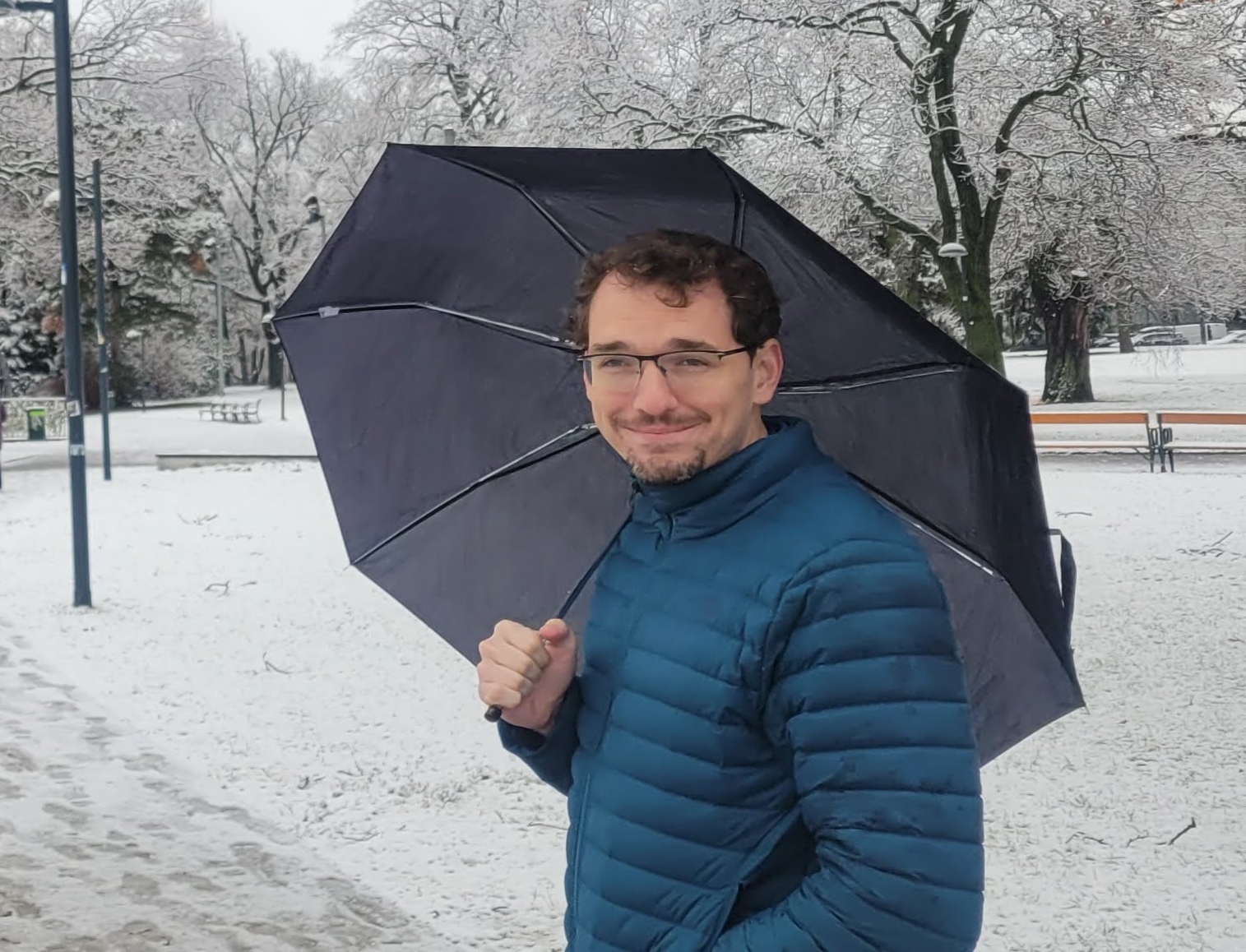
Michael J. Schlosser is a faculty member at the Faculty of Mathematics , University of Vienna. His research focuses on combinatorics, number theory, and special functions, with a particular emphasis on hypergeometric and q-series, elliptic extensions, and rook theory. He has authored numerous publications in collaboration with prominent mathematicians such as Victor Guo, Meesue Yoo, and Christian Krattenthaler. Research Interests : Combinatorics and hypergeometric series Elliptic functions and their applications Partition theory and supercongruences Matrix inversions and determinant evaluations Students : Josef Küstner (Ph.D., 2022) Christian Stump (Ph.D., 2008) Editorial Roles : Associate Editor, Journal of Mathematical Analysis and Applications Editorial Board Member, The Ramanujan Journal Editorial Board Member, Journal of Algebraic Combinatorics
Adam Kleczkowski is a Professor in the Department of Mathematics and Statistics at the University of Strathclyde, where he holds the Global Talent Chair. He is actively involved in research, supervising PhD students, and contributing to public health policy, particularly in epidemiological modeling. University: University of Strathclyde School: Faculty of Science Department: Department of Mathematics and Statistics Position: Professor Email: a.kleczkowski@strath.ac.uk ORCID: 0000-0003-1384-4352 Twitter: @aklecz Education: Doctor of Science in Theoretical Physics, Jagiellonian University (1989) Master of Physics, Jagiellonian University (1984) Adam Kleczkowski's research focuses on mathematical biology, particularly in modeling infectious diseases in human, animal, and plant populations. His work integrates ecological modeling, bioeconomic analysis, and public health, with applications in food security, sustainability in aquaculture, and pollination services. He specializes in parameter estimation for epidemiological systems and develops models to inform disease control strategies. His recent contributions include modeling the spread of COVID-19 in Scottish care homes and analyzing the risks of measles outbreaks due to declining vaccination rates. His recent publications and blog posts reflect a strong trend in combining rigorous mathematical modeling with accessible science communication. He frequently writes for The Conversation and maintains two blogs—'Statistically (in)significant' in English and 'Pandemia 2021' in Polish—covering topics such as tuberculosis, immigration, aging populations, and election data. His scientific work is supported by major funders including NERC, MRC, BBSRC, Scottish Government, and Defra. Scientific Contributions and Outreach: Member, Science Advice and Response Team, Plant Health Centre (Scotland) Expert contributor to Scottish Government on Plant Health business case Contributor to Scottish Government and Public Health Scotland COVID-19 modeling Author of 14 articles in The Conversation (over 1.5 million reads) Regular science blogger and tweeter (@aklecz) He has led or participated in 24 research projects, including international collaborations such as a Memorandum of Understanding with ICRISAT. He has supervised multiple research students and projects, and his work contributes to UN Sustainable Development Goals related to health, food security, and sustainable agriculture. He is also an Honorary Professor at the University of Stirling (2018–2020), reflecting his ongoing academic influence.
Kayll Lake is a Professor in the Department of Physics, Engineering Physics & Astronomy at Queen's University in Kingston, Ontario, Canada. He is affiliated with the Faculty of Astronomy, Astrophysics & Relativity under the Arts & Science school. His contact information includes an email at lakek@queensu.ca and a phone number: 613-533-2720. His academic genealogy traces back to doctoral advisors Werner Israel and John Lighton Synge, with a genealogy PDF available. Education: PhD (University of Toronto) Research Interests: General Relativity Relativistic Astrophysics Computer Algebra Black Hole Physics Gravitational Collapse Recent studies include the propagation of discontinuities in solutions to Einstein’s equations (cosmological structure formation) and the dynamics of gravitational collapse leading to naked singularities. His work emphasizes integrating computational tools with theoretical frameworks to advance understanding of astrophysical processes and cosmology. Publications reflect a focus on applying computer algebra to Einstein’s equations and exploring foundational questions in relativistic astrophysics. He has advised three students: Dr. S. M. M. Rahman in 2018, 2019, and 2020. No grant or award information is explicitly provided. Office: STI 308G, Stirling Hall, 64 Bader Lane, Kingston, ON KL7 3N6.
Orli Herscovici is an Assistant Professor in the Department of Mathematics and Computer Science at St. John’s College of Liberal Arts and Sciences, St. John’s University. Her research focuses on advanced mathematical analysis, combinatorics, and special functions, with notable contributions to fractional calculus, polynomial theory, and combinatorial identities. She has published extensively on topics including Gaussian principal frequencies, deformed fractional transforms, and degenerate polynomials. Her work bridges pure mathematics and applications in probability theory and nonlinear systems. Dr. Herscovici’s academic affiliations include the Mathematics and Computer Science department, where she contributes to teaching and research initiatives. Her publications reflect a deep engagement with interdisciplinary areas such as spectral geometry and umbral calculus. While no specific scientific awards or grants are highlighted in the provided text, her scholarly output demonstrates sustained academic engagement in theoretical and applied mathematics.
Joshua P. Swanson is an RTPC Assistant Professor of Mathematics at the University of Southern California (USC). Previously, he held a Stefan E. Warshawski Visiting Assistant Professorship at the University of California, San Diego (UCSD). He earned his PhD in Mathematics from the University of Washington under advisor Sara Billey, focusing on major index statistics and asymptotics. His research spans algebraic combinatorics with an emphasis on web bases for quantum group representations, plabic graphs, invariant theory, and analytic combinatorics. Education: PhD in Mathematics, University of Washington (2018) Bachelor's degree (implied, details not specified) Research Interests: Algebraic combinatorics, quantum group representations, plabic graphs, Coxeter groups, q-analogues, limit laws, and supercoinvariant algebras. He co-organizes workshops such as ICERM's Topical Workshop on Webs in Algebra, Geometry, Topology, and Combinatorics (2025). Publications: Over 20 peer-reviewed articles in top journals including Algebraic Combinatorics , European Journal of Combinatorics , and Advances in Mathematics . Recent work focuses on web bases, q-Stirling numbers, and harmonic differential forms. Awards: NSF Grant DMS-2348843 ($180,000) AMS-Simons Travel Grant ($5,000) Personal prize from Doron Zeilberger ($300) McKibben & Merner Fellowship ($10,000) Teaching: Taught over 20 courses at USC and UCSD, including Probability Theory (Math 407), Linear Algebra (Math 225), and Combinatorics (Math 184). Active in mentoring undergraduate researchers via USC's SURF program. Professional Engagement: Co-organizes seminars like the USC Combinatorics Seminar and serves on conference committees for FPSAC and CanaDAM. Maintains active collaborations with researchers such as Christian Gaetz, Oliver Pechenik, and Jessica Striker.
Professor Alice A Miller is a faculty member at the University of Glasgow's School of Computing Science, where she has held roles including Postdoc, Daphne Jackson Fellow, Lecturer, and Senior Lecturer since 1997. Prior to this, she worked at the Universities of East Anglia, Western Australia, and Stirling. She currently holds a Leverhulme Research Fellowship and is a Chartered Engineer with the IET. Her membership in the London Mathematical Society reflects her interdisciplinary background. Education: Alice Miller holds a PhD in Number Theory, though her research career has primarily focused on Formal Verification and Model Checking. Her academic trajectory includes leveraging mathematical techniques to analyze systems across engineering and computer science disciplines. Research interests: Her work centers on applying formal verification methods to ensure safety and reliability in complex systems such as autonomous vehicles, robots, and telecommunications. Key techniques include model checking and symmetry reduction. Specific areas include: Modelling and Verification of Concurrent Systems Abstraction and Symmetry Reduction Methods Graph Theory Applications in System Analysis Combinatorics and Group Theory for Optimization Recent publications highlight advancements in overtake planning, sensor network protocols, and probabilistic system analysis. Scientific Awards: Daphne Jackson Fellowship, Leverhulme Research Fellowship, and Chartered Engineer status from the IET. Grants and Advising: Alice has led or co-investigated multiple grants totaling over £3 million, including projects on digital twins, autonomous systems governance (£2.7M), and secure memory management (M4Secure). She has advised on student-led initiatives like UAV demonstrators and overtaking planning simulations, though specific advisee names are not listed in the provided text. Labs/Teams: Collaborates with interdisciplinary teams on projects involving robotics, sensor networks, and formal verification tools such as PRISM and SPIN. Her work frequently intersects with engineering and mathematics groups within the university and industry partners like D-RisQ Ltd.
Eduardo Jesús Sánchez Villaseñor is an Associate Professor in the Department of Mathematics at Universidad Carlos III de Madrid since 2009. He holds a PhD in Theoretical Physics from Universidad Complutense de Madrid (2001). His research focuses on mathematical and theoretical physics, with emphasis on classical and quantum aspects of general relativity, field theory, statistical mechanics, and combinatorics. He has contributed extensively to topics like gravitational theories with boundaries, loop quantum gravity formulations, and geometric approaches to spacetime symmetries. Education: PhD in Theoretical Physics, Universidad Complutense de Madrid (2001) Bachelor's degree in Computer Science with courses in Calculus and Discrete Mathematics (UC3M) Research Interests: His work bridges theoretical physics and mathematics, addressing foundational questions in general relativity (e.g., Palatini formalism, nonmetricity, torsion), quantum gravity (loop quantization, black hole entropy), and combinatorial structures (permutations, recurrence relations). Recent efforts explore edge observables in gauge theories and geometric diffusion phenomena. Publications: His 15 most recent articles (2021–2025) reflect a focus on gravitational theories with boundaries, geometric constraint formulations, and topological field theories. Key themes include equivalence of phase space approaches, self-dual gravity formulations, and Dirac’s algorithm in boundary contexts. Teaching: He teaches courses including Perturbation Methods (Master’s level), Calculus , and Discrete Mathematics at UC3M. His pedagogical materials emphasize applications of advanced mathematical techniques to physics problems. Labs/Teams: Collaborates actively with researchers like F. Barbero, J. Margalef-Bentabol, and V. Varo, focusing on gravitational and mathematical physics projects. His work is supported by institutional research portals at UC3M.
Ilhan Izmirli is an Associate Professor in the Department of Statistics within the Volgenau School of Engineering at George Mason University. He maintains an active research program spanning mathematics education, philosophy of mathematics, history of mathematics, and interdisciplinary applications in music and physics. His institutional roles include Course Coordinator for STAT 250 – Introductory Statistics since 2013 and Department Representative on the Distance Education Committee. His educational background includes: PhD in History of Mathematics from American University PhD in Mathematics from University of South Carolina MS in Mathematics from University of Istanbul BS in Mathematics from Bosphorus University Izmirli's research program demonstrates remarkable interdisciplinary breadth, connecting mathematical concepts across domains. His work in mathematics education emphasizes social constructivist approaches, while his investigations into the philosophy of mathematics draw from Lakatos' quasi-empiricism. The music-mathematics interface appears consistently throughout his publications, exploring topics from dodecaphony to interval vectors and contour classes. His historical analyses of mathematical concepts—from Bernoulli's inequality to cubic equations—reveal deep engagement with the evolution of mathematical thought. Recent work shows increasing focus on the pedagogical implications of historical mathematical developments. His scientific contributions have been recognized through multiple honors: Fulbright Scholarship recipient Multiple comprehensive exams passed with distinction Strayer University Faculty Award of Excellence NSF workshop scholarship Selection to Who's Who Among America's Teachers Izmirli maintains active scholarly service through book and paper reviews for Mathematical Reviews/MathSciNet and various journals. His teaching portfolio spans foundational mathematics courses through advanced graduate seminars, with particular emphasis on statistics education. Professional memberships include the Mathematical Association of America, American Mathematical Society, and American Statistical Association. His current research trajectory shows continued exploration of mathematical structures in music theory alongside historical and philosophical investigations of mathematical concepts.
Sergi Elizalde is a Professor of Mathematics at Dartmouth College, affiliated with the Department of Mathematics within the Arts & Sciences school. He holds the position of Faculty Advisor for the Byrne Scholars Program. Education: B.A., Universitat Politècnica de Catalunya Ph.D., Massachusetts Institute of Technology Research Interests: Elizalde specializes in enumerative and algebraic combinatorics, with a focus on permutations, pattern avoidance, lattice paths, bijections, generating functions, and applications to computational biology and dynamical systems. His work bridges combinatorial theory with interdisciplinary fields like cancer modeling through Markov chain models of chromosomal instability. Teaching & Mentoring: Elizalde has taught courses in graph theory, algebraic combinatorics, and calculus. He currently mentors several Ph.D. students and has advised numerous former students who have completed their doctoral degrees under his supervision. Professional Contributions: He maintains a personal research website and collaborates on projects such as the implementation of Markov chain models for studying tumor evolution. His research has been featured in high-impact journals like Nature and Advances in Applied Mathematics .
Hajime Kaneko is an Associate Professor at the Department of Mathematics, Faculty of Pure and Applied Sciences, University of Tsukuba . His research focuses on Uniform Distribution Theory , Diophantine Approximation , and Transcendental Number Theory , with a particular emphasis on the behavior of number sequences in beta expansions and geometric progressions involving algebraic numbers. Key research topics include Markoff-Lagrange Spectrum , Sturmian Type Numbers , and Digit Exchange Properties in numerical systems. He has actively participated in and organized seminars such as DARF (Diophantine Analysis and Related Fields) and the 2024 Workshop on Number Theory and Ergodic Theory at Kanazawa University. His recent publications highlight collaborations with prominent mathematicians like Shigeki Akiyama , Thomas Stoll , and Wolfgang Steiner . Notably, his work on the Markoff-Lagrange Spectrum (2024) and binary digits of algebraic numbers (2023) has advanced the understanding of digit patterns and their connections to Diophantine equations. He also contributes to the study of rotational beta expansions and irrationality exponents through symbolic dynamics and Padé approximations.
Andy Wilson is an Assistant Professor of Mathematics at Kennesaw State University. Prior to this, he served as a Senior Instructor at Portland State University and held an NSF Postdoctoral Fellowship at the University of Pennsylvania. He earned his PhD in Mathematics from the University of California, San Diego, under the guidance of Jeff Remmel. His research bridges combinatorics and algebra, focusing on symmetric functions, Macdonald polynomials, hyperplane arrangements, Schubert calculus, and permutation statistics. He co-organizes the Discrete Math Seminar at KSU and has taught courses such as Discrete Math, Graph Theory, Linear Algebra, and Modern Algebra. Wilson has published extensively on topics including torus link homology, superspace coinvariant rings, and generalized Tesler matrices. His accolades include an NSF Postdoctoral Fellowship. His work explores structural connections between algebraic objects and combinatorial phenomena.
Ric How serves as an Adjunct Professor in the School of Human Sciences at The University of Western Australia, located at M309, 35 Stirling Highway, Perth, Australia. His contact information includes phone number 08 6488 2671 and email ric.how@uwa.edu.au. Dr. How's research expertise spans several key areas in biological sciences, with particular focus on population genetics and reptile ecology. His work contributes to UN Sustainable Development Goals related to environmental conservation and biodiversity. His research fingerprint reveals significant contributions to understanding population structure (91%), mitochondrial DNA analysis (58%), genetic divergence (58%), microsatellite applications (52%), and genetic variability (50%). Key species of interest in his research include Dasyurus (47%) and reptile assemblages in Australian ecosystems. Analysis of Dr. How's recent publications reveals a consistent focus on how environmental factors, particularly climate change, impact wildlife populations. His research combines genetic analysis with ecological observation to understand population dynamics across different Australian landscapes, from urban environments to remote island archipelagos. A notable trend is his investigation of how historical climate events like Pleistocene glaciations have shaped current species distributions and genetic structures. Dr. How has supervised research work, with evidence of collaboration with individuals who may be students or junior researchers, such as J.R. How who appears as a co-author on a 2022 publication. His research has generated datasets that have been deposited in repositories like DRYAD, indicating commitment to open science practices. His laboratory or research group appears to focus on wildlife population studies, with particular attention to reptiles and marsupials in Western Australia. The research often involves field studies combined with genetic analysis to understand population structures and responses to environmental changes.
Koutras Markos is a Professor at the Department of Statistics and Insurance Science, School of Finance and Statistics, University of Piraeus. With a career spanning over three decades, he has held academic positions at the University of Athens and visiting roles at the University of Manitoba and Queen Mary College, London. His work focuses on reliability theory, scan statistics, multivariate analysis, and quality control. Education : PhD in Probability and Statistics (University of Athens, 1983), MSc in Informatics and Operations Research (University of Athens, 1981), BSc in Mathematics (University of Athens, 1979). Research Interests include: Theory of Reliability (e.g., consecutive-k systems, failure rate analysis) Scan Statistics and Run Lengths Multivariate Analysis Combinatorial Distributions Quality Control via Control Charts and Runs Rules Recent Publications highlight applications in reliability engineering, statistical process control, and combinatorial probability, with keywords spanning Probability, Statistics, and Operations Research. Academic Service includes editorial roles in 8 international journals and referee work for over 30 journals. He has supervised 6 completed PhD theses and 1 ongoing.
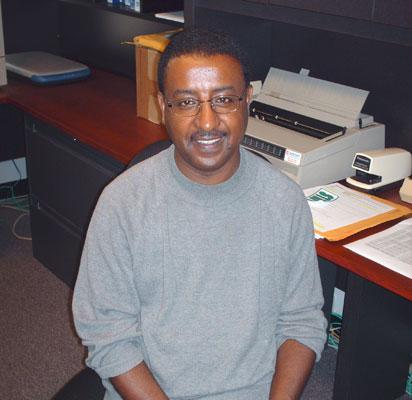
Tewodros Amdeberhan is a Senior Professor of Practice in the Department of Mathematics at Tulane University's School of Science & Engineering. He also holds positions as a Permanent Member of DIMACS/Rutgers University since 2001 and has served as a Visiting Professor at Massachusetts Institute of Technology since 2007 and at Princeton University in 2005. Dr. Amdeberhan earned his Ph.D. in Mathematics from Temple University in Philadelphia in 1997. Prior to this, he completed both his M.S. and B.S. at Addis Ababa University in Ethiopia, with Mathematics as his major and Physics as his minor. Dr. Amdeberhan's research spans multiple areas of pure and applied mathematics. His primary interests include Combinatorics , where he investigates lattice paths, posets, and combinatorial identities; Number Theory , with focus on p-adic valuations, Fibonacci polynomials, and arithmetical properties; and Special Functions , where he has made significant contributions to understanding Ramanujan's master theorem and various integral formulas. His work in Computer Algebra and Algorithmic Proof Theory demonstrates his expertise in developing computational methods for mathematical proofs, while his research in Partial Differential Equations and Harmonic Analysis shows his breadth across mathematical disciplines. Dr. Amdeberhan has been an active participant in the mathematical community, regularly presenting at major conferences including the International Conference on Enumerative Combinatorics and Applications (2025), Algebra and Number Theory Seminars at various universities, and workshops at institutions like Banff International Research Station and MSRI. His research has resulted in numerous publications covering topics from multi-cores and lattice paths to p-adic valuations of special number sequences. As a Permanent Member of DIMACS since 2001, Dr. Amdeberhan has been involved in collaborative research initiatives that bridge theoretical mathematics with practical applications. His work with the Experimental Mathematics group, particularly building on techniques developed by his advisor Doron Zeilberger, has contributed to the advancement of algorithmic proof methods.
David Galvin is Professor and Chair of the Mathematics Department at the University of Notre Dame. His research focuses on combinatorial problems in discrete mathematics, graph theory, and discrete probability, with particular emphasis on phase transitions in statistical physics models and asymptotic behavior of combinatorial sequences. Galvin earned his DPhil from Rutgers University in 2002 under Jeff Kahn and has held positions at Microsoft Research, IAS Princeton, and UPenn. His work develops connections between combinatorics and statistical mechanics, examining phenomena like phase coexistence in lattice models and long-range correlations in random structures. Recent projects investigate unimodality of independent set sequences, combinatorial matrix theory, and hypergraph polynomials. Galvin has received multiple fellowships including the Simons Foundation Collaboration Grant and teaching awards such as the Rev. Edmund P. Joyce Award and Shilts/Leonard Teaching Award. He actively mentors graduate and undergraduate researchers, organizes combinatorial workshops, and serves on editorial boards. His research demonstrates sustained engagement with foundational problems in extremal combinatorics, probabilistic methods, and the interplay between discrete mathematics and physics.