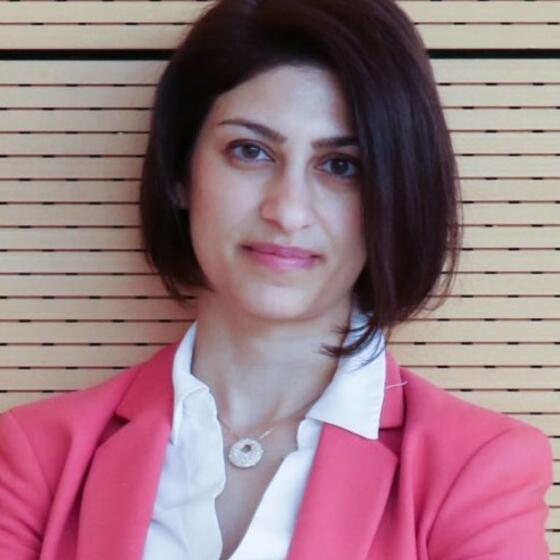
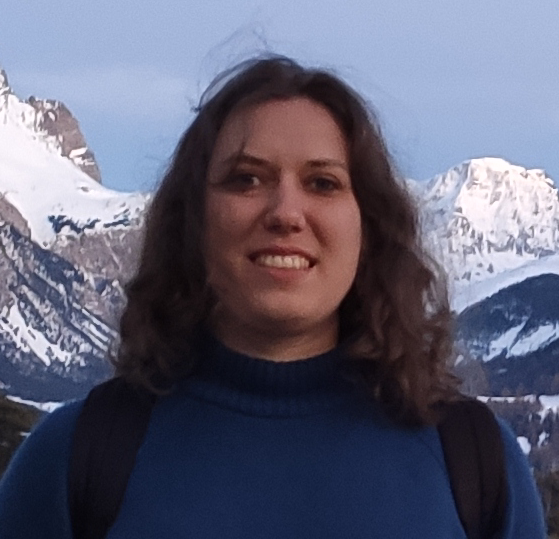
Martha Constantinou is an Associate Professor of Physics at Temple University, specializing in Theoretical/Computational Nuclear Physics with a focus on Lattice Quantum Chromodynamics (QCD). Her research addresses fundamental questions in hadron structure, including nucleon spin content and proton radius puzzles, leveraging supercomputing resources. She leads a group conducting advanced numerical simulations at major computational facilities. Constantinou holds a Ph.D. in Theoretical Computational Physics (University of Cyprus, 2008) and a BS in Physics (University of Cyprus, 2003). Her work aligns with the upcoming Electron-Ion Collider (EIC) at Brookhaven National Lab, aiming to explore nucleon structure and dark matter connections. Key research areas include generalized parton distributions (GPDs), axial form factors, and high-performance computing applications. Notable awards include the US Department of Energy Early Career Award (2019) and the Selma Lee Bloch Brown Professorship (2020). Her publications (15 most recent listed) emphasize Lattice QCD advancements, with contributions to GPDs, quark-gluon momentum partitioning, and EIC theory. She actively promotes STEM outreach and public engagement through collaborative initiatives.
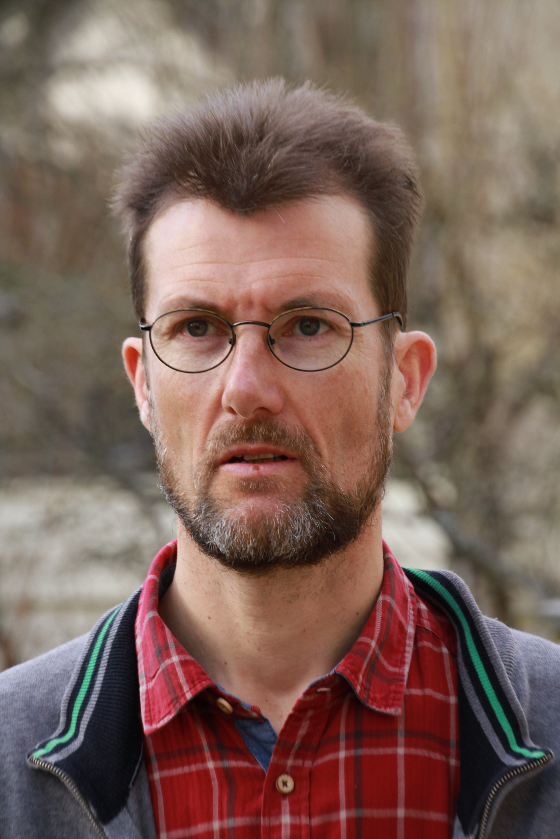
Gary Goldstein is a Professor of Physics & Astronomy at Tufts University's School of Arts and Sciences. His research focuses on theoretical high-energy and nuclear physics, including quantum chromodynamics (QCD), spin dynamics, and the Standard Model. He also explores science policy, nuclear non-proliferation, and science education. Goldstein has held faculty roles at Tufts since 1970, progressing from Assistant to Associate and full Professor. Education: PhD (1969), SM (1964), and SB (1962) in Physics from the University of Chicago. Research interests span particle interactions at medium/high energies, gluon spin distributions, and applications of quantum computing in physics. He has published extensively on topics like generalized parton distributions (GPDs), light-front quantization, and experimental analyses using colliders like the LHC and JLab. Goldstein has secured grants from the U.S. Department of Energy and NSF for quantum simulation and science education initiatives. Teaching includes advanced courses in quantum theory, electromagnetism, and thesis supervision. He actively participates in science policy events, advocating for nuclear disarmament and peace through initiatives like MIT's 'Reducing the Threat of Nuclear War' conferences. His work bridges theoretical physics innovations with societal impact.
Haiyan Gao is the Henry W. Newson Distinguished Professor of Physics at Duke University's Trinity College of Arts & Sciences , with a focus on quantum chromodynamics (QCD), nucleon structure, and fundamental symmetry studies. She has held these positions since 2008 and 2012 respectively, conducting experiments at Jefferson Lab and Duke's Triangle Universities Nuclear Laboratory (TUNL). Current Appointments: Henry W. Newson Distinguished Professor of Physics (2012–Present), Professor of Physics (2008–Present) Education: Ph.D. in Physics (1994) from Caltech, B.S. in Physics (1988) from Tsinghua University Her research interests span the structure of nucleons in terms of quarks and gluons, the search for QCD exotics, and fundamental symmetry studies to explore physics beyond the Standard Model. Recent work includes precision measurements of proton and deuteron properties, spin-density matrix elements , and the development of advanced detectors like the Solenoidal Large Intensity Device (SoLID) for 12 GeV CEBAF upgrades. She investigates the proton charge radius puzzle through electron scattering experiments and studies axion-like particles via photoproduction. Analysis of her 15 most recent publications (2023–2025) reveals a focus on J/ψ meson photoproduction , spin structure functions , and QCD-based nucleon imaging . These works employ facilities like GlueX and Jefferson Lab to probe fundamental symmetries , gluonic gravitational form factors , and low-energy QCD dynamics , often through precision cross-section measurements and Monte-Carlo simulations . Her grants include leadership of Duke's Medium Energy Physics Program (2002–2025), the Natalia Escobar Fellowship (2021–2022), and Jefferson Lab Graduate Fellowships (2021–2022). Her laboratory work involves the GlueX experiment at Jefferson Lab's Hall D and Duke's High Intensity γ-ray Source (HIγS) facility.
Prof. Dr. Andreas Schäfer serves as a Professor at the Institute of Theoretical Physics within the Faculty of Physics at the University of Regensburg, Germany. His office is located in room PHY 4.1.23 with contact details including direct phone (+49 941 943-2087) and secretary Monika Maschek (+49 941 943-2008). His research spans three interconnected domains: Lattice Gauge Theory for QCD : Leading calculations of hadronic properties through Parton Distribution Functions (PDFs), Generalized PDFs (GPDs), Transverse Momentum Dependent PDFs (TMDs), Distribution Amplitudes (DAs), and Double Parton Distributions (DPDs) using advanced methods like Large Momentum Effective Theory (LaMET) as part of the international Lattice Parton Collaboration Quantum Information Science (QIS) : Investigating fundamental dualities between Quantum Field Theory, Quantum Gravity, String Theory, Thermodynamics, and Quantum Computing to reformulate physics problems in computationally optimal frameworks AI in Medicine : Collaborating with Prof. Michael Altenbuchinger at Göttingen University to apply artificial intelligence techniques to clinical data for advancing personalized medicine and treatment optimization Prof. Schäfer maintains active international research partnerships including the Lattice Parton Collaboration and large-scale QIS initiatives, though no specific grants or student supervision details are documented in the source material.
Peter Schweitzer is a Professor and Associate Department Head for Undergraduate Affairs in the Department of Physics at the University of Connecticut. His research focuses on theoretical particle physics, particularly the structure of hadrons and QCD dynamics. He holds a Ph.D. (2001) and Habilitation (2009) from Ruhr-University Bochum, Germany, and has held postdoctoral positions at Ruhr-University (2003-2008) and Universita degli Studi di Pavia, Italy (2001-2003). His research explores quark-gluon structure in high-energy processes, chiral symmetry breaking, and energy-momentum tensor properties of hadrons. Key topics include TMDs, GPDs, proton mechanical structure, and applications to Electron-Ion Collider (EIC) physics. He collaborates on EIC theory initiatives and studies gravitational form factors, hadronic pressure, and exotic heavy-quark systems. Recent work emphasizes form factors of the energy-momentum tensor, D-term analysis, and proton internal forces. His articles span 20+ years of contributions to QCD phenomenology, with 2023-2025 publications addressing EIC precision studies, classical models, and gravitational interactions of hadrons. Schweitzer is a member of the American Physical Society and contributes to international physics schools and detector concepts for next-generation colliders.
Michael Paolone is Assistant Professor of Physics at New Mexico State University, specializing in experimental medium-energy nuclear physics. His research at Jefferson Lab investigates nucleon structure using particle detectors like CLAS12, focusing on gluon distributions and neutron properties. Research explores fundamental questions in quantum chromodynamics through measurements of generalized parton distributions, nucleon resonances, and polarization observables. Work includes developing Cherenkov detectors for particle identification in high-energy experiments. Recent publications concentrate on precision measurements of spin structure, deeply virtual Compton scattering, and resonance electroproduction. Trends show strong emphasis on multidimensional hadronic structure studies using polarized beams and targets. Instrumentation contributions include optimizations for the Solenoidal Large Intensity Device (SoLID), enhancing detection capabilities for next-generation experiments.
Andreas Metz is a Professor of Physics at Temple University, specializing in Theoretical Nuclear and Hadronic Physics. His research focuses on the quark and gluon structure of strongly interacting particles like protons, with an emphasis on QCD factorization, lattice-QCD calculations, and Monte Carlo-based data analysis. He has contributed significantly to understanding parton correlation functions, power corrections, and the proton's mass decomposition. Education: Ph.D. in Physics, University of Mainz (1997) Research Interests: Multi-dimensional quark/gluon structure of hadrons QCD factorization and non-perturbative effects Lattice QCD applications Proton spin and mass decomposition Parton fragmentation functions Publication Trends: His work emphasizes Generalized Parton Distributions (GPDs), lattice-QCD studies of proton structure, and theoretical support for upcoming Electron-Ion Collider (EIC) experiments. Recent studies explore axial-vector GPDs, twist-3 effects, and proton tomography via lattice methods. Awards: 2023 APS Fellow (Topical Group on Hadronic Physics) Advising & Grants: While no advisees are listed, his research aligns with major initiatives like the EIC Theory Alliance and Jefferson Lab projects. Collaborative efforts focus on interpreting experimental data from high-energy facilities. Labs/Teams: Involved in LHCSpin project and EIC-related theoretical collaborations, though specific lab affiliations are not explicitly stated.
Julie Roche is a Professor in the Department of Physics and Astronomy at Ohio University, within the College of Arts and Sciences. She serves as Director of the Institute of Nuclear and Particle Physics (INPP) and as Undergraduate Chair for the department. Her research is centered on experimental nuclear and particle physics, particularly the internal structure of protons and neutrons governed by the Strong force. She conducts experiments at major national facilities such as Jefferson Lab (JLab) and MAMI in Germany, with future involvement at the Electron-Ion Collider. Her research interests include the 3D tomographic imaging of nucleons via Deeply Virtual Compton Scattering (DVCS) and exclusive meson production. She is the spokesperson for three JLab experiments with scientific grading A. Her work aims to test models of the Strong force and explore physics beyond the Standard Model through precision measurements. Supported continuously by the National Science Foundation since 2007, her research has led to over 77 peer-reviewed publications and nearly 4,000 citations. The trends in her recent publications highlight a strong focus on generalized parton distributions (GPDs), high Q² and high Bjorken-x physics, DVCS, and exclusive reactions. These studies are instrumental in mapping quark and gluon dynamics inside the proton, with implications for quantum chromodynamics (QCD) and nucleon structure. Her work bridges experimental data with theoretical models to advance understanding of hadronic matter. Scientific Service and Leadership: Chair, DNP Education Committee, APS (2024–Present) Co-convenor, Working Group 5: Spin and 3D Structure, DIS2024 Conference Chair, JLab Users Organization (2018–2019) Chair, Photonuclear Reactions Gordon Conference (2018) Member, Executive Committee, APS Division of Nuclear Physics (2019–2021) Chair, Hall A/JLab Coordinating Committee (2013–2014) Chair, Jefferson Lab/Hall C Steering Committee (2008) Julie Roche is actively involved in mentoring and advising. She serves as academic advisor to approximately ten undergraduate physics students annually and has been a faculty advisor for the Women in Physics and Astronomy (WIPHA) group. She has received teaching buy-outs and sabbatical support from JLab and JSA, reflecting her research productivity. She teaches a range of courses, including advanced undergraduate laboratories and graduate-level nuclear physics, and is passionate about physics education and equity in STEM. She leads the Nucleon Electro-Weak Structure research group at Ohio University, which includes graduate and undergraduate researchers. Her lab collaborates extensively with JLab and international partners, contributing to major collaborations such as the Hall A Collaboration. Her group’s work is supported by multiple NSF grants, including awards #2209199, #1913170, #1614479, and others dating back to 2007.
Marie Boer is an Assistant Professor of Physics at Virginia Tech, affiliated with the College of Science and Department of Physics. Her research focuses on experimental hadronic physics, particularly studying the nucleon's quark-gluon structure through Generalized Parton Distributions (GPDs) using Jefferson Lab experiments. She leads the PaSHa group (PArtonic Structure of the Hadrons) and collaborates internationally on projects including the Electron Ion Collider (EIC). Affiliations : Virginia Tech, Jefferson Lab, EIC User Group Education : PhD in Nuclear Physics (2014, Université Paris Sud), Postdocs at CERN, LANL, and U.S. universities Research Interests : Tomographic imaging of nucleons via hard exclusive reactions like DVCS and TCS, development of event generators (DEEPGen/DEEPSim), and AI/ML applications in GPD extraction. Key facilities include JLab's 11 GeV electron beam and future EIC. Grants : DOE Early Career Award (2024-2029), EXCLAIM Collaboration (AI/ML funding), 4VA grants. Labs/Teams : Boer Research Group at Virginia Tech, JLab Hall A/C collaborations, EIC ePIC group. Active in detector R&D (e.g., muon detectors) and software development.
Samuel Wallon is Professor at University of Paris-Saclay and Associate Scientific Director of the Department of Theoretical Physics at IJCLab (Laboratoire de Physique des 2 Infinis Irène Joliot-Curie). His academic career focuses on theoretical particle physics with emphasis on Quantum Chromodynamics and high energy phenomena. Dr. Wallon's research spans several key areas in theoretical physics: Unitarization and saturation in high-energy QCD Exclusive processes for testing QCD models Three-dimensional structure of nucleons through GPDs and related distributions Factorization of hard processes with power corrections Non-perturbative methods including AdS/CFT correspondence His work bridges theoretical developments with experimental applications at major facilities worldwide. Analysis of his recent publications reveals a strong focus on Generalized Parton Distributions, exclusive photoproduction processes, and high-energy QCD phenomena. His research demonstrates increasing sophistication in NLO calculations, particularly in shockwave approaches to gluon saturation. Wallon's work provides crucial theoretical frameworks for interpreting data from HERA, LHC, and future Electron-Ion Colliders. As an educator, Wallon teaches across multiple levels: Undergraduate: "Outils et Méthodes pour la Physique" Master's: "Electrodynamique Classique et Quantique" and "Particles and Symmetries" Doctoral: Advanced courses on QCD, gauge theories, and exclusive processes He has been instrumental in organizing international summer schools on QCD. Dr. Wallon leads the Department of Theoretical Physics at IJCLab, collaborating with researchers worldwide. His laboratory focuses on advancing theoretical frameworks for high-energy physics experiments and training the next generation of theoretical physicists.
Chao Peng is an experimental physicist in the Physics Division at Argonne National Laboratory, where he serves as an Assistant Physicist since 2021, following a postdoctoral appointment from 2019 to 2021. His research is centered on probing the internal structure of nucleons and their emergent properties within the framework of Quantum Chromodynamics (QCD), with a focus on spin, mass, size, and polarizabilities. He is actively involved in major electron scattering experiments at Jefferson Lab, including PRad-II, X17, and SoLID, and is preparing for future research using the ePIC detector at the Electron-Ion Collider (EIC). Education: Ph.D. in Experimental Nuclear Physics, Duke University, 2018 B.E. in Engineering Physics, Tsinghua University, China, 2009 Chao Peng’s research interests lie at the intersection of nuclear physics, particle physics, and advanced instrumentation. He specializes in understanding how quark and gluon distributions change when nucleons are embedded in light nuclei such as Deuterium, Helium-3, and Lithium-6. His work combines precision electron scattering with cutting-edge detector development, particularly in calorimetry, Cherenkov detectors, and polarized lithium sources. He leads an Argonne LDRD project focused on polarized 6 Li and 7 Li sources, highlighting his leadership in experimental innovation. The 15 most recent publications reflect a strong emphasis on nucleon structure, precision measurements, and detector R&D. Key themes include the proton radius puzzle, spin structure functions (g₂, d₂), searches for new bosons (X17), and instrumentation for the EIC. The articles span subfields such as transverse momentum dependent parton distributions (TMDs), generalized parton distributions (GPDs), dark photon searches, and Monte Carlo simulation frameworks, indicating a broad and impactful research portfolio. Scientific Awards: Argonne Impact Award (2023): Development of a Novel Imaging Calorimeter for EIC Argonne Impact Award (2023): Experimental Determination of the Proton Mass Density JSA Graduate Fellowship (2014–2015): Hardware Preparation of the PRad Experiment JSA 2014 Poster Competition – 1st Place JSA Graduate Fellowship (2013–2014): Simulation/Analysis Development for the PRad Experiment Nuclear Power Award, Tsinghua University (2008) Chao Peng has played a significant role in advising and leading research projects, serving as Lead PI on an Argonne LDRD project and as Co-spokesperson for multiple high-profile experiments (SoLID-SIDIS, Neutron g₂/d₂, PRad-II, X17). While no formal students are listed, his leadership in collaborative teams suggests mentorship roles within large experimental groups. He has secured competitive fellowships and internal funding, demonstrating strong grant acquisition capabilities. His work is supported by national user facilities such as Jefferson Lab and Argonne’s own advanced research infrastructure. Labs and Teams: He is deeply integrated into major experimental collaborations including the SoLID, PRad, and future ePIC collaborations. His work leverages national user facilities such as the Jefferson Lab Continuous Electron Beam Accelerator Facility (CEBAF) and is aligned with the scientific goals of the Electron-Ion Collider. At Argonne, he contributes to the Physics Division's mission in discovery science and detector innovation, working within multidisciplinary teams focused on advancing the frontiers of nuclear and particle physics.
Caroline Kathrin Riedl is a Research Professor at the University of Illinois Urbana-Champaign's Department of Physics (Grainger College of Engineering). She holds a PhD in particle physics from the University of Erlangen-Nuremberg (2005) and has held postdoctoral roles at DESY and INFN Frascati. Her research focuses on nucleon/nucleus structure using transverse-momentum-dependent (TMD) and generalized parton distributions (GPDs), with key contributions to the COMPASS and sPHENIX experiments. She led instrumentation projects including the COMPASS drift chamber and sPHENIX electromagnetic calorimeter absorbers. Riedl has been awarded Frontera supercomputer allocations for analyzing CERN data and preparing for the Electron-Ion Collider (EIC). She also collaborates on diffractive deep-inelastic scattering studies at the future ePIC detector. Education: Bachelor's Degree in Physics, University of Erlangen-Nuremberg, 2001 Doctorate in Particle Physics, University of Erlangen-Nuremberg, 2005 Research Highlights: Analyzes TMDs via Drell-Yan and SIDIS processes at CERN's COMPASS Leads sPHENIX studies on transversely polarized proton collisions Develops detector hardware for nuclear physics experiments Prepares simulations for the future Electron-Ion Collider (EIC) Affiliations: Principal Investigator for Frontera supercomputing allocations (2020-) Member of CMS Collaboration (LHC) and COMPASS Collaboration (CERN) Future Work: Focuses on ePIC experiment preparations and TMD studies at the EIC, aiming to elucidate nucleon structure and gluon dynamics.
Prof. Krešimir Kumerički is a full professor at the University of Zagreb's Faculty of Science, specializing in theoretical physics with a focus on Quantum Chromodynamics (QCD) and physics beyond the Standard Model. He leads research in hadron structure, generalized parton distributions (GPDs), and applications of machine learning in particle physics. His work is central to the Electron-Ion Collider (EIC) project, exploring proton structure and quark-gluon dynamics. He has coordinated major projects like STRONG-H2020 (EU Horizon 2020), managing GPD-related physics, and MIAU (HRZZ-funded). His research spans DVCS experiments, neutrino models, and collider studies. Notable contributions include NLO calculations for DVCS and neural network-based GPD parametrizations. Education: Advanced degrees in theoretical physics (not detailed in text). Teaching: Leads courses on elementary particle physics, beyond Standard Model physics, and physical cosmology. Research trends emphasize precision QCD studies at the EIC and high-precision DVCS fitting. His collaborative projects address EIC detector concepts and global analyses of parton distributions. Academic leadership includes roles in HadronPhysics3 (FP7-EU). No formal awards listed, but recognized for project leadership and contributions to theoretical physics. Advising and grants details not explicitly provided, though his roles imply significant mentorship. His lab affiliation is the Institute for Theoretical Physics of Particles and Fields, active in international collaborations like DFG and HRZZ initiatives.
Martin Anna is an Associate Professor at the Department of Physics , University of Trieste. She is a member of the COMPASS experiment at CERN, focusing on experimental studies of fundamental interactions and non-perturbative quantum chromodynamics (QCD). Affiliation: Department of Physics, University of Trieste Research Group: COMPASS at CERN Research Interests : Her work centers on Experimental Physics of fundamental interactions, including nucleon spin structure, hadron spectroscopy, and generalized parton distributions (GPDs). Key objectives include testing QCD predictions via Drell-Yan processes and deeply virtual Compton scattering. Activities : She contributes to detector development, data processing/analysis, phenomenological interpretations, and international collaboration management. She has participated in CERN's SPS muon beam experiments and liquid hydrogen target studies. Grants: INFN, UE (STRONG-2020), UniTS (FRA2012, FRA2015, FRA2018), MIUR (PRIN2008) Committee Involvement : Member of the Department's Board, Boards of Studies, and Doctoral Studies Boards for Physics cycles XXIX-XXXVIII and XXXIX.
Prof. Marc Kirch is a Professor of Technomathematics at Berlin University of Technology, affiliated with the Faculty of Mathematics, Physics, and Chemistry. He holds leadership roles including Academic Senate member (since 2025), former Dean of Faculty II (2018–2020), and Vice Dean (2020–2021). His expertise spans applied mathematics, theoretical physics, and optical engineering. Education: PhD in Physics (2006), Ruhr University Bochum – Dissertation: 'From QCD Evolution to Noncompact Spin Chains' Diploma in Physics (2002), Ruhr University Bochum – Thesis: 'Baryonic Form Factors at Large Virtuality' Research Interests: Focuses on mathematical modeling, complex systems, and optical design for semiconductor microlithography. His work integrates stochastic optimization, Monte Carlo methods, and nonlinear dynamics, with applications in EUV illumination optics and quantum physics. Publications: Over 10 patents (2007–2013) in optical engineering for EUV lithography, alongside foundational physics papers on QCD evolution and parton distributions. His recent work emphasizes advanced illumination systems and facet element design. Awards: No explicit awards mentioned, but significant industry-academic collaboration via patents with Carl Zeiss SMT AG. Grants & Advising: No explicit grants listed. Advised students are not documented here, but teaches courses in mathematics, optimization, and engineering at bachelor's and master's levels.