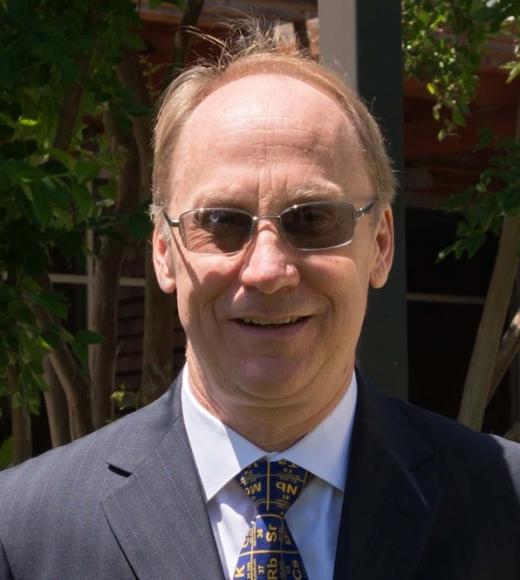
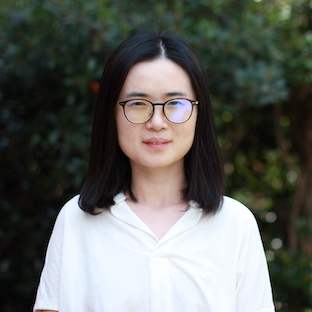
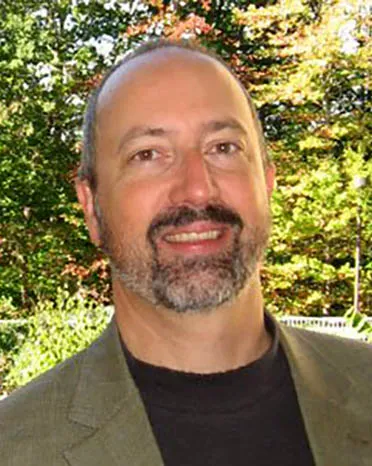
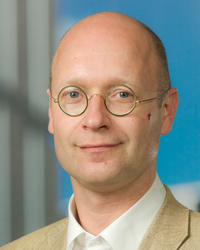
James B Ames is a Professor and Faculty Director of the NMR Facility at the University of California, Davis. His research focuses on using NMR and biophysical techniques to study neuronal calcium sensor proteins involved in signal transduction, particularly in vision processes like phototransduction. Key proteins under investigation include recoverin, GCAPs, DREAM, and CaBPs. He has held academic positions since 1998, including appointments at the University of Maryland Biotechnology Institute and UC Davis, and has received awards such as the AAAS Fellowship (2016) and Beckman Young Investigator Award (2000). Education: Ph.D. in Chemistry, University of California, Berkeley (1992) B.S. in Chemistry, University of Michigan (1986) Postdoctoral Fellow at Stanford University (1993-1997) Research Interests: Ames' work integrates molecular biology, biophysics, and structural biology to understand how calcium-binding proteins regulate cellular signaling. His lab uses NMR spectroscopy to elucidate atomic-level structural changes in proteins like GCAP1 and recoverin, linking these changes to their roles in diseases such as cone dystrophy and pain modulation. Recent studies explore the dynamics of voltage-gated ion channels and the thermodynamics of signal transduction. Awards: Fellow of the American Association for the Advancement of Science (2016) Beckman Young Investigator Award (2000) Grants & Advising: No explicit grant details or student advisees listed, but his publications include collaborations with postdoctoral fellows and graduate students. His work is supported by NIH and NSF grants implied through publication affiliations. Labs & Teams: Ames directs the NMR Facility at UC Davis, housing advanced spectroscopic equipment for structural biology research. His lab collaborates with neuroscientists and biophysicists to bridge molecular mechanisms and physiological outcomes.
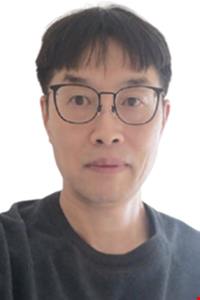
Qin Lu is an Assistant Professor at the University of Georgia's School of Electrical & Computer Engineering. Her research focuses on robust and adaptive Bayesian methods for decision-making using sequential/networked data, including online Gaussian processes, Bayesian optimization, reinforcement learning, and spatio-temporal inference over graphs. Applications span autonomous systems and mobile edge computing. Education details are not explicitly listed in the provided text. Her work emphasizes scalability and uncertainty quantification, with contributions to edge computing resource management, active learning strategies, and multi-agent systems in IoT. Recent publications highlight advancements in Gaussian process dynamical modeling, adaptive Bayesian optimization, and ensemble learning techniques for online systems. No scientific awards are mentioned in the provided materials. Advising and grants details are not provided, though her research indicates collaborations in autonomous systems, underwater acoustics, and sensor networks. She is affiliated with the Boyd GSRC building and reachable at Qin.Lu@uga.edu.
Pau Batlle Franch is a Research Fellow in the Computing and Mathematical Sciences Department at California Institute of Technology (Caltech), working with Professor Houman Owhadi. He holds a PhD from Caltech (June 2025) and was a research affiliate at NASA Jet Propulsion Laboratory (JPL). His research focuses on the intersection of statistics and applied mathematics, including frequentist confidence intervals in inverse problems, game-theoretical uncertainty quantification, and Gaussian processes. He has applied his work to domains like remote sensing, biology, earthquake prediction, and telecommunications engineering. Education : PhD in Computing and Mathematical Sciences (Caltech, 2025); Double undergraduate degree in Mathematics and Engineering Physics from Universitat Politècnica de Catalunya (CFIS program); Research visitor at NYU's Center for Data Science. His research interests include optimization-based statistical methods, Gaussian process frameworks for scientific computing, and uncertainty quantification in physical systems. Notable contributions include resolving the Burrus conjecture and developing computational hypergraph discovery techniques applied to NASA JPL projects. His work bridges theory and application, addressing challenges in ill-posed inverse problems and robust statistical inference. Recent activities include presenting at SIAM conferences and workshops on inverse problems in Earth science. His Gaussian process methods have been published in journals like PNAS and SIMODS, with applications ranging from PDE solving to RNA classification. Collaborations include JPL and the Groningen seismic study. Grants & Collaborations : Ongoing work with NASA JPL on lunar rover control and computational graph discovery; Seismic modeling in the Groningen gas field with epistemic/aleatoric uncertainty frameworks. He maintains an active GitHub profile showcasing projects in machine learning and scientific computing, including repositories like DarwinProjectAnalytics and emb4class .
Michael Bradley is a Professor in the Department of Physics at Umeå universitet. He serves as the Head of the General Relativity research group, which focuses on studying gravitational phenomena in rotating stars, perturbation theory in cosmology, and the interplay between gravity and matter in kinetic descriptions. His research includes analyzing solutions for rotating star interiors, gravitational wave propagation in cosmological models, and density fluctuations influenced by cosmological constants. His research group explores topics such as the matching of internal and external gravitational fields of rotating stars, invariant classification methods for spacetime metrics, and quantum kinetic theory applications in cosmological particle formation. Bradley’s work bridges theoretical frameworks with observational implications in astrophysics and cosmology. Publications span journals like Physical Review D , Classical and Quantum Gravity , and General Relativity and Gravitation , reflecting his contributions to cosmological models, perturbation analysis, and relativistic astrophysics. No notable scientific awards are explicitly mentioned, though his sustained academic output indicates significant contributions in his field. Bradley collaborates with researchers such as Philip Semrén, Mats Forsberg, and Zoltán Keresztes, focusing on fluid dynamics in cosmology and gravitational wave studies. His research group’s work is supported by Umeå University’s Department of Physics infrastructure.
Michael Brown is the Morris L. Clothier Professor of Physics at Swarthmore College, with affiliations to the Department of Physics & Astronomy . He has served as past department chair , past chair of the American Physical Society Division of Plasma Physics , and is currently an APS Councilor . Research Interests Dr. Brown's research spans plasma physics , solar physics , and fusion energy , focusing on magnetic reconnection , MHD turbulence , and experimental plasma dynamics . His work connects laboratory experiments (e.g., the SSX lab ) to space plasma phenomena, exploring topics like 3D reconnection structures , electron heating , and self-organization in plasmas. Publication Trends Recent articles emphasize MHD turbulence , plasma relaxation , and magnetic reconnection . Key themes include equation of state measurements , turbulent intermittency , and flux rope dynamics , with applications to magnetic confinement fusion and astrophysical plasmas . Scientific Awards 2008 APS Award for Research at an Undergraduate Institution Advising & Collaborations Dr. Brown has advised over 30 senior honors theses and mentored 44 student researchers. His collaborations include institutions like Princeton , UCLA , and Caltech . He leads the SSX lab , which focuses on spheromak experiments , Whistler waves , and plasma wind tunnel studies .
William Holderbaum is a Professor at the Department of Electrical Engineering, School of Engineering, University of Reading. His research spans control systems, energy management, functional electrical stimulation, robotics, and wireless power transfer, with over 95 publications since 2002. Research Interests: His work integrates theoretical control theory with practical applications in renewable energy, biomedical engineering, and smart systems. He has made significant contributions to microgrid protection, energy storage control, optimal power management for electric cranes, and FES for paraplegia rehabilitation. His recent work explores soft robotics using electroactive polymers and intelligent sensing for environmental and health monitoring. Publication Trends: His recent articles (2021–2025) reflect a multidisciplinary focus, combining engineering, materials science, and healthcare. Key themes include sustainable energy systems, intelligent control, wearable sensors, and novel computing paradigms using smart materials. Scientific Awards: No awards mentioned in the provided text. Advising and Grants: He has collaborated extensively with researchers such as F. Alasali, T. Yunusov, M. Alkowatly, and V. Becerra, suggesting a strong mentoring role. His work on energy storage, smart grids, and FES implies involvement in funded research projects, though specific grants are not listed. Labs and Teams: He is part of research teams focused on control systems and energy at the University of Reading, collaborating with the group led by B. Potter and V. Becerra. His work with biomedical applications suggests ties to interdisciplinary health-tech initiatives.
Koenraad Schalm is a Professor of Theoretical Physics at Leiden University, affiliated with the Leiden Institute of Physics (LION) within the Faculty of Science. He leads the Schalm Group, which focuses on string theory and its applications in condensed matter and cosmology through holographic duality (AdS/CFT). His research interests include string theory, quantum critical systems, holographic models of superconductivity, black hole physics, and early universe cosmology. He explores how string-theoretic models can explain experimental observations in quantum materials and primordial fluctuations. The recent publications highlight a strong focus on applying holography to condensed matter phenomena, including strange metals, superconductivity, and non-equilibrium transport. There is also significant work on cosmological perturbations and inflation, showing interdisciplinary reach between high-energy theory and observational cosmology. Vici Innovation Research Incentives Award, NWO (2013) Vidi Innovation Research Incentives Award, NWO (2004) FOM Program group grant 'Observing the big bang: the quantum universe and its imprint on the sky' (2014) NWO Graduate Program Award 'de Sitter Program in Cosmology' (2011) FOM Project grant with J. Zaanen (2009) FOM Program group grant 'A String Theoretic Approach to Cosmology and Quantum Matter' (2009) NWO van Gogh Grant with P.S. Corasaniti (2007) FOM Project grant with E. Verlinde and J.P. van der Schaar (2007) Schalm has advised numerous PhD students and collaborators, including Aravindh Swaminathan, Shankar Aleksandar Bukva, Ludwig Hoffmann, and Petter Säterskog. He has been principal investigator on multiple NWO and FOM grants. He co-organized workshops such as 'Black Hole Answers for Condensed Matter Questions' and 'Effective Field Theory in Inflation', and is actively involved in academic service. He leads the Schalm Group, which investigates the interface between string theory and experiment, particularly through the AdS/CMT correspondence. The group aims to uncover quantum signatures of string theory in condensed matter systems and cosmological data.
Dan Steinberg is a senior research scientist and team leader of the Decisions & Statistical Learning team at CSIRO Data61 in Canberra, Australia. His expertise lies in probabilistic machine learning, variational inference, Bayesian deep learning, causal inference, and their application to domains spanning synthetic biology, geospatial analytics, and algorithmic fairness. Education PhD in Computer Vision / Machine Learning (2013) – University of Sydney, Australian Centre for Field Robotics Bachelor of Engineering (Mechatronics, First-Class Honours) – University of Sydney (2008) Bachelor of Commerce (Finance) – University of Sydney (2008) Research Interests Steinberg’s core research agenda revolves around building scalable probabilistic models that can learn efficiently from limited or noisy data and provide principled uncertainty estimates. Key themes include: Variational Inference & Bayesian Deep Learning: developing lightweight yet powerful algorithms for approximate posterior inference in complex models (e.g., Aboleth, Revrand). Active Learning & Experimental Design: creating methods that decide which experiments or measurements will maximise information gain, with recent focus on in-silico protein engineering via Variational Search Distributions (VSD). Causal Inference: leveraging machine-learning tools to perform robust observational causal studies for evidence-based policy, including work on youth well-being and academic outcomes. Algorithmic Fairness: translating normative notions of equity into quantifiable objectives for regression-based decision systems. Large-scale Spatial Analytics: Landshark—an open-source TensorFlow toolkit for supervised learning on massive geospatial raster datasets. Notable Software & Tools Aboleth: A minimal-overhead TensorFlow framework for Bayesian deep learning. Landshark: Command-line tools for large-scale spatial inference. Revrand: Scalable Bayesian generalised linear models with non-conjugate likelihoods. libcluster: Extensible C++ library for hierarchical Bayesian clustering. Scientific Awards Oral Presentation Award – ICML 2025 Workshop on Scaling up Intervention Models (SIMS) Oral Presentation Award – NeurIPS 2024 Workshop on Bayesian Decision-making and Uncertainty (BDU) Oral Presentation Award – NeurIPS 2023 Workshop on Adaptive Experimental Design and Active Learning Spotlight Paper Award – NeurIPS 2014 (Extended and Unscented Gaussian Processes) Research Team & Collaborations As Team Leader – Decisions & Statistical Learning at CSIRO Data61, Steinberg directs a multi-disciplinary group that partners with government agencies (e.g., Jobs and Skills Australia, Australian Institute of Health and Welfare) and industry to deploy machine-learning solutions at scale. He has previously held roles as Principal Researcher at Gradient Institute (2019-2023), Senior Research Engineer at CSIRO Data61 (2016-2019), Researcher at NICTA (2013-2016), and Research Associate at the University of Sydney (2012-2013).
Paolo Pescetto is a Fixed-term tenure-track Assistant Professor in the Department of Energy (DENERG) at Politecnico di Torino, where he is also a member of the Interdepartmental Center PEIC (Power Electronics Innovation Center). He serves on multiple academic boards including the College of Electrical and Energy Engineering, College of Computer, Film and Mechatronics Engineering, and College of Mechanical, Aerospace, and Automotive Engineering. His research focuses on power electronics, electrical machines, and motor drives with particular emphasis on electric vehicle applications. His work spans motor control strategies, thermal management of high-power density motors, sensorless control techniques, and integrated power systems for e-mobility. He has developed advanced methodologies for flux mapping, torque ripple compensation, and fault protection in permanent magnet and synchronous reluctance machines. Analysis of his recent publications reveals a strong trend toward solving practical challenges in electric vehicle powertrains, with significant contributions in multi-phase motor drives, thermal management, and fault-tolerant control systems. His work bridges theoretical advances with practical automotive applications, particularly in third-generation electric vehicle technologies. Dr. Pescetto holds multiple patents in motor control technologies, including methods for MTPA tracking without HF injection, spatial harmonic flux-map identification, and isolated on-board battery chargers for electric vehicles. His intellectual property demonstrates practical innovation in the field of motor drives and power electronics. He actively supervises PhD students Andrei Bojoi and Chen Chen in the Electrical, Electronics, and Communications Engineering program, focusing on electric motor drives and sustainable traction electrification. His research projects include commercial contracts on sensorless control of synchronous reluctance machines, firmware implementation for motor control, and advanced sensorless control methodologies for brushless motors. As a member of the PEEMD Research Group within DENERG, Dr. Pescetto contributes to cutting-edge research in power electronics and motor drives, with a strong industry collaboration focus that translates academic research into practical automotive solutions.
Professor Yongmin Li is a Senior Member of the IEEE and Senior Fellow of the Higher Education Academy at the Department of Computer Science , Brunel University London , within the College of Engineering, Design and Physical Sciences . His work spans multiple domains including data science, artificial intelligence, medical imaging, and foveated rendering. He has consistently been ranked in the world's top 2% scientists by Elsevier's Standardized Citation Indicators since 2020. Research Interests include Data Science Medical Imaging Computer Vision Biomedical Engineering Natural Language Processing Set-Membership Filtering Scientific Awards include 1st Place, RETOUCH Challenge (Online), MICCAI 2023 2nd Place, FeTA Challenge, MICCAI 2022 Most Influential Paper over the Decade Award, MVA 2019 Best Paper Award, Bioimaging 2018 VC Prize, Brunel University 2015
Ayhan Demircan is an Adjunct Professor at the Leibniz School of Optics and Photonics in Leibniz University Hannover. He leads the Micro and Nano Photonics task group and contributes to institutions including the Institute of Quantum Optics , Ultrafast Laser Laboratory , and Hannover Centre for Optical Technologies (HOT) . His work spans photonics, quantum optics, and nonlinear dynamics, with applications in terahertz technology, soliton physics, and optical modeling. Research Interests: Photonics, quantum optics, terahertz radiation, soliton dynamics, nanophotonics, and computational modeling of optical systems. Key Institutions: Leibniz School of Optics and Photonics, Institute of Quantum Optics, HOT, and PhoenixD Cluster of Excellence. Technical Expertise: Develops Python-based tools for nonlinear Schrödinger equations, optical parametric oscillators, and ultrafast laser systems. Contact: demircan@iqo.uni-hannover.de
Günther Hörmann is an Associate Professor at the Faculty of Mathematics, Department of Mathematics, University of Vienna. With an academic career spanning from 1995 to present, he has established himself as a prominent researcher in mathematical analysis with particular expertise in generalized functions, microlocal analysis, and partial differential equations. His research interests span several interconnected areas of mathematical analysis and its applications: Generalized functions and Colombeau algebras Microlocal analysis and wavefront sets Partial differential equations, particularly wave equations Mathematical physics applications in quantum field theory Geophysical modeling and earth deformation Non-smooth geometry and regularization techniques Hörmann's scholarly output demonstrates a consistent focus on developing rigorous mathematical frameworks for analyzing differential equations with singular coefficients or data. His work often bridges pure mathematical theory with applications in physics, particularly in quantum mechanics, relativity, and geophysics. A distinctive feature of his research is the application of generalized function theory to problems that involve singularities or low regularity conditions. His publication record shows remarkable productivity across nearly three decades, with significant contributions in both theoretical mathematics and its applications. The interdisciplinary nature of his work is evident in collaborations across mathematics, physics, and even biomedical research as seen in his 2023 prostate cancer study.
Ronald Kim is an Associate Professor of Linguistics in the Department of Older Germanic Languages within the Faculty of English at Adam Mickiewicz University in Poznań, Poland. Born and raised in New Jersey, USA, he completed his undergraduate studies at Princeton University in 1996 before earning his Ph.D. in Linguistics from the University of Pennsylvania in 2002. After a postdoctoral fellowship at Cornell University, he taught at several US institutions including Penn, Temple, and Swarthmore before joining Adam Mickiewicz University in 2009 as a Visiting Professor, eventually securing his current position as Associate Professor. Kim's academic credentials include an AB in Astrophysical Sciences from Princeton University (1996), a Ph.D. in Linguistics from the University of Pennsylvania (2002), and a D. Litt. in English Linguistics from Adam Mickiewicz University in Poznań (2015). His research spans multiple areas of historical linguistics with particular focus on Indo-European languages including Tocharian, Iranian, Balto-Slavic, Greek, Celtic, and Anatolian, as well as Semitic languages like Aramaic. His work encompasses sociolinguistics, language variation, language contact phenomena, dialect geography, phonology (particularly autosegmental, nonlinear, and prosodic approaches), morphology, and pidgin and creole linguistics with emphasis on English-based contact languages of the Pacific. Analysis of Kim's recent publications reveals a clear trajectory in his scholarly work, with increasing focus on Iranian languages, particularly Ossetic, while maintaining strong connections to broader Indo-European studies. His work demonstrates sophisticated integration of comparative linguistic methods with computational approaches to language evolution, particularly evident in his contributions to phylogenetic studies of Indo-European languages. There's also a consistent thread of interest in suppletion phenomena across multiple language families. His research often bridges theoretical linguistic concerns with historical and geographical contexts, particularly the linguistic landscape of Central Asia and the Silk Road region. Erasmus+ teaching exchange, Ludwig-Maximilians-Universität München, January 2020 Heiwa Nakajima Foundation fellowship, Graduate School of Humanities and Sociology, The University of Tokyo, Spring 2017 AMU research travel grant, Department of Linguistics, University of Pennsylvania, September 2013 Junior Research Grant, Swarthmore College, Spring 2007 Mellon Postdoctoral Fellowship in the Humanities, Cornell University, 2002-03 University of Pennsylvania Graduate School of Arts and Sciences Dissertation Fellowship, 2001-02 William Penn Graduate Fellowship, University of Pennsylvania, 1996-2000 Adam Mickiewicz University rector's prize for publications, 2019 Kim serves in multiple editorial capacities, including General Editor of Indo-European Linguistics (with Joseph F. Eska) and Chatreššar: International Journal for Indo-European, Semitic, and Cuneiform Languages (with Petr Zemánek). He also sits on the Editorial Board of Brill's Studies in Indo-European Languages & Linguistics, the Editorial Advisory Board of Lingua Posnaniensis, and serves as a Board of Reviewer for Tocharian and Indo-European Studies and the Academic Journal of Modern Philology. His research has been supported by numerous grants including projects on Ossetic Historical Grammar funded by the National Science Centre Poland (2020-23), The Historical Morphology of the Old Armenian Verb funded by the Czech Science Foundation (2017-19), and participation in the Indo-European Cognate Relationships project at the Max Planck Institute for the Science of Human History (2015-). Kim maintains an active international presence through frequent conference participation and invited lectures at major institutions worldwide including University of Pennsylvania, Princeton University, Harvard University, Kyoto University, and Ludwig-Maximilians-Universität München. His scholarly network spans multiple continents, reflecting the international nature of Indo-European linguistic research.
Hilmi AYGÜN is an Assistant Professor in the Department of Mechatronics Engineering at Karabük University's Faculty of Engineering and Natural Sciences, where he has been serving since 2019. His academic career began as a Research Assistant in the Electrical and Electronics Engineering Department from 2009-2019 before transitioning to his current position in Mechatronics Engineering. He also serves as the Erasmus Coordinator for both the Mechatronics Engineering Department and the university since 2021. Education: PhD in Electrical and Electronics Engineering (2011-2019), Karabük University, Institute of Science MSc in Electrical and Electronics Engineering (2010-2011), Karabük University, Institute of Science BSc in Electrical and Electronics Engineering (2003-2007), Kırıkkale University, Faculty of Engineering Hilmi AYGÜN's research primarily focuses on electrical machines and energy conversion systems, with particular emphasis on motor control algorithms for electric vehicle applications. His work integrates control theory with artificial intelligence techniques, especially optimization algorithms like Particle Swarm Optimization (PSO) and the Yusufcuk Algorithm. He has made significant contributions to field-oriented control of induction motors, DC motor control systems, and wind energy applications. His publication record shows a clear trajectory toward increasingly sophisticated control systems for electromechanical applications, with recent work focusing on metaheuristic methods for motor control, optimization of wind energy systems, and advanced DC motor control techniques. His research bridges theoretical control concepts with practical engineering applications, particularly in transportation and renewable energy sectors. Hilmi AYGÜN has successfully advised at least one Master's student, Hersh Hasan Taha Al Dawoodı, whose thesis focused on field-oriented control of induction motors using metaheuristic methods. He has participated in two major research projects: one on optimal flux reference direct torque control for asynchronous motors used in electric vehicles (2015-2019), and another on controlling bed temperature in fluidized bed boilers using PSO-PID controllers (2011-2013). As an educator, he has taught numerous courses including Electric Machine Dynamics, Modeling and Control of Biomedical Systems, Control of Electric Machines, Electric and Hybrid Vehicles, Industrial Automation, and various electronics courses. His teaching spans both undergraduate and graduate levels, demonstrating his versatility across multiple engineering disciplines within the mechatronics field.
Angelika Manhart is an Assistant Professor in the Department of Mathematics at the University of Vienna's Faculty of Mathematics. With 26 publications spanning from 2014 to 2025, she has established herself as a leading researcher at the intersection of mathematical modeling and biological processes. Her work bridges rigorous mathematical analysis with biological insight to address fundamental questions in cellular mechanics and dynamics. Dr. Manhart's research focuses on mathematical biology, particularly the mechanics of cellular processes including cell movement, cytoskeletal dynamics, and tissue morphogenesis. She specializes in developing computational frameworks that capture the intricate interplay between physical forces and biological functions at the cellular level. Her work explores how mathematical models can elucidate complex phenomena such as actin network dynamics, nuclear positioning in muscle cells, and epithelial tissue formation. She employs techniques from partial differential equations, dynamical systems theory, and computational mathematics to address biological questions across multiple scales. Her publication record reveals a consistent trajectory of increasingly sophisticated modeling approaches, with recent work incorporating machine learning techniques and multiscale modeling. The research spans diverse biological contexts including wound healing, muscle development, microbial communities, and epithelial morphogenesis, demonstrating the versatility of mathematical approaches in biological inquiry. Several of her papers have received significant citations, with 'Nuclear Scaling Is Coordinated among Individual Nuclei in Multinucleated Muscle Fibers' (2019) accumulating 49 citations and 'Intracellular Fluid Mechanics: Coupling Cytoplasmic Flow with Active Cytoskeletal Gel' (2018) receiving 83 citations. Dr. Manhart actively collaborates with experimental biologists across institutions, as evidenced by her co-authorship with researchers from various biological disciplines. Her work has been presented at conferences including talks on 'Alignment processes in cells - From individual interactions to collectivity' (December 2024) and earlier presentations on 'Model and Simulation of Actin-dependent Cell Movement' (2014), reflecting her continued engagement with both theoretical and applied aspects of her field.