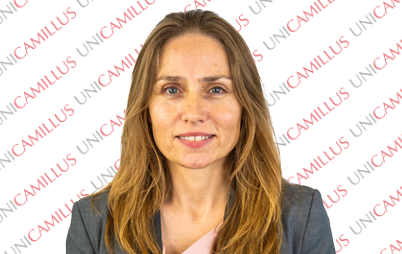
Vera Kopsaj, Ph.D., is a fixed-term researcher (Type A) at UniCamillus in Rome, specializing in Sociology and Social Research. She holds a double degree in Sociology from the University of Trento and Katholische Universität Eichstätt-Ingolstadt, and a Ph.D. in Sociology and Applied Social Sciences from Sapienza University of Rome. She has collaborated with Sapienza’s Department of Statistical Sciences on the Erasmus+ project. Her research focuses on cultural sociology, migration, intercultural communication, and social policy. Notable interests include diaspora communities, health equity, and the intersection of religion with public health governance. Recent work explores translocal Albanian diaspora dynamics and inclusive education policies. Her publications span 2014–2025, addressing topics like empathy in philosophy, Kosovo’s socio-political memory, and EU migration attitudes. She has served as a lecturer at Universitas Mercatorum and guest lecturer at AUXILIUM’s Faculty of Educational Sciences. Collaborations include European projects like Erasmus+, emphasizing social inclusion. No awards are listed, but her work highlights interdisciplinary approaches to global health and cultural conflict resolution.
Laura Cerrocchi is an Associate Professor at the Department of Developmental and Socialization Psychology at Sapienza University of Rome. Her work focuses on intercultural pedagogy, migration, and social inclusion in education systems. She has led projects addressing unaccompanied foreign minors' integration, family dynamics in multicultural contexts, and emergency pedagogy. Key contributions include frameworks for linguistic literacy, teacher training programs in intercultural education, and action-research initiatives to support vulnerable populations. Her research bridges theory and practice, emphasizing systemic change and policy implementation. Educational Focus: Pedagogy, migration studies, child welfare, and policy analysis Notable Projects: Development of inclusion strategies for minors, CPIA network initiatives, and curriculum design for multicultural environments Her publications (2016–2024) explore themes such as refugee education, family-school collaboration, and intercultural integration. She collaborates with institutions like the Bologna Metropolitan Centre for Child Protection (CPIA) and Reggio Emilia’s Ce.IS. Her work prioritizes actionable frameworks for educational equity and community resilience.
Antonia Lonigro is an Associate Professor at Sapienza Università di Roma , affiliated with the Facoltà di Medicina e Psicologia and the Dipartimento di Psicologia dei Processi di Sviluppo e Socializzazione . Her research focuses on developmental psychology, cognitive social processes, and risk behaviors in adolescents and young adults. Notable areas include theory of mind, binge eating, alcohol use, and family functioning. Education: 2018: Specialization in Cognitive-Behavioral Psychotherapy (PTS, Rome) 2013: PhD in Psychology of Orientation and Learning Processes (Sapienza) 2008: Master’s in Psychological Intervention in Development and Socio-Educational Institutions (Sapienza) 2005: Degree in Science and Techniques for Development and Health (Sapienza) Research Interests: Development of social cognition (theory of mind, pragmatics) Temporal perspective and risk behaviors (binge drinking, drunkorexia) Family dynamics and mental health in adolescents Psychological impacts of the pandemic (COVID-19 lockdown effects) Teaching: Current courses: Developmental Psychology, Educational Psychology Past roles: Lecturer at Università Roma Tre and Università Europea di Roma Key Research Trends: Over 50 peer-reviewed articles since 2011, emphasizing: Interplay between theory of mind and physiological markers (e.g., cardiac vagal tone) Psychosocial impacts of pandemic restrictions Socio-cultural factors in binge behaviors and family functioning
Dr. Sara Manganelli is a Tenure Track Researcher in Psychometrics (PSIC-01/C) at the Department of Psychology of Developmental and Socialization Processes at Sapienza University of Rome since 2024. She holds a National Scientific Qualification for Associate Professor in Psychology (2020) and has worked at the National Institute for the Evaluation of the Educational System (INVALSI), and as a lecturer at the Telematica eCampus University. Research Focus: Her work centers on psychological well-being, academic motivation, self-regulation, and socio-economic-cultural impacts on youth development. She specializes in psychometric tool development and formal models to explore relationships between constructs, using advanced quantitative methods. Recent Themes: Key areas include immigrant integration in schools, socio-economic disparities in education, and resilience mechanisms among disadvantaged students. Her studies often involve large-scale national datasets and mixed-methods approaches. Professional Activities: Active in educational policy research, she has contributed to national evaluation frameworks and media literacy interventions to combat substance abuse among adolescents.
Jessica Pistella is a Researcher (Ricercatore a Tempo Determinato Tipo B) at the Department of Developmental and Social Psychology, Faculty of Medicine and Psychology, Sapienza University of Rome. She holds a PhD in Developmental and Social Psychology from Sapienza and is a systemic-relational-symbolic-experiential family psychotherapist. Her primary affiliation is with the 'Be as You Are' Clinical and Research Center, focusing on LGBTQ+ well-being. Her research interests span parenting dynamics, family functioning, coming out processes, homophobic bullying, sexual stigma, and LGBTQ+ mental health. She has led and contributed to over 20 national and international research projects, including studies on nonbinary identities, LGBTQ+ inclusion in education, and minority stress. Dr. Pistella teaches courses like 'Developmental Psychology for Inclusion' and has published extensively in journals such as Journal of Homosexuality , Sexuality Research and Social Policy , and Frontiers in Psychology . Her work emphasizes intersectional approaches to LGBTQ+ issues, with a focus on resilience and policy advocacy. Key grants include the 2024 project on microaggressions in nonbinary populations (€40k) and the 2022 PRIN-funded study on LGBTQ+ university students' mental health (€210k). She actively reviews for 20+ journals and serves on editorial boards, including Gender, Sex and Sexuality Studies . Her clinical work involves supervising cases at the '6 come sei' clinical service and co-facilitating the A.ge.d.o support group. She advocates for inclusive language and anti-discrimination policies in healthcare and education.
Gilda Sensales is an Associate Professor of Social Psychology at Sapienza University of Rome. She holds a dual appointment within the Department of Developmental and Socialization Psychology and the Faculty of Medicine and Psychology. Her academic career spans over three decades, beginning as a researcher in 1994 and advancing to her current rank in 2003. She teaches undergraduate courses in Political Psychology and Communication at the Magistrale in Psychology and Social Work, and has supervised doctoral students in various cycles of the Sapienza PhD program in Social Psychology. Research Focus: Political psychology, social representations, gender studies, populism analysis, and the history of psychology. Collaborations: International editorial roles in journals like Journal of Social and Political Psychology and Critical Psychology , and co-editorship of volumes on populism and gender bias. Key Contributions: Pioneered studies on linguistic sexism in Italian political discourse, Facebook analysis of populist rhetoric, and historical reclamation of marginalized figures in psychology. Her research often employs triangulation methods, combining qualitative data (e.g., free associations, media content analysis) with quantitative metrics (e.g., Need for Closure scales, Big Five personality traits). Notable projects include analyzing post-2018 Italian election communications and curating the volume Political Psychology Perspectives on Populism (2024), featuring global scholars. Recent work addresses how crises like the pandemic and wars amplify populist sentiment via psychological mechanisms like cognitive closure. She has also documented systemic gender biases in parliamentary speeches and media portrayals of female politicians. Grants & Leadership: Oversees international mobility programs with universities in Canada, Argentina, Brazil, and China, and chairs committees on doctoral training and editorial awards. Public Engagement: Hosted prominent speakers like NYU’s John Jost and organized interdisciplinary conferences on political culture and language. Her legacy includes oral histories of Italian psychologists and advocacy for inclusive academic practices, reflecting a commitment to critical social science and disciplinary transparency.
Giuseppe Balirano is Full Professor of English Language and Linguistics at the Department of Literary, Linguistic and Comparative Studies, University of Naples L'Orientale. He serves as Rector's Delegate for E-Learning, Lifelong Learning and Multimedia, and President of the Italian Association of English Studies (AIA). His academic roles include coordinating international research networks and editorial boards. Full Professor (2020-present) President, Italian Association of English Studies (2023-present) Scientific Coordinator, PRIN 2022 Project "ECHOES" Director, Interuniversity Research Center I-LanD (2015-2023) Research focuses on English linguistics as a tool for identity construction , with specific emphasis on: Discursive mechanisms of gender representation Online hate speech and solidarity discourse Multimodal analysis of media texts Audiovisual translation studies Post-pandemic language education His 15 most recent publications demonstrate expertise in hate speech mitigation and multimodal discourse analysis , particularly through projects like: "ECHOES" (2023-present) - Combating online hate through English studies "Different Cinematographic Ideas" (2023) - Innovative teaching methodologies "Digital Education" series - eTandem and autonomy research Scientific recognition includes: FFABR 2017 research fund National Scientific Qualification (2017) Editor-in-Chief, Textus journal (2023-present) As academic leader, he: Chairs research committees Coordinates international conferences Supervises 13 doctoral and research students Manages EU-funded projects like "EU-MADE4LL"
Alvise Mattozzi is an Associate Professor in the Department of Environmental, Land and Infrastructure Engineering (DIATI) at Politecnico di Torino, where he contributes to interdisciplinary research through the FULL Interdepartmental Center – Future Urban Legacy Lab. His work bridges the social sciences and design, focusing on socio-technical systems, urban sustainability, and public engagement with science. His research interests include Actor-Network Theory, design ethnography, semiotics, qualitative research, social design, and the social studies of science and technology (STS) . He investigates the social role of artifacts, interdisciplinary design practices, and socio-technical-environmental controversies, often integrating cultural theory with practical design applications. His methodological focus includes controversy mapping and ethnographic approaches to innovation. His recent publications reflect a strong engagement with inclusive mobility planning, citizen science in hydrology, climate change communication through theater, and critical reflections on STS concepts such as hybridity and translation. These works span computer interaction, environmental science, cultural studies, and philosophy, demonstrating his interdisciplinary reach. His scientific recognition includes being a Fellow of STSItalia (2011–2013) and Vice President of the Italian Association of Semiotic Studies (AISS) (2008–2010). He has also served on the editorial board of Tecnoscienza . Mattozzi teaches courses such as Science and Technology Studies , Systemic Food Design , and Sustainable Urban Mobility across Architecture, Design, and Environmental Engineering programs. He supervises PhD students, including Ludovica Moro , and leads or participates in externally funded research projects like DSooE (Scientific Director) , LIBRA , and SCoolAir , supported by EU, PNRR, and private foundations. He is also affiliated with the tdpLAB (DAD) , contributing to design and ethnography-based research.
Valeria Illuminati is a Fixed-term junior researcher at the Department of Interpretation and Translation, University of Bologna – Forlì Campus, working on translation studies with interdisciplinary methodologies and gender perspective. She holds a Dual Award International PhD from both University of Bologna and Durham University. Current Position: Fixed-term researcher type a) (junior) Scientific-disciplinary sector: FRAN-01/B French language, translation and linguistics Research Project: Translation studies for the analysis of the translation process in publishing/theatrical fields in France and Italy Her primary research interests focus on literary translation, particularly for children's literature from gender perspectives, audiovisual translation, and cultural accessibility. She has developed expertise in audio description for theatrical performances and museum accessibility, having audio described over 50 theatrical performances, films, and museum tours since 2014. Her recent publications reflect trends in gender-sensitive translation practices, with emphasis on children's literature and cultural accessibility. Her work bridges theoretical translation studies with practical applications in making cultural content accessible to diverse audiences. CIUTI PhD Award Laureate (2019) National Scientific Qualification for Associate Professor (December 2023) She actively supervises PhD research and teaches French language courses at the University of Bologna. Her institutional roles include serving as Disability Representative and Alumni Representative for the Department of Interpretation and Translation. She coordinates the 'Teatro No Limits' cultural accessibility project and participates in multiple European initiatives focused on gender-positive literature and inclusive cultural practices.
Luca Salmieri is an Associate Professor in the Department of Social and Economic Sciences within the Faculty of Political Sciences, Sociology, and Communication at Sapienza University of Rome. He teaches Sociology of the Family and Sociology of Culture for the 2024/2025 academic year, with classes held at Via Salaria 113. His institutional email is luca.salmieri@uniroma1.it, and he holds office hours on Thursdays at 3:00 PM in Room 274. Salmieri's research focuses on cultural sociology, educational poverty, social inequalities, and family sociology. His work examines how social structures reproduce inequality across generations, with particular attention to educational systems, gender dynamics, and urban transformations. He has published extensively on Mediterranean urban spaces, Italian family structures outside marriage, and the relationship between culture and social stratification. His recent work increasingly addresses educational poverty in Italy, analyzing both material and immaterial cultural resources that affect learning outcomes. Analysis of Salmieri's recent publications reveals a consistent focus on social inequality mechanisms, particularly in educational contexts. His work spans theoretical frameworks examining social reproduction while also engaging with empirical data on educational poverty, youth transitions to adulthood, and urban transformations. The geographic scope of his research extends across Mediterranean contexts, with comparative analyses of Italian cities and their European counterparts. His methodological approach combines sociological theory with empirical research, often utilizing large-scale datasets like PISA to examine digital technology's impact on educational outcomes. Salmieri serves on the editorial boards of numerous academic journals including Scuola Democratica, International Review of Sociology, and Working Papers Series of the Department of Social and Economic Sciences. He has been involved in multiple research projects funded by Sapienza University and European institutions, particularly focusing on economic inequalities, poverty, and social inclusion policies. His leadership roles include serving as the Steering Committee responsible for the LIA Mediterrapolis project, an international laboratory between Sapienza University of Rome and Aix-Marseille University. As a member of the doctoral faculty for Applied Social Sciences, Salmieri has contributed to graduate education at Sapienza. He has participated in European research frameworks including the 6th and 7th Framework Programs, with projects addressing work-care relationships and social quality in Europe. His teaching responsibilities span multiple degree programs including Sociology, Social Service Sciences and Techniques, and Development and International Cooperation Sciences.
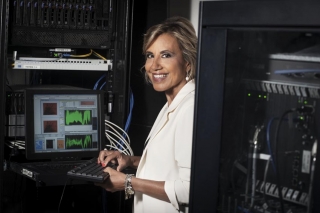
Tiziana Catarci is a Full Professor ( Professore Ordinario ) at the Department of Computer, Automation and Management Engineering Antonio Ruberti (DIAG) within the Faculty of Computer Engineering, Computer Science and Statistics at Sapienza Università di Roma since November 2000. She has had a distinguished academic career marked by numerous leadership roles at Sapienza, including serving as Pro-Rector for Infrastructure and Technologies (2010-2014) and directing the DIAG department (2018-2024). Her research focuses on Human-Computer Interaction , Data Quality , and Database Systems . In recent years, she has expanded her interests to include Ethics of Artificial Intelligence and Gender Issues in STEM , co-founding the Italian Society for AI Ethics (SIpEIA) in 2020 and serving as its president since 2024. She has published over 200 articles in prestigious journals and conferences, and has edited or authored more than 20 books. She has been actively involved in numerous national and international research projects including KIM, VENUS, FADIVA, LAURIN, SEWASIE, DELOS, Interop, WORKPAD, SM4All, PROMISE, and SmartVortex. Her recent publications cover topics ranging from visual analytics solutions to data management architectures, and from ethical considerations in AI to declarative process modeling. Dr. Catarci has received several honors throughout her career, including: Stanford University's World's Top 2% Scientists (2020) Premio Le Tecnovisionarie (2021) Fellow of the European Alliance for Innovation (2018) Nominated among 100 Donne per la Scienza by Fondazione Bracco (2016) Commendatore della Repubblica Italiana (2015) IBM Eclipse Innovation Award for the SEAWER project (2003) She is also a pioneer in promoting women in STEM fields, with activities that have been recognized by the Levi Montalcini Association in 2017, and has been included in InspiringFifty, a list of 50 women who serve as role models in the technology world.
Anna Mongibello is an Associate Professor of English Language and Translation at the Department of Literary, Linguistic and Comparative Studies, University of Naples L'Orientale, where she also serves as Coordinator of the Master's Degree Course in Intercultural Communication in the Euro-Mediterranean Area. Her academic career includes a Visiting Professorship at the University of Toronto (2023-2024) and previous positions as RTDB Researcher at the same university. She leads the Interuniversity Research Center I-Land and participates in multiple research networks including the PRIN 2021 UNITE project focused on inclusive technologies for English language learning. Her research focuses on Social Media Discourse from linguistic and multimodal perspectives, digital communication in English, Media and News Discourse, sociolinguistic aspects of contemporary English (identity, power, ideologies) through Critical Discourse Analysis and Corpus Linguistics methodologies. She explores gender and ethnic representations, e-learning, virtual worlds, intercultural communicative competence, digital tools for English teaching, translation, multilingualism, and Indigenous studies. Her work often intersects with Canadian and Indigenous studies, examining representation, resistance, and digital activism. Her recent publications analyze political deepfakes, Indigenous resistance in digital spaces, media representations of surrogacy, and cross-cultural discourse analysis between Italian and Canadian contexts. Her research demonstrates a consistent focus on discourse analysis methodologies applied to contemporary digital communication phenomena, with particular attention to power dynamics, representation, and identity construction. Doctoral Student Research Award (International Council for Canadian Studies, 2012) Research Travel Grant (University of Naples L'Orientale, 2011) Professor Mongibello actively supervises numerous bachelor's and master's theses on topics ranging from media discourse analysis to sociolinguistic phenomena in English-speaking contexts. She has received research funding for projects including UNITE (Universally Inclusive Technologies to practice English), which explores dialogue systems for EFL learning, particularly for students with disabilities. Her teaching responsibilities span multiple degree programs, focusing on English language, discourse analysis, and intercultural communication. She leads the Interuniversity Research Center I-Land, which focuses on inclusive digital learning environments, and participates in the ERASMUS+ project 'Freedom of movement at play: EU citizens' identity and transnational discourses.' Her research group examines negative solidarities, hate speech, and digital communication ethics in the Anglophone globalized public sphere.
Anna Maria Cimitile is a Full Professor of English Literature (ANGL-01/A) at the Department of Literary, Linguistic and Comparative Studies, Università degli Studi di Napoli L'Orientale. She has held this position since 2012 and serves as Director of the interdisciplinary journal Anglistica AION (ISSN 2035-8504). Her academic career includes significant editorial and research roles, including membership on the scientific committee of RANAM at the University of Strasbourg and serving as Regional Editor for the Global Shakespeares Video and Performance Archive at MIT. Professor Cimitile's research interests focus on Shakespeare studies, early modern English literature, postcolonial literature, book history, and literary adaptation. Her scholarly work demonstrates particular expertise in Shakespearean adaptations, especially in Italian and Mediterranean contexts, as well as the intersection of literature with visual arts and performance. She has conducted extensive research on Othello adaptations, Richard II interpretations, and the reception of classical texts in early modern visual culture. Her recent publications reveal a strong trend toward examining Shakespeare's contemporary relevance, particularly regarding issues of inclusion, race, and emergency politics. She also explores book history through microhistorical approaches, investigating reading practices in early modern England. Her work on Italian adaptations of Shakespearean works demonstrates a unique perspective on Mediterranean cultural identity and postcolonial contexts. Fellowship at Université de Strasbourg (2013) Visiting scholarship at Durham University (2014) Visiting scholarship at Queen Mary University of London (2014) Regional Editor, Global Shakespeares Archive (since 2011) Member of ESRA - European Shakespeare Research Association Board (since 2021) Professor Cimitile actively supervises graduate students and teaches courses including 'Shakespeare across cultures: a journey through international film' and 'Letteratura Inglese II.' She has served as Coordinator of the Master's program in European and American Languages and Literatures (2018-2021, 2021-2024) and as Department Board Member since 2024. Her research connects with multiple ERC sectors including SH5_2 (Theory and history of literature), SH5_3 (Book studies), and SH6_13 (Cultural history).