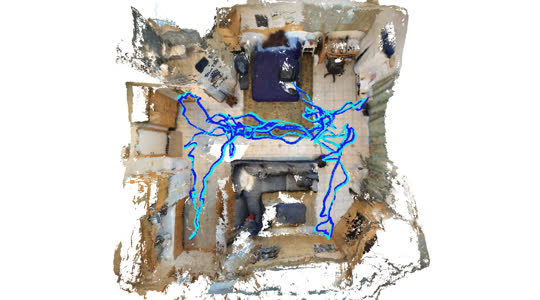
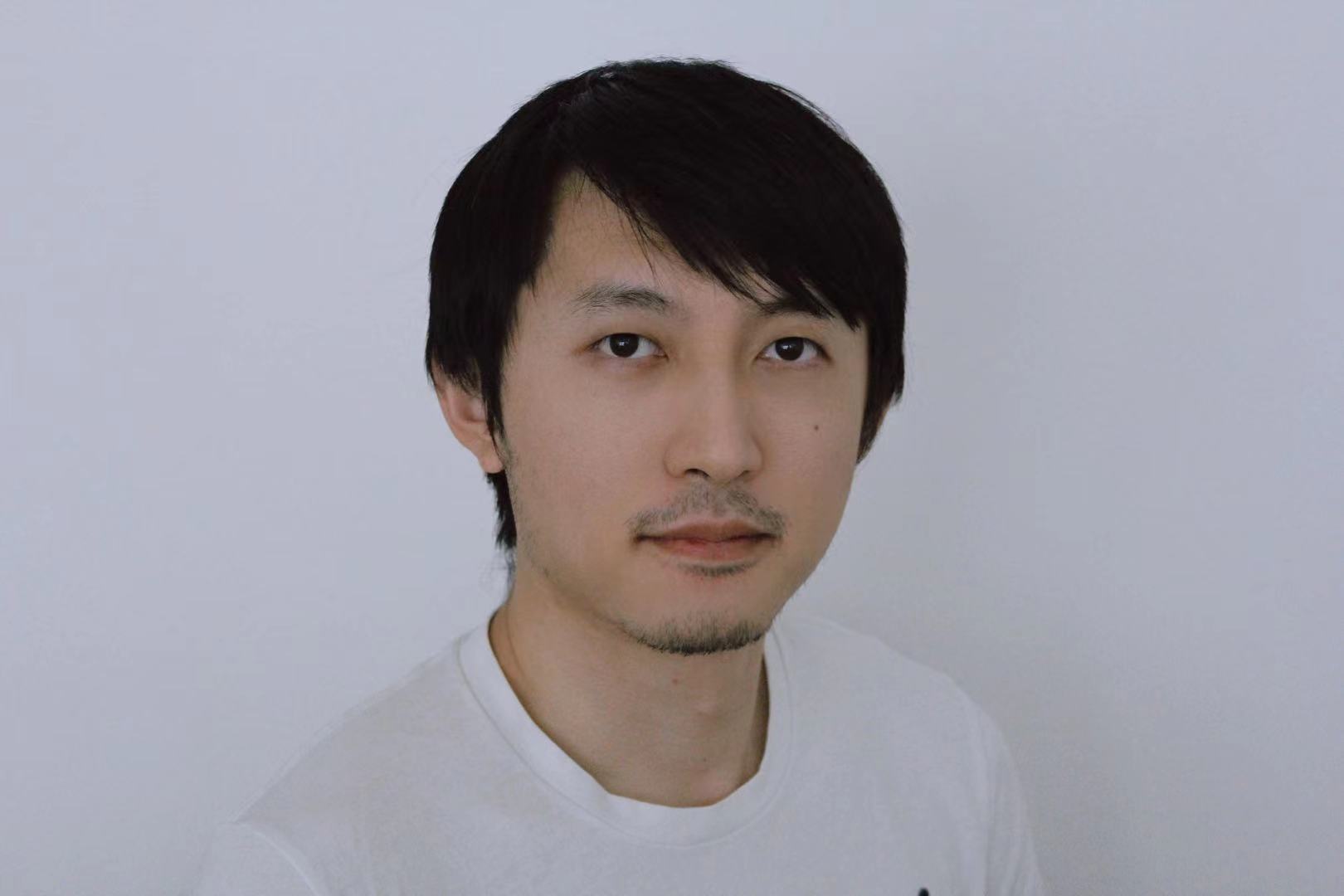
Ganlin Zhang is a PhD researcher at the Technical University of Munich (TUM) within the Computer Vision Group (Informatics 9). His work focuses on 3D Vision , Visual SLAM , and 3D Reconstruction using deep learning and geometric processing techniques. Key research areas: 3D Vision, Visual SLAM, Structure from Motion, 3D Reconstruction, Deep Learning Recent publications highlight advancements in RGB-only SLAM systems with implicit encodings, dynamic scene bundle adjustment, and robust rotation averaging methods. His work bridges classical geometry processing with modern AI approaches for spatial AI applications. He collaborates with leading researchers in the field, including Luc Van Gool and Michael R. Oswald , and contributes to cutting-edge developments in computer vision through active participation in conferences like CVPR and ICCV . The Computer Vision Group at TUM provides a vibrant research environment for his work, with access to state-of-the-art facilities at Boltzmannstrasse 3, Garching, Germany.
Prakhar Verma is a Doctoral Researcher at Aalto University, specializing in machine learning and probabilistic modeling. His work focuses on Gaussian processes, stochastic differential equations, and their applications in sequential learning and Bayesian optimization. Research Interests: Probabilistic modeling with Gaussian processes Scalable inference for stochastic differential equations Bayesian optimization and active learning techniques Sequential learning with memory-based approaches Mathematical modeling of continuous-time systems Computational statistics for high-dimensional data Collaborations: He collaborates with researchers like Arno Solin, Vincent Adam, Paul E. Chang, Ti John, and Victor Picheny. His publications span conferences such as NeurIPS, ICML, and AISTATS.
Paul Peter Hager serves as an Assistant Professor in the Department of Statistics and Operations Research at the University of Vienna, where he teaches courses including Linear Algebra and Applied Optimization. Previously, he held a junior research group leader position at Technische Universität Berlin. His research centers on: Mathematical Finance Machine Learning Stochastic Control Mean-Field Games Fractional Processes Gaussian Multiplicative Chaos Volatility Modeling Hager pioneers applications of rough path signatures in financial mathematics, developing novel frameworks for stochastic control and calibration problems. His work bridges theoretical probability with practical machine learning implementations, particularly in volatility modeling using fractional processes and log-correlated fields. Recent publications reveal a dominant trend in signature-based methods for optimal stopping and mean-field games, with significant contributions to fractional Brownian motion theory. His collaborative work with leading researchers like Peter Friz and Christian Bayer consistently targets high-impact journals in applied probability and financial mathematics. Dr. Hager maintains active research collaborations and has delivered invited talks at institutions including KAUST, focusing on computational implementations of signature methods in finance.
Jie Song is a postdoctoral researcher at ETH Zurich affiliated with the Advanced Interactive Technologies lab. Their work bridges structured information and deep learning pipelines, with applications in hand/body-pose estimation, 3D human reconstruction, and view synthesis. Research Interests: Deep Learning, Computer Vision, 3D Reconstruction, Human Pose Estimation, Motion Capture, 6D Pose Estimation Affiliation: ETH Zurich, Advanced Interactive Technologies lab Jie's recent publications (2023-2025) focus on monocular video-based 3D human modeling, Gaussian rendering, and motion synthesis. Collaborations span institutions like ETH Zurich and MPI Tuebingen, with applications in robotics, augmented reality, and sports analytics. Scientific Awards: 3DV Best Paper Award (2017), Qualcomm Innovation Fellowship Finalist (2015), Swisscom Innovation Award (2014), Birkigt Scholarship (2013), National Scholarship (2009/2010) Jie has supervised multiple student projects, including personalized neural avatars and skeleton-based motion modeling. They serve as a Teaching Assistant for courses like Visual Computing and Machine Perception at ETH Zurich.
Dr. Vennapusa Sivaranjana Reddy is an Associate Professor in the Department of Chemistry at the School of Chemistry, Indian Institute of Science Education and Research Thiruvananthapuram (IISER TVM). With a career spanning theoretical and computational chemistry, her research focuses on ultrafast excited-state intramolecular proton transfer (ESIPT), intersystem crossing (ISC), and triplet state formation in organic molecules. She leads a dynamic research group investigating these phenomena through quantum molecular simulations and computational techniques. Education: M.Sc. and Ph.D. from the University of Hyderabad (2003-2010); B.Sc. from Government Arts College, Kadapa (2000-2003). Professional Experience: Associate Professor (2022–present) and Assistant Professor (2013–2022) at IISER TVM; postdoctoral fellowships at Nagoya University (Japan), Heidelberg University (Germany), and CSIR-HRDG/SERB-funded projects. Her research group explores ESIPT mechanisms in 5- and 6-membered proton transfer cycles, ultrafast ISC pathways in naphthalene and pyrene derivatives, and triplet formation in ESIPT tautomers. The 15 most recent articles highlight her expertise in designing optoelectronic materials, fluorescent probes for H2S detection, and computational modeling of spin-vibronic dynamics. She has secured significant grants from CSIR and SERB and collaborates with institutions across India and abroad. Her students have received prestigious PMRF fellowships and presented award-winning work at international conferences. Scientific Awards: Early Career Research Award (SERB, 2016), Alexander von Humboldt Postdoctoral Fellowship, GATE-2005 (All India Rank 6), UGC-CSIR qualification, and merit scholarship during M.Sc. Dr. Reddy’s group utilizes advanced computational tools like GAUSSIAN 09, TURBOMOLE 7.4, and MCTDH for electronic structure calculations and quantum nuclear dynamics. She mentors Ph.D. students and alumni, including those now at institutions like the University of Vienna and Ludwig-Maximilians-Universität München. Her teaching portfolio includes courses in physical chemistry, quantum chemistry, and computational methods.
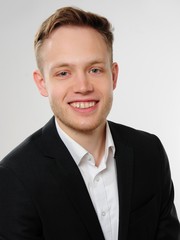
Dr. Sven Klaaßen serves as a Research Fellow at the University of Hamburg's Hamburg Business School within the Professorship for Statistics with Application in Business Administration, collaborating closely with Prof. Dr. Martin Spindler since 2021. His research focuses on developing advanced statistical methodologies for complex data environments. His academic credentials include: Ph.D. in Statistics from Hamburg Business School (2020) Visiting Scholar at MIT Department of Economics (2022) M.Sc. in Business Mathematics from University of Hamburg (2016) BSc in Business Mathematics from University of Hamburg (2014) Dr. Klaaßen's research program centers on Machine Learning, Causal Inference, Deep Learning, and High-Dimensional Statistics, with particular emphasis on developing robust inference techniques for modern data challenges. His work bridges theoretical statistics with practical applications in business analytics and econometrics, often addressing the complexities of high-dimensional datasets where traditional methods fail. Analysis of his recent publications reveals a clear trajectory toward integrating machine learning with causal inference frameworks, exemplified by his leadership in the DoubleML software ecosystem. His research increasingly tackles multimodal data challenges while maintaining rigorous statistical foundations, with applications spanning economics, operations research, and business decision systems. As an active member of Prof. Spindler's research group, Dr. Klaaßen contributes to collaborative projects developing open-source statistical tools and advancing methodological frontiers in causal machine learning. The team maintains strong industry and academic partnerships focused on translating theoretical innovations into practical analytical solutions.
Abhishek Halder is an Associate Professor in the Department of Aerospace Engineering at Iowa State University and an Associate Adjunct Professor in the Department of Applied Mathematics at the University of California, Santa Cruz. He is also a member of the Translational AI Center at Iowa State University. His academic journey includes joining Iowa State University as an Assistant Professor in July 2023 and previously serving as faculty at UC Santa Cruz starting from October 2017. Dr. Halder's educational background includes studies at IIT Kharagpur and Texas A&M University, where he developed expertise in systems and control theory with applications to matrix analysis, probability, and optimization. His research has been recognized with prestigious awards including the O. Hugo Schuck Best Application Paper Award from the American Automatic Control Council, Applied Mathematics Research Award from UC Santa Cruz, Outstanding Doctoral Student Award from Texas A&M, and Best Dual Degree Thesis Award from IIT Kharagpur. His research focuses on stochastic systems, control and optimization with applications to large scale cyber-physical systems. Dr. Halder has made significant contributions to the fields of optimal transport, Schrödinger Bridge theory, distributional control, and uncertainty propagation in dynamical systems. His work bridges theoretical developments with practical applications in power systems, aerospace engineering, and machine learning. He has secured multiple research grants from NSF, including a CPS Frontier project on Computation-Aware Algorithmic Design for Cyber-Physical Systems. Dr. Halder has demonstrated leadership in the control systems community through editorial roles including Associate Editor for IEEE Transactions on Automatic Control (2025-present), ASME Journal of Dynamic Systems, Measurement, and Control (2025-present), Systems & Control Letters (2022-present), and previously for IEEE Control Systems Society Conference Editorial Board (2019-2025) and IEEE Transactions on Aerospace and Electronic Systems (2019-2022). He is a Senior Member of IEEE and a member of IFAC, SIAM and ASME. His research group has produced numerous publications in top-tier journals and conferences, with recent work focusing on connections between optimal transport theory, stochastic control, and machine learning. The publication trends show increasing integration of Schrödinger Bridge formulations with machine learning techniques for distributional control problems across various domains including power systems, aerospace applications, and resource allocation. O. Hugo Schuck Best Application Paper Award (2024) Applied Mathematics Research Award from UC Santa Cruz (2022) IEEE Senior Member (2021) Outstanding Doctoral Student Award from Texas A&M Best Dual Degree Thesis Award from IIT Kharagpur Dr. Halder has mentored numerous PhD students including Alexis, Georgiy, Iman, Shadi, and Kenneth, many of whom have received prestigious fellowships. His research group maintains strong collaborations with national laboratories including Lawrence Livermore National Lab and Los Alamos National Lab, as well as industry partners. Dr. Halder is also committed to education and outreach, having created and taught the 'Feedback Control' course for high school students in the California State Summer School for Mathematics and Science (COSMOS), introducing complex control theory concepts without calculus or linear algebra.
Professor Mahdi Mahfouf holds the Chair in Intelligent Systems at the University of Sheffield's School of Electrical and Electronic Engineering . He obtained his MPhil (1988) and PhD (1991) in Control Systems from the same institution. After postdoctoral research (1992-1996) on Leverhulme-funded projects in Model-Predictive Control and Fuzzy Logic, he progressed through academic ranks at Sheffield to Full Professor (2005). Recipient of the IEE Hartree Premium Award (1992) and MEDIPEX Innovation Award (for ICU Decision Support Systems) Over 370 publications, including 130+ journal papers Head of the Intelligent Systems Research Laboratory Research Themes His work spans fundamental research in Fuzzy Logic (modelling, control), Neural-Fuzzy Systems, Self-Organising Control, and Evolutionary Optimization, alongside applied domains in pharmaceutical manufacturing, aerospace systems, biomedical engineering (ICU monitoring), and intelligent transportation. Recent publications focus on hybrid AI for pharmaceutical processes , type-2 fuzzy control systems , and machine learning in manufacturing metrology . Lab initiatives include multistage process monitoring and human-machine interaction systems for stress management.
Dr Richard Collins is a Senior Lecturer in Water Engineering at the University of Sheffield , affiliated with the School of Mechanical, Aerospace and Civil Engineering. His research focuses on hydraulic transients , pipeline integrity , and smart water infrastructure . Graduated with an Aerospace Engineering degree (2005) and PhD in Materials and Mechanical Engineering (2009) Current research explores pressure transients , leak detection , and autonomous robotic systems for pipeline inspection Projects include fatigue analysis , biofilm mobilisation , and ultrasound-based pipe assessment His publications emphasize cast iron pipe fatigue , acoustic leak detection , and transient-induced contamination . Funded by RCUK and Datatecnics , his work bridges mechanical engineering and civil infrastructure challenges.
Prof. Monika Sester is a distinguished Professor and Executive Director of the Institute of Cartography and Geoinformatics at Leibniz University Hannover, within the Faculty of Civil Engineering and Geodetic Science. She also serves as Spokesperson for the Leibniz Research Center FZ:GEO and holds multiple leadership roles including Faculty Information Officer (FIO) for the Faculty of Civil Engineering and Geodetic Science, Ombudsman for Good Scientific Practice, and Exchange Coordinator for Geodetic Science and Geoinformatics. Her research focuses on the intersection of geospatial information science, cartography, and urban mobility. Prof. Sester's work spans several key areas: Geospatial data processing and analysis Cartographic representation and visualization Urban mobility and transportation systems Spatial data uncertainty and quality Digital mapping technologies and applications Historical map analysis and interpretation Prof. Sester's recent publications demonstrate a strong focus on applying advanced computational techniques to geospatial problems. Her work shows increasing emphasis on machine learning applications for map analysis, urban mobility optimization, and 3D spatial modeling. She has been particularly active in researching applications of deep learning for historical map interpretation, urban mobility patterns, and spatial uncertainty visualization. Her contributions to the field have been recognized through leadership positions in major research initiatives: Executive Director, Institute of Cartography and Geoinformatics Spokesperson, Leibniz Research Center FZ:GEO Faculty Information Officer, Faculty of Civil Engineering and Geodetic Science Ombudsman for Good Scientific Practice Member of multiple academic committees including the Admissions and Examination Board Prof. Sester actively collaborates with students and researchers across multiple projects focused on geospatial information systems, urban mobility, and cartographic visualization. Her leadership extends to guiding research directions within the Leibniz Research Center FZ:GEO, which brings together interdisciplinary expertise to address complex spatial challenges.
Tossapon Boongoen is a Professor in the Department of Computer Science at Aberystwyth University, with over a decade of experience in artificial intelligence and machine learning. Previously, he served as Associate Professor at Mae Fah Luang University (2017-2022) and Royal Thai Air Force Academy (2011-2017), where he also directed the MFU Research and Innovation Institute. His research spans ensemble clustering for privacy-preserving data fusion deep learning in remote sensing and sky survey data network security applications for ransomware and intrusion detection forest fire risk modeling using spatial-temporal data Recent publications focus on convolutional neural networks, adversarial attack classification, and collaborative filtering algorithms. He leads international projects funded by the British Council, FCDO, and Academy of Medical Sciences, including collaborations with institutions in Thailand, Korea, Vietnam, France, and Czech Republic. Professional engagements include editorial roles in journals like Knowledge-Based Systems Frontiers in Neurorobotics PeerJ Computer Science ICT Express and partnerships with GISTDA, GOTO Observatory, and Imperial College London.
Diogo Oliveira e Silva is an Associate Professor in the Department of Mathematics at Instituto Superior Técnico, Lisbon, and holds an Honorary Senior Research Fellow position at the University of Birmingham. His academic journey includes a PhD from UC Berkeley under Michael Christ (2012), a Habilitation at Universität Bonn (2017), and prior roles at Bonn and Berkeley. His research focuses on harmonic analysis, particularly sharp inequalities, oscillatory integrals, Fourier restriction theory, uncertainty principles, and nonlinear Fourier analysis. Education: PhD in Mathematics (2012, UC Berkeley), Habilitation (2017, Universität Bonn) Affiliations: Instituto Superior Técnico (current), University of Birmingham (honorary), former positions at Bonn and Berkeley His work explores Fourier restriction theory , symmetry breaking phenomena , spherical packings , and sharp inequalities across geometric and analytic contexts. Recent publications address dimension-free estimates , stability of extremizers , and sign uncertainty principles , often leveraging collaborations with researchers like R. Mandel, G. Negro, and R. Quilodrán. Grants from EPSRC , DFG , NSF , AIM , and FCT have supported his work. He has been actively involved in international conferences and lecture series , including events in Rwanda, Germany, Brazil, and Japan. Teaching roles span complex analysis, Fourier analysis, and PDE courses at IST and Birmingham.
Sergey Bobkov is a Professor at the School of Mathematics, University of Minnesota. His research spans probability theory, mathematical analysis, information theory, convex geometry, and discrete mathematics, with a focus on high-dimensional distributions, measure concentration, isoperimetric inequalities, entropic stability, and transportation distances. He has made significant contributions to the central limit theorem, Rényi divergence analysis, and Gaussian approximation problems. Research Interests: Probability Theory: High-dimensional distributions, Empirical measures Mathematical Analysis: Isoperimetry, Poincaré and logarithmic Sobolev inequalities Information Theory: Entropic inequalities, Rényi divergence Convex Geometry: Convex bodies, Localization Discrete Mathematics: Finite Markov chains, Graphs Contact: Email: bobkov@umn.edu Office: Vincent Hall 228, University of Minnesota His work often bridges probability with functional inequalities and convex geometry, analyzing phenomena like concentration of measure, transport distances, and stability of Gaussian laws under various conditions.
Dr. Zoltán Kis serves as a Senior Lecturer (Associate Professor) in the School of Chemical, Materials and Biological Engineering at The University of Sheffield and holds an Honorary Lecturer position at Imperial College London's Department of Chemical Engineering. His research focuses on innovating disease-agnostic RNA vaccine and therapeutics manufacturing platforms through process digitalization and intensification. Dr. Kis earned his Ph.D. in Bioengineering from Imperial College London, complemented by an M.Sc. in Applied Biotechnology and a B.Eng. in Chemical with Biochemical Engineering. His interdisciplinary training bridges chemical engineering, biotechnology, and bioengineering disciplines. His research integrates experimental and computational methodologies to revolutionize mRNA production: Development of continuous enzymatic synthesis, purification, and LNP formulation processes Process intensification through novel unit operations and equipment design Digital twin deployment for real-time monitoring and control Techno-economic modeling to reduce production costs Quality by Digital Design framework implementation for regulatory compliance Analysis of recent publications reveals dominant trends in continuous bioprocessing and digital transformation of mRNA manufacturing. Key subfields include oligo-dT chromatography optimization, tangential flow filtration for mRNA purification, and digital twin applications for process control, with strong emphasis on pandemic-response capabilities and cost reduction strategies. Dr. Kis actively supervises PhD students in mRNA bioprocessing and teaches Biopharmaceutical Manufacturing (CPE336/CPE6043) and Introduction to Bioengineering (BIE103). His industry engagement includes advisory roles on Sanofi's mRNA CMC Board and Pfizer's mRNA Technology Advisory Board. He leads the RNA Manufacturing Innovation Team and has secured substantial research funding, including: £3.7 million CEPI grant for RNAbox platform (2024-2027) £7.6 million UK-SEA Vaccine Manufacturing Hub (2023-2028) £2 million Innovate UK project for automated RNA platform (2023-2025) Multi-million USD Wellcome Leap R3 grant for distributed RNA production His work demonstrates significant impact through industry partnerships, policy advisory roles including WHO mRNA Technology Transfer Hub consultancy, and leadership in advancing global vaccine manufacturing capabilities.
Johannes Gräff is an Associate Professor at EPFL, affiliated with the Bioengineering Institute (BMI) under the School of Life Sciences (SV). He also serves as Director of the Neuroscience Doctoral Program (EDNE) and holds roles in the Synapsy Research Center (SRC). His research focuses on interdisciplinary applications of control systems, robotics, and data-driven optimization in bioengineering and manufacturing. Gräff leads the Prof. Gräff Unit (UPGRAEFF) and teaches courses on neuroscience and general biology. He advises multiple doctoral students and contributes to academic governance through roles in doctoral commissions and program management. His expertise spans adaptive control, Bayesian optimization, and closed-loop systems, with applications in precision engineering, additive manufacturing, and neuroscientific instrumentation. Gräff’s work bridges theoretical control methodologies with practical industrial and biomedical challenges, emphasizing safety and efficiency in automation. He oversees the Neuroscience Doctoral Program, guiding interdisciplinary research training, and maintains administrative responsibilities in EPFL’s academic and research structures. His lab (graefflab.epfl.ch) focuses on advancing technologies for autonomous systems and precision control in dynamic environments.