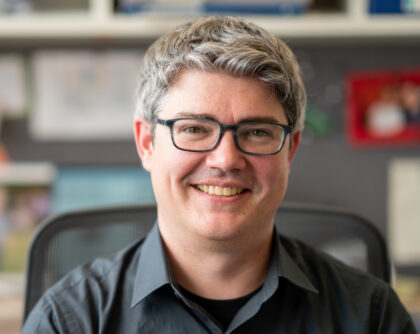
Michael A. McDonald is an Associate Professor of Physics at the Massachusetts Institute of Technology’s Kavli Institute for Astrophysics and Space Research. His research focuses on the evolution of galaxies and galaxy clusters, particularly exploring how environmental factors influence their development. He utilizes a variety of advanced telescopes including the Hubble and Chandra space telescopes, as well as ground-based facilities like Magellan and ALMA. Prior to his current role, he served as a Hubble Fellow at MIT and was appointed Assistant Professor in 2015. Education: BScH and MSc in Physics from Queen’s University (Canada), PhD in Astronomy from the University of Maryland (College Park). His research interests center on the interplay between galaxies, their environments, and supermassive black holes, employing multi-wavelength observations to study phenomena such as cooling flows and AGN feedback. Awards and Honors include the NSF Faculty Early Career Development Grant (2018), NASA Hubble Fellowship (2012), and the Committed to Caring honoree (MIT, 2023-25). His work has led to significant contributions in understanding galaxy cluster dynamics, with the McDonald Research Group actively involved in projects like the South Pole Telescope and James Webb Space Telescope initiatives. Advising and Grants: Currently mentors graduate students Laurel White, Cian Roche, Katiya Fosdick, and Michael Reefe. Former students include Michael Calzadilla and Taweewat Somboonpanyakul. His team has also included postdoctoral researchers such as Aysegul Tumer and Florian Ruppin. Funding for his research has been supported through major grants including the NSF CAREER award and NASA fellowships. Labs/Teams: Leads the McDonald Research Group, affiliated with the MIT Kavli Institute, focusing on multi-faceted astrophysical studies involving galaxy clusters and their environments. The group collaborates with international observatories and cutting-edge instruments to address questions about cosmic structure formation and black hole dynamics.