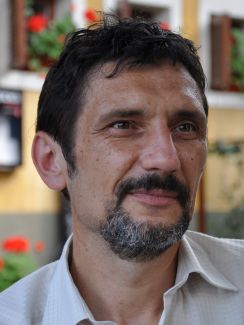
Dr. László Kovács is a Professor at the Faculty of Mechanical Engineering and Informatics , University of Miskolc. He is actively engaged in teaching and research, with consultation hours available on Tuesdays and Thursdays. Research Areas: Optimization of data mining methods, Ontology-based knowledge representation, Uncertainty management in ontology (fuzzy and rough set), Text to ontology conversion
Neil Mac Parthalain is a Senior Lecturer in the Department of Computer Science at Aberystwyth University. He holds degrees including a BSc from Cardiff University, an MSc from the University of Wales, and a PhD from the University of Wales. His research focuses on computational intelligence, with particular emphasis on feature selection, fuzzy-rough sets, data reduction, and their applications in healthcare and engineering. He has led projects such as 'An intelligent approach to bed occupancy modelling to enhance patient care' (2018–2021) and 'Improved modelling techniques for mammographic image analysis' (2012–2014). His work contributes to UN Sustainable Development Goals related to good health and well-being. Key research areas include fuzzy inference systems, reinforcement learning, and three-way classification models. His publications span journals like IEEE Transactions on Fuzzy Systems and PLOS Digital Health, addressing topics such as hospital length of stay prediction and component failure analysis. Collaborations include researchers in mechanical engineering, geology, and robotics. He has supervised 7 doctoral students and contributed to conference proceedings such as the UK Workshop on Computational Intelligence. Media coverage highlights his insights on AI's impact on Welsh language poetry and healthcare systems.
Dr. Yingke Chen is an Associate Professor at the Department of Computer and Information Sciences, Northumbria University. He holds a PhD in Computing Science from Aalborg University (Denmark) and has conducted postdoctoral research at Queen’s University Belfast (UK) and Georgia University (USA). His research focuses on Artificial Intelligence, particularly machine learning, multiagent systems, and formal methods such as model checking. He has secured over £1.3M in Innovate UK grants, collaborating with industries in transportation, logistics, autonomous systems, and e-commerce to apply AI and data science for business growth. Education: PhD in Computing Science (Aalborg University, 2013). Key research areas include machine learning applications, formal verification, and data-driven decision-making. He has published in top venues like Journal of AI Research, AAMAS, AAAI, and IJCAI. Collaborations involve projects with businesses to address real-world challenges, emphasizing practical solutions through theoretical advancements. His work spans anomaly detection, autonomous systems, and cross-domain data analysis. He is open to supervising PhD students and engaging with media inquiries. Research Grants: Over £1.3M in Innovate UK funding (PI/Co-I). Industry Partnerships: Transportation, logistics, autonomous underwater vehicles, education, and e-commerce sectors. Labs/Teams: Actively involved in interdisciplinary teams applying AI to industrial challenges, though specific lab names are not mentioned.
Professor Jarosław Arabas is a distinguished academic at Warsaw University of Technology's Faculty of Electronics and Information Technology, currently serving as Head of the Division of Artificial Intelligence (since 2024) and previously as Director of the Institute of Computer Science (2016-2024). His institutional leadership includes roles as Head of the Scientific Council for Information and Communications Technology and Head of the Faculty Council Committee on Research since 2009. His educational background includes M.Sc. (1993), PhD (1996), and D.Sc. (2006) degrees. Key research areas span Evolutionary Computation, Global Optimization, Artificial Intelligence, Neural Networks, Decision Making Under Uncertainty, Smart Grids, and Energy Markets. His work demonstrates strong interdisciplinary connections between computational methods and energy systems applications. Analysis of his 15 most recent publications reveals dominant trends in surrogate-assisted optimization, particularly for JADE and CMA-ES algorithms, with significant focus on step-size adaptation, matrix-free implementations, and performance benchmarking. His research consistently bridges theoretical algorithm development with practical applications in energy markets and smart grid systems, while maintaining strong contributions to evolutionary computation theory. Rector's Award in Science (2020) Rector's Award in Education (2021) Professor Arabas has supervised 50 promoted theses and led 15 research projects, demonstrating exceptional mentorship capacity. His leadership extends to directing the Institute of Computer Science and heading the Artificial Intelligence Division. Current research activities involve the Zespół Metaheurystycznych Metod Optymalizacji i Ich Zastosowań (Metaheuristic Optimization Methods and Their Applications Team), which he leads, alongside membership in the Koło Naukowe Sztucznej Inteligencji 'GOLEM' (Scientific Circle of Artificial Intelligence).
Prof. Dr. Numan CELEBİ serves as a Professor at Sakarya University's Faculty of Computer and Information Sciences, Department of Information Systems Engineering, where he has held academic positions since 2007. His career progression includes promotion to Associate Professor in 2013 and subsequent advancement to full Professor. His educational foundation comprises a Doctorate in Industrial Engineering from Sakarya University (1998-2004) with thesis Inductive-rough clustering approach to part family generation , a Master's in Electrical and Electronics Engineering (1995-1997) with thesis Development of computer program for the implementation of Adapazari medium voltage distribution network (SCADA) system , and a Licence from Istanbul Technical University's Electrical-Electronic Engineering program (1985-1989). CELEBİ's research spans Artificial Intelligence , Machine Learning , and Computer Vision , with significant contributions to optimization algorithms (Polar Bear Algorithm, Tug of War Optimization), intelligent transportation systems (traffic congestion detection, vehicle rerouting), and computer vision applications (object tracking, saliency detection, UAV-based plant recognition). His methodology frequently integrates Rough Set Theory and fuzzy systems for data analysis and decision support. Analysis of his 15 most recent publications (2007-2023) reveals a clear research trajectory toward applying metaheuristic optimization and deep learning to real-world problems. His work demonstrates increasing focus on transportation systems (40% of recent publications), agricultural technology via UAVs (15%), and novel optimization frameworks (25%), with consistent methodological emphasis on hybrid algorithm design and real-time implementation. As an educator, CELEBİ supervises graduate research through courses like ENF 524 Project and teaches specialized subjects including Meta Heuristic Optimization Methods , Intelligent Techniques in Data Analysis , and Data Science across undergraduate and graduate programs. His teaching portfolio spans discrete mathematics, computer networks, and cloud computing, reflecting interdisciplinary expertise.
Dr. Hai Yan Lu is an Associate Professor at the School of Computer Science , Faculty of Engineering and Information Technology , University of Technology Sydney (UTS) . She serves as Head of Discipline for Data Analytics and is a core member of the Decision Systems and e-Service Intelligence Lab within the Centre for Artificial Intelligence at UTS. Her academic journey includes a PhD in Engineering (2002) from UTS, Master of Engineering (1988) and Bachelor of Engineering (1985) from Harbin University of Science and Technology , China. She transitioned from a Lecturer at Yanshan University to UTS in 1994. Research Interests: Computational Intelligence, Time Series Forecasting, Data Analytics, Electromagnetic Material Modeling, 3D Human Pose Estimation, Smart Energy Systems Key Projects: Smart Power Grids, Intelligent Multi-Agent Systems, Predictive Analytics for Renewable Energy, Electromagnetic Device Optimization Technical Expertise: Machine Learning, Deep Learning, Federated Learning, Multi-Objective Optimization, Granular Computing Professional Affiliations: Senior Member, IEEE Member, ACM Vice Chair, IEEE NSW Section Women in Engineering Secretary/Treasurer, IEEE NSW Computational Intelligence Chapter Her recent publications demonstrate cutting-edge work in: Regularized Deep Learning for Financial Risk Modeling GAN-based Environmental Forecasting Hybrid Forecasting Systems for Solar Energy Advanced Magnetic Material Characterization Explainable AI for Industrial Applications
Richard Jensen is a Lecturer in the Department of Computer Science at Aberystwyth University. His expertise spans Feature Selection, Rough Set Theory, and Fuzzy-Rough Sets with applications in data reduction and machine learning. He holds a BSc from Lancaster University, MSc from the University of Edinburgh, and a PhD from the University of Edinburgh. Research interests include developing fuzzy-rough methods for data analysis, instance selection, and optimization algorithms like Harmony Search and Ant Colony Optimization. His work addresses challenges in imbalanced datasets, missing data imputation, and classifier performance enhancement. He has contributed to over 70 publications since 2004, including edited books on computational intelligence and conference proceedings. Jensen has received the Most Cited Paper Award (2010) and serves on editorial boards for journals like IEEE Transactions on Fuzzy Systems and International Journal of Approximate Reasoning. His research aligns with UN Sustainable Development Goals, particularly in advancing computational methods for health data analysis and environmental applications.
Anita Wasilewska is an Associate Professor in the Department of Computer Science at SUNY Stony Brook University. Her research spans foundational areas in data mining, bioinformatics, automated theorem proving, and rough sets, with applications in knowledge discovery and computational logic. Education: Ph.D. in Mathematics (1975) and M.S. in Computer Science (1967), both from Warsaw University, Poland. Employment: 1989–present at Stony Brook, with adjunct roles at Dowling College (1998–2001) and sabbaticals including Fulbright Scholar (1993–1994). Her research focuses on Data Mining (classification, clustering, association rules), Bioinformatics (protein structure prediction), and Automated Theorem Proving in non-classical logics. Her recent publications emphasize granular models, meta-classifiers, and hybrid systems for knowledge discovery. She has collaborated extensively with institutions in Spain, France, and China, supervised multiple Ph.D. students, and served on program committees for conferences like ICMLA, NAFIPS, and RSCTC. Grants include NCIIA Sustainable Vision (2007–2009) and Fulbright support for research in Poland.
Dr. Sheela Ramanna is a Professor and Chair of the Applied Computer Science Graduate Program at the University of Winnipeg , with an adjunct appointment in the Department of Computer Science at the University of Manitoba. She holds a Ph.D. in Computer Science from Kansas State University (2003), an M.S. in Computer Science (1998), and a B.S. in Electrical Engineering (1996) from Osmania University , India. Adjunct Professor, University of Manitoba Professor & Chair, University of Winnipeg Graduate Program Her research focuses on Artificial Intelligence , Machine Learning , and Soft Computing (Rough Sets, Fuzzy-Rough Sets, Tolerance-based Methods) with applications in Multimodal Information Processing , Natural Language Processing , and Topological Data Analysis . She has developed novel tolerance near-set algorithms for sentiment classification, named entity recognition, and community detection in social networks. Recent publications include 2025 work on speech emotion recognition, 2024 studies on diabetic retinopathy detection and plant species recognition, and 2023 research on text summarization and NLP applications. Her work spans 15+ peer-reviewed articles in journals like Scientific Reports , Information Fusion , and Frontiers in Artificial Intelligence . Scientific Awards include the UW Merit Award for Exceptional Performance (multiple years), MITACS Globalink Research Intern (2024), and 3MT People's Choice Award (2018). She has served as Editor for EAAI Journal , Associate Editor for KES Journal , and Organizing Co-Chair for ISCMI 2025 . She supervises 22+ graduate students and postdocs, including Vrushang Patel (President's Scholarship), Habib Ben Abdallah (MITACS Fellow), and Anil Rahate (collaborative PhD with SIT Pune). Her NSERC-funded projects include precipitation forecasting with WeatherLogics Inc., road condition classification, and LULC mapping using satellite imagery.
Adel Mehrpooya is a Researcher at the Mahani Mathematical Research Center (MMRC), Shahid Bahonar University of Kerman, and a PhD candidate in the School of Mathematical Sciences at Queensland University of Technology (QUT). His research is supported by the Centre for Biomedical Technologies (CBT) and Max Planck Queensland Centre (MPQC). He holds a BSc in Pure Mathematics (Ferdowsi University of Mashhad, 2006) and an MSc in Pure Mathematics (Geometry) from Shahid Bahonar University of Kerman (2010). Since 2010, he has contributed to pure and applied research projects at MMRC and collaborated with the Department of Computer Engineering at Shahid Bahonar University since 2019. His research focuses on biological modeling, artificial intelligence, data mining, uncertainty quantification, and dynamical systems. Key areas include mathematical models for biomedical engineering, such as signal propagation in bone tissue remodeling. He explores interdisciplinary topics like fuzzy logic applications in AI, feature selection methods, and systems pharmacology. Adel’s work demonstrates trends in computational biology, data-driven methodologies for healthcare, and algebraic approaches to information entropy. His collaborations bridge mathematics and engineering, addressing challenges in biomedical systems and environmental modeling. He has been supported by institutional grants and has no listed awards but has produced influential publications in his fields. Advising activities and student mentorship details are not explicitly mentioned. His primary affiliations are with MMRC and QUT, where his research aligns with biomedical and mathematical sciences initiatives.
Dr. Fabio Caraffini is an Associate Professor in Computer Science at Swansea University's School of Mathematics and Computer Science. He holds dual PhDs in Mathematical Information Technology (University of Jyväskylä, 2016) and Computer Science (De Montfort University, 2014), along with BSc and MSc degrees in Engineering from the University of Perugia. His research focuses on computational intelligence, particularly heuristic optimization methods like evolutionary algorithms and differential evolution. He also holds an honorary position as Senior Research Fellow at De Montfort University (2022–2024). Education History: BSc in Electronics Engineering (University of Perugia, 2008) MSc in Telecommunications Engineering (University of Perugia, 2011) PhD in Mathematical Information Technology (University of Jyväskylä, 2016) PhD in Computer Science (De Montfort University, 2014) Research Interests: Dr. Caraffini's work bridges theoretical optimization and practical applications. Key areas include evolutionary computing, structural bias analysis in algorithms, and interdisciplinary AI applications such as medical imaging, climate risk modeling, and robotics. His SOS Platform and BIAS toolbox are notable contributions to algorithm benchmarking and bias detection. Recent projects include AI-driven solutions for crop mapping, medical record analysis, and rail scheduling optimization. Publications & Trends: His 150+ publications span journals like Information Sciences , IEEE Transactions , and Applied Soft Computing . Themes include algorithmic robustness, constraint handling, and real-world optimization challenges. Notable works address differential evolution improvements, climate transition risk prediction, and medical decision support systems. Awards & Grants: Fellow of the Higher Education Academy (FHEA) Recipient of multiple research grants for projects in optimization and AI applications Advising & Collaboration: Actively supervises PhD students in AI-driven optimization and interdisciplinary applications. Collaborates with institutions globally on topics like microgrid energy management and pandemic prediction through self-organizing maps. Labs & Teams: Engaged in Swansea's Computational Foundry and the Morgan Advanced Studies Institute (MASI), contributing to cross-disciplinary research initiatives in AI and computational science.
Dr Yuanchen Xu is a Lecturer in Computer Science in the Department of Computing & Informatics at Bournemouth University, Faculty of Science and Technology. He holds a PhD in Computer Science (2022) and an MSc in Computing from De Montfort University, and brings over 8 years of industry experience in full-stack software development. Research Interests: His work centers on computational intelligence, including fuzzy logic, rough set theory, neural networks, and grey systems, applied to complex real-world problems involving uncertainty and stochastic decision-making. His primary applications are in cybersecurity, particularly proactive incident response informed by cyber threat intelligence, and intelligent decision support systems. The recent publications reflect a strong focus on integrating business processes with cyber threat intelligence models, developing efficient computational methods using rough sets, and exploring human-centric intelligent systems such as motivation-aware e-learning tools. The research spans disciplines of cybersecurity, artificial intelligence, and human-computer interaction. Scientific Grants: Psychological aspects and cyber threat intelligence (BU Computing QR, awarded October 21, 2024) Teaching and Supervision: Dr Xu leads key units including Security Operations (SecOps) and Introduction to Information Systems Analysis. He also supervises undergraduate final year projects and postgraduate research students. He is actively involved in both undergraduate and postgraduate teaching profiles. Laboratory and Research Environment: While specific lab affiliations are not explicitly mentioned, his research is conducted within the Department of Computing & Informatics at Bournemouth University, likely involving collaboration with cybersecurity and AI research groups.
Taha Yasin ÖZTÜRK is a Professor at Kafkas University, Faculty of Arts and Sciences, Department of Mathematics, since 2023. He previously held academic positions including Associate Professor (2017-2023) and Assistant Professor (2013-2018). Bachelor’s Degree: Mathematics, Kafkas University (2004-2008) Master’s Degree: Mathematics (Thesis), Kafkas University (2008-2010) PhD: Topology, Atatürk University (2010-2013) His research focuses on topology with applications to fuzzy , soft , and neutrosophic set theories , emphasizing decision-making algorithms and topological structures . Recent work includes Fermatean fuzzy soft topology and its implications for sustainable security systems. His publications (37 journal articles, 41 conference papers) explore generalized topological frameworks, soft continuity, and compactness. Collaborations include researchers like Adem Yolcu, Çiğdem Gündüz, and Sadi Bayramov. Metrics: h-index 12 (Google Scholar), 636 citations.
David Gégény serves as an Instructor at the Department of Analysis within the Institute of Mathematics at the University of Miskolc, Hungary. His teaching responsibilities include core undergraduate courses such as Linear Algebra, Discrete Mathematics, and Automata and Formal Languages for both full-time and correspondence programs, with documented exam results and course materials spanning academic years 2021-2024. His research focuses on advanced theoretical frameworks in Rough Set Theory and Fuzzy Logic , particularly exploring lattice structures, multigranular approximations, and semiconcept representations. Key contributions examine tolerance relations in redundant coverings, crisp reference sets in fuzzy rough sets, and algebraic foundations of approximation spaces, bridging mathematical theory with computational applications in knowledge representation. Analysis of his 2019-2024 publications reveals a consistent trajectory toward increasingly sophisticated lattice-theoretic models in rough set theory. His work demonstrates progressive deepening from tolerance relations and covering-based approximations toward multigranular frameworks and fuzzy-rough lattice structures, with strong emphasis on algebraic formalization. This research cluster positions him at the intersection of theoretical computer science and abstract algebra, contributing to granular computing foundations while maintaining rigorous mathematical formalism.
Gégény Dávid is a researcher at the University of Miskolc 's Faculty of Mechanical Engineering and Informatics . His work focuses on fuzzy rough sets, lattice structures, and approximation algorithms. Affiliation: Institute of Mathematics, University of Miskolc Doctoral School: József Hatvany Doctoral School of Informatics (since 2006) Research Interests : Fuzzy Rough Set Theory Lattice and Conceptual Structures Pattern Mining Algorithms Granular Computing Tolerance Relations Mathematical Modeling Publications (2019-2024) span journals like International Journal of Approximate Reasoning , Knowledge-Based Systems , and conferences including IEEE FUZZ-IEEE . Key themes include Optimistic approximations in multigranular systems Rough set applications in image processing Interpolation methods for fuzzy environments Lattice-theoretic foundations for knowledge discovery