Dr. Hak-Keung Lam is a Reader in the Department of Engineering at King's College London, part of the Faculty of Natural, Mathematical & Engineering Sciences. He holds an IEEE Fellowship and has been a Clarivate Web of Science Highly Cited Researcher since 2018. His research focuses on fuzzy control systems, neural networks, stability analysis, and their applications in biomedical and engineering domains. Education: Dr. Eng. (2000), B. Eng. (1995), both from Hong Kong Polytechnic University. Research Interests: Fuzzy modeling, neural network-based control, computational intelligence, machine learning, and biomedical applications such as ECG/EEG signal classification. His work bridges theoretical advancements with practical implementations in robotics, autonomous systems, and healthcare technology. Publications: Over 480 publications (as of 2023) in top-tier journals and conferences, with a focus on control systems, fuzzy logic, and intelligent systems. Recent work includes fault-tolerant control, cyber-physical systems, and explainable AI. Awards: IEEE Fellow (2019), 1st Place in PhysioNet Computing in Cardiology Challenge (2022). Grants/Projects: Active projects include fuzzy control system stabilization, autonomous robots in healthcare environments, and networked control of robotic systems. Labs/Teams: Center for Robotics Research, contributing to solutions for societal challenges through robot-centric approaches.
Professor Hakan Ali Çırpan is a distinguished faculty member at Istanbul Technical University's Faculty of Electrical and Electronics Engineering, where he serves as Professor in the Department of Electronics and Communication Engineering. He also holds the position of Vice Dean at Istanbul Technical University since 2021. With over three decades of academic experience, Professor Çırpan has established himself as a leading researcher in signal processing and communications. His educational background includes: PhD from Stevens Institute of Technology (1993-1997) Master's degree in Electrical-Electronic Engineering (with thesis) from Istanbul University (1989-1992) Bachelor's degree in Electrical and Electronic Engineering from Uludağ University (1985-1989) Professor Çırpan's research spans multiple domains within signal processing and communications. His primary interests include wireless communications, radar systems, machine learning applications in communications, and electronic warfare. His work on channel estimation, orthogonal frequency division multiplexing, and maximum likelihood methods has been particularly influential. He has pioneered research in areas such as source localization, spectrum sensing, and physical layer security. His recent work focuses on 5G/6G networks, AI-enhanced communications, and integrated sensing and communication systems. Analysis of his recent publications (2023-2025) reveals a strong focus on next-generation wireless technologies, particularly 5G/6G networks, AI integration in communications, and electronic warfare applications. His research demonstrates a consistent pattern of addressing fundamental challenges in signal processing while adapting to emerging technological needs. A significant portion of his recent work involves machine learning applications for spectrum management, optimization techniques for radar systems, and novel approaches to network slicing and resource allocation. His notable scientific achievements include: ASELSAN ACADEMY THESIS COMPETITION WINNER (2020) Professor Çırpan has supervised 59 theses throughout his career, mentoring numerous graduate students in the fields of signal processing and communications. He has secured significant research funding, including the "AI-Enhanced 5G/6G Networks with Integrated Camera and ISAC Systems" project (2023-2024) and the "Railway Vehicle Infrastructure New Generation Secure Communication Systems" TÜBİTAK project with a budget of ₺955,000. His research has practical applications in defense systems, railway communications, and next-generation wireless networks. His laboratory work focuses on wireless communications systems, radar signal processing, and AI-enhanced communication technologies. Professor Çırpan leads research teams working on projects related to 5G/6G networks, electronic warfare countermeasures, and secure communication systems. His group collaborates with industry partners like ASELSAN and conducts research with practical applications in national defense and critical infrastructure.
Kamal Al Haddad is a Lecturer in the Department of Electrical Engineering at École de technologie supérieure (ÉTS). He holds a Doctorate from INTP, Toulouse, and advanced degrees from UQTR. His research focuses on power electronics, renewable energy integration, and smart grid technologies. He leads the GREPCI research group, specializing in Power Electronics and Industrial Control. Education: B.Eng., M.Sc.A. (UQTR), Doctorate (INTP, Toulouse). Research interests span energy conversion, industrial electronics, power quality, and electromagnetic interference. He emphasizes sustainable energy solutions, electric traction systems, and high-efficiency power sources. His work includes developing advanced power electronic converters and grid stability solutions. Recent articles highlight advancements in modular converters for STATCOM, AI-driven fault detection in hydrogenerators, and renewable energy policy frameworks. He has received notable awards, including the 2014 IEEE Eugene Mittelmann Prize and Fellowships from IEEE and other institutions. Supervised over 60 students, including doctoral theses on topics like hydrogenerator diagnostics, EV charging systems, and renewable energy integration. His research also involves real-time simulation of power systems and FPGA-based implementations. Labs/Teams: GREPCI – Power Electronics and Industrial Control Research Group, leading projects on smart grids and energy efficiency.
Simon Yang is a Professor in the School of Engineering at the University of Guelph, part of the College of Engineering and Physical Sciences. His research focuses on artificial intelligence, robotics, sensors, control systems, and bio-inspired intelligence. He has contributed to advanced robotics applications, including mobile robot navigation, underwater vehicle control, and agricultural automation. Dr. Yang holds editorial roles for journals such as the International Journal of Robotics and Automation and IEEE Transactions on Cybernetics . His work bridges theoretical advancements with practical implementations in areas like sensor networks, machine learning, and multi-agent systems. Recent projects include developing robust control frameworks for autonomous systems, digital twin applications, and bio-inspired neural network algorithms. His research emphasizes real-world challenges in robotics, environmental monitoring, and precision agriculture, with a focus on integrating AI-driven solutions for enhanced decision-making and system reliability. Professional contributions include advisory roles in multiple journals and conference committees, reflecting his leadership in the field.
Wooram Park is an Associate Professor in the Department of Mechanical Engineering at the University of Texas at Dallas (UT Dallas), affiliated with the Erik Jonsson School of Engineering and Computer Science. He leads the Robotics and Intelligent Systems Laboratory (ROBINS Lab) and holds a PhD from Johns Hopkins University (2008), along with MS and BS degrees from Seoul National University (2003 and 1999). His research focuses on robotics, biomedical robotics, computational structural biology, and image processing. Key projects include flexible needle steering for medical applications, haptic feedback systems, and advanced algorithms for motion planning and image reconstruction. He has received notable awards such as the Creel Fellowship (2007) and Critics’ Choice Award in ArtBot Design (2004). His work spans theoretical contributions in stochastic systems and practical innovations like vibratory magnetic robots (Vimbot) and wearable haptic devices. The ROBINS Lab emphasizes interdisciplinary research at the intersection of mechanical engineering, computer science, and biomedical applications.
Dr. Tingkai Wang is a Senior Lecturer in the School of Computing and Digital Media at London Metropolitan University. His research focuses on mobile robots, intelligent systems, artificial intelligence, control systems, image/signal processing, and virtual reality. He teaches the Programming for Computer Science module and has led projects like the Virtual Environment and Simulation System (2000-2002) and Navigation and Control of Mobile Robots (1995-1998). His work emphasizes interdisciplinary approaches, combining expert systems, neural networks, and fuzzy logic to address challenges in autonomous systems. Notable contributions include AGV navigation algorithms, hybrid control systems, and predictive modeling. Over 30 publications span robotics, control engineering, and AI applications. He collaborates internationally and has presented at venues like the International Conference on Intelligent Systems Engineering and the IEEE Conference on Engineering in Medicine and Biology. Dr. Wang’s expertise bridges theoretical modeling and practical implementation, with applications in manufacturing automation, environmental monitoring, and industrial management systems. His current research continues exploring adaptive control mechanisms and AI-driven robotics solutions.
John F. Reid is a prominent Research Professor at the University of Illinois at Urbana-Champaign in the College of Engineering , with dual appointments in Computer Science and Agricultural and Biological Engineering . He serves as Executive Director of the Center for Digital Agriculture . With over 35 years of experience in academic and industrial R&D, his career spans faculty roles at UIUC (1986-2000), leadership at Deere & Company (2000-2020), and Vice President positions at Brunswick Corporation (2020-2022). Education : Ph.D. in Agricultural Engineering (Texas A&M, 1987), M.S. and B.S. in Agricultural Engineering (Virginia Tech, 1982 & 1980) Dr. Reid's research focuses on agricultural automation , machine vision , and innovation management . He has pioneered agricultural robotics , precision technologies , and embodied AI applications in food, construction, and marine systems. His work has resulted in over 30 patents in automated guidance , sensor systems , and agricultural informatics . His scientific contributions center on stereo vision navigation , 3D field mapping , and adaptive control systems for mobile equipment. These innovations underpin modern precision agriculture and agricultural robotics frameworks. Major awards include: NAE Election (2019) ASABE Fellow (2004) University Scholar (1995) Academy of Engineering Excellence (2020) He holds leadership roles in international organizations including the CIGR Working Group on Circular Bioeconomy Systems (Chair 2024-present) and Fraunhofer USA (2013-2022).
Professor Min An is a Professor of Construction and Risk Management at the University of Salford, leading the Infrastructure Research Group within the School of Science, Engineering & Environment. He holds an honorary professorship at two overseas universities (China and Portugal) and serves on the editorial boards of 12 international journals. With over 40 years of experience, his career spans academic roles at Heriot-Watt University, Coventry University, and the University of Birmingham, alongside industry roles as a civil engineer and researcher. His research focuses on safety and risk management in construction, transportation systems, and energy sectors, with over 200 publications. Key areas include railway and highway safety, offshore oil & gas risk assessment, and nuclear reliability management. He has secured funding from EPSRC, EU, DfT, and industry partners, leading 20+ projects. Notable achievements include developing methodologies for infrastructure safety and maintaining collaborations with 30+ industrial partners. Professor An has supervised 30 PhD students and over 280 postgraduate projects, contributing to industry workshops and best practices. Awards include multiple science technology prizes and conference best paper/keynote recognitions. His teaching spans risk management, construction safety, and project management across MSc programs.
Professor Brian Surgenor is a faculty member at Queen's University's Department of Mechanical and Materials Engineering, part of the Smith Engineering faculty. He holds a B.Sc. (1977), M.Eng. (AECL/Whiteshell), and Ph.D. (1983) in Mechanical Engineering from Queen's University. His research focuses on machine vision systems for automation, autonomous vehicle navigation, and mechatronic system design education. He has held key administrative roles including Department Head (1993-2002), Associate Dean (2008-2013), and Vice-Dean (2013-2016). His work emphasizes interdisciplinary innovation, such as the Mitchell Hall design project and contributions to Ingenuity Labs. Education: B.Sc. Mechanical Engineering, Queen's University (1977) M.Eng. Engineering Physics, McMaster University (AECL/Whiteshell) Ph.D. Mechanical Engineering, Queen's University (1983) Research interests include: - Pneumatic servosystems - Intelligent algorithms for machine vision - Off-road autonomous vehicle systems - Mechatronics education methodologies - Hybrid powertrain systems for vehicles His recent publications (2017–2024) explore autonomous systems, machine vision applications, and fuel cell hybrid technologies. Notable trends include advancements in UAV-based infrastructure inspection, terrain-adaptive autonomous driving, and low-cost machine vision solutions for small part sorting. His work bridges theoretical control systems with practical industrial automation challenges. He has contributed to laboratory design for CDIO curricula and pioneered mechatronics education through problem-based learning. His administrative leadership has shaped Queen's engineering graduate programs and research infrastructure. Currently involved in Ingenuity Labs, fostering cross-disciplinary innovation.
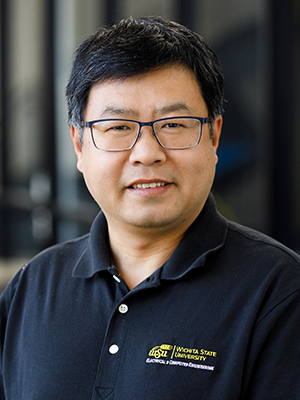
Chengzong Pang is an Associate Professor and MSECE Graduate Coordinator at the Department of Electrical and Computer Engineering, College of Engineering, Wichita State University. His work focuses on power systems, electrical engineering innovations, and renewable energy integration. He specializes in transient stability analysis, control systems, and smart grid technologies. Research Interests: Dr. Pang's expertise includes advanced control strategies for power electronics (e.g., PMSM, UPQC), machine learning applications for grid stability (LSTM/SVM), and energy storage solutions for renewable integration. His research also addresses challenges in microgrid operation, subsynchronous oscillation mitigation, and battery storage systems. Key Trends in Publications: Over 20 years of publications (2002–2022) emphasize: (1) Machine learning for power system analysis, (2) Control system design for renewable integration, (3) Grid stability enhancement via advanced algorithms, and (4) Smart grid infrastructure optimization. Recent works (2021–2022) highlight transient stability prediction and ANFIS-based power quality solutions. Labs/Teams: Active in energy systems research groups focusing on renewable integration and grid modernization, though specific lab names are not explicitly stated in the provided texts.
İlhan Kocaarslan is a Professor in the Department of Control and Automation Engineering at Istanbul Technical University (ITU), Faculty of Electrical and Electronic Engineering. His research focuses on advanced control systems, energy conversion, and sustainable transportation technologies. Research Interests: His work spans Load Frequency Control , Adaptive and Fuzzy Logic Control , PI Controllers , Electric Vehicle energy modeling , Battery and Fuel Cell systems , and Smart Grid integration . He actively contributes to innovations in renewable energy and electromobility. Publication Trends: Recent publications emphasize high-fidelity energy modeling for electric vehicles, optimization of battery systems, control strategies for fuel cells using fuzzy and Lyapunov-based PI controllers, and electromagnetic design for next-generation transportation like Hyperloop. His work bridges theoretical control design with practical energy applications. Scientific Awards: No awards mentioned in the provided text. Advising and Grants: He supervises 25 ongoing theses, indicating active mentorship. He is Principal Investigator (PI) on multiple research projects funded by ITU’s BAP and TTO programs, including initiatives on blockchain-based energy systems, hydrogen technologies, electric mobility, and cybersecurity-integrated sustainability platforms. Labs and Teams: While specific lab names are not mentioned, his role as PI on diverse energy and control projects suggests leadership in a multidisciplinary research group focused on smart energy systems, power electronics, and sustainable transportation at ITU.
Navid Bayati is an Associate Professor at the University of Southern Denmark, affiliated with the Institute of Mechanical and Electrical Engineering and the Centre for Industrial Electronics. He leads the Control and Protection of Smart Grids (CAP-SG) group and focuses on renewable/hybrid power systems, microgrid protection, and grid code compliance. Education: Ph.D. in Power Systems & Microgrid Protection (2020, Aalborg University); M.Sc. in Power Systems (2017, Amirkabir University of Technology) His research spans renewable energy integration , transient analysis , grid interconnection , and digital twin applications . Recent work includes machine learning for carbon emission prediction, fault localization in DC microgrids, and supercapacitor resilience in hybrid systems. Collaborations include projects like IEA Wind Task 50 and RePoSys , addressing grid renovation, life cycle assessment, and digital twin resilience. His teaching portfolio covers power electronics , energy management , and microgrid control .
Dr. Miguel Rico-Ramirez serves as Associate Professor of Radar Hydrology and Hydroinformatics at the University of Bristol's School of Civil, Aerospace and Design Engineering. His research integrates advanced radar technology with hydrological modeling to address critical water resource challenges including flood forecasting, drought management, and precipitation measurement across diverse global contexts from South Korea to Mexico City. Education: Bachelor of Engineering (Eng.) Master of Engineering (M.Eng.) Ph.D. in Engineering, University of Bristol His research program focuses on radar-based precipitation estimation, hydroinformatics, and flood prediction systems. He pioneers deep learning applications for rainfall nowcasting and develops innovative methods for uncertainty quantification in hydrological modeling. Current work emphasizes cosmic-ray neutron sensor validation, satellite-based flood mapping, and seasonal forecast applications for reservoir operations, with strong emphasis on translating research into operational water management solutions. Recent publications (2023-2025) reveal three dominant research thrusts: (1) deep learning frameworks for spatiotemporal rainfall prediction, (2) global validation of precipitation and soil moisture datasets using novel sensor networks, and (3) operational implementation of seasonal forecasts for drought mitigation in South Korea. His work consistently bridges radar meteorology with practical hydrological applications across urban and data-scarce environments. Scientific Awards: No specific awards documented in source materials Dr. Rico-Ramirez supervises postgraduate researchers in radar hydrology and hydroinformatics, with projects spanning flood early warning systems, precipitation nowcasting, and climate adaptation strategies. His research receives funding for international collaborations focused on water security challenges, particularly in drought-prone regions and data-scarce basins like the Nile Delta. Current grants support development of integrated forecasting systems combining global datasets with machine learning for extreme event management. He leads the Radar Hydrology research group within Bristol's Water and Environmental Engineering division, collaborating closely with Professor Dawei Han on hydroinformatics and Dr. Rafael Rosolem on water-climate interactions. The team maintains active partnerships with meteorological agencies and water authorities globally, particularly in flood forecasting system implementation across South Korea and Mexico.
Pooya Davari is a Professor and Head of the Section for Applied Power Electronic Systems at Aalborg University , Denmark. He leads the EMI/EMC in Power Electronics Research Group and serves as Vice Chair of the Energy Efficiency Mission. His research focuses on electromagnetic interference (EMI) and harmonic mitigation in power electronic systems, with over 200 publications and significant contributions to renewable energy integration. Education: B.Sc. and M.Sc. in Electronic Engineering (2004, 2008), Ph.D. in Power Electronics from Queensland University of Technology (2013) Prior Roles: Lecturer at QUT (2013–2014), Postdoc at AAU (2014) Research Interests: Harmonic and EMI analysis in grid-tied converters High power density converter design Signal processing for converter modeling Reliability of power electronic systems Article Trends: Recent work emphasizes EMI/EMC in renewable energy systems, wide bandgap semiconductors (SiC/GaN), and reliability modeling for EVs and hydrogen production via electrolysis. Sub-fields include converter topologies, grid integration challenges, and AI-driven diagnostics. Scientific Awards: Equinor 2022 Prize (Denmark’s oldest engineering award) IEEE EMC Society Young Professional Award (2020) World’s Top 2% Highly Cited Scientist (Stanford, 2021–2025) Multiple best paper awards (IEEE, Applied Sciences, etc.) Grants & Editorial Roles: Recipient of grants from Innovation Fund Denmark (Supra-EMC project), Horizon Europe (SOLARIS), and industry partnerships. Serves as Area Editor for IEEE Transactions on Transportation Electrification , Associate Editor for IEEE Transactions on Power Electronics , and Editor-in-Chief of Circuit World Journal (2020–2025). Labs & Standards: Coordinator of the EMC Laboratory at Aalborg University. Member of IEC standardization Working Groups 6 and 8 (TC77A), focusing on EMC strategies for power grids.
Maneesh Agrawala is the Forest Baskett Professor of Computer Science and Director of the Brown Institute for Media Innovation at Stanford University. He is also a consulting AI Scientist at Roblox. His research lies at the intersection of computer graphics, human-computer interaction (HCI), and visualization, with a focus on cognitive design principles for improving audio/visual media. He leads a vibrant research group and has advised numerous PhD students and postdocs. His research interests include: Computer Graphics Human-Computer Interaction Visualization and Visual Communication Cognitive Design Principles Generative AI and Diffusion Models Interactive Video and Sketch-based Interfaces Data and Information Visualization His recent publications (2023–2025) reflect a strong trend toward leveraging generative models—particularly diffusion models—for video and image synthesis, editing, and personalization. Key themes include controllable generation (e.g., SparseCtrl, ControlNet), sketch-to-image translation, relightable texturing, and tools that enhance visual storytelling and data communication. His work integrates cognitive science with computational tools to build systems that support human creativity and understanding. His scientific honors include: MacArthur Foundation Fellowship (2009) Alfred P. Sloan Foundation Fellowship (2007) NSF CAREER Award (2007) SIGGRAPH Significant New Researcher Award (2008) Allen Distinguished Investigator Award (2014) Induction into the SIGCHI Academy (2021) ACM Fellow (2022) Okawa Foundation Research Grant (2006) A dedicated mentor, Agrawala has advised a large cohort of students and postdocs, many of whom have gone on to influential positions in academia and industry. His lab develops tools for video editing (e.g., AnimateDiff, ControlNet), sketch-based design, and visualization (e.g., EmphasisChecker), often bridging theory with practical applications in media and education. He continues to be a leading figure in visual computing and interactive systems.