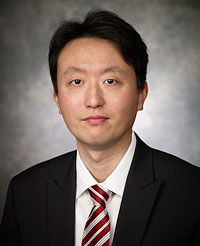
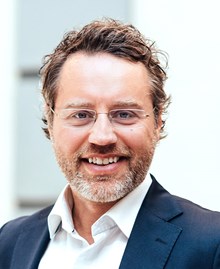
Wooram Park is an Associate Professor in the Department of Mechanical Engineering at the University of Texas at Dallas (UT Dallas), affiliated with the Erik Jonsson School of Engineering and Computer Science. He leads the Robotics and Intelligent Systems Laboratory (ROBINS Lab) and holds a PhD from Johns Hopkins University (2008), along with MS and BS degrees from Seoul National University (2003 and 1999). His research focuses on robotics, biomedical robotics, computational structural biology, and image processing. Key projects include flexible needle steering for medical applications, haptic feedback systems, and advanced algorithms for motion planning and image reconstruction. He has received notable awards such as the Creel Fellowship (2007) and Critics’ Choice Award in ArtBot Design (2004). His work spans theoretical contributions in stochastic systems and practical innovations like vibratory magnetic robots (Vimbot) and wearable haptic devices. The ROBINS Lab emphasizes interdisciplinary research at the intersection of mechanical engineering, computer science, and biomedical applications.
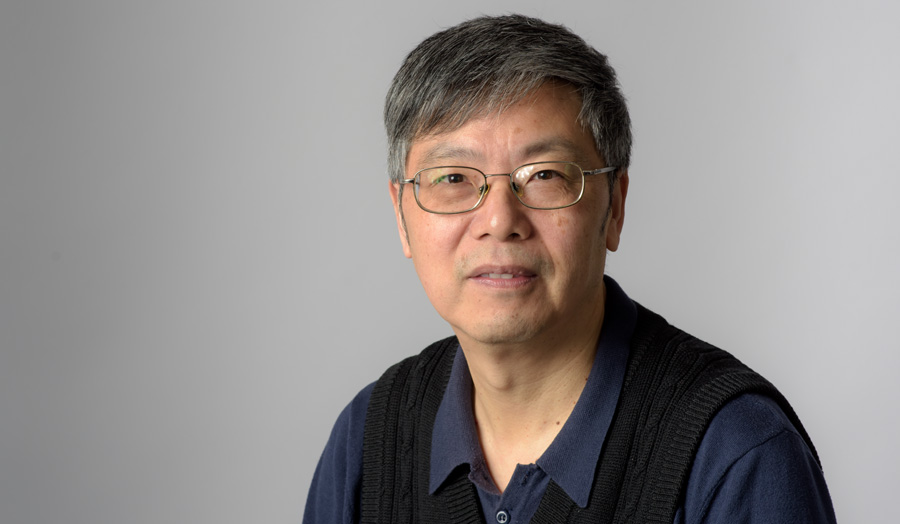
Dr. Tingkai Wang is a Senior Lecturer in the School of Computing and Digital Media at London Metropolitan University. His research focuses on mobile robots, intelligent systems, artificial intelligence, control systems, image/signal processing, and virtual reality. He teaches the Programming for Computer Science module and has led projects like the Virtual Environment and Simulation System (2000-2002) and Navigation and Control of Mobile Robots (1995-1998). His work emphasizes interdisciplinary approaches, combining expert systems, neural networks, and fuzzy logic to address challenges in autonomous systems. Notable contributions include AGV navigation algorithms, hybrid control systems, and predictive modeling. Over 30 publications span robotics, control engineering, and AI applications. He collaborates internationally and has presented at venues like the International Conference on Intelligent Systems Engineering and the IEEE Conference on Engineering in Medicine and Biology. Dr. Wang’s expertise bridges theoretical modeling and practical implementation, with applications in manufacturing automation, environmental monitoring, and industrial management systems. His current research continues exploring adaptive control mechanisms and AI-driven robotics solutions.
John F. Reid is a prominent Research Professor at the University of Illinois at Urbana-Champaign in the College of Engineering , with dual appointments in Computer Science and Agricultural and Biological Engineering . He serves as Executive Director of the Center for Digital Agriculture . With over 35 years of experience in academic and industrial R&D, his career spans faculty roles at UIUC (1986-2000), leadership at Deere & Company (2000-2020), and Vice President positions at Brunswick Corporation (2020-2022). Education : Ph.D. in Agricultural Engineering (Texas A&M, 1987), M.S. and B.S. in Agricultural Engineering (Virginia Tech, 1982 & 1980) Dr. Reid's research focuses on agricultural automation , machine vision , and innovation management . He has pioneered agricultural robotics , precision technologies , and embodied AI applications in food, construction, and marine systems. His work has resulted in over 30 patents in automated guidance , sensor systems , and agricultural informatics . His scientific contributions center on stereo vision navigation , 3D field mapping , and adaptive control systems for mobile equipment. These innovations underpin modern precision agriculture and agricultural robotics frameworks. Major awards include: NAE Election (2019) ASABE Fellow (2004) University Scholar (1995) Academy of Engineering Excellence (2020) He holds leadership roles in international organizations including the CIGR Working Group on Circular Bioeconomy Systems (Chair 2024-present) and Fraunhofer USA (2013-2022).
Professor Min An is a Professor of Construction and Risk Management at the University of Salford, leading the Infrastructure Research Group within the School of Science, Engineering & Environment. He holds an honorary professorship at two overseas universities (China and Portugal) and serves on the editorial boards of 12 international journals. With over 40 years of experience, his career spans academic roles at Heriot-Watt University, Coventry University, and the University of Birmingham, alongside industry roles as a civil engineer and researcher. His research focuses on safety and risk management in construction, transportation systems, and energy sectors, with over 200 publications. Key areas include railway and highway safety, offshore oil & gas risk assessment, and nuclear reliability management. He has secured funding from EPSRC, EU, DfT, and industry partners, leading 20+ projects. Notable achievements include developing methodologies for infrastructure safety and maintaining collaborations with 30+ industrial partners. Professor An has supervised 30 PhD students and over 280 postgraduate projects, contributing to industry workshops and best practices. Awards include multiple science technology prizes and conference best paper/keynote recognitions. His teaching spans risk management, construction safety, and project management across MSc programs.
Professor Brian Surgenor is a faculty member at Queen's University's Department of Mechanical and Materials Engineering, part of the Smith Engineering faculty. He holds a B.Sc. (1977), M.Eng. (AECL/Whiteshell), and Ph.D. (1983) in Mechanical Engineering from Queen's University. His research focuses on machine vision systems for automation, autonomous vehicle navigation, and mechatronic system design education. He has held key administrative roles including Department Head (1993-2002), Associate Dean (2008-2013), and Vice-Dean (2013-2016). His work emphasizes interdisciplinary innovation, such as the Mitchell Hall design project and contributions to Ingenuity Labs. Education: B.Sc. Mechanical Engineering, Queen's University (1977) M.Eng. Engineering Physics, McMaster University (AECL/Whiteshell) Ph.D. Mechanical Engineering, Queen's University (1983) Research interests include: - Pneumatic servosystems - Intelligent algorithms for machine vision - Off-road autonomous vehicle systems - Mechatronics education methodologies - Hybrid powertrain systems for vehicles His recent publications (2017–2024) explore autonomous systems, machine vision applications, and fuel cell hybrid technologies. Notable trends include advancements in UAV-based infrastructure inspection, terrain-adaptive autonomous driving, and low-cost machine vision solutions for small part sorting. His work bridges theoretical control systems with practical industrial automation challenges. He has contributed to laboratory design for CDIO curricula and pioneered mechatronics education through problem-based learning. His administrative leadership has shaped Queen's engineering graduate programs and research infrastructure. Currently involved in Ingenuity Labs, fostering cross-disciplinary innovation.
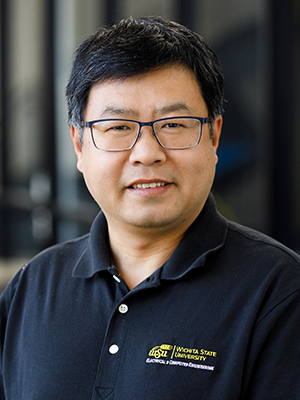
Chengzong Pang is an Associate Professor and MSECE Graduate Coordinator at the Department of Electrical and Computer Engineering, College of Engineering, Wichita State University. His work focuses on power systems, electrical engineering innovations, and renewable energy integration. He specializes in transient stability analysis, control systems, and smart grid technologies. Research Interests: Dr. Pang's expertise includes advanced control strategies for power electronics (e.g., PMSM, UPQC), machine learning applications for grid stability (LSTM/SVM), and energy storage solutions for renewable integration. His research also addresses challenges in microgrid operation, subsynchronous oscillation mitigation, and battery storage systems. Key Trends in Publications: Over 20 years of publications (2002–2022) emphasize: (1) Machine learning for power system analysis, (2) Control system design for renewable integration, (3) Grid stability enhancement via advanced algorithms, and (4) Smart grid infrastructure optimization. Recent works (2021–2022) highlight transient stability prediction and ANFIS-based power quality solutions. Labs/Teams: Active in energy systems research groups focusing on renewable integration and grid modernization, though specific lab names are not explicitly stated in the provided texts.
Professor Mohan Lal Kolhe is a distinguished academic at the University of Agder , serving as a Full Professor in Smart Grid and Renewable Energy within the Faculty of Engineering and Science and the Department of Engineering Sciences . With over three decades of international academic experience, he has held positions at prestigious institutions including University College London, University of Dundee, and Hydrogen Research Institute in Canada. His career spans technical innovation, policy development (e.g., as a member of South Australia’s Renewable Energy Board), and extensive research leadership in sustainable energy systems. Research Leadership : Focus on Smart Grid integration, Electric Vehicles, Hydrogen Energy, Solar/Wind Systems, and Techno-Economic Energy Analysis. Global Recognition : Listed in the top 2% of scientists worldwide (2020-2023) by Stanford University, with 10 publications averaging 200+ citations. Recent publications emphasize advanced optimization techniques for renewable integration, EV charging infrastructure, hydrogen production, and power system stability. His work has secured competitive funding from entities like the Norwegian Research Council and EU programs. Awards and Expert Roles : Top 2% Global Scientist (Stanford, 2020-2023) Highly Cited Researcher (Top 10 publications, 200+ avg. citations) Expert evaluator for European Commission, Royal Society London, EPSRC, and Cyprus Research Foundation He actively contributes to international conferences as keynote speaker and editorial board member, with leadership roles in research groups like Autonomous and Cyber-Physical Systems and Energy Systems .
İlhan Kocaarslan is a Professor in the Department of Control and Automation Engineering at Istanbul Technical University (ITU), Faculty of Electrical and Electronic Engineering. His research focuses on advanced control systems, energy conversion, and sustainable transportation technologies. Research Interests: His work spans Load Frequency Control , Adaptive and Fuzzy Logic Control , PI Controllers , Electric Vehicle energy modeling , Battery and Fuel Cell systems , and Smart Grid integration . He actively contributes to innovations in renewable energy and electromobility. Publication Trends: Recent publications emphasize high-fidelity energy modeling for electric vehicles, optimization of battery systems, control strategies for fuel cells using fuzzy and Lyapunov-based PI controllers, and electromagnetic design for next-generation transportation like Hyperloop. His work bridges theoretical control design with practical energy applications. Scientific Awards: No awards mentioned in the provided text. Advising and Grants: He supervises 25 ongoing theses, indicating active mentorship. He is Principal Investigator (PI) on multiple research projects funded by ITU’s BAP and TTO programs, including initiatives on blockchain-based energy systems, hydrogen technologies, electric mobility, and cybersecurity-integrated sustainability platforms. Labs and Teams: While specific lab names are not mentioned, his role as PI on diverse energy and control projects suggests leadership in a multidisciplinary research group focused on smart energy systems, power electronics, and sustainable transportation at ITU.
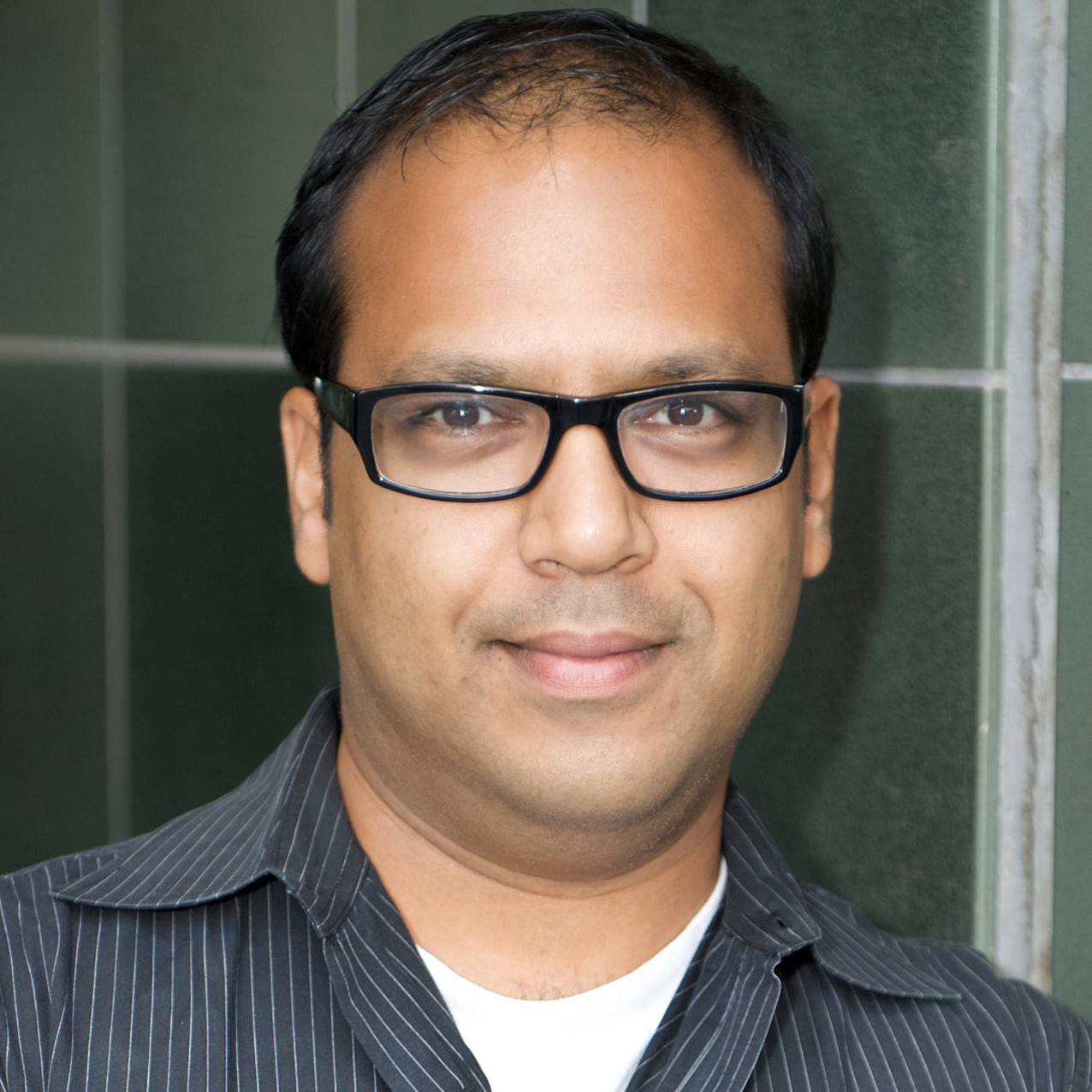
Pooya Davari is a Professor and Head of the Section for Applied Power Electronic Systems at Aalborg University , Denmark. He leads the EMI/EMC in Power Electronics Research Group and serves as Vice Chair of the Energy Efficiency Mission. His research focuses on electromagnetic interference (EMI) and harmonic mitigation in power electronic systems, with over 200 publications and significant contributions to renewable energy integration. Education: B.Sc. and M.Sc. in Electronic Engineering (2004, 2008), Ph.D. in Power Electronics from Queensland University of Technology (2013) Prior Roles: Lecturer at QUT (2013–2014), Postdoc at AAU (2014) Research Interests: Harmonic and EMI analysis in grid-tied converters High power density converter design Signal processing for converter modeling Reliability of power electronic systems Article Trends: Recent work emphasizes EMI/EMC in renewable energy systems, wide bandgap semiconductors (SiC/GaN), and reliability modeling for EVs and hydrogen production via electrolysis. Sub-fields include converter topologies, grid integration challenges, and AI-driven diagnostics. Scientific Awards: Equinor 2022 Prize (Denmark’s oldest engineering award) IEEE EMC Society Young Professional Award (2020) World’s Top 2% Highly Cited Scientist (Stanford, 2021–2025) Multiple best paper awards (IEEE, Applied Sciences, etc.) Grants & Editorial Roles: Recipient of grants from Innovation Fund Denmark (Supra-EMC project), Horizon Europe (SOLARIS), and industry partnerships. Serves as Area Editor for IEEE Transactions on Transportation Electrification , Associate Editor for IEEE Transactions on Power Electronics , and Editor-in-Chief of Circuit World Journal (2020–2025). Labs & Standards: Coordinator of the EMC Laboratory at Aalborg University. Member of IEC standardization Working Groups 6 and 8 (TC77A), focusing on EMC strategies for power grids.
Maneesh Agrawala is the Forest Baskett Professor of Computer Science and Director of the Brown Institute for Media Innovation at Stanford University. He is also a consulting AI Scientist at Roblox. His research lies at the intersection of computer graphics, human-computer interaction (HCI), and visualization, with a focus on cognitive design principles for improving audio/visual media. He leads a vibrant research group and has advised numerous PhD students and postdocs. His research interests include: Computer Graphics Human-Computer Interaction Visualization and Visual Communication Cognitive Design Principles Generative AI and Diffusion Models Interactive Video and Sketch-based Interfaces Data and Information Visualization His recent publications (2023–2025) reflect a strong trend toward leveraging generative models—particularly diffusion models—for video and image synthesis, editing, and personalization. Key themes include controllable generation (e.g., SparseCtrl, ControlNet), sketch-to-image translation, relightable texturing, and tools that enhance visual storytelling and data communication. His work integrates cognitive science with computational tools to build systems that support human creativity and understanding. His scientific honors include: MacArthur Foundation Fellowship (2009) Alfred P. Sloan Foundation Fellowship (2007) NSF CAREER Award (2007) SIGGRAPH Significant New Researcher Award (2008) Allen Distinguished Investigator Award (2014) Induction into the SIGCHI Academy (2021) ACM Fellow (2022) Okawa Foundation Research Grant (2006) A dedicated mentor, Agrawala has advised a large cohort of students and postdocs, many of whom have gone on to influential positions in academia and industry. His lab develops tools for video editing (e.g., AnimateDiff, ControlNet), sketch-based design, and visualization (e.g., EmphasisChecker), often bridging theory with practical applications in media and education. He continues to be a leading figure in visual computing and interactive systems.
Tracy Becker is an Adjunct Assistant Professor in the Department of Civil Engineering at McMaster University, where she has been since 2014. Her expertise lies in the design, modeling, and experimental testing of high-performance structural systems with a focus on seismic isolation. Education: BS in Structural Engineering, University of California, San Diego MS and PhD in Structural Engineering, Mechanics and Materials, University of California, Berkeley Post-doctoral research at Kyoto University's Disaster Prevention Research Institute Research Interests: Becker specializes in seismic isolation systems, hybrid simulation methods, and structural performance under extreme events. Her work spans bridge engineering, nuclear infrastructure protection, and innovative materials for earthquake resilience. She integrates computational modeling with experimental validation to address challenges in: Nonlinear system behavior in isolated structures Multi-hazard optimization for seismic and wind loads Bridge management using data-driven and fuzzy logic frameworks Advanced gusset plate design for seismic retrofit Adaptive isolation systems for nuclear facilities Probabilistic lifetime demand predictions for infrastructure Teaching: She has instructed courses in Seismic Design (CIVENG 4ED4), Structural Mechanics (CIVENG 2C04), and Earthquake Engineering (CIVENG 730) at McMaster University.
Ebru Turanoglu Bekar is a Senior Lecturer at the Department of Industrial and Materials Science, Chalmers University of Technology, specializing in Smart Maintenance and Production Systems. She contributes to the Production Service Systems & Maintenance research group. Research Interests: Total Productive Maintenance (TPM), Artificial Intelligence applications in manufacturing, Multi-Criteria Decision Making, Performance Measurement systems Recent Focus: Development of data-driven algorithms for predictive maintenance, integration of digital twins in industrial contexts Key Projects: Factory SensAI (2025–2028) - Data integration for AI in manufacturing Trustworthy Predictive Maintenance TPdM (2022–2025)
Martin Carlsson-Wall is a Full Professor at Stockholm School of Economics (SSE) in the Department of Accounting within the House of Governance and Public Policy. He serves as Center Director for both the Center for Municipality Governance and the Center for Security and Resilience. In 2024, he was named "The Linder Chair in Sports and Business," the first Chair at SSE on Sports and Business topics. Since 2017, he has been Program Director for the MSc in Accounting, Valuation and Financial Management, and in 2015, he founded the Center for Sports and Business, which now includes 40 faculty members and has strategic partnerships with major Swedish sports organizations across football, hockey, golf, and skiing. Martin Carlsson-Wall's research focuses on accounting in sports organizations and accounting in inter-organisational relationships across both private and public sectors. His work extensively examines management control systems , particularly in contexts of innovation , growth companies , and risk management . His research often takes a qualitative approach, investigating how accounting practices function in extreme situations (such as the Swedish migrant crisis), high-intensity organizations (like football clubs), and during organizational change processes. Analysis of Professor Carlsson-Wall's recent publications reveals a strong thematic focus on the intersection of accounting practices with sports management and public sector administration. His work demonstrates how management control systems adapt to different organizational contexts, from football clubs to technology firms and public administration during crises. A recurring theme is how accounting practices mediate tensions between different stakeholder interests and how they evolve in response to organizational challenges. His research methodology typically employs in-depth case studies that examine accounting as a social practice rather than merely a technical function. Professor Carlsson-Wall has received significant recognition through his appointment as "The Linder Chair in Sports and Business" in 2024, establishing the first dedicated research position at SSE focusing on the business aspects of sports. As an educator, Professor Carlsson-Wall serves as Program Director for the MSc in Accounting, Valuation and Financial Management and teaches several key courses including BE901 Hybrid Organizations: Value Creation and Strategy at the bachelor's level, and course 3313 Investments and Value Creation in Global Sports (which he directs) and course 3302 Management Control at the master's level. He also supervises master's theses in Accounting and Financial Management. In Executive Education, he teaches on management control, costing, performance management, transfer pricing, investment management, and financial analysis through both open programs and customized corporate offerings. Professor Carlsson-Wall founded and directs the Center for Sports and Business, which has grown to include 40 faculty members and established partnerships with major Swedish sports organizations. He also leads the Center for Municipality Governance and the Center for Security and Resilience, demonstrating his commitment to applying accounting and management control research to practical governance challenges in both public and private sectors.
Nadjib Brahimi is an Associate Professor at Rennes School of Business, specializing in Supply Chain Management and Operations Research. He holds a PhD in Production and Logistics Systems from Université de Nantes and has extensive academic experience, including roles as Academic Head of the Supply Chain Management & Information Systems department (2019–2020) and Programme Manager of the MSc in Data and Business Analytics. His expertise spans Production Planning, Supply Chain Optimization, and Reconfigurable Manufacturing Systems. Education: PhD in Production and Logistics Systems, Université de Nantes, 2004 M.Sc. in Automatic Control and Applied Computing, Ecole Centrale de Nantes, 2001 Engineering Degree in Electronics and Electrical Engineering, National Institute of Electronics and Electrical Engineering, Boumerdes, Algeria, 1999 Research Focus: His work emphasizes optimization of production systems, reconfigurable manufacturing, and sustainable supply chains. Key areas include task reassignment in assembly lines, biomass supply chain design, and disruption resilience strategies. Key Contributions: Over 40 peer-reviewed articles in journals like International Journal of Production Economics and European Journal of Operational Research . Developed robust optimization models for supplier selection and production routing. Advocated for circular economy principles in hybrid manufacturing systems. Labs/Teams: He collaborates with research groups on reconfigurable manufacturing systems and bioenergy supply chain design, contributing to projects in France, UAE, and Algeria.
Soufiene Djahel is a Professor at the Centre for Future Transport and Cities (CFTC) at Coventry University, UK. His research focuses on connected and autonomous vehicles (CAVs), unmanned aerial vehicles (UAVs), cyber security, and smart cities. He holds a PhD in Secure Routing and Medium Access Protocols from Université des Sciences et Technologies de Lille (2010), and has held academic positions including Senior Lecturer at the University of Huddersfield and Manchester Metropolitan University. His research interests include CAV coordination protocols, cyber-physical security solutions, and intelligent transportation systems. Djahel leads projects such as the £1.2M AeroPharma Logistics initiative and has secured funding from the Newton Fund and JSPS. He is a recipient of the 2021 JSPS Invitational Fellowship and has published extensively in IEEE journals and conferences. Current projects explore UAVs-as-a-service, digital twins for CAVs, and B5G/6G for smart infrastructure. He advises PhD students on topics like AI-based threat mitigation and transport electrification. Djahel also serves as an external examiner and editorial board member for journals like IEEE Transactions on Intelligent Transportation Systems.