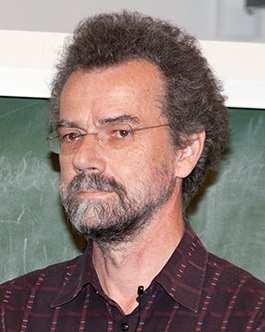
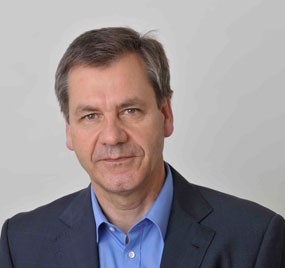
Prof. Dr. Peter Schneider is a faculty member at the University of Münster, affiliated with the Faculty of Mathematics and Computer Science and the Department of Mathematics and Computer Science . He is a principal investigator in the CRC 1442 Geometry: Deformations and Rigidity and contributes to the Mathematics Münster cluster. University: University of Münster School: Faculty of Mathematics and Computer Science Department: Department of Mathematics and Computer Science Academic Rank: Professor His research focuses on arithmetic geometry and representation theory , particularly the p-adic Langlands program , cohomology theories in mixed characteristics, and noncommutative algebraic structures. He investigates derived categories of p-adic representations, moduli spaces of Galois representations, and geometric approaches to automorphic forms. He has supervised numerous students, including Torsten Schoeneberg (2009), Marten Bornmann (2009), and Marius Kley (2016, 2019). His collaborative works with Rachel Ollivier, Otmar Venjakob, and Marie-France Vigneras explore modular Hecke algebras, Iwasawa theory, and (phi, Gamma)-modules. Emails: pschnei@wwu.de pschnei@uni-muenster.de Workshops Organized: Noncommutative Algebras (2006) Instructional workshop on noncommutative main conjectures (2011) International workshop on K-types for p-adic groups (2003)
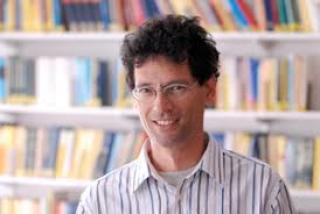
Christopher Deninger is a distinguished Professor in the Mathematical Institute at the University of Münster, Germany, where he leads research in Arithmetic Geometry and Representation Theory. His office is located in Room 413 of the Einsteinstr. 62 building, and he maintains active teaching responsibilities including courses in Representation Theory of Finite Groups, Linear Algebra, and specialized topics like Adic Spaces. Deninger's research spans multiple interconnected domains of modern mathematics, with a consistent focus on the deep connections between number theory and geometry. His work has evolved from classical arithmetic geometry to incorporate increasingly sophisticated connections with p-adic analysis, dynamical systems, and more recently proalgebraic fundamental groups. A unifying theme throughout his career has been exploring analogies between different mathematical structures, particularly those connecting analytic number theory with dynamical systems on foliated spaces. His recent publications reveal a continued expansion of his research program into new territories while maintaining connections to his foundational work. The most recent papers show increasing integration of algebraic topology concepts with arithmetic geometry, particularly through proalgebraic fundamental groups and their applications. The consistent thread throughout his decades of publications is the search for deeper structural connections between seemingly disparate areas of mathematics, particularly those bridging analysis, geometry and number theory. Professor Deninger has mentored an extensive number of doctoral students and postdoctoral researchers, as evidenced by the comprehensive list of former members in his working group. His collaborations span the international mathematical community, with numerous joint publications with leading mathematicians across Europe and beyond. While specific grant information isn't detailed in the available materials, his sustained publication record across decades suggests consistent research support for his mathematical investigations. The Mathematical Institute at Münster provides the institutional home for Deninger's research activities, where he maintains an active working group focused on arithmetic geometry and related fields. His office environment includes support staff and colleagues working in closely related mathematical domains, creating a vibrant research community centered around advanced topics in pure mathematics.
Prof. Dr. Harald Tauchmann is a Professor of Health Economics at Friedrich-Alexander University Erlangen-Nuremberg (FAU), where he has held a faculty position since 2013. He is affiliated with the School of Business, Economics and Social Sciences, specifically within the Department of Economics. Prof. Tauchmann also participates in multiple research focus areas at FAU, including 'Insurance and Risk' and 'Work in Transition,' demonstrating his interdisciplinary approach to health economics. Prof. Tauchmann received his education at Heidelberg University and the University of Manchester, UK, where he studied economics, political science, and sociology. He graduated in 1998 and completed his doctorate at the Interdisciplinary Institute for Environmental Economics (University of Heidelberg) in 2003. Prior to joining FAU, he worked as a research associate at the Rhineland-Westphalian Institute for Economic Research (RWI) in Essen from 2003 to 2012 and headed a junior research group at the health economics research center CINCH at the University of Duisburg-Essen. His research expertise lies in empirical health economics, with a particular emphasis on health insurance choice and competition, as well as individual health behavior. He has made significant contributions to understanding obesity, health shocks, mental health care payment systems, and thyroid diagnostics through his extensive publication record. His methodological work includes developing specialized Stata modules for econometric analysis, which have been widely adopted by researchers in the field. Prof. Tauchmann's scholarly work demonstrates a consistent focus on applying rigorous econometric methods to pressing health policy questions. His research portfolio shows particular strength in causal analysis of health behavior, especially regarding obesity interventions, health insurance market dynamics, and the economic consequences of health shocks. His recent publications (including several forthcoming in 2025) indicate continued scholarly productivity and relevance to current health policy debates. From March 2021 to April 2022, Prof. Tauchmann served as chairman of the German Society for Health Economics, highlighting his leadership and recognition within the national health economics community. His email contact is harald.tauchmann@fau.de for professional inquiries.
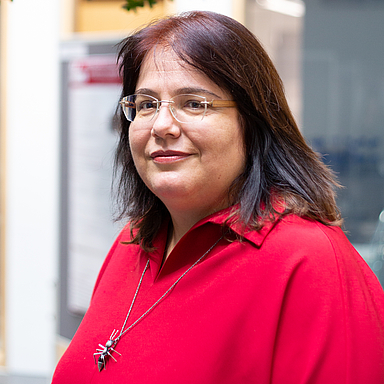
Prof. Dr. Susanne Foitzik is a Professor of Evolutionary Biology at Johannes Gutenberg University Mainz since 2010, where she leads the Evolution & Behavioral Ecology of Ants research group at the Institute of Organismic and Molecular Evolution (IOME). Previously, she was Professor in Behavioral Ecology at LMU Munich (2004-2010) and Assistant Professor in Zoology at the University of Regensburg (2000-2004). She earned her PhD in Biology from Julius Maximilian University, Würzburg in 1998. Her research integrates approaches from behavioral ecology through genomics to epigenetics, focusing on ants as model organisms to study complex social behaviors. Host-parasite coevolution and social parasitism in ants Molecular mechanisms underlying division of labor Reversal of the fecundity-longevity trade-off in social insects Gene regulation in phenotypic plasticity Evolution of chemical communication systems Analysis of her recent publications (2022-2025) reveals a strong focus on molecular mechanisms of social behavior, with particular emphasis on host-parasite interactions, epigenetic regulation of behavior, and genomic adaptations in social insects. Her work increasingly combines transcriptomic, proteomic, and functional genomic approaches to understand the molecular basis of social evolution. Among her notable scientific achievements: Speaker of Research Training Group 2626 GenEvo: Gene Regulation in Evolution (2019-present) Speaker of EES Master Program funded by VW foundation (2007-2010) DAAD Fellow at State University of New York (1992-93) Prof. Foitzik has supervised numerous PhD students and postdocs, including Maide Macit, Tom Sistermans, and Marcel Caminer. Her research is supported by multiple DFG-funded projects investigating host-parasite coevolution, the role of gene regulation in division of labor, and parasite interference in host gene expression. She serves as Handling Editor for Biology Letters and previously served on the editorial board of Insectes Sociaux. Her research group operates within the Institute of Organismic and Molecular Evolution (IOME) at Mainz, with laboratory facilities at the Biozentrum I. The group collaborates extensively with researchers across Germany and internationally, including partnerships with institutions in Frankfurt, Freiburg, Bristol, and Tel Aviv.
Luigi Acerbi is an Associate Professor in the Department of Computer Science at the University of Helsinki, where he leads the Machine and Human Intelligence research group. He is also an active member of the Finnish Center for Artificial Intelligence (FCAI) and ELLIS (European Laboratory for Learning and Intelligent Systems). His research focuses on probabilistic machine learning and computational neuroscience, particularly on developing efficient methods for statistical inference, Bayesian models of perception, and resource-constrained rationality. His work bridges machine learning and cognitive science, with applications in Bayesian optimization, simulation-based inference, and image completion. The recent publications highlight a strong trend toward unifying probabilistic conditioning across diverse tasks using transformer-based meta-learning frameworks like the Amortized Conditioning Engine (ACE). These works emphasize amortized inference, flexible latent variable modeling, and the integration of prior knowledge at runtime, enabling efficient and scalable Bayesian methods for complex problems. Scientific Affiliations: University of Helsinki, Department of Computer Science Finnish Center for Artificial Intelligence (FCAI) ELLIS (European Laboratory for Learning and Intelligent Systems) Education: PhD in Computational Neuroscience, Doctoral Training Centre, Edinburgh, UK Advisor: Sethu Vijayakumar and Daniel Wolpert Visiting work at Computational and Biological Learning Lab, Cambridge Postdoctoral Experience: Alex Pouget’s lab, University of Geneva, Switzerland Wei Ji Ma, New York University, USA Collaboration with the International Brain Laboratory Luigi Acerbi mentors PhD students including Daolang Huang and Nasrulloh Loka, and collaborates widely with researchers such as Samuel Kaski. He has contributed to open-source tools like PyVBMC and is involved in community initiatives such as the EurIPS conference. His work is supported by grants from the Research Council of Finland, Business Finland, and the UKRI Turing AI World-Leading Researcher Fellowship. He leads a research lab focused on amortized probabilistic inference, with ongoing projects including PriorGuide and Stacked VBMC, aiming to make Bayesian methods more practical and accessible for real-world scientific and engineering applications.
Daniel Schnurr holds the Chair of Machine Learning, especially Uncertainty Quantification at the University of Regensburg since August 2022, where he conducts research at the intersection of artificial intelligence, data economics, and digital market regulation. Previously, he headed the Data Policies research group at the University of Passau, building his expertise in the economic and regulatory aspects of digital markets. His educational background includes a doctorate in business informatics from the Karlsruhe Institute of Technology (2016), where he also worked for three years as a research associate at the Institute for Information Systems and Marketing. He completed his undergraduate and master's studies in Information Systems at KIT (2007-2013), with international experience at Concordia University in Canada and Singapore Management University. Professor Schnurr's research focuses on the technical, economic, and social implications of new machine learning methods and data as a decisive competitive factor and driver of innovation in digital markets. His work examines how data functions as both an economic asset and regulatory challenge, particularly in contexts of market power, competition policy, and AI governance. He investigates uncertainty quantification in machine learning systems while considering their broader economic and societal impacts. His publication portfolio demonstrates consistent output in top-tier journals including Management Science, Journal of Information Technology, and Journal of Competition Law & Economics, with recent work increasingly focusing on AI regulation, data access remedies, and uncertainty-aware AI systems. The trajectory shows evolution from telecommunications infrastructure research to contemporary digital market and AI regulation issues. As a Research Fellow at the Centre on Regulation in Europe (CERRE) since 2022, he has authored numerous policy reports addressing regulation of cloud computing services, digital platforms, and data economy frameworks. His policy contributions bridge academic research with practical regulatory implementation, particularly regarding the European AI Act and Digital Services Act. His research program involves experimental approaches to understanding data markets, human-AI interaction dynamics, and regulatory effectiveness. Through his work at CERRE and collaborations with international scholars, he contributes to shaping evidence-based digital policy in the European context while maintaining strong connections to academic research communities in information systems and economics.
Lieselotte Ahnert serves as a Visiting Professor for Developmental Psychology at the Free University of Berlin's Department of Education and Psychology, specifically within the Department of Developmental Science and Applied Developmental Psychology. Her academic journey began at Humboldt University in East Berlin, where she studied psychology during a period of significant political change in the GDR. After completing her doctorate in 1982, she held various research positions including director of the Interdisciplinary Center for Applied Socialization Research (IZAS e.V.) from 1991-1996 and a visiting scientist position at the National Institutes of Health in Washington from 1996-1999. Prior to her current position at FU Berlin (since 2019), she was a Professor of Developmental Psychology at the University of Vienna from 2008-2019. Professor Ahnert's research focuses on early childhood development, attachment theory, and the specific contributions of fathers to child development. Her work examines how children develop within various caregiving contexts, including the transition from home to childcare settings, the effects of socioeconomic disadvantage on attachment security, and the unique role fathers play in children's language development and emotional regulation. She has conducted extensive research on stress responses in infants during childcare transitions and how care providers influence these responses. Her interdisciplinary approach draws from behavioral biology, genetics, neuroscience, pediatrics, and education to understand the complex interplay between genetic and environmental influences in early development. Ahnert's publication record demonstrates significant contributions to understanding father-child relationships, with recent work exploring how fathers' attachment security and education contribute to early child language skills beyond mothers' influence. Her research has also examined the 'terrible twos' phase, investigating how children cope with frustration and tantrums and how parents support them through these developmental challenges. She has published extensively in high-impact journals including Child Development, Developmental Psychobiology, and Attachment and Human Development. Professor Ahnert has received recognition for her expertise, including being commissioned to provide expertise for the Federal Chancellery of Austria in 2021. Her work has practical applications in early childhood education and intervention programs, particularly in understanding how public childcare can compensate for developmental risks in socioeconomically disadvantaged children. In addition to her research, Ahnert has made significant contributions to academic training and supervision. Her book publications, including 'It's the fathers who matter' (2023) and 'How much mother does a child need?' (2020), bridge the gap between academic research and public understanding of child development. Her work continues to influence both academic discourse and practical approaches to early childhood care and education.
Holger Wittges is the Managing Director of the SAP University Competence Center (UCC) at the Technische Universität München (TUM) . His work focuses on Digital Transformation , Next Generation ERP , and Hybrid Cloud infrastructure. He is affiliated with the KrcmarLab and collaborates with IBM via the OpenPOWER@TUM initiative. Educational Background: 2004: Dr. rer. oec. (Promotion), Universität Hohenheim 1996: Diplom Wirtschaftsinformatiker, Universität Bamberg Research Interests include Digital Transformation, Cloud Computing, Enterprise Resource Planning (ERP), XaaS (Everything as a Service), and Service-Oriented Architecture (SOA). His work bridges academic innovation with industry needs through SAP UCC TUM, which provides 40+ educational service bundles like SAP HANA and S/4HANA for teaching and research. Recent Publications highlight advancements in machine learning for ERP support ticket systems, energy efficiency in SAP S/4HANA, and educational frameworks for cloud-based enterprise software. Articles emphasize collaboration with institutions across Europe and contributions to digital ecosystems like the SAP University Alliances. Key Projects include the OpenPOWER@TUM initiative with IBM, focusing on accessible AI/ML infrastructure for academia, and the SAP UCC TUM, which drives Education as a Service (EaaS) strategies for digital business ecosystems.
Muhammad Ali Gulzar is an Assistant Professor in the Computer Science Department at Virginia Tech and an Amazon Scholar at Amazon Web Services. His research focuses on improving developer productivity through automated debugging and testing for applications in emerging domains, including data-intensive software such as dataflow programs, ML/AI applications, and computational notebooks. Education Ph.D. in Computer Science from University of California, Los Angeles (Google Ph.D. Fellow 2017-2020) Research Interests Gulzar's research spans three primary areas: (1) automated tracking-code localization techniques in web applications, (2) re-engineering testing and debugging for data-intensive applications, and (3) advancing current testing and debugging practices in Federated Learning Applications. His work addresses the challenges of debugging in complex systems where traditional approaches fail due to the scale and distributed nature of modern applications. His research has significant implications for improving software quality, developer productivity, and accessibility in web applications. Research Trends Recent publications demonstrate a strong focus on debugging and testing challenges in emerging application domains. His work bridges traditional software engineering with machine learning, data-intensive systems, and web technologies. Notably, he has made significant contributions to Federated Learning debugging (FedDebug), accessibility challenges in ad-driven web applications, and semantic caching for Large Language Models. His approach often combines novel algorithmic insights with practical implementations that address real-world challenges in software development and maintenance. Scientific Awards Google Ph.D. Fellow (2017-2020) $1.1 million NSF award for Federated Learning research ACM CCS 2024 Distinguished Artifact Award Advising and Grants Gulzar leads a productive research group with multiple students contributing to publications in top-tier venues. His NSF-funded research on Federated Learning demonstrates his ability to secure competitive funding for innovative projects. His advising style appears to emphasize practical impact alongside theoretical contributions, with students often taking lead roles in publications. Current research directions include debugging techniques for Large Language Models, accessibility challenges in modern web applications, and novel testing approaches for distributed data processing systems.
Thomas Berger is a Professor at the University of Hohenheim , affiliated with the Faculty of Agricultural Sciences and leading the Department of Economics of Land Use . He also contributes to the Computational Science Hub and Hohenheim Tropics initiatives. Focus Areas: Climate change adaptation, land-use modeling, biodiversity-productivity trade-offs, agent-based simulation, and machine learning in agricultural systems. Key Projects: Simulation frameworks for smallholder resilience in Ethiopia, bioeconomic modeling in the Amazon, and hybrid intelligence applications in European agricultural policy. Recent Publications: 2025 study on climate change effects on insecticide reduction in Germany, 2024 work on reconciling biodiversity with productivity via hybrid models, and 2023 methodological contributions to surrogate modeling and seasonal forecast integration. Research Trends: Interdisciplinary integration of climate science, agricultural economics, and computational modeling, with increasing emphasis on AI-assisted decision support systems and sustainability policy validation. Teaching & Outreach: Offers Agricultural Economics seminars and Hohenheim Tropics discussions, requiring advance email registration for office hours.
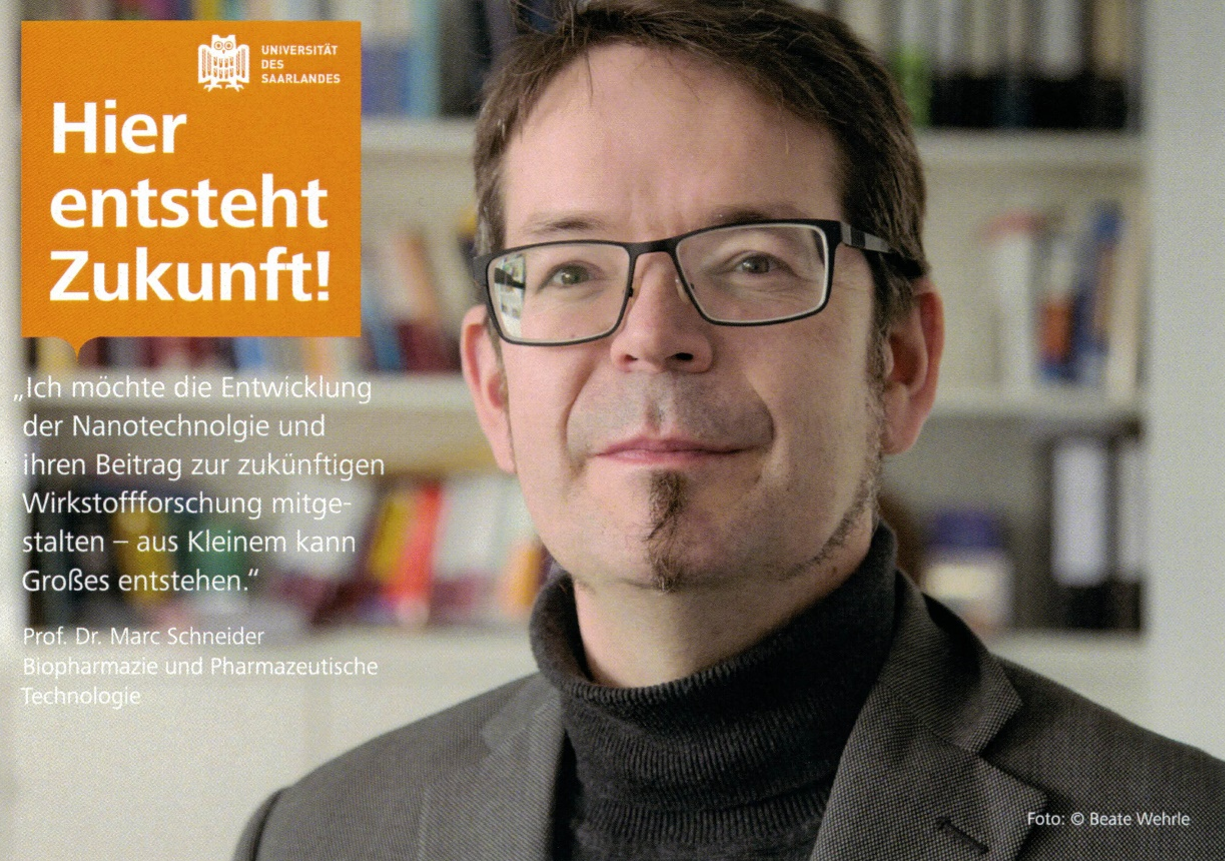
Prof. Dr. Marc Schneider holds a professorship in Biopharmaceutics and Pharmaceutical Technology at Saarland University's College of Pharmacy . His research focuses on colloidal drug delivery systems, particularly nanostructured and non-spherical particle engineering for overcoming biological barriers in pulmonary and transdermal applications. He leads an internationally recognized lab in Saarbrücken, collaborating with Helmholtz Institute for Pharmaceutical Research Saarland (HIPS) and trinational institutions. Research Highlights: Development of inhalable nano/microparticle systems Surface modification of gelatin nanoparticles Characterization of mucus-penetrating particles 3D printing for microneedle fabrication Atomic Force Microscopy (AFM) for nanoparticle analysis Selected Scientific Awards: European Journal of Pharmaceutics and Biopharmaceutics Best Paper Award (2018) for mucus-penetrating nanoparticles Recognized in 'Ausgezeichnete Orte im Land der Ideen' competition (2018) for 'Nano-Mais' drug delivery system Collaborative Networks: Co-editor for Advanced Drug Delivery Reviews special issue on biological barriers Key participant in trinational Master's program in Biomedicine with Strasbourg, Mainz, and Luxembourg Active in Controlled Release Society (CRS) conferences and local chapters
Andrew Pavlo is a Professor in the Computer Science Department at Carnegie Mellon University's School of Computer Science. His research focuses on database management systems, particularly in the areas of transaction processing, in-memory databases, and self-driving database systems. He leads a productive research group that has published extensively in top database venues including VLDB, SIGMOD, and CIDR. Pavlo's research interests span database management systems, transaction processing, in-memory databases, non-volatile memory databases, and self-driving database systems. His work often bridges theoretical database concepts with practical system implementation, focusing on performance optimization, query processing, and system architecture. Recent work has explored machine learning applications for database tuning, novel storage techniques, and innovative approaches to transaction processing. An analysis of his recent publications reveals a strong focus on self-driving database systems, with significant work on the Database Gym framework for training machine learning models to optimize database performance. His research also examines columnar storage formats, transaction scheduling, and novel approaches to user-defined function optimization. The work demonstrates a consistent trajectory toward making database systems more autonomous and efficient through a combination of systems techniques and machine learning. Pavlo has been instrumental in mentoring numerous PhD students who have become active contributors to the database research community. His research has been supported by significant grants that have enabled the development of innovative database technologies and frameworks. His research group operates within CMU's vibrant database ecosystem, collaborating with other researchers on projects related to database systems, storage engines, and query processing frameworks. The group maintains close connections with industry partners to ensure practical relevance of their research contributions.
Prof. Dr. Daniel Hug is a Professor at the Karlsruhe Institute of Technology (KIT) , affiliated with the Department of Mathematics and the Institute of Stochastics . His research focuses on Probability , Geometry , Convex geometric analysis , Stochastic geometry , and Educational mathematics . He contributes to the DFG Priority Program Random Geometric Systems and previously participated in the DFG research unit Geometry and Physics of Spatial Random Systems . Prof. Hug has co-authored two influential monographs: Poisson Hyperplane Tessellations (Springer Monographs in Mathematics) and Lectures on Convex Geometry (Springer Graduate Texts in Mathematics, 2020). His work spans theoretical advancements in convex and stochastic geometry , including integral geometry, random mosaics, and tensor valuations, alongside applied studies in digital microstructures and Minkowski tensors . His publications from 2025–2024 emphasize hyperbolic space , Boolean models , and Minkowski tensor estimators , reflecting ongoing collaborations with researchers like M. Klatt, C. Thäle, and R. Schneider. Prof. Hug leads courses such as Stochastic Geometry and seminars on Random graphs and tessellations , and is actively involved in working groups like AG Stochastische Geometrie and AG Stochastik .
Prof. Jürg Kramer is a Professor of Mathematics at Humboldt University of Berlin, affiliated with the Faculty of Mathematics and Natural Sciences and the Institute of Mathematics. His research focuses on Arakelov geometry, automorphic forms (particularly modular forms), and their intersections. Notable contributions include advancements in arithmetic intersection theory with logarithmic singularities and sup-norm bounds for modular forms. He is also deeply engaged in mathematics education, leading initiatives for teacher training and promoting mathematical talent through networks like the Berlin School Mathematics Network. Active in academic service, he served as EMS Education Committee Chair (2017–2022) and President of the German Mathematical Society (2013/14). His work bridges pure mathematics with pedagogical innovation, emphasizing public understanding through popular science publications. Research: Arakelov geometry, modular forms, L-functions, hyperbolic geometry methods Education: Teacher training programs, math talent promotion, textbook authorship Affiliations: Leibniz Institute for Science and Mathematics Education (IPN), EMS, Deutsche Akademie der Technikwissenschaften Key educational contributions include Felix-Klein teacher training programs and co-authoring standards for mathematics teacher education. His publications span advanced mathematical research and accessible expositions on topics like Fermat’s Last Theorem and Riemann Hypothesis.
Holger Straßheim is Professor of Political Sociology at Bielefeld University, affiliated with the Faculty of Sociology, Department 4 – Politics and Society. He also holds leadership roles as co-director of the Institute for Interdisciplinary Studies of Science (ISOS) and the Institute for World Society Studies, and is an elected member of the university’s Senate. He coordinates the MA program in Political Communication and serves on multiple examination and ethics committees. University: Bielefeld University School: Faculty of Sociology Department: Department 4 – Politics and Society Research Institutes: ISOS, Institute for World Society Studies Administrative Roles: Program Coordinator MA Political Communication, Member of BA/MA Examination Boards, Habilitation Committee His research centers on the interplay between science and politics, particularly the role of expertise and evidence in public policy. Key areas include behavioral public policy, climate and consumer policy, Arctic geopolitics, and the temporal dimensions of governance. He investigates how knowledge is produced, legitimized, and used in policy-making across transnational contexts. The most recent publications reflect a strong focus on evidence cultures, ethical expertise in crises, and the global spread of behavioral governance. These works analyze how expert advice functions under uncertainty, the paradoxes of evidence-based policy, and the institutionalization of ethical guidance during emergencies like the COVID-19 pandemic. The research often employs comparative and interdisciplinary methods, engaging with science and technology studies, political sociology, and policy analysis. Best Dissertation Award, University of Tübingen (2011) Visiting Fellow, Harvard Kennedy School (2014) Visiting Research Fellow, Collège d’études mondiales, Paris (2018) Visiting Research Fellow, University of Bologna (2022) Straßheim has supervised and advised in various research projects and PhD initiatives, particularly through his leadership in DFG and ESRC-funded programs. He has secured significant third-party funding, including projects on Arctic knowledge co-production and ethics in crisis governance. He is actively involved in academic service, reviewing for major journals and research councils, and shaping policy discourse through editorial roles in Critical Policy Studies and the Advances in Critical Policy Analysis book series. He leads the Straßheim Research Group, fostering interdisciplinary collaboration on science-policy interfaces. He is a key figure in research networks such as the Science and Democracy Network (Harvard) and the International Arctic Science Committee. His work bridges academic inquiry with real-world policy challenges, emphasizing democratic accountability, epistemic pluralism, and the ethical dimensions of expertise.