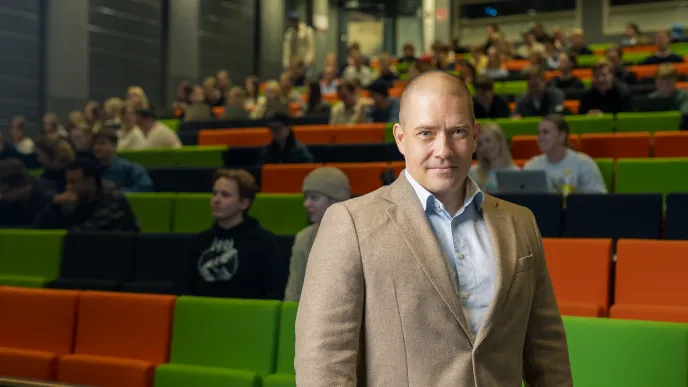
Dr. Olle Järv is an Academy Research Fellow at the University of Helsinki's Department of Geosciences and Geography. As Docent in Human Geography and holder of a joint PhD from University of Tartu and Ghent University, his research focuses on leveraging big data sources like mobile phone records and social media for analyzing human mobility patterns across European cross-border regions. Key research areas: Spatial segregation, urban diversity, transnationalism, and pandemic-induced mobility changes Current projects: BORDERSPACE (2020-2025) – Mapping transnational spaces through mobility data MOBI-TWIN (2023-2026) – Regional mobility patterns in twin transitions WinWin4WorkLife (2024-2027) – Sustainable cross-border remote work His methodological innovations include developing tools for analyzing social media data and mobile phone records to study urban dynamics. Recent recognitions include the 2024 Research Council of Finland Award and 2021 Best Paper Award from Journal of Location Based Services.
Brita Wårvik is a Professor in the Department of Languages at Åbo Akademi University, affiliated with the Faculty of Humanities, Psychology and Theology. She holds a Doctor of Philosophy (Phil. Dr.) from the same institution, awarded in 2013, and has been actively contributing to linguistic research for decades. Doctor of Philosophy (Phil. Dr.), Åbo Akademi University, 2013 Her research centers on discourse analysis, pragmatics, and historical English linguistics, with a particular focus on Early Modern and Medieval English texts. She investigates discourse interaction, textual structures, and pragmatic conservatism in religious prose, often employing corpus-based and textual analysis methods. Her work bridges micro and macro perspectives in discourse, exploring how semantic units contribute to broader text worlds. Analysis of her recent publications reveals a consistent trajectory in historical discourse studies, with increasing emphasis on corpus linguistics, manuscript variation, and the evolution of discourse markers. Her editorial work, such as the 2024 volume Structures in Discourse , highlights her leadership in synthesizing interdisciplinary perspectives on language use. Scientific Awards: Teacher of the Year (2001) ÅAU Student Union's Rose (2007) Brita Wårvik actively supervises and mentors academic visitors and collaborators, as seen in her hosting of scholars like Carmen Lee and Lieselotte Anderwald. She is the coordinator of the ongoing Project ICLE (International Corpus of Learner English) , securing research continuity and international collaboration. Her involvement in organizing workshops, such as the ICLE+30 FI-subcorpus Workshop in 2024, underscores her role in fostering academic exchange. In terms of research infrastructure, she is deeply embedded in the ICLE network, contributing to the development of learner language corpora. Her activities reflect strong international collaborations, particularly in the fields of historical linguistics and discourse studies, with a visible presence in both research and academic community-building.
Suvi Saarikallio is a Professor of Music Education at the University of Jyväskylä, Finland , affiliated with the Faculty of Humanities and Social Sciences and the Department of Music, Art and Culture Studies . She leads interdisciplinary research bridging music psychology, education, and therapy, with a focus on youth development, emotion regulation, and well-being. Research Groups: Centre of Excellence in Music, Mind, Body and Brain (2022-2029), Musiconnect (2022-2027) Key Projects: Music and You, Stress & music listening, MPACT (Music and Sports), Music and Cross-modal Associations, SOSUS (Social Sustainability for Children) Research Trends: Her recent publications explore music's role in emotional regulation, cross-modal perception, health outcomes, and educational applications. Themes include AI's impact on music evaluation, rhythm's connection to cognitive skills, and music's influence on stress and social-emotional development. Contact: suvi.saarikallio@jyu.fi
Lappeenranta-Lahti University of Technology LUTFinland
Sami Sykkö serves as a Professor of Practice at LUT University's School of Economics, where his working life professorship (1.9.2022–31.12.2025) focuses on bridging academic theory with practical business applications. Funded by OP cooperative banks with 140,000 euros, his position emphasizes responsible business practices and evolving consumer behavior trends. Sykkö holds a Master's in International Marketing from the University of Vaasa (1996) with additional studies at Parsons School of Design in New York. His educational background combines economics with design sensibility, creating a unique interdisciplinary perspective. As he states: 'Clothing is more responsible the longer and more often it is used' , reflecting his philosophy on sustainable consumption. His research centers on what he calls 'a megatrend that's hard to imagine being more interesting' - responsibility in business and consumption. Sykkö examines how consumer patterns are shifting, where customer flows are heading next, and how needs, habits, and desires are changing. He emphasizes that 'not only trade but also the life of all humanity is at stake' in these discussions. Through his Taloustango podcast series, Sykkö analyzes economic trends by bringing together university experts and business representatives to discuss greenwashing, sustainable consumption, and design's future. His approach favors real-world examples over theoretical lessons, drawing from his extensive professional network. Professional Recognition Nominated for Presenter of the Year (2018) Widely praised for hosting skills: 'The highest quality hosting I've ever experienced,' 'A master of situational awareness' Academic Engagement Sykkö plans to host 'Professor Sykkö's Question Hour' with Finnish business leaders and aims to become 'Finland's first TikTok professor' to reach younger audiences. His co-hosted 'Sami & Jorma' podcast (42,497 followers) demonstrates his ability to connect academic concepts with cultural discussions on fashion, design, and travel. Professional Activities Beyond academia, Sykkö has interviewed three Finnish presidents, Karl Lagerfeld, and Jane Fonda. He has reported on major global events including the London terrorist attack and Paris Fashion Week. His editorial work includes revamping Gloria magazine and editing publications for the Didrichsen Art Museum.
Elisa Maarit Lähde serves as an Assistant Professor in the Department of Architecture at Aalto University, where she advances sustainable urban design through interdisciplinary research at the intersection of landscape architecture, ecology, and planning. Her work focuses on transforming urban environments through biodiversity integration and socio-ecological innovation. Dr. Lähde's research centers on urban biodiversity mainstreaming, regenerative design frameworks, and landscape architectural storytelling. She pioneers approaches for integrating ecosystem services into urban planning, with particular emphasis on climate adaptation, green-blue infrastructure, and human-nature connection building. Her methodologies frequently employ co-creative processes with stakeholders to develop context-specific socio-ecological solutions. Recent publications (2024-2025) demonstrate a cohesive research trajectory examining practical applications of biodiversity principles across diverse urban contexts. Key thematic clusters include: (1) ecological assessment frameworks for built environments; (2) regenerative design strategies for Anthropocene challenges; (3) maritime spatial planning innovations; and (4) narrative techniques for enhancing ecological literacy. Her work bridges theoretical rigor with Finnish and international case studies, reflecting strong commitment to both scholarly contribution and real-world implementation. Dr. Lähde's scholarly contributions have been recognized through significant professional accolades: First prize in the Elielinaukio architectural competition (December 2021) for Helsinki Central Railway Station surroundings renewal Finalist in Ericsson Innovation Awards for FoodGrid project (June 2017) addressing Future of Food challenges First prize in International Stormwater Innovation Competition (November 2014) for urban furniture with water detention Honorary mention in Hiedanranta ideas competition (January 2017) for "There’s a New Town in the City" proposal While specific advising relationships and grant funding details aren't documented in available materials, her research portfolio demonstrates substantial collaborative engagement through multi-institutional publications and competition participations that likely involve student mentorship and research team leadership.
Arri Priimägi is a Professor at Tampere University's Faculty of Engineering and Natural Sciences, leading the Smart Photonic Materials research group. He focuses on functional soft materials, particularly light-activated systems for applications in soft robotics, photonics, and biomaterials science. His interdisciplinary work bridges physics, chemistry, and engineering, emphasizing collaboration to advance materials for future technologies. Education: PhD in Applied Physics from Helsinki University of Technology (2009), MSc in Physics from Tampere University of Technology (2004). His career includes postdoctoral research in Japan (Tokyo Institute of Technology) and Italy (Politecnico di Milano). Research Interests: Design of stimuli-responsive materials, light-driven actuators, and bioinspired systems. Key projects include ERC Starting Grant-funded work on tunable photonic structures and an ERC Proof-of-Concept Grant for optical humidity sensing. He leads the Chemistry & Advanced Materials research cluster and contributes to the PREIN Flagship in photonics. Awards : Academy of Finland Award for Scientific Courage (2018) ERC Starting Grant (2016) Outstanding Doctoral Dissertation Award (2009) Grants & Projects : ERC Proof of Concept: Optical Sensing of Humidity (2018–2020) ERC Starting Grant: Tunable Photonic Structures (2016–2021) Academy of Finland Fellowship: Halogen-Bonded Materials (2014–2019) Labs/Teams: Active in the Smart Photonic Materials group and collaborates internationally on soft robotics and photonic materials.
Andrea Santangeli serves as a Supervisor in the Doctoral Programme in Wildlife Biology and holds a Docentship in the Organismal and Evolutionary Biology Research Program at the University of Helsinki's Faculty of Biological and Environmental Sciences. He maintains an additional affiliation as an Honorary Fellow at the University of Cape Town's FitzPatrick Institute of African Ornithology under the National Research Foundation Centre of Excellence since August 2019. His research spans international collaborations across multiple continents, with particular focus on African and European conservation challenges. Dr. Santangeli completed his doctoral thesis titled 'Assessing the effectiveness of different approaches to species conservation' at the University of Helsinki in 2013. His educational background established the foundation for his current research program focused on evidence-based conservation strategies and effectiveness assessment. His research interests center on wildlife conservation biology, particularly avian ecology and species protection. Santangeli's work examines human-wildlife interactions, conservation prioritization, and the effectiveness of different conservation approaches. He investigates how climate change affects species distributions and community composition, with special attention to vulture conservation, bird-feeding practices, and the impacts of agricultural systems on biodiversity. His approach integrates ecological, social, and policy dimensions to develop comprehensive conservation solutions. Species conservation effectiveness Human-wildlife interactions Climate change impacts on biodiversity Vulture conservation Bird community dynamics Ecosystem services assessment Analysis of Santangeli's recent publications (2023-2025) reveals a strong focus on interdisciplinary conservation science addressing urgent global challenges. His work increasingly integrates One Health approaches, examining connections between wildlife health, ecosystem functioning, and human activities. Key themes include climate change adaptation strategies, human dimensions of conservation, and technological innovations for monitoring and protection. His research shows growing emphasis on policy-relevant science that directly informs conservation decision-making at multiple scales. His scientific recognition includes an Honorary Fellowship at the University of Cape Town's prestigious FitzPatrick Institute of African Ornithology, part of the DST NRF Centre of Excellence. This position acknowledges his significant contributions to African ornithology and conservation science, particularly his work on vulture conservation across the continent. As a doctoral supervisor, Santangeli guides the next generation of conservation scientists through the Wildlife Biology doctoral program. His research is supported by multiple projects, including the ongoing 'Understanding the drivers and species ecological traits underpinning the global trade in wild birds' (2019-2024), which examines wildlife trade dynamics and conservation implications. His work demonstrates strong international collaboration networks across Europe, Africa, and beyond. Santangeli's research activities involve extensive fieldwork, data analysis, and policy engagement. He participates in academic visits to institutions like the Center d'Études Biologiques de Chizé in France and contributes to scientific conferences and peer review for leading conservation journals. His work often involves citizen science approaches, as evidenced by the 'iratebirds' project on aesthetic attraction to birds.
Tuija Tessaliina Tolonen is a Doctoral Researcher at the Department of Neuroscience and Biomedical Engineering, Aalto University. Her work focuses on neuroimaging, ADHD research, and brain connectivity. Research Interests: Functional and structural connectivity in adult ADHD Impact of early life stress on neural networks Cognitive neuroscience and neuroimaging methodologies Intervention studies with working memory training Selected Publication Trends: Her recent works examine brain network abnormalities in ADHD, neuroplasticity following cognitive training, and the effects of stress on developing brains. Collaborations span neuroscience, psychology, and biomedical engineering fields. Affiliations: Aalto University, Finland.
Dr. Udayanto Atmojo is a Staff Scientist in the Department of Electrical Engineering and Automation at Aalto University. His research focuses on industrial automation systems, distributed control architectures, and IEC 61499 standard implementation. He holds a doctoral degree in Engineering from the University of Auckland. Research Focus: Distributed control systems using IEC 61499 standard OPC-UA integration for industrial interoperability Cybersecurity in Industry 5.0 environments Digital twin applications in industrial settings His publications demonstrate strong emphasis on industrial automation standards, secure data exchange, and virtual commissioning. Recent work addresses security challenges in human-intensive automated factories and confidential data sharing for life cycle assessments in process industries. Projects and Recognition: Principal investigator for TwinFlow project on distributed control systems (2024-2026) Contributor to CloViC project on cloud virtual commissioning Finalist in World Challenge Finland 2018 competition He develops laboratory test procedures for industrial applications and contributes to open science initiatives including FAIR principles for research software.
Mia Liljeström is a Staff Scientist at the Department of Neuroscience and Biomedical Engineering, Aalto University. She holds a Doctoral Degree in Engineering and Technology from Aalto University (2010) and a Master's Degree in Engineering and Technology from Helsinki University of Technology (2002). Doctoral Degree: Aalto University, 2010 Master's Degree: Helsinki University of Technology, 2002 Her research focuses on Magnetoencephalography (MEG) , Functional Connectivity , and Brain Networks . She explores Transcranial Magnetic Stimulation (TMS) , Functional MRI , and Neural Networks to map language-critical brain areas and study cortical dynamics. Recent work includes automated speech artefact removal from MEG data and test-retest reliability of brain connectivity metrics. Mia actively participates in conferences like MEG Nord and has presented invited talks on language processing and large-scale brain networks. Her publications emphasize MEG-informed TMS, cortical beta modulation, and brain stimulation precision. She contributes to the UN Sustainable Development Goal of Quality Education through neuroimaging research.
Ti John is a Research Fellow at Aalto University's Department of Computer Science within the School of Science. He is affiliated with Professor Marttinen's research group and the Probabilistic Machine Learning group led by Professor Samuel Kaski. His work connects with the Finnish Center for Artificial Intelligence (FCAI) and the Helsinki Institute for Information Technology (HIIT). Dr. John's research focuses on machine learning, particularly Bayesian optimization, Gaussian processes, and point process models. His work spans theoretical developments in neural processes and practical applications in healthcare analytics and large language models. He has made significant contributions to equivariant neural processes, causal mediation analysis in healthcare, and interpretability of additive models. His publication record shows consistent output with 17 publications between 2021-2024, including multiple papers at top AI conferences like NeurIPS, ICML, and ICLR. His research demonstrates strong interdisciplinary connections between statistical modeling, artificial intelligence, and healthcare applications. Active reviewer for NeurIPS, ICLR, AISTATS Reviewer for Journal of Machine Learning Research Member of Finnish Center for Artificial Intelligence project Dr. John has been actively contributing to the machine learning community through peer review and conference participation, demonstrating expertise across multiple subfields of artificial intelligence and statistical modeling.
Aleksi Lehikoinen is an Associate Professor at the University of Helsinki's Faculty of Biological and Environmental Sciences, holding a docentship and serving as Supervisor in the Doctoral Programme in Sustainable Use of Renewable Natural Resources and the Doctoral Programme in Wildlife Biology. He works in the Zoology Unit as Chief Superintendent and is based at the Biocenter 3 in Viikinkaari, Helsinki. His research focuses on ornithology, climate change impacts on biodiversity, and conservation biology, with extensive field work in Finnish ecosystems. Lehikoinen's research interests center on bird population monitoring, climate change effects on avian communities, and biodiversity conservation. His work examines how climate warming influences species distributions, community composition, and ecosystem functioning, particularly in boreal regions. He investigates the effectiveness of protected areas in mitigating climate change impacts and studies human-wildlife interactions through citizen science initiatives. His research combines long-term monitoring data with advanced statistical approaches to understand ecological patterns and processes. His recent publications (2024-2025) demonstrate a strong focus on climate change ecology, with particular attention to how warming temperatures affect bird communities in boreal regions. The research spans multiple scales from individual species responses to community-level changes, examining thermal niches, distribution shifts, and biodiversity-stability relationships. His work increasingly incorporates interdisciplinary approaches, connecting ecological monitoring with human dimensions of conservation through studies of citizen science and public engagement in bird monitoring. BirdLife Suomen kultainen ansiomerkki (2024) Environmental award of Sophie von Julins society to Hanko Bird Observatory (2010) Helsingin Seudun Lintutieteellisen yhdistyksen Tringan BirdLife -ansiomerkki (2011) Influencer of the year in the Finnish Museum of Natural History (2011) Newcomer of the year 2010 in the Museum of the Natural History (2010) Lehikoinen actively supervises doctoral students in sustainable resource use and wildlife biology programs. He leads multiple significant research projects including 'Lajien kumulatiiviset ja vuorovaikutteiset vasteet ilmastonmuutokseen' (2024-2028) funded by the Academy of Finland, 'HABITRACK RIA' (2024-2027) with the European Commission, and 'Digitaalinen kansalaistiedekeskus Erkko' (2024-2028) funded by the Jane and Aatos Erkko Foundation. His work combines scientific research with practical conservation applications. Lehikoinen is deeply involved in large-scale biodiversity monitoring initiatives, particularly bird population monitoring programs in Finland. He collaborates with the Finnish Museum of Natural History and participates in citizen science projects that engage the public in data collection. His work with the 'Lintuatlas' (Bird Atlas) project represents a significant contribution to understanding bird distribution changes across Finland, combining professional scientific monitoring with volunteer observations.
Leena Linden serves as University Lecturer at the Department of Agricultural Sciences, University of Helsinki, holding a Docentship and affiliations with the Institute for Urban Studies (Urbaria) and Institute of Sustainability Science (HELSUS). She supervises doctoral students in both the Plant Sciences and Sustainable Use of Renewable Natural Resources programmes. Her research spans multiple interconnected domains: Horticulture and plant genetics, particularly lilacs and apple varieties Urban forestry and green space management Sustainable agricultural practices and crop production Ecosystem services provided by urban vegetation Applications of sphagnum moss in sustainable agriculture With 75 publications spanning from 1999 to present, her recent work demonstrates a strong interdisciplinary focus on urban-plant science intersections. Her 2023-2024 publications reveal sophisticated integration of genetic analysis with practical urban applications, examining how urban forests provide ecosystem services and how genetic profiling informs horticultural practices. She publishes across plant genetics, urban sustainability, and agricultural science journals. Dr. Linden actively contributes to scholarly discourse through peer review for journals including Urban Forestry & Urban Greening, Scientific Reports, and Urban Climate. Her research projects demonstrate sustained engagement with practical applications: Garden plant history (ongoing since 2008) Variety identification (ongoing since 2006) i-Tree urban ecosystem services valuation (2018-2020) Urban trees, biodiversity and ecosystem services (2017-2022) Sphagnum moss cultivation possibilities (2015-2020)
University Lecturer Anu Lehtovuori is affiliated with the Department of Electronics and Nanoengineering at Aalto University, where she actively bridges teaching and research. Her roles encompass academic teaching, project leadership, grant writing (e.g., Academy of Finland applications), and collaboration with doctoral students. She specializes in cutting-edge topics such as antenna design for 5G/6G systems, reconfigurable MIMO architectures, and RF technology for mobile devices. Her research focuses on optimizing antenna performance in compact environments, mitigating interference, and enhancing wireless communication efficiency. Notable areas include wideband antenna systems, decoupling techniques for multi-element arrays, and adaptive antenna-amplifier integration. Lehtovuori emphasizes practical applications, addressing challenges like user interaction effects on mobile antenna performance and minimizing electromagnetic emissions. Research Trends: Dominant themes include 6G IoT antenna solutions, mmWave component integration, and reconfigurable systems leveraging mutual coupling. Grants: Actively pursuing funding through initiatives like the Academy of Finland. Her contributions span both theoretical advancements (e.g., bandwidth optimization algorithms) and industrial applications (e.g., antenna cluster techniques for full-screen smartphones). While no specific awards are documented, her work reflects a strong focus on impactful, industry-relevant innovations.
Esa Ruskeepää is a Lecturer at Aalto University's Department of Architecture (School of Arts, Design and Architecture). His academic work focuses on architectural design, urban development, and competition entries for public and cultural spaces. Current affiliation: Aalto University, Department of Architecture Academic rank: Lecturer Research interests include: Architecture and urban design Architectural competition entries Sustainable building practices Public infrastructure projects Recent publications highlight architectural proposals for museums, hotels, schools, and urban planning initiatives across Finland and international contexts. No scientific awards were explicitly mentioned in the provided materials.