Aydin Babakhani is a Professor in the Department of Electrical and Computer Engineering at the University of California, Los Angeles (UCLA), affiliated with the College of Life Sciences. He directs the Integrated Sensors Laboratory (ISL), which focuses on the design and implementation of integrated sensors and systems. His research spans high-speed wireless communication, terahertz technology, medical implants, radar systems, and industrial monitoring solutions. Research Interests: Prof. Babakhani's work integrates silicon-based technologies with applications across multiple domains. Key areas include: Silicon mm-Wave/THz transceivers and on-chip antennas for communication and sensing Wirelessly powered medical implants for biopotential monitoring and neural stimulation THz radar systems for micrometer-resolution imaging and vibration detection Energy harvesting solutions for batteryless sensors in industrial and biomedical applications CMOS-based optoelectronic systems and photonic computing accelerators His recent publications (2021-2025) demonstrate a strong emphasis on terahertz systems, wireless power transfer, and miniaturized medical electronics. Over 80% of his latest articles involve silicon-integrated solutions for biomedical implants or THz sensing, with emerging focus on AI-accelerated photonic computing and multi-Gbps wireless links.
Qing Li is an Associate Professor in the Department of Electrical and Computer Engineering at Carnegie Mellon University (CMU), part of the College of Engineering. He holds a B.E. in Electronics Engineering from Tsinghua University (2006) and a Ph.D. in Electrical and Computer Engineering from Georgia Institute of Technology (2013). Prior to CMU, he worked as a postdoctoral researcher at the National Institute of Standards and Technology (NIST), where he developed quantum frequency conversion and microresonator-based optical systems. His research focuses on light-matter interactions in integrated photonics, emphasizing nonlinear optics and quantum information processing. He has pioneered silicon carbide and aluminum nitride platforms for chip-scale quantum technologies and optical metrology. Dr. Li has been recognized with prestigious awards including the Darpa Young Faculty Award (2019), OSA Paul F. Forman Team Engineering Excellence Award (2020), and Sigma Xi Best Ph.D. Thesis Award (Georgia Tech). His work bridges classical and quantum information systems, with applications in secure communication, atomic systems interrogation, and high-precision frequency synthesis. He actively contributes to the Pittsburgh Quantum Institute (PQI), advancing regional quantum engineering initiatives. His research group’s key projects include developing compact optical frequency synthesizers, soliton microcombs for communication grids, and entangled photon pair sources for quantum networks. Grants and collaborations support his exploration of novel photonic materials and devices, targeting advancements in both fundamental science and applied technologies.
Minghao Qi is a Professor in the Department of Electrical and Computer Engineering at Purdue University's College of Engineering, West Lafayette. His research focuses on integrated photonics systems for optical communications, quantum information, and precision metrology applications. Professor Qi's work spans several critical photonics domains: Design and application of microresonator-based optical frequency combs (Kerr combs) Silicon and silicon nitride integrated photonic circuits Thin-film lithium niobate devices for nonlinear optics Quantum information processing using frequency-bin entangled photons Photonic neuromorphic computing with machine learning co-design Optical sensors and time-of-flight ranging systems Analysis of his 2022-2025 publications reveals three dominant research vectors: (1) Vernier microcombs for optical atomic clocks and RF stabilization, (2) Trident edge coupler architectures for octave-spanning nonlinear processes on lithium niobate, and (3) Physics-informed neural networks applied to photonic device design and signal processing. His recent work demonstrates strong convergence between integrated photonics, quantum technologies, and machine learning.
Zoya Popovic is a Distinguished Professor and holds the Lockheed Martin Endowed Chair in RF Engineering at the University of Colorado Boulder's Department of Electrical, Computer, and Energy Engineering. She earned a Dipl.Ing. from the University of Belgrade (1985) and a PhD from Caltech (1990). She has advised over 50 PhD students and was a visiting professor at Technical University of Munich (2001). Her research focuses on high-efficiency microwave/millimeter-wave circuits, smart antenna arrays, wireless powering systems, and biomedical microwave applications. Notable contributions include quasi-optical imaging techniques and low-noise amplifier designs. Key awards: IEEE Microwave Prizes (1993/2006), Humboldt Research Award (2000), Terman Medal (2001) Lab Group Website: [Link] Recent work emphasizes in-band full-duplex systems, GaN MMICs, and quantum-based waveform modulation. Her group maintains advanced facilities for millimeter-wave and terahertz research.
Ruonan Han is a Professor of Electrical Engineering and Computer Science at MIT and serves as Associate Director of the Microsystems Technology Laboratories (MTL) and Director of the MIT-MTL Center for Integrated Circuits and Systems . His research focuses on ultra-high-frequency microelectronic circuits , particularly addressing the 'terahertz gap' in sensing, metrology, security, and communication. He leads the Terahertz Integrated Electronics Group at MIT's MTL, established in 2014. Education: B.S. in Microelectronics, Fudan University (2007) M.S. in Electrical Engineering, University of Florida (2009) Ph.D. in Electrical and Computer Engineering, Cornell University (2014) Research Interests: Terahertz (THz) integrated circuits and systems High-frequency CMOS technologies Quantum sensing and magnetometry RF systems for imaging, radar, and molecular sensing Energy-efficient communication systems His work bridges electronic circuits , electromagnetics , and quantum physics , with applications in defense, healthcare, and environmental monitoring. Awards & Recognition: 2023 IEEE SSCS New Frontier Award 2020 NSF CAREER Award 2019 Intel Outstanding Researcher Award 3× IEEE RFIC Best Student Paper Awards (2012, 2017, 2021) Advising & Leadership: Ph.D. advisor to over 10 students (many recipients of MIT MTL Dissertation Awards) Co-advises with Prof. Anantha Chandrakasan and Prof. Tomás Palacios Editorial roles at IEEE Transactions on Quantum Engineering and VLSI Systems Technical committee member for ISSCC, RFIC, and IMS Labs & Teams: Terahertz Integrated Electronics Group at MIT MTL: Focuses on chip-scale THz systems, quantum devices, and next-generation RF circuits Collaborations with industry (e.g., Apple, MediaTek) and academic groups (e.g., D. Englund's lab at MIT)
Olivier Pfister is a Professor in the Department of Physics at the University of Virginia , with courtesy appointments in Electrical and Computer Engineering (2022–). His research focuses on experimental quantum optics and quantum information , particularly leveraging optical frequency combs to develop scalable quantum computing platforms. The Quantum Fields and Quantum Information (QFQI) group , which he leads, has pioneered techniques for generating multipartite entanglement in continuous-variable systems, achieving cluster-state entanglement in 60+ qumodes (with potential scaling to thousands). Collaborations span institutions like NIST, University of Sydney, CUNY, and Jefferson Laboratory, with applications in quantum simulation , non-Gaussian state characterization , and hybrid quantum technologies . Key contributions include the 2013 APS Fellowship for groundbreaking work on quantum frequency combs, NSF Distinguished Research Awards , and patents in quantum photonic devices. His group’s NSF-funded research (e.g., QLCI Preliminary Proposal, $3.2M; RAISE-EquIP, $750K) explores fault-tolerant quantum computing, machine learning integration, and microresonator-based entanglement. Pfister’s scientific awards include the 2013 UVA Distinguished Research Career Award and the 1996 JILA Clever Idea Contest Second Prize . His students and postdocs (e.g., Amr Hossameldin , Miller Eaton , Rajveer Nehra ) have published extensively on quantum tomography, cluster states, and photonic detector design. Pfister also serves on advisory and planning committees at UVA, emphasizing interdisciplinary collaboration across physics , engineering , and quantum information .
Michal Lipson serves as the Eugene Higgins Professor of Electrical Engineering and Professor of Applied Physics at Columbia University's Fu Foundation School of Engineering and Applied Science. Elected to both the National Academy of Engineering and National Academy of Sciences, she pioneered critical building blocks in silicon photonics that have transformed the field, with over 50,000 related publications annually. Her research has generated more than 250 scientific publications and 45 issued patents. Lipson's research focuses on nanophotonics and silicon photonics, where she demonstrated the ability to tailor electro-optic properties of silicon in landmark 2004 and 2005 Nature papers. Her work has enabled the development of photonic devices and circuits that now form the foundation of over 1,000 papers published yearly. She investigates novel optical phenomena while developing practical applications that address major bottlenecks in microelectronics. Her research spans fundamental physics to practical device implementation, with particular emphasis on integrated photonic systems. Analysis of her recent publications reveals a strategic expansion from foundational silicon photonics into emerging applications including quantum information processing, machine learning acceleration, biomedical sensing, and topological photonics. While maintaining core expertise in silicon-based devices, her work increasingly incorporates 2D materials, heterogeneous integration, and novel optical phenomena to push performance boundaries. The research demonstrates consistent progression from fundamental device physics to system-level implementations with practical applications. National Academy of Engineering (2025) National Academy of Sciences MacArthur Fellowship Blavatnik Award Optica's R.W. Wood Prize IEEE Photonics Award John Tyndall Award NAS Comstock Prize in Physics Thomson Reuters Top 1% Highly Cited Researcher (annually since 2014) Professor Lipson has mentored an exceptional research group, graduating 40 PhD students and 2 MS students, with numerous postdocs and visiting researchers. Her alumni occupy prominent positions including professorships at major universities (Rochester, Ottawa, UNICAMP, Johns Hopkins), leadership roles at Intel, Bell Labs, and startups she co-founded (HyperLight, Voyant Photonics). Her laboratory has received substantial research funding supporting cutting-edge work in nanofabrication, optical characterization, and device development. Current research directions include quantum photonics, AI-accelerated optical systems, and novel materials integration. The Lipson Research Group operates state-of-the-art facilities for nanophotonic device design, fabrication, and characterization. The team comprises principal investigators, postdoctoral researchers, PhD students, and administrative staff working collaboratively across disciplines including electrical engineering, materials science, physics, and applied physics. The group maintains strong industry partnerships while pursuing fundamental scientific advances in light-matter interactions at the nanoscale.
Ralph Jimenez is an Adjunct Professor of Chemistry and Institute Fellow at JILA, University of Colorado Boulder. He holds a Ph.D. from the University of Chicago (1996) and completed postdoctoral work at the University of California, San Diego (1997-1998), followed by research at The Scripps Research Institute (1998-2003). His research focuses on quantum spectroscopy and photophysics of fluorescent proteins, leveraging quantum optics to enhance spectroscopic sensitivity and developing genetically encoded biomarkers with improved photophysical properties. Key achievements include fluorescence-lifetime-based methods to engineer brighter fluorescent proteins and machine-learning approaches to improve photostability. His awards include the Arthur S. Flemming Award (2017) and U.S. Department of Commerce Gold Medal (2017). His group's work integrates quantum engineering with biophysical studies, targeting real-world applications in molecular imaging and materials science. The Jimenez Group operates labs at JILA (B117, B119, B121) and collaborates on projects involving entangled photons, two-photon absorption, and ultrafast spectroscopy. Research themes include quantum-enhanced spectroscopy for complex systems and overcoming limitations in fluorescent protein imaging through physical chemistry strategies. His lab develops novel instrumentation, including microfluidic sorting systems and tabletop X-ray spectroscopy platforms, to advance biomarker engineering and environmental monitoring.
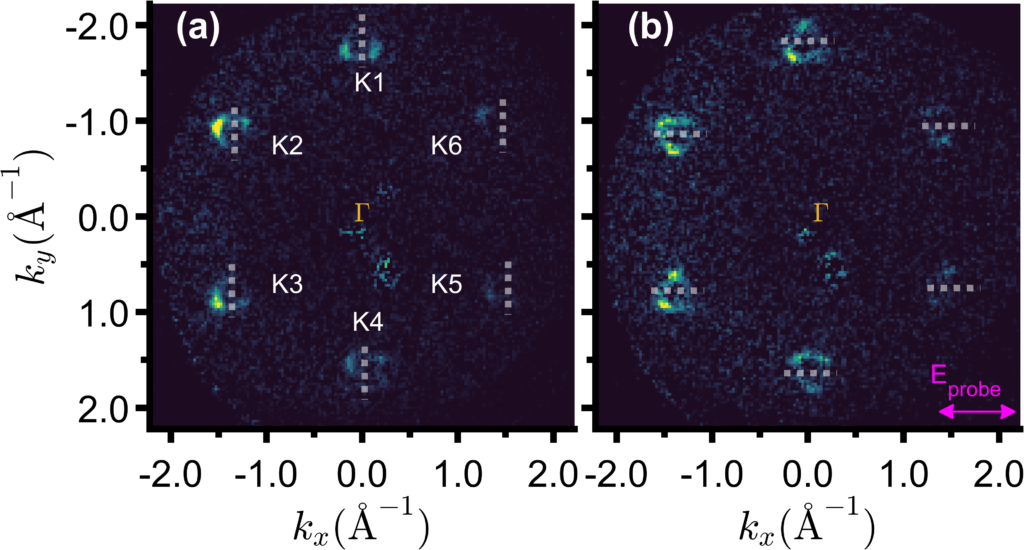
Professor Tom Allison leads an active research group at Stony Brook University focusing on ultrafast laser spectroscopy and nonlinear optics. His laboratory specializes in time- and angle-resolved photoemission spectroscopy (tr-ARPES) and frequency comb laser development for studying ultrafast dynamics in novel materials. His research interests center on understanding electron dynamics in two-dimensional materials, particularly graphene and transition metal dichalcogenides. Using sophisticated tr-ARPES instrumentation, his group investigates pseudospin dynamics, valley polarization, and exciton coupling with unprecedented momentum and energy resolution. The research bridges condensed matter physics, quantum materials, and ultrafast optical science. Professor Allison's recent publications demonstrate a strong focus on 2D materials physics, with particular attention to momentum-resolved phenomena in graphene and TMD heterostructures. His group combines cutting-edge experimental techniques with theoretical modeling to unravel complex ultrafast processes at the quantum level. Scientific Recognition: DOE Office of Science Highlight for work on valley polarization dynamics in monolayer WS2 NSF Major Research Instrumentation grant for developing high-power frequency combs Marie Skłodowskiej-Curie fellowship awarded to group member Grzegorz Professor Allison has successfully mentored multiple graduate students to completion of their degrees, including PhD candidates Jin Bakalis and Myles Silfies, and MS student Michael Wahl. His former postdoc Alice Kunin has secured an assistant professor position at Princeton University. Current research is supported by NSF funding for developing advanced frequency comb technology spanning from THz to soft x-ray regions.
F. Levent Degertekin is a Regents' Entrepreneur and the George W. Woodruff Chair in Mechanical Systems and Professor at the George W. Woodruff School of Mechanical Engineering at Georgia Institute of Technology. His office is located in Love Building, room 311B, and his contact email is levent.degertekin@me.gatech.edu. Dr. Degertekin's academic journey includes a Ph.D. in Electrical Engineering from Stanford University (1997), an M.S. in Electrical Engineering from Bilkent University, Turkey (1991), and a B.S. in Electrical Engineering from Middle East Technical University, Turkey (1989). Dr. Degertekin's research focuses on micromachined ultrasonic devices and systems for medical applications, particularly in intravascular ultrasound imaging, therapeutic ultrasound, and acousto-optical sensors for MRI. His work spans from fundamental research on novel transduction methods to complete catheter-based imaging systems close to commercialization. He has made significant contributions to capacitive micromachined ultrasonic transducers (CMUTs), developing diffraction grating based optomechanical sensing methods now commercialized by Silicon Audio, novel atomic force microscopy imaging probes, and micromachined ultrasonic ejector structures for cell transfection commercialized by OpenCell Technologies. His research integrates acoustics, optics, and their combinations for various medical applications, utilizing conventional microfabrication (MEMS) and integrated circuit technologies. The Degertekin lab exposes students to applied physics, electrical, mechanical and biomedical engineering, biology, and biomimetic systems, providing them with thorough theoretical and experimental education in acoustics and optics while learning interdisciplinary research. Dr. Degertekin's work has received significant media attention, including coverage in IEEE Spectrum, Wired Magazine, The New York Times, and Fox Business News, highlighting innovations such as handheld ultrasound probes, MRI safety sensors, and minimally invasive cardiac imaging technologies. IEEE Fellow for 'Contributions to micromachined ultrasonic and optomechanical transducers and systems,' 2022 IEEE UFFC Society Inaugural Carl Hellmuth Hertz Ultrasonic Achievement Award, 2014 George W. Woodruff School Outstanding Achievement in Commercialization and Entrepreneurship Award, 2024 National Science Foundation CAREER Award, 2004-2009 Whitaker Foundation Biomedical Engineering Research Grant Award, 2001 66 US and 6 International Patents Dr. Degertekin has mentored numerous students who have gone on to make significant contributions in the field. Several of his students have received IEEE Ultrasonics Symposium Best Student Paper Awards, including Jeff McLean (2003), Sheng-Yu Peng (2006), Rasim O. Guldiken (2005 and 2007), and Toby Xu (2014). His research has been supported by various grants including the NSF CAREER Award and Whitaker Foundation grant. His work has led to multiple commercial ventures including Silicon Audio and OpenCell Technologies. The Degertekin Group at Georgia Tech focuses on transducers and systems for medical imaging and sensing, with current projects including capacitive parametric transducers, acousto-optic sensors for MRI, novel transducer methods for focused ultrasound in the brain, microsystems for intravascular and intracardiac ultrasound imaging, and CMUT-on-CMOS systems for IVUS imaging.
Karl Ulrich Schreiber is an Adjunct Professor at the Department of Physics and Astronomy, University of Canterbury, New Zealand, and an apl. Professor at the Institute for Astronomical and Physical Geodesy at the Technical University of Munich (TUM). He is a scientist at the Geodetic Observatory Wettzell, jointly operated by TUM and the Bundesamt für Kartographie und Geodäsie (BKG). His work bridges fundamental physics and geodetic applications, with leadership roles in major international projects including ESA’s MAGIC/Science, QSG4EMT, and Baltic+ Theme 5, as well as DFG Research Units NEROGRAV and UPLIFT. His research focuses on Space Geodesy , Satellite and Lunar Laser Ranging , and Ring Laser Technology . He has pioneered the use of large ring laser gyroscopes for measuring Earth's rotation, polar motion, and seismic rotations. His work enables high-precision monitoring of geophysical phenomena such as Earth tides, Chandler wobble, and rotational ground motions from earthquakes. He is a key contributor to multi-technique co-location studies (VLBI, SLR, GNSS) and time transfer experiments, advancing the Global Geodetic Observing System (GGOS). His recent publications show a strong trend in developing and applying large-scale ring laser arrays (e.g., ROMY) for geophysical sensing, photon-counting laser ranging for space debris and satellite tracking, and optical timing systems for synchronization across geodetic networks. These efforts span disciplines including geodesy, seismology, quantum optics, and fundamental physics. Scientific contributions include: Development of the Wettzell Large Ring Laser (G-ring) for continuous Earth rotation monitoring. First direct measurements of Earth's diurnal polar motion and Chandler wobble using ring lasers. Pioneering work in rotational seismology, validating ring laser data against seismic arrays. Contributions to lunar laser ranging and its role in reference frame realization. Leadership in ESA and DFG projects advancing space geodesy and inertial sensing. He advises doctoral and master’s students within the DFG Research Training Group UPLIFT and collaborates with international institutions on instrumentation and data analysis. His lab at Wettzell hosts advanced laser ranging and ring laser systems, serving as a fundamental geodetic observatory. Future work includes enhancing clock ties for global geodesy, expanding multi-component rotation sensing, and advancing space-based geodetic technologies.
Professor Radan Slavik is a distinguished academic at the University of Southampton's Optoelectronics Research Centre (ORC) within the Faculty of Engineering and Physical Sciences. His research focuses on the generation, manipulation, and detection of optical signals carrying information through signal phase and amplitude-phase interactions. As a Professorial Fellow-Research, he leads groundbreaking work in coherent optical communications, hollow core optical fibres, and optical frequency combs. Slavik's research interests span multiple cutting-edge domains including Coherent Optical Communications, Hollow Core Optical Fibres, Optical Frequency Combs, Ultra-stable Laser Oscillators, and Radio Frequency Photonics. His work has been pivotal in developing lightwave technologies that exploit optical phase, enabling significant advancements in internet capacity through coherent optical communications. His research on hollow core fibres has revealed their remarkable insensitivity to environmental variations, particularly temperature, which has opened new applications in seismic sensing, LIDAR calibration, and data center networks. His publication record reveals a strong focus on hollow core fibre technology, with recent work exploring thermal stability, gas dynamics in hollow core fibres, and applications in telecommunications infrastructure. The research demonstrates increasing sophistication in measurement techniques, fibre design, and practical implementations across multiple domains including sensing, communications, and metrology. Fellow of OSA (2017) Thermally-insensitive Hollow Core Optical Fibres (2018) Professor Slavik actively supervises multiple PhD students including Mitchell Gerrard, Win Adiyansyah Indra, Rene Andres Reynolds Hamel, Usue Irene Barbeito Edreira, Karim Elglmady, and Amalie Gjelsvik. His research is supported by significant grants from EPSRC, Royal Society, and EURAMET-EMRP-MSU, with collaborations spanning National Physical Laboratory, API Sensors Ltd., and University College London. His work on hollow core fibres with low thermal sensitivity forms a flagship research topic, comprising four distinct streams: fundamental fibre properties, new approaches to thermal stability, demonstration of low thermal sensitivity applications, and gas dynamics in gas-filled hollow core fibres.
Ye (Sarah) Sun is an Associate Professor in the Department of Mechanical Engineering at the University of Virginia (UVA), part of the School of Engineering and Applied Science. She joined UVA in 2021 after serving as an Associate Professor at Michigan Technological University. Her work focuses on wearable sensors, robotics, smart health systems, and cyber-physical systems. She leads the WEARLab research group. Education: Ph.D. in Electrical Engineering from Case Western Reserve University (2021), B.S. in Instrumentation Engineering from Tianjin University (not specified). Research interests include wearable electronics, health monitoring, and human-technology interaction. Her interdisciplinary approach integrates engineering innovations with healthcare applications. Notable projects involve self-powered triboelectric sensors and optical fiber-based health monitoring systems. Recent publications highlight advancements in photodiode technologies for high-frequency applications, including millimeter-wave generation and photonic integrated circuits. Awards include the NSF CAREER Award (2018) and NSF BRITE Award (2022). She has organized major conferences and holds editorial roles in health technology journals. Grants include NSF funding for cyber-physical systems and smart health initiatives. Her lab collaborates on projects involving wearable robotics and connected health solutions, with a focus on real-world applications in healthcare and IoT.
Amy C. Foster is an Associate Professor in the Department of Electrical and Computer Engineering at Johns Hopkins University, affiliated with the Whiting School of Engineering. She leads the Integrated Photonics Laboratory, focusing on nanoscale design of silicon-based photonic devices for optical communication systems and security applications. Her work emphasizes CMOS-compatible fabrication techniques for integrated photonic devices with applications in sensing, imaging, and high-speed processing. Education: BS (Electrical Engineering, University at Buffalo, 2003); MS & PhD (Electrical and Computer Engineering, Cornell University, 2007 & 2009) Postdoctoral Research: Cornell University (2009–2010) Professional Roles: Associate Editor of Optics Express (OSA), Chair of OSA Frontiers in Optics Committee, IEEE Photonics Conference Committee Member Her research interests center on silicon photonics, nonlinear optics, and photonic physical unclonable functions (PUFs). Key areas include developing secure authentication systems using chaotic microcavities, optimizing high-index materials like NbTiOx for visible light photonics, and advancing integrated photonic interconnects for multi-layer systems. Recent work explores machine learning-resistant PUFs and parametric nonlinear effects in sputtered metal oxides. Foster's publications highlight advancements in optical frequency combs, autofluorescence analysis of waveguides, and GHz-rate optical parametric amplifiers. Her lab’s innovations address challenges in quantum photonics, secure communications, and ultra-low-power signal processing. Awards: 2016 Johns Hopkins Catalyst Award, 2012 DARPA Young Faculty Award Grants: IARPA, NSF, APL, DARPA Her lab develops cutting-edge photonic devices for applications in space communications, neural stimulation, and security. Current projects aim to enhance multi-layer photonic integration and leverage nonlinear effects for novel signal processing architectures.
Jean Provost is a Full Professor in the Department of Engineering Physics at Polytechnique Montréal , with affiliations to the Montreal Heart Institute , IVADO , and the Institute of Biomedical Engineering . His research focuses on ultrasound imaging , cardiac and cerebral vascular imaging , and superresolution image reconstruction using machine learning and optimization . Based on 96 publications, his work emphasizes ultrasound localization microscopy , neural network applications , and microvascular hemodynamics . Education : Ph.D. (Columbia University), MPhil (Columbia University), M.Sc.A. (École Polytechnique Montréal), Engineering Degree (École Centrale Paris), License (Université Paris XI), B.Eng. (École Polytechnique Montréal) Research trends from 15 recent articles include: 3D and dynamic ultrasound localization microscopy for microvascular mapping Deep learning for image reconstruction and neural network pruning Machine learning-driven aberration correction and superresolution imaging Acoustoelectric and cavitation-based imaging techniques Applications in cardiac diagnostics and dementia detection Supervision includes 2 Ph.D. and 8 Master's theses completed at Polytechnique Montréal (2023), covering topics like optical ultrasound detection , microbubble modulation , and spatiotemporal sampling .