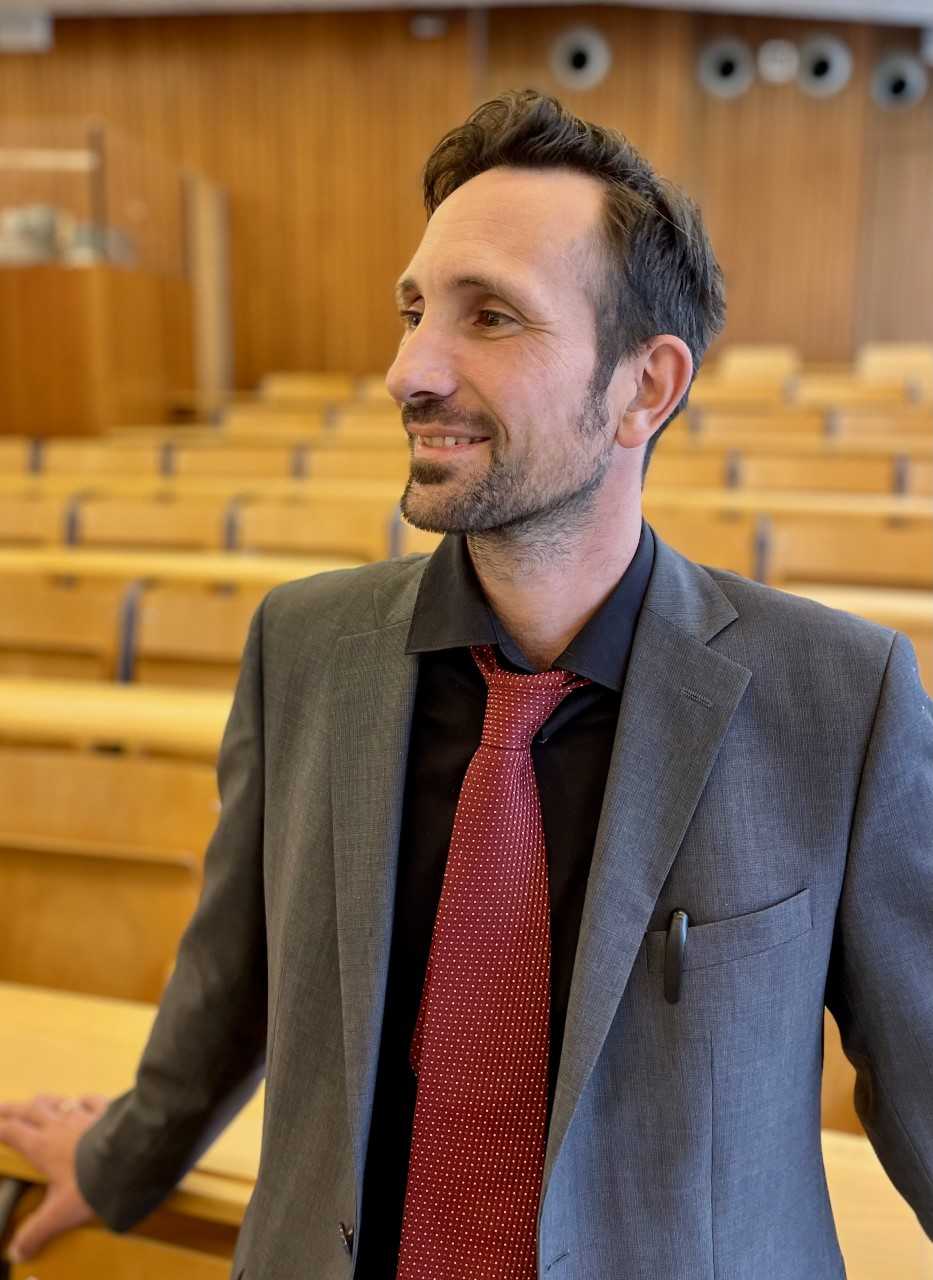
Prof. Dr. Claudine Moulin is a Full Professor of Historical Linguistics at the Department of German Studies, University of Trier. She co-directs the Trier Center for Digital Humanities and serves as Vertrauensdozentin der Deutschen Forschungsgemeinschaft. With academic roots in Brussels and Bamberg, she completed her PhD in 1990 and Habilitation in 1999 at the University of Bamberg. Her research spans medieval and early modern languages, manuscript studies, digital humanities, and Luxembourgish linguistics. As a leading scholar in historical linguistics, Moulin's work explores urban language history, phraseology, and cultural knowledge transmission through manuscripts. She has directed major digital humanities projects like LexicoLux and Cartul@rium, while pioneering digital codicology methods for medieval texts. Her research combines traditional philology with computational approaches. Her academic accolades include the Akademiepreis Rheinland-Pfalz (2010), Landesverdienstorden (2014), and the Verdienstkreuz am Bande (2025). She has held visiting professorships at Sorbonne, EHESS Paris, and EPHE, and received fellowships from the Humboldt Foundation and European Science Foundation. Notable Academic Roles: Co-founder and Chair of DHd (Digital Humanities in German-speaking countries) Founding member of Trier Center for Language and Communication Member of German Historical Institute Paris scientific board Advisory positions at Austrian Center for Digital Humanities and Herzog August Bibliothek Her editorial leadership includes chief editorship of Sprachwissenschaft journal and co-editorship of Germanistische Bibliothek monograph series. She has mentored over 40 graduate students in topics ranging from medieval marginalia to urban language studies.
Hakan Özkan is a Privatdozent and Research Associate at the Institute of Arabic and Islamic Studies, Department of Middle Eastern Studies, University of Münster, where he has been working since 2007 in various capacities. He was awarded his Venia Legendi (Habilitation) in November 2019 for Arabic and Islamic Studies with his thesis 'History of Eastern Zajal – Dialectal Arabic Verse Poetry from the East of the Arab World.' His academic background includes a Franco-German doctorate completed in 2006 from Université de Provence and University of Cologne, supervised by Claude Audebert and Monika Gronke, with external reviewers including Wolfhart P. Heinrichs from Harvard University. His educational background includes: 2019: Venia Legendi for Arabic and Islamic Studies, University of Münster 2002-2006: Franco-German Doctorate in Arabic Studies and Narratology (Université de Provence and University of Cologne) 1995-2000: Master of Arts in Islamic Studies, Oriental Languages and Literatures (University of Cologne) 2000-2001: Course program in Modern Standard Arabic and Syrian-Lebanese dialect at Institut Français d'Etudes Arabes de Damas Özkan's research focuses on premodern Arabic dialect poetry, particularly zajal and muwashshaḥ forms, narratology, prosimeter literature, socio-literary history, and diachronic dialectology. His interdisciplinary approach bridges linguistic analysis with literary criticism, examining how dialectal forms evolved within Arabic literary traditions across different historical periods and geographical regions. He has conducted extensive field research in Arab countries including Syria, Egypt, Lebanon, Tunisia, and Morocco, with particular emphasis on the historical development of poetic forms from the Mamluk through Ottoman periods. His publication history demonstrates consistent scholarly contributions to Arabic literary studies, with his 2020 monograph 'History of Eastern Zajal' representing a landmark study in the field. His recent work has expanded to include analyses of religious poetry praising the Prophet Muhammad in zajal form, wine poetry in Arabic literary traditions, and the integration of dialects into Arabic language teaching methodologies. His scholarly output spans monographs, critical editions, encyclopedia entries, journal articles, and book chapters across multiple languages including German, English, French, and Turkish. Among his academic recognitions: 2018: Second place on shortlist for W2 Professorship for Arabic Language and Translation Science, University of Leipzig 2008: Offered Junior Professorship at American University in Cairo (declined) 2007: Second place on shortlist for maître de conférence position at University of Nancy 2007: Official Qualification from National University Council (CNU) for positions as maître de conférence at French universities Özkan has served on numerous academic committees, including appointment committees for professorships in Sinology and Arabic and Islamic Studies at the University of Münster. He has been a juror for the Sheikh Hamad Award for Translation and International Understanding in Doha and has served on the steering committee for the 'Translation for Dialogue' program of the Anna Lindh Foundation. His editorial work includes reviewing for Mamluk Studies Review, Die Welt des Islams, and Middle Eastern Literatures since 2012. His scholarly activities extend to linguistic fieldwork on Pontic Greek dialects in Turkey and organizing significant academic conferences including 'The Race Course of Literature – An-Nawāǧī and His Contemporaries' in 2018 at the University of Münster. His multilingual capabilities (Arabic, Turkish, German, French, English, Persian, Ottoman Turkish, and knowledge of Modern Greek) enable his comparative work across multiple linguistic and cultural traditions in the Mediterranean region.
Leibniz Institute for Jewish History and CultureGermany
Dr. Enrico Lucca serves as a Research Fellow at the Dubnow Institute, where he has held the position of Research Associate since January 2018. He concurrently coordinates the Research Unit 'Knowledge', the Institute's Forum, and oversees peer reviewing for the Dubnow Institute Yearbook. His academic work centers on twentieth-century European-Jewish history and thought, with specialized focus on knowledge transfer between Europe and Israel/Palestine, intellectual history, and institutional history within Jewish contexts. Lucca completed his Master's degree in Philosophy at the University of Milan in 2007, followed by doctoral studies (2009-2012) at the same institution, culminating in a dissertation titled 'A Dialectic Vision of Jewish History. Gershom Scholem and the Legacy of Messianism.' His academic training includes post-graduate specialization in Cultural Studies at Scuola Alti Studi in Modena (2009) and visiting research periods at the University of Chicago Divinity School (2009-2010) and Hebrew University of Jerusalem (2011). His research traverses European-Jewish intellectual history, Jewish cultural studies, and philosophy of religion, with particular emphasis on messianic thought, Kabbalah studies, and Hebrew literature. Lucca's scholarship frequently examines biographical and institutional frameworks that shaped Jewish thought in the twentieth century, especially through figures like Gershom Scholem, Franz Rosenzweig, and Hugo Bergmann. His methodological approach integrates cultural history with philosophical analysis to explore knowledge transmission across geographical and temporal boundaries. Analysis of his 15 most recent publications reveals consistent engagement with Central European Jewish intellectual migration to Palestine/Israel, institutional history of the Hebrew University, and critical reinterpretations of Scholem's legacy. His work demonstrates interdisciplinary breadth across history, philosophy, and literary studies, with recurring themes of linguistic identity, cultural transfer, and the interplay between mysticism and modernity in Jewish thought. No scientific awards are documented in the provided materials. While no formal students are listed, Lucca has secured significant research funding including a Gerda Henkel Foundation fellowship (2016-2017) for 'German-Jewish Knowledge and Cultural Transfer 1918–1948' and currently serves as Principal Investigator for the German Research Foundation-funded International Research Training Group 'Belongings: Jewish Material Culture in Twentieth-Century Europe and Beyond' (since 2024). Lucca actively leads the Research Unit 'Knowledge' and co-directs the International Research Training Group 'Belongings'—a tripartite collaboration between the Dubnow Institute, Leipzig University, and Hebrew University of Jerusalem—focusing on material culture approaches to Jewish history through comparative, transnational frameworks.
Prof. Dr. Ute Fendler holds the Chair of Romance Literature and Comparative Studies with Special Emphasis on Africa at the University of Bayreuth. Her academic journey includes a 2006 Habilitation and 1992 PhD from Saarland University, with research spanning Francophone African literatures , intermedial phenomena , and postcolonial cinematic analysis . She coordinates the Bayreuth Academy of Advanced African Studies as Vice-Director and serves on multiple editorial boards. 2006-Present: Professor at University of Bayreuth 2011-2015: Director of Institute for African Studies 2015-Present: Vice-Director of Bayreuth Academy of Advanced African Studies Her research interrogates urban ecotonal spaces through African music videos, transnational cinematic flows in African and Afro-Asian contexts, and mediated memory practices . Recent publications explore post-apocalyptic storytelling and decolonial aesthetics in music videos and films. Scientific contributions include: 2025: Staging Atmosphere: Urban Ecotonal Spaces in African Music Videos (Brill) 2024: Co-edited Asia-Africa: Multifaceted Engagement (Palgrave Macmillan) 2022: Animating the Future: Superheroes in Africa (Brill) 2020: Ghosts as Mediators: Memory and Hauntology (iwalewabooks) 2019: K-Pop Fandom in Germany (Korea University Press) She received the Faculty Enrichment Award from the Canadian Embassy in 2005 and serves on multiple academic committees including the University Library Commission (2007-2016).
Irene Albers is a full Professor at Free University of Berlin's Department of Philosophy and Humanities, holding dual appointments at the Peter Szondi Institute for General and Comparative Literature and Institute for Romance Philology since 2004. She chairs both the Examination Board and Doctoral Committee for General and Comparative Literature, serves as Trustee of Studienstiftung des deutschen Volkes since 2004/05, and has been Principal Investigator for the Friedrich-Schlegel Graduate School for Literary Studies and Cluster Languages of Emotion since 2007. Her research bridges comparative literature, anthropology, and visual culture with institutional leadership spanning editorial projects and international conferences. Her educational background includes: Born in Bremen (1967) Romance Studies, Philosophy, and German Studies at Universities of Tübingen, Tours, and Konstanz M.A. from University of Konstanz (1993) Ph.D. from University of Konstanz (1999) on literature and photography in Émile Zola, Proust, and Claude Simon Albers' core research examines literary anthropology through colonial/postcolonial lenses, focusing on French literary engagement with Africa, surrealism, and literature-photography intersections. She pioneered studies on Michel Leiris' ethnological poetics and Claude Simon's photographic techniques, extending to historical emotion research (anatomy of affects, body language) and romance novella traditions. Her work consistently challenges Eurocentric literary canons through primitivism critique and heteronomy aesthetics, emphasizing textual restitution and cultural reclamation. Recent publications (2018-2025) reveal a sharp turn toward colonial restitution ethics, particularly in oral literature provenance. Articles increasingly analyze literature as colonial loot, connecting French modernism with African/Caribbean contexts through collaborative projects with anthropologists like Eléonore Devevey. This trajectory builds from earlier surrealist studies to concrete frameworks for decolonizing literary scholarship, spotlighting institutional complicity in cultural appropriation while advancing symmetrized modernity revisions. Scientific awards include: Senior Fellow and Prize Winner of the Zukunftskolleg, University of Konstanz (2009) Albers supervises master's and doctoral students through dedicated AVL colloquia while securing major research funding as Principal Investigator for Friedrich-Schlegel Graduate School (2007-present) and Cluster Languages of Emotion (2007-2012). Her current DFG-funded project 'Literature as Colonial Loot?' with Andreas Schmid pioneers philological provenance research. Earlier, she contributed to Collaborative Research Center 511 'Literature and Anthropology' (Konstanz, 1999-2002) and DFG-funded conferences on Claude Simon. She leads the DramaNet research project and co-edits the 'machina' series at transcript Verlag since 2010. As board member (2007-2009) and deputy (2008-2012) of Cluster Languages of Emotion, she coordinates Area D 'Cultural Codings of Emotions'. Her Zukunftskolleg fellowship (2012-2013) and Marcel Proust Society collaborations underscore sustained engagement with literary anthropology networks.
Katrin Bromber is a German Researcher at the Centre for Modern Oriental Studies in Berlin, where she has led the research group "Progress and its Discontents: Ideas, Practices, Materiality" since 2014. Her career spans senior research roles at ZMO and academic teaching positions at the University of Vienna. Nationality: German. Language skills: Native German, fluent English/Swahili, moderate Amharic, good reading knowledge in French/Russian, basic Tigrinya. Habilitation (2009–): African Studies, University of Vienna PhD (1993): African Linguistics, University of Leipzig MA (1988): Swahili Studies, University of Leipzig Katrin Bromber's research interrogates intersections of body politics , sports history , Swahili linguistics , and Ethiopian modernity . Her work traces how physical culture, media representation, and colonial/imperial narratives shape national identities across Africa and Asia. Current focus: "Progress" as contested concept in Ethiopian and Gulf urbanism. Key article trends reflect her translocal methodology: 2017 studies on Ethiopian stadiums and fitness culture ; 2014-2013 publications analyzing East African military press , sports branding in the Gulf , and Swahili poetry ; 2007-2000 works on colonial linguistic politics , Indian Ocean slavery , and German colonial Swahili promotion . Recurring sub-fields: body as political text, translocal modernity, media historiography. Scientific Awards: Research Grant of the Berlin City Council (1999-2000): Gendered Slavery study Service to the Scientific Community: Chairwoman, Academic Association for Horn of Africa Studies (2012–) Editorial Advisory Board - Stichproben. Vienna Journal of African Studies (2015–) Editorial Advisory Board - Studies of Department of African Languages and Cultures (2015–) Teaching Experience: Textlinguistics, Mediacommunication, African Linguistics, Swahili (elementary/advanced), Swahili Literature, Swahili in Arabic Script at Leipzig, Humboldt-Berlin, Free Berlin, and Vienna universities Anthropology of the Body at Mekelle University Summer School Field Research: Tanzania (1993-2003): Swahili Poetry, Intellectual History Kenya (2005): Indian Ocean WW2 UAE/Bahrain (2009): Sports and Body Cultures Ethiopia (2009-2015): Sports, Body Politics
Prof. Dr. Pascal Fischer is a Professor for English and American Cultural Studies at the Faculty of Humanities and Cultural Studies, Otto-Friedrich-University Bamberg. He serves as Head of the Examination Board for the B.A. English and American Studies program and has held various academic roles since 2014, including interim professorships at multiple German universities earlier in his career. Education: PhD (summa cum laude) in English Literature (2003), Habilitation in English Philology (2009), both from University of Würzburg. His research spans interdisciplinary intersections of British Romanticism with medical humanities , urban studies , and Jewish-American literature . Key themes include: Political and religious discourse in historical contexts Urban space as a site of resistance and identity negotiation Cognitive approaches to literature and political thought Language as a marker of cultural identity in diasporic communities Prominent publications include monographs on literary conservatism and Jewish identity , co-edited volumes on poetry pedagogy and urban politics, and articles analyzing: Edmund Burke’s legacy in Brexit discourse Biblical texts in early modern political theory Cognitive contrasts between human and AI: literature as a bridge Scientific contributions: PhD with highest honors (2003) Keynote addresses at conferences (e.g., Anglistentag 2011 ) Teaching initiatives focus on integrating lyrical texts into language education and fostering interdisciplinary seminars for pre-service English teachers.
Sergiusz Michalski is a Professor at the Institute of Art History within the Faculty of Philosophy at the University of Tübingen, where he has held his position since 2001. Previously, he served as Managing Director of the Art History Institute at TU Braunschweig from 1996-2001 and completed his Habilitation at Goethe University Frankfurt in 1995. His distinguished academic career spans multiple European institutions including universities in Munich, Leipzig, Frankfurt, Kiel, Fribourg, Zurich, and Torun. Michalski's research focuses encompass Reformation and Art, Mannerism, 16th and 17th century Dutch and Flemish painting, Art theory, 18th century French painting, 20th century art, Public monuments, and Methodological questions in art history. His scholarly output includes approximately 270 publications with notable books such as 'The Reformation and the Visual Arts' (1992), 'Public Monuments' (1998), 'L'art de l'Europe Centrale' (2008), and 'Einführung in die Kunstgeschichte' (2015). His recent publications demonstrate continued engagement with contemporary issues in art history, particularly in public monument discourse, digital methodologies, and Central European art traditions. Michalski has edited several prominent art history journals including Ars Artibus et Historiae, Folia Historiae Artium, and Ikonotheka. Member of Royal Swedish Academy for Literature and Humanities Member of Polish Academy for Sciences and Arts Member of Göttingen Academy of Sciences Member of Academia Europaea / The Academy of Europe London Member of Latvian Academy of Sciences Member of Council of Experts of European Science Foundation Michalski maintains an active research profile with recent publications addressing digital methodologies in art history, contemporary monument discourse, and Central European art traditions. His international scholarly network is reflected in his editorial roles and academy memberships across Europe.
Yashar Mohagheghi is a Researcher at the Department of German and General Literary Studies, RWTH Aachen University, where he has worked since 2018 under Prof. Dr. Caroline Torra-Mattenklott. His academic trajectory includes a postdoctoral fellowship at Bielefeld University's Graduate School of Linguistics and Literary Studies (2012–2017), a research stint at the Bibliothèque Nationale de France (2015), and a Junior Lecturer position at Johns Hopkins University (2011). His research interests span Literary Theory, Cultural History, and German Literature with specialized focus on Time Theory, Festival Culture, Material Philology, and Small Literary Forms. Mohagheghi's work bridges systematic analysis of concepts like Festkultur and Zeitlichkeit with historical investigations of Early Modern literature, Goethe-era writings, Aestheticism, and Modernism. His scholarship frequently examines intersections between material culture, sensory theory, and political communication across different historical periods. Mohagheghi's publications reveal a trajectory emphasizing temporal aesthetics in Hölderlin's work, material philology in 19th-century literature, and sociological analyses of Weimar Republic culture. His research demonstrates increasing engagement with ecological perspectives in literary studies, particularly regarding resource economies in book production and sustainability in literary materiality. Publikationspreis 2021 der Philosophischen Fakultät der RWTH Aachen Dissertationspreis 2018 der Kulturwissenschaftlichen Gesellschaft As an active academic organizer, Mohagheghi has co-chaired significant conferences including Wissenschaften des Konkreten (2023) and Ressource ‚Schriftträger‘ (2021), demonstrating leadership in contemporary literary theory discussions. His scholarly network extends across German, French, and American institutions, with particular strength in European literary theory and cultural history.
Dagmar Abendroth-Timmer is a Professor in Romance Studies - Didactics at the University of Siegen, Faculty I. She is a leading figure in foreign language didactics, with a strong focus on action-oriented teaching, multilingualism, teacher education, and digital learning environments. Her research is deeply international, involving collaborations across Europe through projects like LANGSCAPE, ENROPE, and ViMuLEnc. University: University of Siegen School: Faculty I Department: Romance Studies - Didactics Position: Professor Email: abendroth@romanistik.uni-siegen.de Her research interests include foreign language didactics, multilingual and intercultural education, teacher professionalization, empirical research methods, and digital learning. She has made significant contributions to the development of action-oriented language teaching models, particularly in digital and multilingual contexts. Her recent publications explore virtual multilingual encounters, translanguaging, and identity formation in language classrooms. The recent articles reflect a strong trend toward digitalization in language education, with a focus on virtual exchange, teacher training in digital environments, and the role of multilingualism in online learning. There is a consistent emphasis on reflective practice, identity, and critical pedagogy across her work. She is actively involved in academic leadership, serving as a network consultant for LANGSCAPE and coordinating international projects. She has contributed to numerous edited volumes and special journal issues, particularly on plurilingualism and teacher education. Dagmar Abendroth-Timmer supervises research assistants and contributes to curriculum development in teacher education. She is engaged in ongoing research projects such as ViMuLEnc, which explores virtual multilingual learning encounters, and drama pedagogy in language teaching. Her work bridges theory and practice, aiming to enhance both teacher training and classroom instruction in foreign languages.
Konstantin Voigt, Professor of Musicology II , serves at the University of Würzburg within the Faculty of Philosophy and Institute of Music Research. His research spans medieval Latin song traditions, music theory, notation systems, and digital humanities applications. He also explores 20th-century composers like Arnold Schoenberg and the reception of medieval music in popular culture. Current: Chair of Musicology II, University of Würzburg (2024–) Previous: Tenure-track Professor, University of Freiburg (2020–2024) Education: PhD (Würzburg), MA (Erlangen-Nürnberg), Musicology & Art History Voigt's research bridges premodern music history with digital methodologies, focusing on: Medieval Latin song structures (9th–13th centuries) Development of musical notation and visualization Digital editions as tools for manuscript analysis Intermedial relationships in postmodern composition Stefan George’s poetry in Schoenberg’s works His recent publications analyze scribal practices in Paris 1139 manuscripts and digital approaches to monophonic music. He co-leads the Weave Lead project on French music reception in Central Europe before 1350 and contributes to the Corpus monodicum digital edition. Collaborations include PD Dr. Hana Vlhova-Wörner (Prague) and institutions like the Schola Cantorum Basiliensis.
Prof. Dr. Claudia Schlaak is Professor of Language Teaching and Learning Research: Didactics of French and Spanish at the University of Kassel, where she serves as Head of the Department of Foreign Language Teaching and Learning Research. She has held this position since September 2020, following an acting professorship at the same institution from October 2018 to December 2019. Her academic work bridges theoretical research and practical application in foreign language education, with particular focus on inclusive teaching methodologies and multilingual contexts. Dr. Schlaak's research centers on foreign language teaching and learning, with special emphasis on didactics of French and Spanish, inclusive education approaches, multilingualism in educational contexts, and the integration of digital technologies in language acquisition. Her work examines how diverse language backgrounds influence learning processes, with particular attention to bilingual learners (especially German-Turkish bilinguals) acquiring Romance languages. She investigates pronunciation acquisition, text complexity, intercultural competence development, and the implementation of inclusive teaching strategies that recognize learner diversity as a resource rather than a challenge. Analysis of her recent publications reveals a strong trend toward digital learning environments, with increasing focus on virtual reality applications, 360-degree learning environments, and digital tools for pronunciation training. Her research consistently addresses multilingual contexts and inclusive approaches, with growing attention to potential-oriented teaching methodologies that shift focus from deficits to learner strengths. The interdisciplinary nature of her work connects linguistics, educational psychology, and technology-enhanced learning. Dr. Schlaak serves as co-editor of the journal Romance Language and its Didactics (since January 2019) and the series French Didactics in Dialogue (since April 2020). She has contributed significantly to academic discourse through numerous edited volumes, special journal issues, and collaborative research projects that bridge theoretical insights with practical classroom applications. Her work demonstrates strong commitment to teacher education, with multiple publications addressing pre-service and in-service teacher training, particularly regarding inclusive practices, intercultural competence development, and the integration of digital tools in language teaching. She has developed practical teaching materials, including method cards for foreign language instruction and inclusive teaching resources for Spanish language classrooms.
Eleanor Goerss serves as a Research Fellow at the Institute of Art History within the Faculty of Humanities at the University of Tübingen, working since 2023 on the DFG-funded project 'History as a Visual Concept: Peter of Poitiers’ Compendium historiae' under Prof. Andrea Worm’s direction. Her position involves reconstructing medieval visual epistemology through manuscript analysis and digital editing methodologies. Her academic foundation includes a PhD in History of Art and Architecture from Harvard University (2016–2023) and a dual BA in Art History and Mathematics from Columbia University (2012–2016). This quantitative-humanistic training informs her analytical approach to medieval diagrammatic systems. Goerss specializes in the visual representation of knowledge in 13th–14th century Europe, with particular focus on Lullian art, genealogical diagrams, and manuscript transmission networks. Her research interrogates how medieval thinkers encoded theological and philosophical concepts through recursive visual structures, examining the interplay between mathematical logic and religious epistemology in diagrammatic forms. This work bridges art history, cognitive science, and medieval studies through rigorous paleographic analysis. Her 2024 publications reveal a cohesive trajectory exploring recursive structures in Lullian figures, manuscript adaptation of dialogue forms, and Peter of Poitiers’ historiographical diagrams. Collectively, these works demonstrate how medieval visual systems functioned as cognitive tools for knowledge organization, with particular attention to the materiality of manuscripts and cross-institutional transmission patterns across European intellectual centers. Her scientific recognition includes: Kress Institutional Fellowship at Institut national d’histoire de l’art, Paris (2021–2023) DAAD Research Grant at University of Freiburg (2019–2020) Frederick Sheldon Traveling Scholar Grant from Harvard University (2019–2020) Certificate of Distinction in Teaching, Harvard University (2018–2019) Art History Senior Thesis Prize, Columbia University (2016) As lead researcher on the DFG project, Goerss directs manuscript digitization efforts and develops analytical frameworks for reconstructing Peter of Poitiers’ genealogical systems. Her grant portfolio demonstrates consistent success in securing competitive funding from German, French, and American institutions, reflecting the international significance of her work. Though no current advisees are documented, her Harvard teaching award indicates pedagogical excellence in undergraduate instruction. She operates within the DFG project team at Tübingen’s Institute of Art History, collaborating with Prof. Andrea Worm on the scholarly edition of Peter of Poitiers’ Compendium. This interdisciplinary team integrates codicology, digital humanities, and historical theology to produce critical editions and visual reconstructions of medieval knowledge systems.
Prof. Anja Müller-Wood holds a Professorship in English Literature at Johannes Gutenberg University Mainz since 2003. She earned her Ph.D. (1995) from Philipps-Universität Marburg and completed her Habilitation (2002) at the University of Trier. Her research focuses on early modern English literature (16th-17th centuries), 19th-20th century English literature, and interdisciplinary fields like narratology, stylistics, and literary linguistics. She teaches advanced BA/MA courses on these topics and co-leads core modules like 'Introduction to Literary Studies' and 'Colloquium' for literature and education students. Her work explores intersections between literature and cultural identity, particularly in post-Reformation religious dynamics and narrative form. She actively supervises theses aligned with her research areas. Her recent publications include analyses of Jacobean drama, cognitive approaches to narrative, and studies on Angela Carter and Ian McEwan. She serves on the editorial board of the International Journal of Literary Linguistics and maintains academic profiles on ResearchGate and academia.edu. Research emphasizes cognitive narratology, examining how literary forms interact with human cognitive processes. She also investigates transnational cultural exchanges in early modern and modern British literature, blending historical analysis with contemporary theoretical frameworks.
Julia Wurr is a Junior Professor of Postcolonial Studies at the Institute for English and American Studies, Carl von Ossietzky University of Oldenburg, within the School of Linguistics and Cultural Studies. Her research spans postcolonial theory, gender studies, medical humanities, and Anglophone literatures, with a strong focus on reproduction, biocapitalism, and neo-orientalism. Her research interests include postcolonial medical humanities, biocapitalism, reproductive studies, gender and sexuality, Indian and Arab Anglophone writing, and literary theory. She critically examines how literature engages with medical, demographic, and security discourses, particularly in postcolonial and diasporic contexts. The recent articles highlight a consistent engagement with themes of reproductive labor, surrogacy, racial capitalism, and narrative ethics. Her work bridges literary analysis with critical theory, feminist studies, and global health, often analyzing how fiction reflects and challenges structural inequalities in medicine, demography, and security. Associate Editor, Journal of Postcolonial Writing (2024–) Vice-President, GAPS (Association for Anglophone Postcolonial Studies) (2023–2025) Member, DFG Network 'Bioethik und strukturelle Ungerechtigkeit' Member, Gesellschaft für Anglophone Postcolonial Studies (GAPS) Member, Anglistikverband Julia Wurr advises emerging scholars and promotes PhD opportunities in German-speaking countries through her involvement with GAPS. She has delivered numerous invited talks at international institutions including Columbia University, UC Berkeley, IISER Bhopal, and the University of Washington, reflecting her growing academic influence. Her work is supported by interdisciplinary networks and collaborative research initiatives. She is also active in public scholarship and teacher training, as seen in her workshop on Sarfraz Manzoor’s memoir.