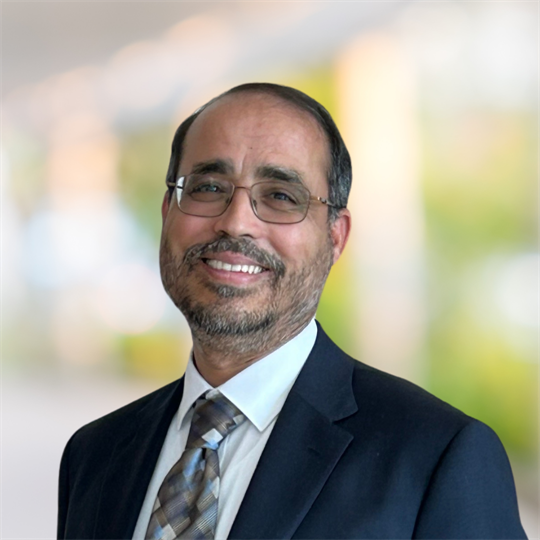
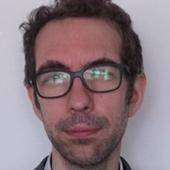
Dr. Elkafi Hassini is a tenured Professor in the Operations Management department at McMaster University 's DeGroote School of Business. As Associate Dean, Research , he drives academic innovation while maintaining an active research agenda in supply chain analytics and sustainability. Key research themes include data-driven optimization , IoT integration , and supply chain risk management Active in smart freight systems , food delivery logistics , and urban delivery networks Lectures on applied optimization and procurement strategy His work has been published in top journals including Production and Operations Management , European Journal of Operational Research , and INFORMS Journal on Applied Analytics . Recent research explores: Time-slot pricing in on-demand delivery IoT-enabled supply chain visibility Freight bottleneck analytics Equitable ride-sharing design Post-pandemic logistics transformation Awarded by CFI , NSERC , and SSHRC , he leads the Smart Freight Centre partnership and advises on Peel Region e-commerce logistics. Collaborations include researchers from King Fahd University and Harbin Institute of Technology .
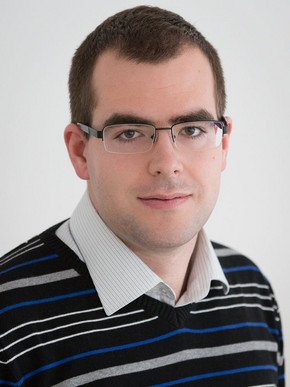
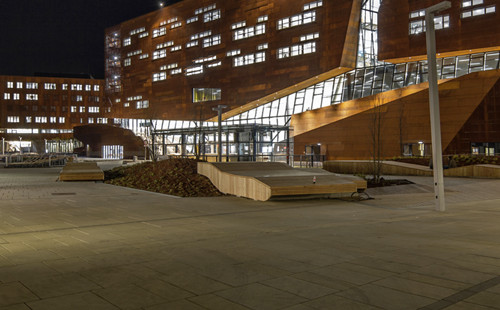
Martin Hrusovsky is an Assistant Professor at the Institute for Production Management within the Department of Information Systems and Operations Management at Vienna University of Economics and Business (WU) . His work bridges teaching and research, focusing on mathematical optimization models, uncertainty handling via stochastic methods, and simulation applications in transport and supply chain management. Education PhD in Production Management (2013-2018, WU Vienna) Master in Supply Chain Management (WU Vienna) Research Interests center on sustainable supply chains , logistics optimization , and quantitative decision-making . His work addresses fleet sizing under uncertainty, risk management, and sustainability integration in transportation systems. He actively explores the Physical Internet concept for SCM innovation. Recent Publications highlight trends in freight railcar optimization , blockchain for supply chain resilience , and cryptographic solutions to the bullwhip effect . His collaboration network spans institutions like the University of Innsbruck and Springer publications. Projects Backbone PI: Rail (2019-2020) - Researcher Case Study Development - Business Analytics (2018) European Wide Service Platform for Green European Transportation (2012-2015) - Researcher
Emma Frejinger is a full Professor at the Department of Computer Science and Operations Research, Faculty of Arts and Science, Université de Montréal. She holds the Canada Research Chair in Demand-Driven Optimization of Transport Systems and the CN Chair in Railway Operations Optimization. Her work bridges operations research and statistical learning to solve large-scale transportation challenges. Ph.D. in Mathematics, École Polytechnique Fédérale de Lausanne, Switzerland Her research focuses on transportation network optimization , demand forecasting , and discrete choice modeling . She develops data-driven methodologies for railway operations, EV charging infrastructure, and traffic prediction, emphasizing scalability and real-world applicability. Recent publications highlight trends in integrating machine learning with combinatorial optimization , particularly for MIPs , competitive facility location , and stochastic transport systems . These works span freight logistics , urban mobility , and reinforcement learning applications . Scientific Awards: Two-time INFORMS Transport Science and Logistics Society best Ph.D. thesis award 2017 Grand Prix d'excellence en transport (freight category) She has supervised 21+ graduate students in topics ranging from locomotive routing to electric vehicle adoption , with projects funded by NSERC, FRQ, and industry partners like CN Rail and Purolator. Her lab affiliations include CIRRELT and OPTIM , focusing on simulation and optimization.
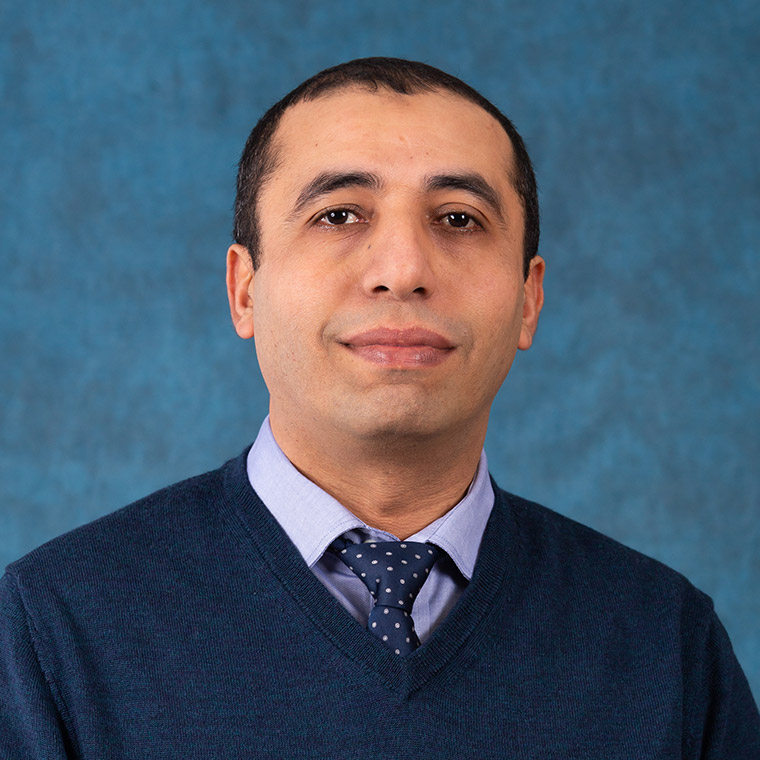
Fabian Akkerman is a researcher at the Digital Society Institute within the Industrial Engineering & Business Information Systems department at the University of Twente . His work bridges theoretical advancements in machine learning with practical applications in logistics, energy sustainability, and transportation systems. Primary Affiliation : University of Twente, Industrial Engineering & Business Information Systems Research Focus : Artificial Intelligence, Reinforcement Learning, Autonomous Systems, and Sustainable Logistics Fabian's research specializes in sequential decision-making problems, particularly in dynamic and stochastic environments. A key area of his contributions lies in applying reinforcement learning and optimization techniques to address challenges in: Vehicle routing with uncertain demand Inventory management and warehouse operations Time slot pricing for delivery services Smart transportation and freight logistics Stochastic modeling for supply chain resilience Industry 4.0 adoption in production systems His work demonstrates a strong emphasis on developing algorithmic frameworks (e.g., DynaPlex) that combine statistical modeling with real-world implementation. Recent publications highlight applications in autonomous vehicles, intelligent transport systems, and circular economy strategies. Scientific Awards : 2024 Transportation Science Meritorious Service Award 2025 2nd Place in ISIR Research Challenge for Production-Inventory Planning at ASML
Professor Sebastian Kummer is a distinguished academic and practitioner in the field of transport and logistics management. Currently serving as Head of the Institute for Transport and Logistics Management at Vienna University of Economics and Business (WU Vienna), he has shaped the field through both academic research and practical applications since joining WU in 2001. His academic journey began with studies in economics and philosophy at the University of Tübingen (1982-1984) and business administration at the University of Cologne (1984-1987), followed by doctoral and habilitation work at WHU Otto Beisheim School of Management. His professional path uniquely combines academic rigor with industry experience, having served as CEO of Zahnradfabrik Unna GmbH from 1989-1993 before transitioning to academia with a professorship at TU Dresden (1997-2001). Professor Kummer's research spans transport industry, mobility management, logistics controlling, supply chain management, sustainable mobility, and digitization. His work bridges theoretical frameworks with practical applications, particularly evident in his development of the 'Kummertabellen' for truck toll calculation, which became an industry standard across multiple European countries. His recent research focuses on carbon management in supply chains, digital transformation in logistics, and urban mobility solutions. With 555 publications including 10 leading textbooks, Professor Kummer has established himself as a prolific scholar whose work informs both academic discourse and industry practice. His publication trend shows consistent output over decades, with recent works increasingly addressing sustainability challenges in transport and supply chains. Red Arrow 2022 infrastructure award from Future Business Austria Silver Honorary Pin from the Austrian Federal Association of Logistics (2017) Emerald Literati Network Outstanding Paper Award 2022 WU Vienna Excellence in Teaching Award (2013) Alexander Freud Medal (2007) Honorary member of the Austrian Transport Science Society (2017) Professor Kummer maintains strong industry connections, having consulted for major companies including Deutsche Bahn, Siemens, and Red Bull. He leads numerous research projects (201 total, with 102 currently active) and serves in leadership roles including President of the German Arbitration Court for Logistics and Head of the Austrian BVL. His work exemplifies the integration of academic research with practical problem-solving in the transport and logistics sector. His institute serves as a hub for both teaching and applied research, with Professor Kummer directing the university course in logistics and supply chain management while maintaining active collaborations with industry partners across Europe. He has developed several educational programs including the Professional MBA Mobility Management at WU in cooperation with Porsche Holding and the MBA Supply Chain Management at ETH Zurich.
Dr. Tuo Mao serves as a Research Fellow at the Data Science Institute within the Faculty of Engineering and Information Technology at University of Technology Sydney (UTS). He also holds visiting scientist status at the Intelligent Mobility group at Data61 CSIRO. With a PhD from University of New South Wales (UNSW), Dr. Mao has established himself as a senior engineer specializing in transportation systems research. Dr. Mao's research interests span Transport Engineering with particular expertise in traffic modelling, microscopic simulation, and traffic signal control and management. His work focuses on vehicle infrastructure integration (VII) systems within intelligent transport systems (ITS), with specific applications in motorway modelling, coordinated ramp metering optimization, and V2I communication wireless connection system modelling. He has developed significant expertise in applying genetic algorithms to traffic signal control plan optimization and specializes in machine learning applications, particularly reinforcement learning, for transportation challenges. His recent publications (2023-2025) demonstrate a clear progression toward AI-driven transportation solutions, with emphasis on digital twins for passenger flow prediction, connected vehicle data analysis for railway safety, and micro-mobility pattern analysis. These works reveal consistent application of machine learning techniques to both recurrent and non-recurrent traffic conditions, with practical implementations across Australian transportation networks. EV Charging as a Service (2024-2026) - Australian Renewable Energy Agency UTS Smart Campus for energy saving (2022-2023) - UTS Central Research Budget V2X freight and emergency vehicle priority trial (2021-2022) - iMOVE CRC Safety and risk evaluation of Train Level Crossings (2021) - Transport for NSW Ai-RAP Automation for Australian Road Safety (2020-2022) - iMOVE CRC Dr. Mao actively contributes to the Future Mobility Lab at UTS, where his team develops integrated approaches to transportation challenges through collaboration with government agencies including Transport for NSW and research consortia like iMOVE CRC. His work bridges theoretical optimization methods with practical transportation solutions across Australian contexts, with particular focus on Sydney's transportation infrastructure.
Dr. Uday Venkatadri is a Full Professor and Department Head in the Department of Industrial Engineering at Dalhousie University's Faculty of Engineering, where he has taught since 2001. His industrial experience includes roles as Lead Architect at Baan and Research Associate at Université Laval. His research bridges facilities planning, supply chain optimization, and Industry 5.0 technologies, utilizing Mixed Integer Linear Programming as a core methodology. Research interests span: Hyperconnected logistics systems Production planning under uncertainty Healthcare supply chain resilience Sustainable operations AI/ML applications in industrial systems His publication trends show strong focus on: Optimization under uncertainty (35% of recent works) Sustainable supply chains (25%) Healthcare operations (20%) Maintenance systems (15%) Industry 5.0 applications (5%) Notable scientific awards: 2021 IISE Teaching Award (Logistics Division) Dalhousie Teaching Excellence Awards (2016, 2004) Purdue University Fellowships (1991-1993, 1987-1990) IIE Master's Thesis Award (1988) Advising and grants: Supervises graduate students in supply chain optimization and production systems Research funded through industry partnerships and institutional grants Developed 15+ graduate courses including Advanced Facilities Planning Laboratory involvement includes leading computational research groups focused on logistics optimization and sustainable operations, though no dedicated physical lab is specified.
Adnène Hajji is a Full Professor at Université Laval's Faculty of Business Administration, specializing in Operations and Decision Systems. His academic journey includes a postdoctoral fellowship at Polytechnique Montréal, Ph.D. from École de technologie supérieure, and bachelor's degree from National Engineering School of Tunis. Research Focus: Professor Hajji's work bridges operations research and artificial intelligence, with core interests in: Production planning and control for unreliable systems Stochastic optimization in manufacturing/remanufacturing Hybrid AI models (deep learning + evolutionary algorithms) Sustainable operations and closed-loop supply chains Project scheduling under uncertainty His 50+ publications demonstrate consistent innovation in integrating predictive maintenance with production planning, developing optimization algorithms for engineer-to-order contexts, and applying data-driven approaches to healthcare and smart cities. Recent work shows strong emphasis on CNN-LSTM architectures and genetic algorithm hybrids. Student Supervision: Actively advises graduate researchers in industrial engineering and operations management, though specific student names aren't publicly listed.
Jesus Gonzalez Feliu is a Professor of Supply Chain Management at Excelia Business School in La Rochelle, France. He holds a PhD in Computer and Systems Engineering from the Politecnico di Torino (Italy) and an Habilitation à Diriger des Recherches from the University of Paris Est. His academic journey includes positions as Research Engineer at CNRS, Assistant Professor at Ecole des Mines de Saint-Etienne, and current Professor at Excelia Business School since 2020. Habilitation à diriger des recherches, Université Paris Est, France (2016) Doctorat en Génie informatique et des systèmes, Politecnico di Torino, Italie (2008) Master en Transport et mobilité durable, Politecnico di Torino, Italie (2004) Professor Gonzalez Feliu specializes in sustainable urban logistics, demand modeling and forecasting, transport optimization, sustainable food logistics, humanitarian logistics and resilience, and group decision-making processes. His research often focuses on data production and demand estimation, interactive problem solving, and scenario evaluation in logistics contexts. He has made significant contributions to understanding urban freight systems, particularly in developing sustainable solutions for cities in both developed and developing countries. His extensive publication record includes over 75 peer-reviewed journal articles, 2 monographs, and guest editorship of more than 10 special journal issues. His most recent work demonstrates a continued focus on spatial accessibility in logistics warehouses, urban goods transport demand estimation, and sustainable supply chain solutions, with particular attention to applications in developing countries and humanitarian contexts. Chair of Urban Logistics Lab Scientific Committee, Deakin University, Melbourne (2019-2023) Member, Urban Mobility Observatory, Universidad del Pacifico, Lima (2020-present) Professor Gonzalez Feliu has supervised numerous research projects and collaborations across Europe, Latin America, and Australia. His work bridges theoretical modeling with practical applications, particularly in developing decision support systems for urban logistics planning and management. His international perspective is reflected in his research on logistics systems in diverse contexts, from European cities to developing economies in Latin America.
Frances Sprei is a Professor at Chalmers University of Technology, working within the Physical Resource Theory research group in the Department of Space, Earth and Environment. She conducts interdisciplinary research on sustainable mobility with a focus on electric and alternative fuel vehicles, as well as innovative mobility solutions like car pools, ride-sharing, and micromobility options. Her work integrates economic, political, technical and behavioral perspectives to evaluate incentives, business models, and methods for making travel more sustainable. Dr. Sprei's research spans several critical areas of transportation sustainability: Electric Vehicle Systems: She investigates real-world performance of plug-in hybrids, charging behavior patterns, and infrastructure requirements across European contexts Alternative Mobility Solutions: Her work examines how e-bikes, e-scooters, and car-sharing can replace conventional car trips and reduce emissions Policy Analysis: She evaluates the effectiveness of transportation policies, particularly incentives for electric vehicle adoption and corporate fleet electrification Behavioral Adaptation: Her research explores how users adapt to new mobility technologies in household contexts and urban environments Analysis of her recent publications (2023-2025) reveals an increasingly systemic approach to transportation decarbonization, addressing both supply-side challenges in vehicle manufacturing and infrastructure development alongside demand-side factors influencing consumer adoption. Her work shows particular attention to regional variations in adoption patterns and the integration of multiple mobility solutions into cohesive sustainable transportation systems. Dr. Sprei actively engages with policy contexts through multiple leadership roles: Chair of the Research Council for Västra Götaland's climate work Member of the working group for fossil-free transport in the Collaboration Program for the Climate Transition of the Swedish Industry Board member of Transport & Environment She leads and participates in numerous research projects funded by Swedish agencies including Energimyndigheten, Formas, VINNOVA, and Mistra, with current projects extending through 2027. These projects address critical challenges in home electrification, mobility services, regional logistics electrification, and the integration of micro-mobility solutions into urban transportation systems.