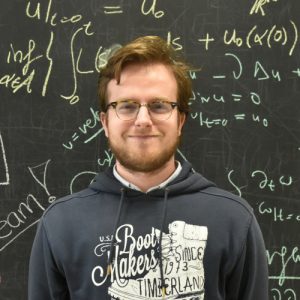
Borjan Geshkovski is a Researcher affiliated with the Universidad Autónoma de Madrid (UAM) under a Marie Skłodowska-Curie fellowship at the Conflex Project. He has been associated with institutions such as FAU Erlangen-Nürnberg, University of Deusto, and the DyCon team during his academic journey. PhD in Control Theory (2021, UAM) MSc in Applied Mathematics (2016–2018, University of Bordeaux) BSc in Applied Mathematics and Computer Science (2012–2016, University of Bordeaux) His research focuses on the intersection of Control Theory and Free Boundary Problems in fluid mechanics, with recent explorations into Deep Learning from a mathematical control perspective. Key contributions include work on turnpike properties, optimal actuator design, and controllability of nonlinear PDEs. Scientific awards include the Best Review and Presentation Prize at the 2nd ConFlex workshop (2019). His publications span topics like neural ODEs, porous medium flows, and obstacle problems, reflecting collaborations with the DyCon team and ConFlex consortium.
Javier Sánchez Cañizares is a Spanish physicist, theologian, Catholic priest, and full professor at the University of Navarra since 2022. He works in the Mind-Brain (MB) Group at the Institute for Culture and Society (ICS) and leads the Science, Reason and Faith (CRYF) Group . He holds two Ph.D.s: one in Physics from Universidad Autónoma de Madrid (1999) and another in Theology from Pontifical University of the Holy Cross (2006). Education Ph.D. Physics, Universidad Autónoma de Madrid (1999) Ph.D. Theology, Pontifical University of the Holy Cross (2006) Research Interests : His work bridges science and religion, focusing on the philosophy of nature , quantum mechanics , and interdisciplinary studies between physics, theology, and ethics. He explores emergence in complex systems , integrated information theory , and causation in natural processes. Awards : Expanded Reason Award (2018) for Universo singular Projects : He directed the Science and Religion in Spanish Schools project (2018-2021) funded by the John Templeton Foundation. He is co-editor of the journal Scientia et Fides and author of Naturaleza creativa (2018).
Carlos Alberto Blanco Pérez is an Adjunct Professor at the Facultad de Ciencias Humanas y Sociales in the Department of Philosophy and Humanities at the Universidad Pontificia Comillas (Madrid). He holds PhDs in Philosophy (2011) and Theology (2010), and has taught courses on Theory of Knowledge, Intercultural Dialogue, and Philosophy of Religion since 2014. His research focuses on philosophy of science, mind, religion, and creativity, alongside Egyptology and interdisciplinary knowledge integration. Education: Simultaneously earned degrees in Philosophy, Chemistry, and Theology from the University of Navarra and UNED. Notable academic milestones include a 2009-2011 Visiting Fellow position at Harvard University. Research interests span philosophy of science, mind, religion, creativity, and Egyptology. He co-founded The Altius Society, convening global thinkers to address transhumanism and AI ethics. Awards include membership in the World Academy of Art and Science (2015) and European Academy of Sciences and Arts (2016). Publications include over 20 books and articles on philosophy, theology, and interdisciplinary studies. Recent works explore epistemological integration, philosophical creativity, and the future of education.
Marti Prats Soler is an Associate Professor (2021–2023) at the Universitat de Barcelona's Department of Mathematics, within the Faculty of Mathematics. His research focuses on harmonic analysis, geometric measure theory, and partial differential equations, particularly involving Sobolev spaces, quasiconformal mappings, and Triebel-Lizorkin regularity. He holds a Ph.D. from the Universitat de Barcelona (2015) and has held postdoctoral positions at Aalto University (2019–2020) and Universidad Autónoma de Madrid (2015–2017). Education: Ph.D.: Singular Integral Operators on Sobolev Spaces (Universitat de Barcelona, 2015) Master in Advanced Mathematics (2011) Teaching Certificate in Mathematics (2010) Undergraduate Degree in Mathematics (Universitat de Barcelona, 2005) Research Interests: Functional analysis of Sobolev and Triebel-Lizorkin spaces Quasiconformal mappings and their regularity properties Free boundary problems and harmonic measure Calculus of variations and PDEs Current Project: Collaborator in the INTEGRALES SINGULARES, TEORIA GEOMETRICA DE LA MEDIDA Y EDP'S project (2021–2025).
Pedro Navas serves as Associate Professor at the Department of Continuum Mechanics and Structural Theory within the Civil Engineering School of Universidad Politécnica de Madrid (Technical University of Madrid). His academic progression includes Assistant Professor (2019-2022), Contract Doctor Professor (2022-present), with upcoming appointment as Department Director (September 2024). He also contributes as a member to the R&D+i Center for Smart and Sustainable Civil Infrastructure (CIVILis) since November 2024. His educational background includes PhD studies in Computational Mechanics at the University of Castilla-La Mancha (2013-2017) followed by a PostDoc position at the Polytechnic University of Catalonia (2017-2018). Navas specializes in computational mechanics with particular expertise in Material Point Method applications for large deformation problems in geotechnical engineering. His research spans soil-water coupled problems, landslide modeling, biomechanics, and numerical methods for saturated soils. Current projects focus on 'Meshfree modeling of dynamic problems in civil engineering,' employing techniques like MPM, OTM, and PFEM. His technical skills encompass Differential Equations, Numerical Modeling, Nonlinear Dynamics, and Mathematical Modeling across civil engineering applications. His publication record demonstrates consistent output in computational geomechanics, with recent work emphasizing two-phase modeling, stabilization techniques for numerical methods, and interdisciplinary applications in medical engineering. The research shows strong methodological development in meshfree approaches with practical applications to geotechnical challenges. Juan de la Cierva - Formación Scholarship (June 2018) Navas maintains active collaborations with researchers across Spain and internationally, evidenced by co-authorship with institutions including Polytechnic University of Catalonia, King's College London, and various Spanish research centers. His work bridges theoretical numerical methods with practical engineering applications across civil infrastructure and biomedical contexts.
Juan Carlos López Ríos is an Associate Professor at the School of Mathematics, Industrial University of Santander (UIS), Bucaramanga, Colombia. He specializes in Partial Differential Equations, Inverse Problems, and Fluid Mechanics, with a focus on water-wave dynamics and control theory. His work involves collaborations with international researchers from Chile, Spain, and France. Education: PhD in Engineering Sciences (2015), University of Chile Bachelor in Mathematics (2006), National University of Colombia His research addresses mathematical modeling of fluid dynamics, including sloshing problems, chemotaxis-Navier-Stokes systems, and heat transport in Hele-Shaw geometries. Recent work explores controllability of surface gravity waves and inverse problems in shallow water equations. Publications span journals like Inverse Problems , ESAIM: Control, Optimization and Calculus of Variations , and Journal of Mathematical Fluid Mechanics . Collaborative efforts include numerical methods for PDE-constrained optimization and surface measurement-based bottom detection in water waves.
Pablo Alvarez Caudevilla is an Associate Professor in the Mathematics Department at Carlos III University of Madrid (UC3M). His research focuses on partial differential equations and their applications, with specialization in nonlinear analysis and mathematical modeling. He leads the research group "Ecuaciones Diferenciales y Aplicaciones" (Differential Equations and Applications). His primary research interests include: Partial Differential Equations Nonlinear Analysis Mathematical Physics Calculus of Variations Applied Mathematics Higher-Order Differential Equations Dr. Alvarez Caudevilla's publication record demonstrates deep expertise in fourth-order equations including thin film equations and bi-Laplace equations. His work addresses critical questions about existence, regularity, asymptotic behavior, and singularity formation in nonlinear PDEs. He has made significant contributions to understanding blow-up phenomena, gradient behavior, and self-similar solutions across multiple equation types. He has secured competitive research funding as principal investigator for projects including "Ecuaciones en derivadas parciales y sistemas de EDPs acopladas: Análisis y aplicaciones" (2020-2023) funded by AGENCIA ESTATAL DE INVESTIGACION and "Ecuaciones diferenciales de alto orden de tipo parabolico y eliptico" (2013-2015) funded by MINISTERIO DE ECONOMÍA, COMERCIO Y EMPRESA. Dr. Alvarez Caudevilla maintains an extensive international research network with regular collaborations at institutions including Université Paris 7/Laboratoire Jacques-Louis Lions (France), University of Bath (UK), Kyoto Sangyo University (Japan), and University of Sydney (Australia). His research mobility includes numerous funded visits across Europe, Asia, and Australia focusing on advanced problems in differential equations.
Matteo Bonforte is a Full Professor at the Department of Mathematics, Universidad Autónoma de Madrid, and a faculty member of the Institute of Mathematical Sciences (ICMAT). He co-leads the research group PID2023-150166NB-I00 on Nonlinear PDEs and has co-organized major events like the 2023 Thematic Period on PDEs in Madrid. He serves on the editorial board of Nonlinear Analysis: Real World Applications . Current Position: Full Professor, Universidad Autónoma de Madrid Research Focus: Nonlinear/nonlocal PDEs, functional inequalities, entropy methods Key Grants: Spanish government-funded research group PID2023-150166NB-I00 His research spans asymptotic behavior, Harnack inequalities, regularity theory, and geometric applications of nonlinear diffusion. Recent work includes fractional porous medium equations and time-fractional models. His publications (over 50) emphasize quantitative estimates and stability in inequalities. Notable collaborations include Alessio Figalli, Gabriele Grillo, and Juan Luis Vázquez. He teaches advanced courses in calculus, partial differential equations, and mathematical analysis at both undergraduate and master's levels.
José Antonio Pastor González is Professor of Geometry and Topology in the Department of Mathematics at the University of Murcia. His research focuses on differential geometry, convex geometry and Lorentzian geometry, with publications in journals including Classical and Quantum Gravity and Journal of Geometry and Physics . Key research areas include spacelike hypersurfaces in Lorentzian manifolds, constant mean curvature surfaces, and geometric analysis. His monograph 'Poetry in the Time of War' (2007) bridges mathematical and literary analysis. Recent work examines curvature properties in relativistic space-times and convex set inequalities. He teaches advanced geometry courses and supervises doctoral research in geometric analysis. No information is available regarding current grant funding or laboratory affiliations.
Luis Raul Sanchez Fernandez is a Full Professor at Universidad Carlos III de Madrid, serving as Director of the Master's Degree in Plasma Physics and Nuclear Fusion. His research focuses on plasma turbulence, magnetohydrodynamics (MHD), and advanced confinement regimes in fusion devices. Key areas include I-mode transport control, Alfven eigenmode dynamics, and numerical methods for plasma equilibrium. His work integrates computational tools like SIESTA and FLIPEC for solving MHD equilibria and stability problems. Recent studies explore non-diffusive transport, magnetic island effects, and cross-phase modification for enhanced plasma confinement. He has contributed to ITER-related pedestal transport analysis and tungsten impurity studies. Publications emphasize fusion energy applications, plasma edge physics, and turbulence modeling. His team addresses challenges in stellarators and tokamaks, with a focus on self-organized criticality and transport barrier formation. Ongoing projects include developing efficient numerical algorithms and advancing control mechanisms for burning plasmas.
Cristina Brandle Cerqueira is an Associate Professor in the Department of Mathematics at the University Carlos III of Madrid, serving as Assistant Vice-Rector for Teaching and Research Staff. Her research focuses on nonlinear partial differential equations, with a particular emphasis on nonlocal equations, fractional Laplacian, and ergodic problems. She has contributed to studies on phase transitions, Hamilton-Jacobi equations, and blow-up phenomena in parabolic systems. Her work integrates theoretical analysis and applications in areas such as population models and material science. Brandle Cerqueira holds a position in the academic leadership, overseeing research and teaching policies. She has been involved in significant research projects funded by institutions like the Ministry of Economy, Trade, and Industry (Spain) and the State Agency for Research. Her collaborations include international stays at the University of Tours (France) to study nonlocal Hamilton-Jacobi equations and numerical methods for Stefan problems. Her publications span high-impact journals like Nonlinear Analysis, SIAM Journal on Mathematical Analysis, and Transactions of the American Mathematical Society. Key areas of her research include nonlocal diffusion processes, ergodic control, and the mathematical modeling of phase transitions with mid-range interactions. She has also explored numerical methods for handling blow-up in parabolic systems and contributed to the theoretical foundations of nonlocal heat equations.
Rosana Rodríguez López is a Professor at the University of Santiago de Compostela, affiliated with the Department of Statistics, Mathematical Analysis and Optimization within the Faculty of Mathematics. Her research focuses on nonlinear differential equations, fractional calculus, and fuzzy mathematics. She holds a PhD from the University of Santiago de Compostela (2005) and has authored over 100 publications. Her work emphasizes boundary value problems, fixed point theory, and applications of fractional operators. She is a member of the Galician Mathematical Research and Technology Center (CITMAga). Key contributions include studies on fuzzy differential equations, impulsive systems, and fractional dynamics. Education: PhD in Mathematics, University of Santiago de Compostela (2005) Research Interests: Nonlinear differential equations, fractional calculus, fuzzy systems, operator theory Collaborations: Over 60 co-authors, including Juan J. Nieto and Alireza Khastan Her research explores theoretical foundations and applications of differential equations in dynamical systems, with a focus on uncertainty quantification and generalized derivatives. She has contributed to fixed point theorems, interval-valued equations, and control theory in fuzzy environments.
Natividad Calvo Ruibal is a researcher in the Department of Applied Mathematics II at the School of Industrial Engineering , University of Vigo. She holds a doctorate from the University of Vigo (1999) for her work on Analysis and numerical resolution of some mathematical models of the free boundary in glaciology , supervised by Dr. José Durany Castrillo and Dr. Carlos Vazquez. Her research focuses on Geophysics , Numerical Analysis , and Fluid Mechanics , with particular emphasis on ice sheet dynamics, thermomechanical coupling, and free boundary problems. She has contributed to the development of GLANUSIT , a software toolbox for simulating large ice masses. Key Research Areas Mathematical modeling of glaciological systems Finite element methods for moving boundary problems Coupled multivalued models for ice streams Notable Collaborations Jose Durany Carlos Vazquez Raquel Toja Emanuele Schiavi Her publications span journals like Journal of Computational and Applied Mathematics and Physica D , addressing topics such as nonisothermal ice flow models and thermomechanical simulations.
Dr. José Manuel Rodríguez Seijo is an Associate Professor at the Department of Mathematics within the Higher Technical School of Architecture at the University of A Coruña. With 6 teaching quinquennia and 4 research sexennia, he specializes in mathematical modeling for physical systems. Research Focus: Partial differential equations, asymptotic analysis, and mechanics of continuous media Teaching: Mathematics for Architecture, Continuum Mechanics, Mathematical Modeling Students: Supervised 2 doctoral theses to completion His recent publications predominantly address thin domain modeling in elasticity and shallow water dynamics , with key contributions to asymptotic analysis and numerical methods for reduced dimensional problems. Active in European research projects (2019-2022) and national grants (MINECO 2016-2020, multiple earlier projects), he has presented at international conferences across 15 countries including Finland, Italy, and Portugal.
María Victoria Otero Piñeiro is a Professor in the Department of Mathematics at the University of A Coruña (UDC), affiliated with the School of Architecture. With over 5 quinquennial periods of teaching merit, she specializes in applied mathematics with a focus on modeling and numerical analysis. Current academic affiliations: Department of Mathematics, School of Architecture, University of A Coruña Research areas: Mathematical modeling, numerical methods for PDEs, solidification/phase-change phenomena, optical flow in images, asymptotic fluid mechanics models Teaching experience: Mathematics courses for architectural studies (110-158 annual hours), supervision of final degree projects