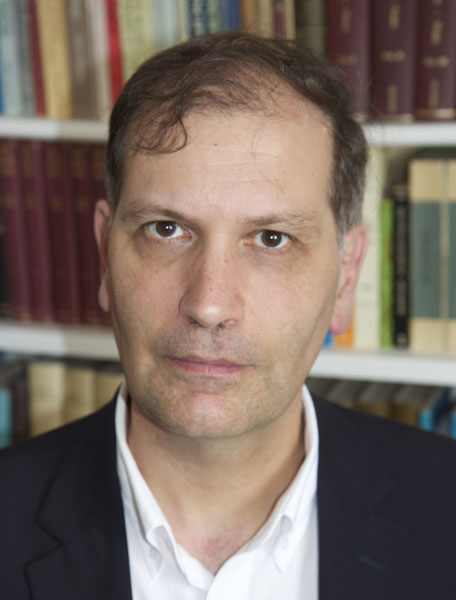
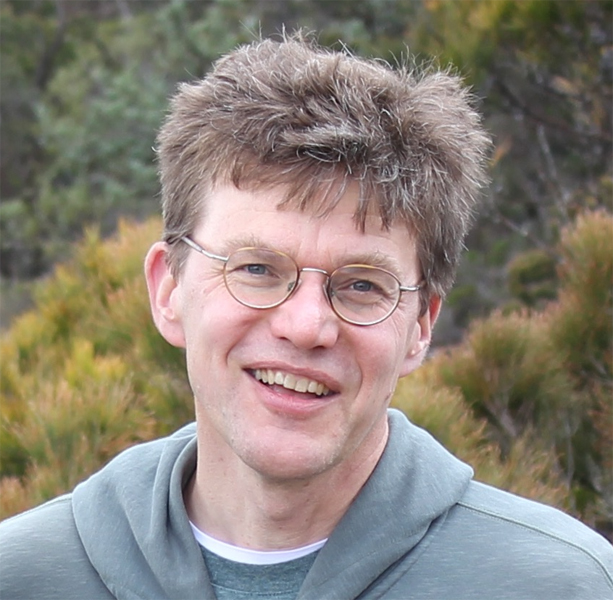
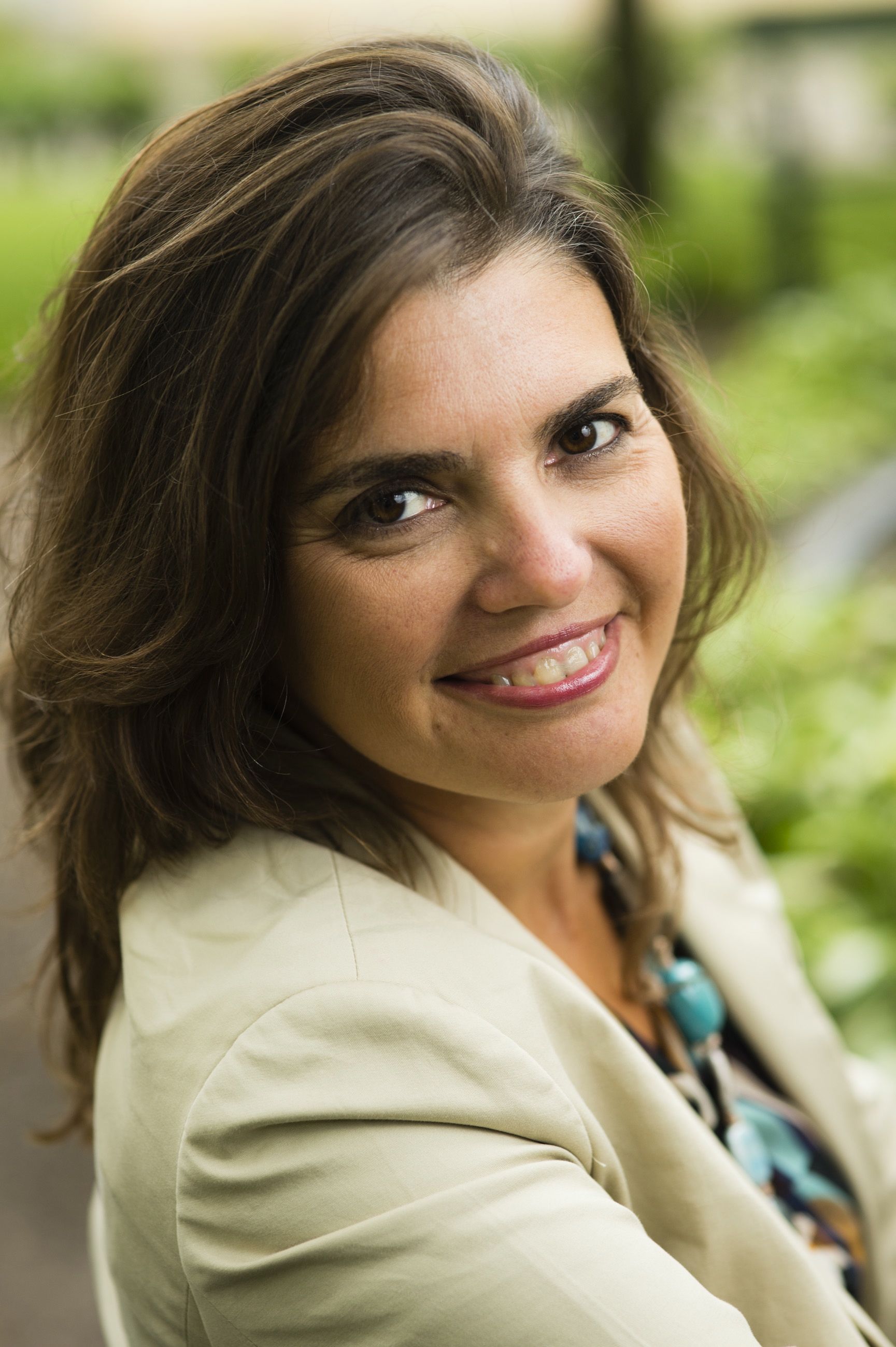
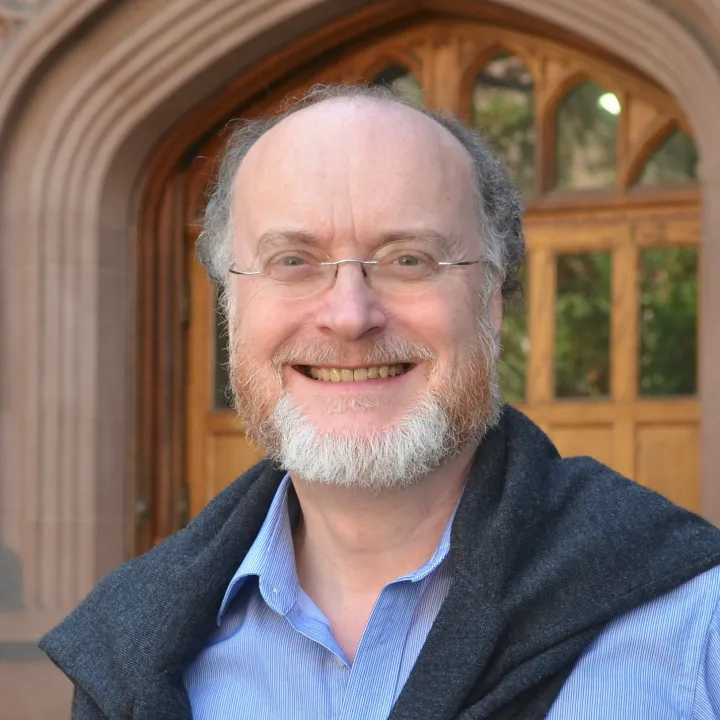
Warwick Tucker is a Professor in the School of Mathematics at Monash University. He holds a PhD in Mathematics from Uppsala University (1998) and a Docent qualification (2004). His research focuses on dynamical systems, chaos theory, and computer-assisted proofs with applications to complex systems and artificial intelligence. Key contributions include rigorous analysis of the Lorenz attractor, validation of numerical methods for differential equations, and studies on Julia sets and celestial mechanics. He leads a major project on non-hyperbolic dynamics funded until 2026. Notable awards include the EMS Prize (2004) and Moore Prize (2002). Collaborations span global institutions including École Normale Supérieure de Lyon. His work bridges pure mathematics with computational tools, emphasizing algorithmic proof techniques and validated numerical analysis.
Jean-Benoît Bost is a Full Professor in the Department of Mathematics at Paris-Sud University (Orsay, France), where he has been employed since 1998. He previously held positions as Directeur de Recherche CNRS (1993-1998) and Chargé de Recherche CNRS (1988-1993) at the Institut des Hautes Études Scientifiques (IHES). His research spans several interconnected fields within mathematics. His work focuses on algebraic geometry, number theory, and their interactions with mathematical physics. Key research areas include Arakelov theory, Diophantine geometry, non-commutative geometry, and applications of geometric methods to number theory. He developed foundational theories like slope estimates and evaluation maps that transformed classical Diophantine approaches. Bost's publications demonstrate consistent exploration of connections between geometry, topology, and arithmetic, with recurring themes in Arakelov theory, geometric invariant theory, and operator algebras applied to number theory problems. His research has influenced developments in foliation theory and arithmetic algebraization. Major scientific recognitions include: IBM Prize 'Young Researcher' (1988) Peccot Prize and Lectures at Collège de France (1990) Elie Cartan Prize (2002) Senior Member of Institut Universitaire de France (2005-2015) Invited Speaker at International Congress of Mathematicians (2006) Fellow of the American Mathematical Society (2013) He leads research within the Arithmetic and Algebraic Geometry team at Paris-Sud University, focusing on arithmetic aspects of algebraic varieties and formal subvarieties.
Barry Smith is a SUNY Distinguished Professor of Philosophy at the University at Buffalo, holding the Julian Park Chair in the Department of Philosophy. He also serves as Director of the National Center for Ontological Research (NCOR) and maintains affiliate appointments in Biomedical Informatics and Computer Science & Engineering. With joint appointments across multiple departments, Smith is a leading figure in the field of applied ontology and its applications across disciplines. Smith received his PhD in Philosophy from the University of Manchester in 1976, following MA and BA degrees in Mathematics and Philosophy from Oxford University. His educational background reflects his interdisciplinary approach that bridges philosophy, mathematics, and computer science. Smith's research focuses primarily on applied ontology, with significant contributions to biomedical informatics, artificial intelligence, and philosophy of science. His work has established foundational frameworks that enable data integration and knowledge representation across multiple domains. He has pioneered the development of Basic Formal Ontology (BFO), which has become the most widely adopted top-level ontology framework and was approved as an ISO standard (ISO/IEC:21838-2). His research has significantly influenced the Open Biomedical Ontologies (OBO) Foundry, a suite of interoperable ontology modules supporting biology and biomedicine research. Smith's publications over the past five years demonstrate a consistent focus on the applications of ontology to pressing scientific challenges, particularly in biomedical domains (including COVID-19 research), artificial intelligence limitations, and knowledge representation. His work spans theoretical developments in formal ontology while maintaining strong practical applications in real-world information systems. Wolfgang Paul Award of the Alexander von Humboldt Foundation (2002) Paolo Bozzi Prize in Ontology (2011) Fellow of the American College of Medical Informatics (FACMI) (2013) Smith has supervised numerous graduate students and postdoctoral researchers, contributing to the development of a new generation of ontologists. His research has been supported by major funding agencies including the National Institutes of Health, National Science Foundations of the US, Switzerland and Austria, the Volkswagen Foundation, the European Union, and the US Department of Defense. Since 2000, he has served as a consultant to Hernando de Soto on projects related to property and business rights among the poor in developing countries. As Director of the National Center for Ontological Research, Smith leads a team focused on advancing ontological methods and applying them to diverse domains including biomedical informatics, defense intelligence, and industrial engineering. His work continues to shape how we represent and integrate knowledge across disciplinary boundaries.
Gabriel Alejandro Valiente Feruglio is a Professor at the Universitat Politècnica de Catalunya (UPC), affiliated with the Barcelona School of Informatics (FIB) and the Department of Computer Science. He is a member of the ALBCOM research group, focusing on Algorithms, Bioinformatics, Complexity, and Formal Methods. His work integrates theoretical computer science with applications in computational biology, including phylogenetic analysis, graph algorithms, and metagenomics. Valiente’s research emphasizes the development of algorithms for biological networks, phylogenetic tree and network comparison, and efficient graph representation. He has contributed to tools like TANGO for taxonomic assignment in metagenomics and AligNet for protein-protein interaction network alignment. His publications span over 140 works in journals like BMC Bioinformatics, IEEE-ACM Transactions on Computational Biology, and Bioinformatics. He leads and collaborates in competitive research projects funded by institutions like the Catalan government, focusing on bioinformatics, computational biology, and algorithmic methods. His research also extends to LaTeX typesetting for scientific documents and the structural analysis of scientific collaborations in graph transformations.
Michael Zurel is a NSERC Postdoctoral Fellow in the Department of Mathematics at Simon Fraser University, working under Dr. Nadish de Silva, Canada Research Chair in the Mathematics of Quantum Computation. His research focuses on foundational aspects of quantum computation, quantum information, and nonclassical physics. Key interests include quantum contextuality, negativity in quasiprobability representations, and classical simulation algorithms for quantum systems. He holds a PhD, MSc, and BSc in Physics and Mathematics from the University of British Columbia (2024, 2020, 2019), all supervised by Dr. Robert Raussendorf. His doctoral work explored classical descriptions of quantum computations via hidden variable models and quasiprobability representations. His master’s thesis addressed hidden variable models and classical simulation algorithms for quantum computation with magic states on qubits. Research interests emphasize bridging quantum foundations with computational efficiency, particularly how nonclassical features like contextuality enable quantum advantage. Collaborators include prominent figures such as Robert Raussendorf, Juani Bermejo-Vega, and Cihan Okay. His scientific achievements include the NSERC Postdoctoral Fellowship. Advising and grants are not explicitly detailed, but his work is supported by foundational research grants. He collaborates actively within quantum information theory and computational physics communities.
Uli Sauerland is a Professor and Department Head of FB4 Semantics and Pragmatics at the Leibniz-Centre General Linguistics (ZAS) in Berlin since 2017. He holds honorary professorships and research fellowships in Germany and Japan. His research focuses on syntax, semantics, pragmatics, and language acquisition. He has led numerous international research projects and serves on editorial boards of journals like Linguistic Inquiry and Semantics & Pragmatics . Education: 1993: Diploma (M.Sc.) in Mathematics, Universität Konstanz 1998: Ph.D. in Linguistics, MIT 2003: Habilitation in General Linguistics, Universität Tübingen 2018: außenplanmäßiger Professor, Universität Potsdam Research Interests: His work explores formal semantics, pragmatics, and syntax, with a focus on scalar implicatures, presuppositions, and experimental methods. He investigates cross-linguistic phenomena in languages like Japanese, German, and indigenous Brazilian languages. Recent topics include child language acquisition and computational modeling of pragmatic reasoning. Awards: 2018 Honorary Professorship at Universität Potsdam 2014 Humboldt Alumni Fellowship 2011 Japan Society for the Promotion of Science Bridge Fellowship Grants & Leadership: Coordinated DFG SPP 1727 (XPrag.de, 2014-2020) Principal Investigator in EU-funded projects like CHLaSC (2006-2009) and COSY (2016-2019) Organized international conferences including Experimental Pragmatics 2007 and Formal Approaches to Japanese Linguistics 6 Labs & Collaborations: Leads the Semantics and Pragmatics Department at ZAS, fostering interdisciplinary research. Collaborates globally through networks like Euro XPRAG and COST Action A33.
François Labourie is a Professor at the University of Nice Sophia Antipolis (Université Côte d'Azur) in the Department of Mathematics. He previously held positions as Professor at Paris-Sud University (1994–2014) and Assistant Professor at École Polytechnique (1991–2001), alongside a CNRS Research Fellowship at École Polytechnique (1986–1994). His research focuses on geometry of surfaces, Teichmüller theory, dynamics, and geometric structures. Key achievements include the European Mathematical Prize (1992), Carrière Prize (1993), and an ERC Advanced Grant (2009). He has delivered an invited lecture at the 1998 International Congress of Mathematicians (ICM). His work bridges dynamical systems, differential geometry, and representation theory, with notable contributions to Anosov flows and higher Teichmüller theory. Labourie's recent projects include the ERC-funded Geometry and Analysis of Surface Groups (2023–2028) and the ANR-DynGeo project (2017–2021). He teaches advanced courses in differential geometry, hyperbolic geometry, and group theory at the undergraduate and graduate levels. Contact: francois.labourie@univ-cotedazur.fr , Laboratoire de Mathématiques, Université Côte d'Azur, Nice, France.
Wei Li is a Professor at the School of Computer Science and Engineering, Beihang University (since 1986), and Director of the State Key Laboratory of Software Development Environment (since 1992). He has held visiting positions at institutions including the University of Minnesota and Universität Saarlandes. Education: Ph.D. in Computer Science, University of Edinburgh (1979–1983) B.Sc. in Mathematics, Peking University (1961–1966) Research Interests span Mathematical Logic, Concurrent Programming Languages, Satisfiability Problems, Artificial Intelligence, Software Crowdsourcing, and Big Data. His work includes foundational contributions to logical frameworks for belief revision and specification evolution, with applications in software trustworthiness and constraint satisfaction. Publication Trends reveal a focus on formal methods (R-calculus, open logic systems), software crowdsourcing, and phase transitions in constraint satisfaction problems. His research integrates theoretical rigor with practical applications in information science and engineering. Scientific Awards include: Chinese Government Award for Publishing (2017) Tsiolkovsky Medal (2007) National Prize of First Class for Achievements in Education (2005) Ho Leung Ho Lee Prize (1998) Academician, Chinese Academy of Sciences (1997) He also supervised 8 post-docs, 52 Ph.D., and over 100 graduate students.
Sara Negri is a Professor of Mathematical Logic at the University of Genoa, Italy, and previously held the Chair in Theoretical Philosophy at the University of Helsinki (2015–2020). She has held academic positions including Senior Researcher at the University of Helsinki's Department of Philosophy and Academy Research Fellow (2002–2012). Her research focuses on proof theory, modal and non-classical logics, epistemic logic, and formal epistemology. She has authored influential works such as Structural Proof Theory (2001) and Proof Analysis (2011) with Jan von Plato. Education: Ph.D. in Mathematical Logic from the University of Padova (1996). She has also been a Humboldt Fellow at the University of Munich and a visiting scholar at the Mittag-Leffler Institute and Hausdorff Research Institute for Mathematics. Her research has been supported by grants including the Academy of Finland's 'Modalities and Conditionals' project (2017–2021) and leadership roles in the EUTYPES COST Action. Her awards include the Humboldt Foundation Research Fellowship (2004) and Academy Research Fellowships (2002–2012). She has supervised five doctoral dissertations and is active in academic leadership roles, including membership on the Scandinavian Logic Society's executive committee and the Italian Society for Logic and Philosophy of Science's governing board. Her work bridges proof theory with applications in formal epistemology, non-classical logics, and the foundations of mathematics. Recent research emphasizes counterfactual reasoning, topological semantics, and epistemic dynamics, with contributions to the logical analysis of belief, knowledge, and modal systems.
Romeo Brunetti is an Associate Professor of Mathematical Analysis at the Department of Mathematics, University of Trento. His academic career includes roles such as 'Rientro dei Cervelli' fellow (2006–2010) and research positions at the University of Naples and the DFG (Germany). He specializes in foundational aspects of classical and quantum field theories, with a focus on quantum gravity, algebraic structures in QFT, and relativistic systems. Education: Bachelor’s Degree in Physics, University of Rome 'La Sapienza' (supervised by Prof. Marzio Cassandro and Prof. G. Parisi). PhD in Physics, University of Naples 'Federico II' (supervised by Prof. G. Marmo and Prof. R. Longo). Research Interests: His work explores perturbative quantum gravity, Bose-Einstein condensation in relativistic QFT, quantum spacetime coordinates, nonlinear dynamics in field theories, and classical relativistic scalar fields. He emphasizes rigorous mathematical approaches to quantum field theories in curved spacetimes. Publications: His articles span topics like renormalization in algebraic QFT, quantum gravity models, and time observables in quantum mechanics. The most recent studies address thermodynamic aspects of fermions and covariant approaches to effective quantum gravity. Awards: Featured Review in Mathematical Reviews (MR1736329). Conferences & Committees: Co-organized major events including 'Recent Mathematical Developments in Quantum Field Theory' (Oberwolfach, 2016) and 'Advances in Mathematics and Theoretical Physics' (Accademia dei Lincei, 2017). Active in promoting interdisciplinary dialogue between mathematics and physics. Labs/Teams: Collaborates extensively with international groups on algebraic QFT and quantum gravity, though no dedicated lab is explicitly mentioned in the text.
Prof. Dr. Peter Sanders is a full professor in Theoretical Computer Science at the Karlsruhe Institute of Technology (KIT), leading the Algorithm Engineering group. His academic career includes a doctoral degree from Karlsruhe University and research stints at institutions like the Max Planck Institute for Informatics. He specializes in algorithm theory and engineering, focusing on parallel computing, large-scale data processing, and graph partitioning. His research bridges theoretical foundations with practical implementations, emphasizing real-world applications in optimization, route planning, and distributed systems. Education: Ph.D. in Computer Science, Karlsruhe University (1996) Bachelor/Master studies at Karlsruhe University (1988-1996) Research Interests: Algorithm design and analysis Parallel and distributed algorithms Graph algorithms and partitioning Algorithm engineering for big data High-performance computing Publications: Over 250 papers, emphasizing parallel algorithms, distributed systems, and graph theory. Recent work includes scalable SAT solving, hypergraph partitioning, and distributed string sorting. His contributions have advanced practical applications in route planning, load balancing, and large dataset processing. Awards: Recipient of the prestigious Leibniz Prize (DFG) and Baden-Württemberg State Research Prize. He coordinated the DFG Priority Program on Algorithm Engineering and is an active reviewer for major funding bodies. Consulting: Engages with companies like SAP and Google, focusing on optimization, route planning, and database algorithms. Leads projects on algorithm scalability and real-world problem-solving. Labs/Teams: Heads the Algorithm Engineering group at KIT, fostering collaborations in distributed computing and algorithmic research.
Sven Schewe is a Professor in the Department of Computer Science at the University of Liverpool, affiliated with the School of Electrical Engineering, Electronics and Computer Science. He leads the AI Section and is a founding member and former leader of the Verification Group. He also has secondary affiliations with the Algorithms, Complexity Theory and Optimisation Group and the Institute for Risk and Uncertainty. Research Interests: His research centers on automata theory and game theory, particularly their applications in the verification and synthesis of reactive and safety-critical systems. He investigates infinite-duration games, automata over infinite words and trees, and develops algorithms and tools for automated verification, synthesis, and learning of optimal control strategies. His work extends to reinforcement learning with formal guarantees, cyber-physical systems, and AI safety. Recent Research Trends: His recent publications demonstrate a strong integration of formal methods with machine learning, particularly in adversarial training, neural network robustness, and model-free reinforcement learning under omega-regular objectives. He also applies formal reasoning to interdisciplinary domains such as chemical space exploration and materials science. Scientific Awards: Finalist for the ERCIM Cor Baayen Award 2010 Dr. Eduard Martin Preis 2009 GI Dissertation Award 2008 Advising and Grants: He actively supervises numerous PhD students and postdoctoral researchers. He is Principal Investigator (PI) or Co-Investigator (CI) on multiple major grants, including EPSRC Programme Grants, Royal Society Fellowships, and Horizon Europe projects. His funded research spans topics such as game theory, verification, synthesis, reinforcement learning, and risk analysis. He has hosted visiting researchers and collaborated internationally with institutions in Germany, France, India, Taiwan, and the US. Labs and Teams: He co-founded and led the Verification Group and previously led the AI Section at the University of Liverpool. These groups focus on formal methods, automata, games, and their applications in AI and safety-critical systems.
Andreas Stollwitzer is a researcher affiliated with the Research Area Steel Construction at TU Wien. His academic titles include Univ.Ass. (University Assistant), Dipl.-Ing. (Diplom-Ingenieur), and Dr.techn. (Doctor of Technical Sciences). His research focuses on railway bridge dynamics, track-bridge interaction, and structural health monitoring. Key areas of investigation include the behavior of ballasted tracks on railway bridges, dynamic characteristics of bridge-track systems, and vibration analysis in high-speed rail infrastructure. His work emphasizes experimental and numerical methods to study phenomena such as longitudinal/lateral track-bridge interaction, dynamic stiffness and damping measurement, and destabilization of ballast beds under vertical vibrations. He has contributed to projects like DYS-GROS, analyzing the dynamic interaction between track components and bridge structures through both simulations and in-situ testing. Recent publications (2021–2023) highlight advancements in damping factor calculations, comparison of vehicle-bridge interaction approaches, and the application of indirect structural health monitoring techniques using vehicle-based sensors. His findings aim to improve bridge safety, reduce computational uncertainties in dynamic analyses, and optimize railway infrastructure design under high-speed conditions. He collaborates with institutions and researchers in Austria and internationally, focusing on railway engineering challenges. While no formal awards are listed, his extensive publication record reflects significant contributions to civil engineering dynamics and infrastructure systems.
Nicholas Read is the Henry Ford II Professor of Applied Physics at Yale University, with additional appointments in the Departments of Physics and Mathematics. He is affiliated with the School of Engineering & Applied Science. His research focuses on theoretical and mathematical physics, particularly in areas such as condensed matter physics, quantum topology, and topological quantum states. He is based at SPL 55B, 217 Prospect Street, New Haven, CT. While no formal education details are provided here, his academic roles suggest advanced training in physics and mathematics. His work often bridges theoretical concepts with experimental systems, as seen in his exploration of 'Knots in the resonator,' which highlights the interplay between topology and physical systems. No awards, grants, or advising records are explicitly mentioned in the provided text. His current address and contact details are listed, though an email is not fully disclosed.
Maria Basterra is a Professor in the Department of Mathematics and Statistics at the University of New Hampshire (UNH), where she is a core faculty member in Women's Studies. She is actively contributing to both research and teaching in advanced mathematics. Education: Ph.D. in Mathematics, University of Chicago M.S. in Mathematics, University of Chicago B.S. in Mathematics, University of Texas at Austin Her research centers on Algebraic Topology, Category Theory, and Homological Algebra , with deep investigations into E-infinity ring spectra, operads, and topological Hochschild homology. She has made foundational contributions to the homology and cohomology of structured ring spectra and the calculus of functors. A strong advocate for diversity in mathematics, she actively supports the retention and advancement of women in the field, notably through leadership in the Women in Topology (WIT) collaborations. Her recent publications (2015–2018) reflect a sustained focus on homotopy theory, particularly through collaborative projects that explore operads, infinite loop spaces, and stabilization. These works often emerge from interdisciplinary workshops, highlighting her role in fostering research communities. She has been a co-principal investigator on research projects including the MSRI WIT Open Problems Workshop (awarded by the Clay Institute, 2017) and Women in Topology (awarded by BIRS, 2013), and has participated in the Homotopy Harnessing Higher Structures program. Maria Basterra teaches a wide range of courses, including Calculus II, Mathematical Proof, Abstract Algebra, and multiple advanced topics in Topology (MATH 784, 884, 955, 966). Her teaching record extends through 2025, confirming her active status. She advises and mentors students and early-career researchers, particularly through collaborative research initiatives.