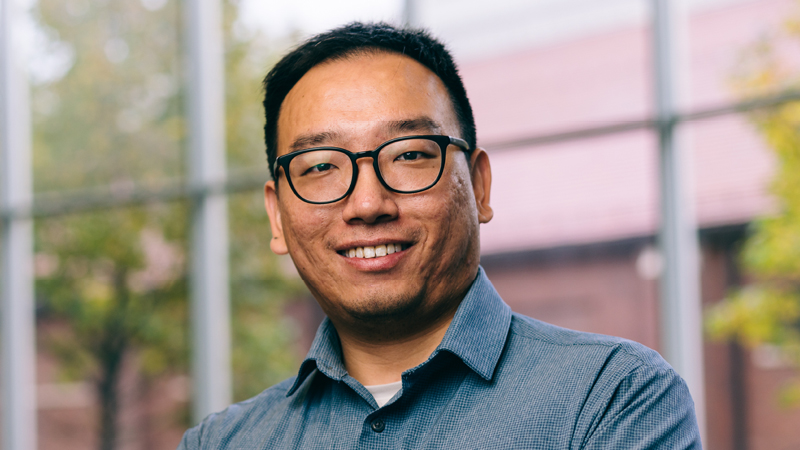
Sean Welleck is an Assistant Professor at Carnegie Mellon University's School of Computer Science, Language Technologies Institute, leading the L3 Lab. His research focuses on bridging informal and formal reasoning with AI, spanning machine learning for mathematics and code, inference algorithms, and AI agents. PhD in Computer Science from New York University (advised by Kyunghyun Cho) Postdoctoral work at University of Washington (advised by Yejin Choi) His work explores AI-driven formal methods for mathematics and code generation, test-time compute scaling, and algorithms enabling AI improvement over time. Recent publications analyze reasoning evaluation, premise selection, and automated proof optimization in systems like Lean. Key article trends include neural theorem proving, code generation, and inference-time compute optimization. Awards: NVIDIA AI Labs Pioneering Research Awards (2017, 2018), NAACL 2025 Best Paper. Current advisees include PhD students Pranjal Aggarwal, Weihua Du (co-advised with Yiming Yang), Andre He (co-advised with Daniel Fried), and Seungone Kim (co-advised with Graham Neubig). He co-organizes workshops like Autoformalization for the Working Mathematician (ICERM 2025) and VerifAI: AI Verification in the Wild (ICLR 2025), and teaches Advanced NLP at CMU.
Josef Urban is a leading researcher at the Czech Institute of Informatics, Robotics and Cybernetics (CIIRC) , Czech Technical University in Prague, heading the ERC Consolidator project AI4REASON . Previously, he held positions as a postdoc at Radboud University Nijmegen and assistant professor at Charles University in Prague, where he co-founded the Prague Automated Reasoning Group. Education Ph.D. in Computer Science (2004), Charles University, Prague M.S. in Mathematics (1998), Charles University, Prague B.S. in Economics (1995), Charles University, Prague Research Interests Urban specializes in automated reasoning over large formalized knowledge bases, combining deductive theorem proving and inductive machine learning . His work aims to realize "strong AI" through formalized mathematics, particularly using systems like Mizar and the AI/TP Challenges . He advocates for computer-verifiable mathematics as a foundation for AI progress. Article Trends Urban's publications focus on integrating machine learning with automated theorem proving in systems like ENIGMA and BliStr . Key trends include semantic guidance for ATPs, premise selection in formal libraries, and automated proof compression via concept invention. Scientific Contributions Head of ERC Consolidator project AI4REASON Marie-Curie Fellow at University of Miami Co-founder of Prague Automated Reasoning Group Editor for Formalized Mathematics Advising and Grants Urban has advised numerous PhD and MSc students including Daniel Kuehlwein, Krystof Hoder, and Yutaka Nagashima. He has secured grants like the ERC Consolidator Grant and Marie-Curie Fellowship . Labs and Collaborations Urban leads the AI4REASON team at CIIRC and collaborates with the Foundations Group at Radboud University. He contributes to projects like Mizar TWiki and XML-based API for Mizar , aiming to create a semantic AI ecosystem for formal knowledge.
Caroline Lemieux is an Assistant Professor at the Department of Computer Science, University of British Columbia (UBC), with research focused on advancing software correctness, security, and performance through innovative testing and synthesis techniques. Her work bridges Programming Languages and Software Engineering , particularly in fuzz testing, specification mining, and program synthesis. PhD from University of California, Berkeley (2021), advised by Koushik Sen Postdoctoral researcher at Microsoft Research, NYC (2021-2022) Key contributions: FuzzFactory , CodaMOSA , Arvada , and Gauss Her research integrates machine learning with traditional testing methods, exemplified by projects like RLCheck (reinforcement learning for test generation) and AutoPandas (neural synthesis for dataframes). Recent publications analyze generator-based fuzzing challenges and propose hybrid strategies combining coverage feedback with AI-driven insights. Scientific Awards : ACM/SIGSOFT Best Paper Award (ESEC/FSE 2019) ACM/SIGSOFT Tool Demonstration Award (ISSTA 2019) ACM/SIGSOFT Distinguished Artifact Award (ISSTA 2019) NSERC Postgraduate Scholarship-Doctoral (PGS D) UBC Governor General's Silver Medal (2016) Teaching roles include: 2025W2: CPSC 539L - Topics in Programming Languages 2024W2: CPSC 410 - Advanced Software Engineering 2023W2: CPSC 410 (with Alex Summers) She supervises graduate and undergraduate researchers working on projects like ExploTest (automated unit test generation) and GRIMOIRE (grammar extraction from pseudo-rules). Her research team collaborates with institutions including Microsoft Research, Google, and academic partners in systems security and AI-driven testing.
John MacLaren Walsh is a Professor in the Department of Electrical and Computer Engineering at Drexel University, where he leads the Adaptive Signal Processing and Information Theory Research Group. He holds BS, MS, and PhD degrees from Cornell University, all completed under Dr. C. Richard Johnson, Jr. His research spans information theory, network coding, distributed computing, and machine learning applications in patent analysis. His work focuses on: Bounding entropic vectors and their impact on communication networks Rate region computation for network coding and distributed storage Information theory for distributed function computation Machine learning-enhanced patent processing systems Publications emphasize entropy geometry, network coding complexity, distributed algorithms, and patent analysis, with consistent themes of optimization and combinatorial methods. Recent work (2016-2019) shows increased focus on probabilistic supports and computational efficiency in network coding. Awards: 2011 NSF CAREER Award for 'Entropy Geometry in Variational Inference Signal Processing' He has advised PhD students on topics like entropy region mapping, network coding, and distributed control. Key grants include NSF CAREER and AFOSR funding for wireless network overhead control. He directs the Adaptive Signal Processing and Information Theory Research Group, which develops algorithms for network coding, distributed storage, and patent analysis systems.
Juan Zhai is an Assistant Professor in the Manning College of Information and Computer Sciences (CICS) at the University of Massachusetts Amherst. She co-directs the Laboratory for Advanced Software Engineering Research (LASER) and is a member of the UMass NLP group. Her research advances software engineering through automated techniques for building high-quality systems with emphasis on behavioral specifications, AI safety, and trustworthy AI. Her work addresses the fundamental challenge of aligning software behavior with intended specifications through two main directions: automated specification synthesis (translating natural language comments to formal specifications via tools like C2S and LLMCup) and defect detection/repair (developing frameworks for AI system testing, bias mitigation, and training diagnostics). Her vision integrates these into end-to-end assurance systems that continuously validate, repair, and audit evolving software in dynamic environments. Recent publications (2024-2025) reveal dominant trends at the software engineering/AI intersection: formal specification synthesis for IoT and code generation, comment maintenance using LLMs, deep learning framework testing (DevMuT, Citadel), bias detection in LLMs, and automated training repair (AutoTrainer, DREAM). These contributions appear in top venues including ICSE, FSE, ASE, ISSTA, and ACL. Professor Zhai currently advises PhD student Gehao Zhang (focusing on Software Engineering and AI Safety) and actively recruits new PhD/Master's students. Her LASER lab develops practical tools for specification inference, LLM-driven synthesis, and trustworthy AI, while collaborating with the UMass NLP group on language-centric software analysis. The LASER lab, co-directed by Zhai, pioneers techniques for behavioral specification enforcement across traditional and AI-powered systems. Key projects include CPC for bidirectional code-comment analysis, ModelMeta for deep learning framework testing, and frameworks for bias mitigation across the ML lifecycle. The lab emphasizes practical, scalable tools that enhance correctness, robustness, and fairness in critical AI applications.
Daniel Varro is a Professor affiliated with McGill University (Faculty of Engineering, School of Computer Science), with strong ties to Budapest University of Technology and Economics and Linköping University. He is a leading researcher in model-driven engineering, cyber-physical systems, and software engineering, actively contributing to top-tier conferences such as MODELS, ICSE, and ASE. His research focuses on model-based systems engineering (MBSE) , automated model generation , model transformations , and constraint-based consistency checking . Recently, his work has expanded into integrating large language models (LLMs) and machine learning into modeling workflows, including model querying, domain modeling, and bug detection. The recent publications reveal a strong trend toward AI-augmented modeling, logic-based solvers (e.g., Refinery), and safety assurance of autonomous systems (e.g., COLREGs compliance). His work bridges formal methods with practical software engineering challenges in industrial and safety-critical domains. Scientific Awards: No specific awards mentioned in the text. Advising and Grants: While no explicit list of students or grants is provided, his mentorship in the Doctoral Symposium and repeated leadership roles suggest active supervision and likely grant funding. He has led projects on automated model generation, model quality, and AI integration in modeling. Labs and Teams: Daniel Varro is associated with research groups focused on model-driven engineering and software evolution, likely leading or co-leading teams working on the VIATRA and Refinery frameworks for model transformation and solving.
Danqi Chen is an Associate Professor in the Department of Computer Science at Princeton University's School of Engineering and Applied Science. Their research focuses on advancing large language models (LLMs), with emphasis on model alignment, safety, and long-context reasoning capabilities. Key research areas: LLMs, AI safety, retrieval systems, and model optimization Recent work explores theorem proving, context encoding, and ethical content generation Their 2025 publications highlight innovations in formal verification scaffolding, attention mechanism efficiency, and copyright-aware generation. 2024 studies investigate continual memorization, rule-based chatbot representations, and scientific literature retrieval benchmarks. Current projects demonstrate commitment to improving model robustness, interpretability, and security compliance in multimodal systems.
Daniel Balasubramanian is an Adjunct Associate Professor of Computer Science and Research Scientist at Vanderbilt University's School of Engineering. His research focuses on cybersecurity, software verification, and cyber-physical systems, with expertise in symbolic execution, code analysis, and formal methods. He contributes to advancing secure systems through frameworks like RAMPART for adversarial defense and Syntheto for formal verification. His work intersects edge computing, hardware security, and autonomous systems resilience. Research Interests: Cybersecurity (including ethical hacking, network defense), formal methods (verification, theorem proving), edge computing (tinyML, cloud integration), and cyber-physical systems (emulation, testbeds). His recent work emphasizes assurance provenance in software documentation and adversarially robust autonomous systems. Publications since 2019 highlight contributions to cybersecurity testbeds, reinforcement learning for penetration resistance, and hardware security against rowhammer attacks. He has explored domain-specific languages (Syntheto), incremental modeling techniques (differential-formula), and cloud-edge service resilience against adversarial perturbations. Labs/Teams: Affiliated with the Institute for Software-Integrated Systems (ISIS), focusing on integrating software with physical systems through model-driven approaches and cybersecurity innovations.
Stefania Dumbrava is an Associate Professor of Computer Science at ENSIIE (École Nationale Supérieure d'Informatique pour l'Industrie et l'Entreprise) and a permanent member of the ACMES team in the SAMOVAR laboratory at Télécom SudParis, Institut Polytechnique de Paris. She is also actively involved in the Property Graph Schema Working Group and the European Research Network on Formal Proofs (EuroProofNet). Education PhD in Computer Science, Université Paris-Sud (2016) MSc in Computer Science, Jacobs University Bremen (2012) BSc in Mathematics, Jacobs University Bremen (2010) Research Interests Dumbrava's research lies at the intersection of formal methods and data management . She designs and verifies algorithms and systems for graph databases , with emphasis on property graphs , schema discovery , query optimization , and distributed graph processing . Recently, her work focuses on certifying large-scale distributed graph systems under the ANR JCJC VERDI project (2025–2029). Awards & Honors SIGMOD Best Paper Award 2023 – “PG-Schema: Schemas for Property Graphs” SIGMOD Research Highlight Award 2023 – “Threshold Queries” VLDB 2022 Best Regular Research Paper Runner-Up – “Threshold Queries in Theory and in the Wild” SIGMOD 2025 Distinguished Reviewer Award ICDE 2025 Best Program Committee Member Award EASST Best Software Science Paper Award, ICGT 2025 Students & Grants Dumbrava has supervised numerous research interns and is actively recruiting PhD students for her ANR VERDI project on verified foundations of large-scale distributed graph systems. She has also served on six PhD thesis committees as examiner since 2021. Labs & Teams She leads the ACMES research group within the SAMOVAR laboratory (Télécom SudParis, Institut Polytechnique de Paris), where her team develops formally verified graph-database engines and tools such as GRASP, VerDILog, and DatalogCert.
Debjit Pal is a Post-Doctoral Associate at the School of Electrical and Computer Engineering, Cornell University, and a member of the Computer Systems Laboratory. His research focuses on machine learning techniques for hardware verification, SoC validation, and FPGA optimization. Education: Ph.D. in Computer Engineering (University of Illinois at Urbana-Champaign, 2019) M.S. in Computer Science (IIT Kharagpur, 2012) B.E. in Electronics Engineering (Jadavpur University, 2008) Research Interests: Machine Learning for Electronic Design Automation (EDA) System-on-Chip (SoC) Verification Edge Intelligence as a Service Compiler Optimizations for Reconfigurable and High-Performance Computing Scientific Awards: IEEE CEDA Student Research Award (2016) Best Paper Nomination (ICCAD 2015, DAC 2018, ASP-DAC 2019) E. J. McCluskey Best Doctoral Thesis Competition Semi-Finalist (2020) Travel Grants for ICCAD/DAC/ASPDAC (2018-2019) Professional Roles: Technical Program Committee Member (DAC, VLSID), Reviewer (IEEE TVLSI, DATE, ICCAD). Collaborates with researchers like Zhiru Zhang and Shobha Vasudevan.
Henry Yuen is the Srivani Family Associate Professor of Computer Science at Columbia University, with affiliations in the CS Theory group, Data Science Institute, and Columbia Quantum Initiative. His work bridges theoretical computer science and quantum information, focusing on the computational foundations of quantum systems. Yuen received his BA in Mathematics from the University of Southern California (2010) and PhD in Computer Science from MIT (2016). His research explores quantum complexity theory, quantum cryptography, and quantum information through both theoretical frameworks and practical applications. His recent publications reveal a strong focus on quantum pseudorandomness, quantum circuit complexity, and quantum cryptographic primitives. The research trajectory demonstrates increasing sophistication in connecting quantum computational models with fundamental questions in complexity theory, particularly through the lens of quantum interactive proofs and quantum state complexity. His work frequently intersects with operator algebras and quantum information theory, reflecting the interdisciplinary nature of modern quantum computing research. NSF CAREER award Sloan Fellowship Yuen actively mentors graduate students, with several PhD students having graduated to postdoctoral positions or faculty roles. His service includes co-organizing the Columbia CS Theory Seminar and serving on program committees for major conferences including QIP, STOC, and ITCS. He has organized multiple workshops on quantum computing challenges and cryptography. As a member of the Columbia Quantum Initiative, Yuen contributes to Columbia's growing quantum ecosystem, collaborating across departments to advance both theoretical foundations and potential applications of quantum information processing.
Vijay Kumar is the Nemirovsky Family Dean of Penn Engineering at the University of Pennsylvania, with faculty appointments in the Departments of Mechanical Engineering, Computer and Information Science, and Electrical and Systems Engineering. He is a leading figure in robotics and computer architecture research. Research Interests include robotics, particularly multi-robot systems and micro aerial vehicles (MAVs), as well as computer architecture innovations for machine learning, GPU acceleration, and datacenter efficiency. His work spans theoretical foundations and practical applications in autonomous systems and hardware optimization. Scientific Awards include: 1991 NSF Presidential Young Investigator Award 1996 Lindback Award for Distinguished Teaching 2012 ASME Mechanisms and Robotics Award 2014 Engelberger Robotics Award 2017 IEEE George Saridis Leadership Award Multiple best paper awards at DARS, ICRA, and RSS conferences Editorial Leadership includes serving as Editor of the ASME Journal of Mechanisms and Robotics and Advisory Board Member of AAAS Science Robotics Journal . His GRASP Lab team developed foundational frameworks for micro UAV testbeds and swarm robotics.
Matthew Lakin is an Associate Professor with tenure in the Department of Computer Science at the University of New Mexico, with a courtesy appointment in the Department of Chemical & Biological Engineering. He is affiliated with the UNM Center for Biomedical Engineering and the School of Engineering, and collaborates extensively with the UNM Health Sciences Center and external institutions. Education: Ph.D., Computer Science, University of Cambridge, 2010 M.A. (Cantab), University of Cambridge, 2009 B.A. (Hons), Computer Science, University of Cambridge, 2005 Dr. Lakin's research focuses on molecular computing, DNA nanotechnology, synthetic biology, and formal verification of biomolecular circuits. He develops computational models and experimental systems for programmable biological devices, especially using heterochiral DNA to enhance stability in living cells. His work spans software tools for biodesign and experimental validation in mammalian systems, with applications in nanomedicine and biosensing. The recent publications highlight a strong trend in engineering robust, intelligent biomolecular systems. His work integrates machine learning concepts into chemical reaction networks, advances geometric modeling of DNA systems, and pioneers L-DNA-based circuits for intracellular applications. The research spans theoretical foundations, software tools, and wet-lab experimentation, emphasizing interdisciplinary innovation. Scientific Awards: Presidential Early Career Award for Scientists and Engineers (PECASE), 2025 NSF CAREER Award, 2021 UNM School of Engineering Junior Faculty Research Excellence Award, 2021 Multiple student awards under his mentorship, including the Outstanding Graduate Student Award and DNA28 Best Student Presentation recognition Dr. Lakin has advised numerous graduate and undergraduate students, including Ph.D. graduates in Biomedical Engineering and Computer Science. He leads major funded projects such as the NSF CAREER grant on heterochiral molecular computing, an EPSCoR Research Fellowship, and a $3M NSF grant on heavy metal biosensing in collaboration with Native American communities. He is also PI on multiple NSF grants related to synthetic cells and nucleic acid technologies. He directs the Lakin Lab for Programmable Biology, which operates within the Department of Computer Science and collaborates with Chemical & Biological Engineering and the Center for Biomedical Engineering. The lab emphasizes both computational modeling and experimental molecular biology, and runs an NSF-funded biotechnology summer camp in partnership with ¡Explora! science museum to strengthen STEM education in New Mexico.
Tianyi Zhang is a Tenure-Track Assistant Professor in the Department of Computer Science at Purdue University, part of the College of Science. He leads the Human-Centered Software Systems Lab, focusing on AI-driven systems that synergize human expertise with machine intelligence to enhance programming productivity and software reliability. Prior to Purdue, he was a Postdoctoral Fellow at Harvard University under Dr. Elena Glassman and earned his Ph.D. from UCLA (2019) and B.Sc. from Huazhong University of Science and Technology (2013). Education: Ph.D. in Computer Science, University of California, Los Angeles (2019) Bachelor's in Computer Science, Huazhong University of Science and Technology (2013) Research Interests: His work spans Software Engineering, Human-Computer Interaction, and AI. Key areas include program synthesis, interactive debugging tools, autonomous driving system testing, and mitigating biases in AI models. He develops systems like Interpretable Program Synthesis and SQLucid to bridge human and machine intelligence. Recent Trends in Publications: Recent work emphasizes human-in-the-loop AI, including mixed-initiative systems for data wrangling (Dango), interactive program repair, and bias analysis in text representations (STILE). He also explores challenges in autonomous driving testing and LLM-based code generation errors. Awards & Grants: NSF Career Award (2024) Amazon Research Award Showalter Trust Research Award for pre-diabetes research $1.5M NSF grant for software supply chain security Best Paper Honorable Mentions at CHI and VAHC Advising & Teams: Supervises 12+ PhD/Master's students and 30+ research interns. Notable advisees include Bonan Kou (API misuse studies) and Yuan Tian (text-to-SQL systems). Collaborates with Harvard Medical School on healthcare data analysis. Labs & Initiatives: Directs Purdue's Human-Centered Software Systems Lab. Co-founded the Societal Impact Fellows program. Active in open-source projects like Examplore for API usage visualization and JShrink for Java debloating.
Andrew Rice is a Professor of Computer Science at the University of Cambridge's Department of Computer Science and Technology, and holds the Hassabis Fellowship in Computer Science. He is also the Director of Studies in Computer Science at Queens' College. His research focuses on programming languages, software engineering, and machine learning applications in software development. He leads projects like Isaac Computer Science and ALTA (Automated Language Teaching and Assessment), advancing adaptive learning technologies. His work includes static analysis tools such as Error Prone at Google, energy efficiency studies in computing infrastructure, and contributions to the Computing for the Future of the Planet initiative. His teaching emphasizes practical skill development through flipped classrooms and video lectures, earning him the 2014 Pilkington Prize for teaching excellence. He has held visiting roles at Google and collaborated on energy consumption research for mobile devices and data centers. His research spans systems, networking, and natural language processing, with a strong focus on applying computational methods to real-world challenges. Key Projects: Isaac Physics/Computer Science, ALTA, Error Prone Static Analysis Research Themes: Programming Languages, Machine Learning, Energy Efficiency Awards: Pilkington Prize (2014)