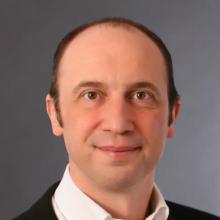
Roberto Segala is a Full Professor at the Department of Computer Science, University of Verona. His academic career spans over two decades, with a focus on formal methods and theoretical computer science. Academic Sector: INFO-01/A - Informatics Research Interests: Algorithms, Security, Cryptography, Hybrid Systems, Formal Verification Research Highlights: He specializes in concurrent stochastic and hybrid models for distributed systems, with applications in cloud computing security, autonomous vehicles, and cryptographic protocols. His work includes development of Probabilistic Automata and Hybrid I/O Automata. Teaching: Roberto has taught courses like Algorithms and Cryptography across multiple academic years (2000-2025), covering both undergraduate and graduate levels. Leadership Roles: Actively involved in departmental governance as a member of the Computer Science Teaching Committee and Department Council.
Nicola Fausto Spoto is an Associate Professor in the Department of Computer Science at the University of Verona, specializing in Informatics (INFO-01/A academic sector). His research falls under ERC sectors PE6_3 (Software engineering, programming languages and systems) and PE6_4 (Theoretical computer science, formal methods, automata). His primary research interests include Static Program Analysis for object-oriented languages focusing on correctness and security properties, Blockchain and Smart Contracts development, and Program Semantics for characterizing security problems. He leads research in the SPY (Formal Methods) Laboratory and is involved with the Blockchain research group which focuses on blockchain technology applications and smart contract infrastructure. Prof. Spoto serves as Chair of the Spin-off Commission and is a member of several important bodies including the Faculty Board of PhD in Computer Science, Computer Science Teaching Committee, and Computer Science Department Council. His current teaching responsibilities include Introduction to Programming, Programming I, Programming II and Software Engineering, and Introduction to Blockchain for the PhD program. He is actively involved in multiple research projects, with the most recent being 'In search of evidence of stealth cyber threats - COVERT' (starting June 2024), 'Organisation of informative events for SMEs in Veneto region' (starting September 2023), and 'Study and formalization of an algorithm for dynamic vehicle rental pricing determination' (starting July 2023).
Pietro Baroni is a Full Professor of Computer Science at the Department of Information Engineering, University of Brescia. His research focuses on artificial intelligence, computational argumentation, uncertainty representation, decision support systems, automated diagnosis, and multi-agent systems. He has authored over 110 scientific papers and holds a patent in his field. Key research interests include formal argumentation frameworks, causal reasoning, and their applications in healthcare robotics, energy systems, and decision-making. His work bridges theoretical foundations (e.g., abstract argumentation semantics) with practical implementations in domains like medical automation and sustainable engineering. Notable contributions include advancing automated diagnosis methods for power grids, developing collaborative robotics for personalized medicine, and integrating user preferences into decision support systems. His recent publications emphasize explainable AI, energy efficiency optimization, and interdisciplinary applications of argumentation theory. Baroni’s research has been applied to real-world challenges such as wastewater treatment optimization and environmental footprint assessment. He actively contributes to academic communities through editorial roles and conference organization, including the Logic and Argumentation (CLAR) conference series.
Veronica Bartolucci is a Research Fellow at the Department of Information Engineering (DII) of the Polytechnic University of the Marche, currently affiliated with the LabMACS (Laboratory of Modeling, Analysis and Control of dynamical Systems) under Professor Scaradozzi. She holds a Master's Degree (cum laude) in Computer and Automation Engineering from the same university, with a thesis on BLDC motor test benches, followed by a Ph.D. in Information Engineering focusing on max-plus algebra modeling of robotic fish swarms. Previously, she worked at the University of Bologna on the MAXFISH project, addressing multi-agent control for robotic fish swarms. Her research spans underwater robotics, multi-agent systems, biomimetic marine vehicles, and educational robotics. Key projects include DiveSafe and MAXFISH (PRIN 2022) for marine robotics, and RoboPisces/RoboAquaria for educational applications. She also contributed to low-cost hydrophone development for dolphin vocalization monitoring and digital twin infrastructures for underwater surveys. Publications emphasize mathematical frameworks (max-plus algebra), control strategies, and hardware/software systems for robotics and energy applications. Despite no explicitly stated awards, her work demonstrates significant contributions to biomimetic robotics and educational technologies. She advises no listed students but collaborates actively in lab-based and project-driven research. Current focus includes advancing max-plus algebra methodologies for autonomous underwater systems and integrating robotics in STEM education.
Marino Miculan is a Professor of Computer Science at the University of Udine, leading the MADS Lab and Cybersecurity Lab. His research focuses on formal methods, cybersecurity, and distributed systems, with an emphasis on verifying security in concurrent systems. He has authored over 100 publications and contributed to 16 research projects. His research interests include formal verification of security protocols, distributed computing architectures, and the application of category theory to system modeling. He has developed frameworks like Netstaldi for network discovery and tools such as DBCChecker for analyzing container compositions. Miculan’s work bridges theoretical foundations (e.g., adhesive categories, behavioral equivalences) with practical applications in IoT security, multi-factor authentication, and cloud containerization. His labs explore cutting-edge topics like continuous learning for anomaly detection and stateful access control mechanisms.
Patrizia Scandurra is a Professor at the University of Bergamo, Italy. She has held significant roles including Co-chair of the Doctoral Symposium-track at ECSA 2020, Program Co-Chair for multiple conferences, and is a member of steering and organizing committees for various international software engineering events. Her research focuses on Software Architecture, Formal Methods, Self-adaptive Systems, and Cyber-Physical Systems. She has contributed to frameworks like ASMETA and RAMSES, emphasizing rigorous system design and safety assurance. Her work spans formal specification, model-based testing under uncertainty, and adaptive systems for diverse applications such as automotive systems, medical devices, and smart cities. She has published extensively on topics like self-adaptation under model uncertainty, microservices resilience, and anomaly detection in urban infrastructure. Patrizia’s contributions include conference organization across ECSA, ASE, ICSE, and SEAMS, reflecting her leadership in advancing software architecture theory and practice. Her research bridges formal methods with real-world applications, addressing challenges in autonomous systems and digital twin integration.
Cosimo Perini Brogi is an Assistant Professor (RTD-a) in Theoretical Computer Science at the IMT School for Advanced Studies Lucca, Italy. He is part of the SySMA (Systems' Security Modelling and Analysis) Research Unit and currently leads the SWOPS project under the NextGenerationEU fund. His academic journey includes a PhD in Mathematics (2022, University of Genoa) and a MA in Logic from the University of Florence (2018). His research focuses on proof theory, non-classical logics, and formal methods, particularly in verification of systems and automated reasoning. He has contributed to journals like Studia Logica and Journal of Automated Reasoning , and his work bridges computer science, mathematics, and philosophy. He is active in outreach through Archimede and MaddMaths! , promoting mathematics accessibility. Affiliations include EuroProofNet, The Proof Society, and the Italian Chapter of EATCS. He holds grants from PRIN 2017 and an academic-industrial grant from the University of Barcelona (2022). His current research explores dynamic epistemic verification and collective adaptive systems analysis.
Josie Esteban Rodriguez Condia is a Fixed-term Assistant Professor in the Department of Control and Computer Engineering (DAUIN) at Politecnico di Torino. She is a member of the CARS@PoliTO Interdepartmental Center - Center for Automotive Research and Sustainable Mobility and serves as an invited member of both the College of Electronic, Telecommunications, and Physics Engineering and the College of Computer, Film, and Mechatronics Engineering. Her research focuses on computer architecture reliability, particularly in GPU and AI accelerator systems. Key areas include functional testing, general purpose graphics processing units (GPGPUs), hardware accelerators, hardware architecture, and parallel processing. Her work addresses critical challenges in reliability assessment of AI-based automotive systems, self-test libraries for tensor cores, and hardening techniques for neural networks on GPUs. Her recent publications demonstrate a strong trend toward reliability engineering for AI hardware, with particular emphasis on automotive applications and GPU-based neural network implementations. The research spans fault injection methodologies, error modeling, and architectural solutions to enhance system resilience against soft errors and permanent faults. Dr. Rodriguez Condia actively supervises PhD students including Gustavo Vilar De Farias, Giuseppe Esposito, and Robert Alexander Limas Sierra, all working on reliability evaluation and enhancement of neural networks. She is a member of the PNRR Research Group for the National Center for HPC, Big Data and Quantum Computing (2022-2025). She teaches multiple courses including GPU Programming and High Performance Computing for both Computer Engineering and Quantum Engineering programs. Her editorial work includes serving as Guest Editor for APPLIED SCIENCES in 2024.
Lorenzo Ceragioli is an Assistant Professor (RTD-A) in Computer Science at IMT Lucca within the SySMA research unit. Previously, he was a postdoctoral researcher at the University of Pisa's Department of Computer Science, where he also earned his PhD in Computer Science. His work focuses on quantum systems modeling, formal verification methods for security protocols, and access control systems. University Affiliation: IMT Lucca Research Unit: SySMA Research interests include: Quantum process verification through bisimulation techniques Analysis of SELinux security policies Logical modeling of multi-agent systems Recent work has explored firewall policy translatability and information flow control in SELinux configurations. His tools like SELinuxIFCIL and F2F address policy verification and firewall system compatibility challenges. Key contributions include: Developed IFCIL extension for SELinux policy verification Created F2F tool for firewall policy expressiveness analysis Advanced quantum process bisimulation theories
Letterio Galletta is an Assistant Professor of Computer Science at IMT School for Advanced Studies Lucca, within the SySMA research unit. Previously, he held a postdoctoral researcher position at the University of Pisa's Department of Computer Science and earned his Ph.D. in Computer Science from the University of Pisa in 2014. His research focuses on language-based security, leveraging programming languages, compilers, and formal verification to address security challenges in adaptive software, IoT, firewalls, and blockchain technologies. Key research areas include secure compilation, access control policy analysis, smart contract formal models, and static analysis techniques. His work bridges theoretical foundations with practical applications, such as securing satellite communication systems (IRIS2) and enhancing firewall policy enforcement. Publications highlight contributions to blockchain transaction parallelism, IoT security metrics, and formal methods for SELinux configurations. He actively contributes to tools like FWS (Firewall Synthesizer) and VeriOSS for bug bounty protocols. His research emphasizes interdisciplinary approaches, combining cybersecurity with distributed systems and embedded computing.
Dr. Yuriy Zacchia Lun is Assistant Professor (RTDa) at University of L'Aquila's DISIM department. Joint PhD from Gran Sasso Science Institute and IMT Lucca. Research focuses on wireless networked control systems and cyber-physical security. Develops methods for control-communication co-design using stochastic hybrid systems and formal verification. Visiting researcher at University of Oxford. Work addresses challenges in industrial automation and secure networked systems.
Pietro Ferrara is an Associate Professor in the Department of Environmental Sciences, Informatics and Statistics at Ca' Foscari University of Venice. His research focuses on applying abstract interpretation-based static analysis to address security vulnerabilities in software systems, particularly in blockchain smart contracts, IoT devices, and distributed systems. He is a member of the Software and System Verification group and has contributed to frameworks like LiSA for multilanguage static analysis. Teaching responsibilities include courses such as Software Architectures, Object-Oriented Programming, and Introduction to Coding and Data Management across undergraduate and graduate programs. His work emphasizes formal verification techniques, cybersecurity, and privacy enforcement in modern software systems. Recent research explores static analysis for detecting concurrency issues in Hyperledger Fabric, vulnerabilities in Go-based smart contracts, and GDPR-compliant privacy analysis. Ferrara collaborates with industry on practical applications of formal methods, including security policy extraction for ROS2 and industrial blockchain software determinism. His research has been published in top venues such as ACM SAC and IEEE Access, with a strong focus on bridging theoretical program analysis with real-world software systems. He maintains an active presence in open-source tools and educational materials for static analysis techniques.
Juan Pablo Saenz Moreno is a Fixed-term Assistant Professor in the Department of Control and Computer Science (DAUIN) at the Polytechnic University of Turin, affiliated with the College of Computer, Film and Mechatronics Engineering. His work bridges research and teaching in information processing systems and human-computer interaction. His research interests focus on Human-Computer Interaction , End-User Development , Mobile Application Privacy , Internet of Things , and Computing Education . He explores how users interact with intelligent systems, develop software themselves, and manage privacy in mobile environments. His work emphasizes user empowerment and interactive design. The recent publications highlight a strong trend in interactive computing systems, particularly in education, privacy, and creative applications of code. The research spans journals and top-tier conferences like ACM CHI and EICS, showing interdisciplinary engagement across computing, education, and art. Keywords include human-computer interaction, cybersecurity, software engineering, and digital creativity. Scientific contributions include work on collaborative computing education, privacy tools for end-users, IoT interaction models, voice-assisted debugging, and code-based art. Though no formal awards are listed, the publication record reflects impactful research in niche but growing areas of computer science. He has actively contributed to teaching across multiple degree programs, serving as course instructor and collaborator for Introduction to Web Applications , Web Applications I , Business Information Systems , and Empirical Research Methods at bachelor's, master's, and PhD levels. No formal advisees or grants are mentioned in the available text. He is a member of the ELITE - Intelligent and Interactive Systems research group within DAUIN, which focuses on developing intelligent, user-centered technologies for real-world applications.
Giancarlo Bigi is an Associate Professor of Operations Research in the Department of Computer Science at the University of Pisa, Italy. He has been a faculty member since 2000, advancing from Assistant Professor to Associate Professor in 2017. He holds a Ph.D. in Mathematics from the University of Pisa and has achieved national habilitations for both full and associate professorship in Operations Research and Mathematical Methods of Economics. His research is centered on optimization and equilibrium problems, with a strong focus on variational inequalities, game theory, multiobjective optimization, and nonlinear programming. He develops theoretical frameworks and algorithmic solutions for complex equilibrium models, including applications in economics and energy markets. The recent publications highlight a consistent trend in developing and analyzing gap functions, descent algorithms, and penalization techniques for equilibrium and hierarchical programming problems. His work bridges theoretical optimization with practical applications, particularly in modeling oligopolistic markets and decentralized energy systems. Associate Professor, Department of Computer Science, University of Pisa (2017–present) Assistant Professor, Department of Computer Science, University of Pisa (2000–2017) Ph.D. in Mathematics, University of Pisa (1997–2003) Bigi has no explicitly listed scientific awards in the provided material. He has not published any acknowledgments of grants, but his sustained research output suggests ongoing funding support. He collaborates extensively with researchers such as Mauro Passacantando, Marco Castellani, and Massimo Pappalardo. He is affiliated with the Operations Research Group within the Department of Computer Science at the University of Pisa, contributing to a collaborative research environment focused on optimization and decision-making models.
Davide Sangiorgi is a Full Professor in the Department of Computer Science and Engineering at the University of Bologna, Italy, where he conducts research and teaching in theoretical computer science. His work is affiliated with the College of Science and Engineering, contributing to foundational advancements in computing. His primary research interests lie in theoretical computer science , with a focus on concurrency theory , process calculi such as the pi-calculus, programming language semantics , and type systems for ensuring program correctness. His work bridges formal methods and programming language design, aiming to enhance the reliability and expressiveness of concurrent and distributed systems. Davide Sangiorgi has authored numerous influential publications in top-tier theoretical computer science venues. His research demonstrates a consistent focus on the logical and mathematical foundations of computation, particularly in modeling dynamic and mobile systems. Over the years, his work has evolved to include behavioral equivalences, coinduction, and session types, contributing to both the theory and practical application of secure and correct communication protocols. No scientific awards were mentioned in the provided text. He is actively involved in academic advising and research supervision, though specific names of students are not listed. He has likely secured research grants through national and international funding bodies in computer science, given his senior academic position and research output, although specific grants are not detailed in the source material. Davide Sangiorgi is associated with the Department of Computer Science and Engineering at the University of Bologna, which serves as his primary research and teaching unit. He may collaborate with research groups in programming languages, formal verification, and distributed systems, both within the university and internationally.