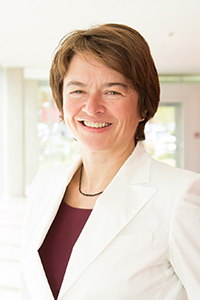
Prof. Dr. Regina Schreiber is a Professor and Vice President for Research and Transfer at Kempten University of Applied Sciences , affiliated with the Faculty of Mechanical Engineering and Competence Center for Applied Research in Food and Packaging Technology . She serves as Institute Management and Scientific Management, while also holding the role of Practical Officer for Food and Packaging Technology and Process Engineering and Sustainability bachelor programs. Primary Research Areas: Food Technology Project Management Product Life Cycle Engineering Additive Manufacturing Recent Publications focus on additive manufacturing with polymer powders, sustainable packaging solutions, and e-commerce logistics for perishable goods. Her work includes patents like the Dosierspender (EP3844094) for precision food dispensing systems. Contact : Office: Room S1.01 Email: regina.schreiber@hs-kempten.de
Anni Bygvrå Hougaard serves as Associate Professor in the Department of Food Science at the University of Copenhagen's Faculty of Science, specializing in Ingredient and Dairy Technology. Since October 2023, she has concurrently held the position of Deputy Head of Department for Teaching (VILU), which occupies approximately half her working hours. Her career spans over 15 years of research and teaching with extensive collaboration with Denmark's dairy industry across product development and processing scales from molecular interactions to pilot experiments exceeding 100L. Her educational background includes a PhD in Food Science from the University of Copenhagen (2010) and an MSc in Food Science and Technology/Dairy Science (Mejeriingeniør) from The Royal Veterinary and Agricultural University (2006). Professional development encompasses pedagogy training (2012-2013), powder technology studies at Lund University (2014), and project management certification (2016). Research centers on dairy product functionality, examining composition-processing-property relationships with emphasis on milk powder stability, protein interactions, and rheological behavior. Current investigations address spray drying dynamics, acidification effects, and microstructural analysis using advanced techniques like super-resolution microscopy and SAXS. Her work bridges fundamental science with industrial applications to optimize dairy ingredient performance. Recent publications (2022-2026) demonstrate consistent focus on dairy protein behavior under processing conditions, particularly casein aggregation mechanisms, powder surface chemistry, and gel microstructure. Key trends include multi-parameter analysis of protein interactions, in situ structural monitoring during thermal/acid treatments, and characterization of whey protein effects in model systems. Teaching responsibilities include coordinating Dairy Product Technology 1 & 2 since 2021, supervising master's and bachelor's theses since 2010, and developing high school laboratory programs. She lectures on raw material quality and has coordinated multiple dairy-focused courses including internships and process engineering modules. Her research operates within the Ingredient and Dairy Technology section, leveraging industry partnerships for real-world validation. Current projects examine stickiness mechanisms in acidified milk powders and feed formulation effects on spray drying deposition, with implications for industrial dairy ingredient manufacturing.
Jose Carlos Bonilla Oliva serves as a Tenure Track Assistant Professor in the Department of Food Science at the Faculty of Science, University of Copenhagen. His research focuses on food colloids microstructure using advanced physical characterization techniques. Educational background: PhD in Food Science, Purdue University (awarded May 9, 2020) His primary research integrates food structure analysis with computational methods, specializing in microscopy, rheology, and texture properties of colloidal systems. He develops machine learning approaches for image analysis to quantify microscopic features in food matrices, bridging fundamental science with practical applications in food product development. His recent publication in Food Hydrocolloids (2025) demonstrates machine learning applications for droplet quantification in colloids, reflecting a growing trend toward computational image analysis in food science. This work advances precision in microstructural characterization with implications for texture engineering and functional food design. No scientific awards or student advising information is documented in available sources. Laboratory collaborations appear focused on country-level external partnerships as indicated by network visualization data, though specific team structures remain unspecified.