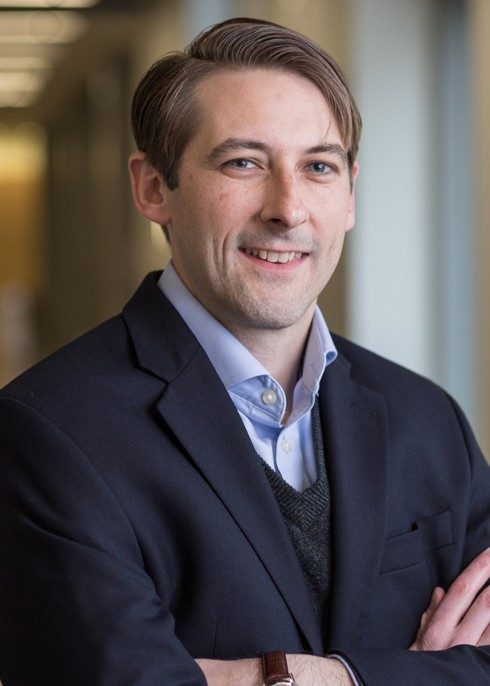
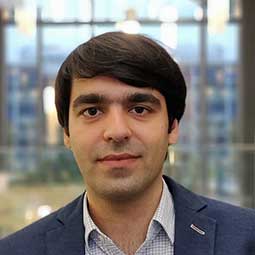
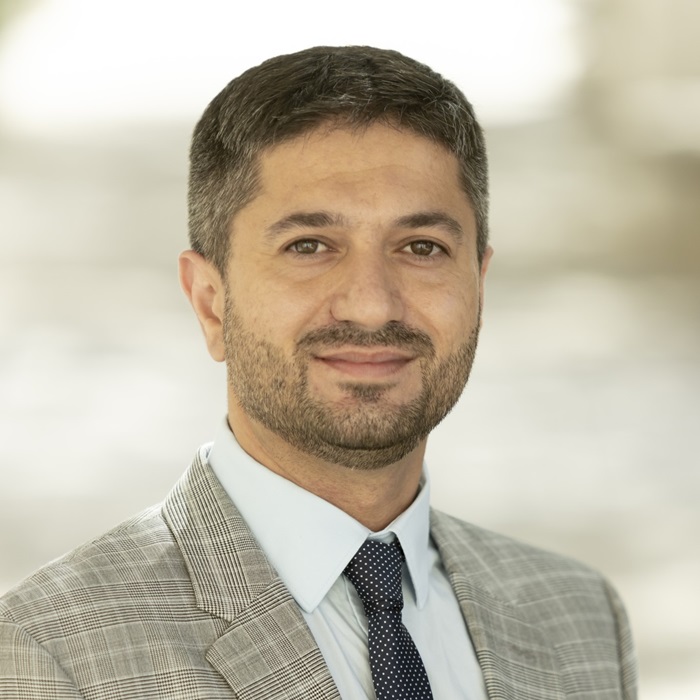
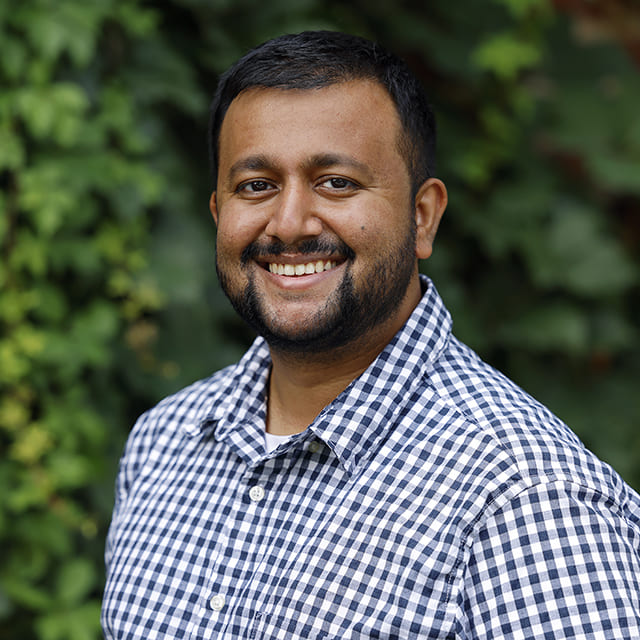
Cyrille Allery is a Teacher-Researcher at the University of La Rochelle, affiliated with the Civil Engineering and Mechanics department. His primary responsibilities include organizing laboratory seminars and managing the 2nd-year Civil Engineering and Mechanics degree program. Research focuses on model reduction techniques (POD, PGD, A Priori Reduction) Applies reduced-order models for fluid flow control and transfer problems Specializes in numerical asymptotic methods for bifurcation analysis Works on fluid-structure interaction simulations His work bridges computational mechanics, applied mathematics, and fluid dynamics, addressing complex engineering challenges through advanced numerical methods.
Maria Strazzullo is a Fixed-term Assistant Professor at the Department of Mathematical Sciences (DISMA) within Politecnico di Torino, Italy. Her research focuses on reduced order methods, optimal control theory, and numerical analysis for parametrized partial differential equations. Numerical Analysis and Scientific Computing Model Order Reduction Neural Networks for Parametrized PDEs Uncertainty Quantification Her recent publications address convection-dominated flows, bifurcating nonlinear PDEs, and optimal control problems with random inputs. She collaborates on interdisciplinary projects integrating machine learning with computational physics.
Anoop Kodakkal is a Researcher at the Chair of Statics and Dynamics of the Technical University of Munich , where he has worked since 2024. He was previously a Research Associate at the Chair of Structural Analysis (2020-2024) and completed his doctoral studies (Dr.-Ing.) at TUM as a DAAD scholarship holder (2016-2020). He holds an M.Tech in Structural Engineering from IIT Delhi (2012-2014) and a B.Tech in Civil Engineering from NIT Calicut (2008-2012). Research Interests: Wind Engineering Uncertainty Quantification (UQ) Fluid-Structure Interaction Structural Optimization Isogeometric Analysis Machine Learning in Structural Dynamics Scientific Awards: DAAD Doctoral Research Grant (2016-2020) DAAD IIT Master Sandwich Scholarship (2013-2014) Recent Publications focus on wind-induced vibrations, uncertainty quantification, and machine learning integration with finite element analysis. Notable trends include: Optimization under uncertain wind conditions Development of neural networks for structural dynamics Standardization of membrane roof design Multi-fidelity modeling for turbulent flows Stochastic analysis of nonlinear systems Computational tools for wind engineering
Jan Heiland is an Assistant Professor at Otto von Guericke University Magdeburg and a Researcher at the Max Planck Institute for Dynamics of Complex Technical Systems. His work focuses on computational methods in systems and control theory, particularly for differential-algebraic equations (DAEs) and data-driven modeling of fluid dynamics. Research Interests: Systems and Control Theory, Differential-Algebraic Equations, Data-Driven Modelling, Flow Control, Fluid Dynamics, Reduced-Order Modeling Publication Trends: Recent work emphasizes low-dimensional approximations of nonlinear systems using machine learning techniques (e.g., polytopic autoencoders, convolutional autoencoders) and robust control methods for Navier-Stokes equations. Key themes include model reduction, uncertainty quantification, and computational approaches to large-scale dynamical systems. Teaching: He teaches numerical methods for partial differential equations and scientific computing at TU Ilmenau and OVGU Magdeburg.
Gian Marco Melito is an Assistant Professor at the Institute of Mechanics within the Faculty of Mechanical Engineering at Graz University of Technology (TU Graz). His research spans Advanced Materials Science and Information, Communication & Computing fields, with a strong focus on biomedical applications, particularly cardiovascular modeling and medical imaging. With over 21 publications and active participation in numerous research projects and conferences, Dr. Melito has established himself as a significant contributor to computational biomechanics and medical engineering. Research Interests Dr. Melito's primary research focuses on computational modeling of cardiovascular systems, with particular expertise in aortic dissection, blood flow dynamics, and electrical conductivity of blood. His work integrates sensitivity analysis, numerical modeling, and medical imaging to develop innovative approaches for understanding and diagnosing cardiovascular conditions. His research portfolio demonstrates a consistent trajectory from fundamental hemodynamics toward clinically applicable tools. His technical expertise spans computational mechanics, biomedical engineering, and data science, with recent work emphasizing 3D medical shape analysis, aortic modeling, and impedance-based diagnostic techniques for aortic pathologies. The fingerprint analysis of his work reveals strong connections to Simulation Modeling (100%), Electrical Conductivity (85%), Model Parameter analysis (85%), and Electrical Impedance engineering (64%). Publication Trends Dr. Melito's publication record shows a clear progression from fundamental cardiovascular modeling toward practical medical applications. His most recent work focuses on dataset development for medical imaging (MedShapeNet, SynthAorta), demonstrating his shift toward creating foundational resources for the medical AI community. The consistent theme across his publications is the application of sensitivity analysis to improve cardiovascular modeling accuracy and clinical relevance. Professional Activities Dr. Melito is actively engaged in the academic community with 14 recorded activities including conference organization (such as UNCECOMP 2025 and ECCOMAS 2024), presentations, and editorial work. His upcoming role as organizer for UNCECOMP 2025 in June 2025 demonstrates his ongoing active status in the field.
Jeff Borggaard is a Professor of Mathematics at Virginia Tech, affiliated with the College of Science and the Interdisciplinary Center for Applied Mathematics (ICAM). His research focuses on numerical analysis, computational science, and control theory, with emphasis on optimization and control of systems governed by partial differential equations (PDEs). He specializes in sensitivity analysis, reduced-order modeling, and their applications in fluid dynamics and engineering systems. His work includes developing computational methods for PDE-constrained optimization, control of fluid flows, and uncertainty quantification. Key collaborations involve researchers at institutions like Florida State University and École Polytechnique de Montréal. Borggaard has been funded by agencies including the Air Force Office of Scientific Research (AFOSR) and the National Science Foundation (NSF), supporting projects on model reduction, flow control, and energy-efficient building systems. Research highlights include advancements in proper orthogonal decomposition (POD) for turbulent flows, nonlinear balanced truncation techniques, and applications of reduced-order models in control and optimization. His contributions also extend to thermal energy modeling in buildings and parameter estimation in groundwater flow systems. Borggaard holds positions at both the Department of Mathematics (McBryde Hall) and ICAM (Wright House), and maintains active involvement in professional societies such as the Society for Industrial and Applied Mathematics (SIAM) and the American Mathematical Society (AMS).
Jan Heiland is a Lecturer at TU Ilmenau, focusing on systems and control theory, with affiliations to the Max Planck Institute for Dynamics of Complex Technical Systems (MPI Magdeburg). His work emphasizes differential-algebraic equations, data-driven modeling, and flow control. He holds a PhD in Applied Mathematics from TU Berlin. Education: PhD in Applied Mathematics (TU Berlin). Research Interests: Control theory, numerical methods for PDEs, model reduction, and applications in fluid dynamics. Current courses include Numerical Solutions of PDEs and Scientific Computing. He leads projects on nonlinear controller design (LPV Approximations), scientific computing in MaRDI, and fluid dynamics modeling. Grants & Projects: Projects include LPV Approximations for Nonlinear Controller Design (2023), MaRDI (2023), and MRI Fingerprinting with Philips (2021). His research also involves uncertainty quantification and robust stabilization techniques. Talks/Publications: Recent talks address H-infinity robust control and computational approaches for large-scale systems. Key publications focus on autoencoder-based reduced-order modeling and low-rank solutions for Riccati equations.
Todd Lowe is a Professor in the Kevin T. Crofton Department of Aerospace and Ocean Engineering at Virginia Tech. He holds leadership roles in several research centers, including Co-Director of the Virginia Tech Advanced Propulsion and Power Laboratory and Director of the Virginia Tech–Pratt & Whitney Center of Excellence. His expertise spans experimental fluid mechanics, propulsion systems, and aerodynamics, with a focus on flow diagnostics, supersonic jet noise reduction, and turbulence modeling. Education: Ph.D., M.S., and B.S. in Aerospace Engineering from Virginia Tech (2006, 2004, 2001). Professional Affiliations: Fellow of the Royal Aeronautical Society, ASME, and AIAA (Associate Fellow). Research interests include developing advanced measurement techniques (e.g., Laser Doppler Velocimetry, Filtered Rayleigh Scattering) for propulsion and energy systems. Key projects involve supersonic jet noise reduction for aircraft safety, turbulence modeling validation, and propulsion/airframe integration for hybrid-wing-body configurations. Recent awards include the 2023 Dean’s Award for Excellence in Teaching and the 2018 SAE Ralph R. Teetor Educator Award. He has advised numerous graduate students and leads initiatives like the English-to-Engineering (E2E) program, fostering undergraduate research in sustainable aerospace propulsion. Lowe’s lab, the Vortical Flow and Diagnostics Lab, collaborates with industry partners like Rolls-Royce and Pratt & Whitney. His work bridges fundamental research and practical applications, with over 100 peer-reviewed publications and contributions to CFD validation standards.
Hamed Farokhi is a Senior Lecturer in Mechanical Engineering at Northumbria University since 2018. Prior to this role, he was a Post-doctoral Research Associate at Imperial College London (2017–2018), working on a European Project focused on probabilistic optimization of composite structures. He obtained his PhD in Mechanical Engineering from McGill University in 2017. Education: PhD in Mechanical Engineering, McGill University, 2017 Research Interests: His research focuses on nonlinear vibration and dynamic analysis of mechanical systems across macro/micro/nano scales, with applications in energy harvesting and structural design optimization. His work emphasizes experimental validation, reduced-order modeling, and fluid-structure interaction. Key areas include cantilever dynamics, composite structures, and MEMS/NEMS devices. Publications & Awards: With over 90 peer-reviewed publications, Hamed is recognized for contributions to nonlinear dynamics and structural mechanics. He has been invited as a peer-reviewer for 25+ journals and received the Outstanding Reviewer award from Elsevier. The Royal Academy of Engineering endorsed him as an exceptional promise in Mechanical Engineering. Expertise: His research bridges theory and experiment, addressing challenges in extreme nonlinear vibrations, probabilistic optimization, and energy harvesting systems. Recent work includes validated models for curved panels, cantilevered pipes, and wind turbine aeromechanics.
Hamidreza Karbasian is an Assistant Professor in AI-Powered Digital Engineering Systems at Southern Methodist University (SMU)'s Lyle School of Engineering (Department of Mechanical Engineering). He holds a Ph.D. in Mechanical Engineering from Concordia University and a Master's from Pusan National University. His roles include academic research, postdoctoral fellowships at MIT, Polytechnique Montreal, and the Fields Institute (University of Toronto). He led aerodynamics projects at Limosa Inc. and received the Fields CQAM Postdoctoral Fellowship. Education: Ph.D., Mechanical Engineering, Concordia University M.Sc., Mechanical Engineering, Pusan National University Additional training: MIT, Fields Institute (Applied Mathematics), Polytechnique Montreal Research Focus: Integrating artificial intelligence with engineering systems, including multidisciplinary design optimization, reduced-order modeling, and computational fluid dynamics. His work emphasizes physics-constrained data-driven approaches for aerodynamic design and turbulent flow analysis. Key application areas include morphing airfoils, wind turbine blades, and electric aircraft design. Grants & Awards: Fields CQAM Postdoctoral Fellowship Labs & Projects: Leads AI4DLab (website: ai4dlab.github.io ), focusing on AI-driven digital engineering systems. Collaborates on digital twin technology and deep learning algorithms for industrial applications.
Aditya G. Nair is an Assistant Professor in the Department of Mechanical Engineering at the University of Nevada Reno, specializing in aerospace engineering. He holds a PhD from Florida State University (2018), an MS from the University of Michigan (2013), and a B.E. from the University of Mumbai (2011). His research focuses on computational fluid dynamics (CFD), fluid-structure interaction, and applying network theory and data science to fluid systems. He teaches courses such as Aerodynamics, Compressible Flow, and Computational Fluid Dynamics. His research explores topics like turbulence control, phase-based flow stabilization, and machine learning applications in fluid dynamics. Nair’s work bridges fluid mechanics with network science and data-driven methodologies, with applications in unsteady aerodynamics and flow control. He maintains an active GitHub repository portfolio, including projects on modal decomposition and fluid flow control strategies. Education: PhD in Mechanical Engineering, Florida State University (2018) MS in Mechanical Engineering, University of Michigan (2013) B.E. in Mechanical Engineering, University of Mumbai (2011) Research Interests: Integrating fluid mechanics with data science, network theory, and graph theory to address challenges in turbulence, flow control, and CFD. His work emphasizes model reduction techniques, adaptive mesh refinement, and invariant-based control strategies. Teaching: ME482/682 Aerodynamics (2020–2023), ME480/680 Compressible Flow (2021, 2023), ME793 Computational Fluid Dynamics (2022). Research Outputs: Recent work focuses on network-theoretic modeling of fluid flows, data-driven control strategies, and turbulence modification through energy/enstrophy manipulation. Key themes include phase-based control systems and machine learning-enhanced metamodeling. Labs/Teams: Active contributor to open-source projects via GitHub, including repositories like Modal-Decomposition-ROM and Vortical-community-detection , reflecting his interest in reduced-order modeling and fluid flow analysis.
Urban Fasel is a Lecturer in Data-Driven Aerospace Engineering at Imperial College London's Department of Aeronautics. His research integrates machine learning with aerospace systems for applications in autonomous flight, aeroelastic control, and composite structures. Research spans co-design optimization, adaptive structures, and data-driven control methods, with particular focus on morphing wings for airborne energy systems and flapping-wing micro aerial vehicles. Recent work explores sparse modeling techniques for nonlinear dynamics discovery and robust control under uncertainty. Publications emphasize computational efficiency in aeroelastic modeling, reinforcement learning for flow control, and Bayesian approaches for system identification. Emerging themes include interpretable machine learning for distributed systems and morphing wing optimization for eVTOL applications.
Yongyun Hwang is Professor of Fluid Mechanics at Imperial College London's Department of Aeronautics. His research combines theoretical and computational approaches to study instabilities, turbulence, pattern formation, and biological fluid systems. Research interests include hydrodynamic stability theories, turbulence phenomena, biological pattern formation, and active fluid dynamics. Current work focuses on reduced-order modeling of turbulent flows and dynamics of active filaments. Recent publications concentrate on turbulence modeling, reduced-order approaches for flow systems, and nonlinear dynamics in biological contexts. Research demonstrates advanced computational techniques for analyzing wall-bounded turbulence and pattern formation. Leads the Instability, Turbulence & Pattern Formation Group and collaborates internationally on fluid dynamics research.
Eric Darve is a Professor of Mechanical Engineering and Director of the Institute for Computational and Mathematical Engineering (ICME) at Stanford University. His research focuses on machine learning for science/engineering, numerical linear algebra, high-performance computing, and GPU-accelerated algorithms. He holds a PhD in Applied Mathematics from Pierre et Marie Curie University (2009), and completed postdoctoral work at Stanford/NASA Ames before joining Stanford’s faculty in 2001. Education: PhD, Applied Mathematics, Paris VI University (1999) MS, Applied Mathematics, Paris IX University (1994) BS, Mathematics & Physics, Paris VI University (1993) Research interests include: Machine learning for scientific applications Surrogate/Reduced Order Modeling Anomaly detection in engineering systems Parallel computing and numerical algorithms Physics-informed learning machines Awards include: H. Julian Allen Award (NASA, 2010) Habilitation à Diriger des Recherches (France, 2007) Leslie Fox Prize in Numerical Analysis (2001) James H. Clark Faculty Scholar (2001) Led development of scalable linear solvers and hybrid physics-data approaches. Active in computational engineering education and interdisciplinary research initiatives through ICME.
Professor Ekkehard Sachs is affiliated with the Department of Mathematics at the University of Trier . His research focuses on optimization, numerical analysis, control theory, and their applications in fields such as partial differential equations (PDEs), mathematical finance, and engineering. He has made significant contributions to PDE-constrained optimization, Riccati feedback control, and reduced-order modeling techniques. His work spans theoretical developments and computational methods, with a strong emphasis on interdisciplinary applications. Notable areas include the analysis of non-monotone line search algorithms, the study of Ramsey models in economics, and the numerical solution of complex systems such as integro-differential equations. Sachs has also contributed to the calibration of financial market models and the design of efficient numerical algorithms for optimal control problems. His publications highlight advancements in optimization theory, numerical methods for PDEs, and computational techniques for high-dimensional problems. While no specific scientific awards or grants are explicitly mentioned, his extensive publication record reflects a prolific and impactful academic career. His involvement in organizing international conferences and editing proceedings underscores his influence in the optimization community.