Daniel Lokshtanov is a Professor at the Department of Informatics, University of Bergen. His research focuses on parameterized algorithms, graph theory, and computational complexity. He has collaborated extensively with leading researchers such as Fedor Fomin and Saket Saurabh. Notable contributions include foundational work on kernelization techniques, fixed-parameter tractability, and algorithm design for graph problems. His work often addresses structural graph properties and combinatorial optimization challenges. Lokshtanov has authored influential papers on topics like Odd Cycle Transversal, cograph completions, and algorithms for planar graphs. He co-authored the textbook *Kernelization: Theory of Parameterized Preprocessing* (2019), a key reference in the field. His research spans theoretical breakthroughs and practical algorithmic advancements, with over 150 publications in top venues like ACM Transactions on Algorithms and SIAM Journal on Computing.
Jesper Jensen is a Professor at the Department of Electronic Systems, part of The Technical Faculty of IT and Design at Aalborg University. His research focuses on acoustic signal processing, machine learning, and speech enhancement, with particular expertise in applications like hearing aids, noise reduction algorithms, and deep learning architectures for audio systems. He serves as a project supervisor at institutions including Oticon A/S since 2007, and co-leads the CASPR (Centre for Acoustic Signal Processing Research) center. Key research interests include multichannel signal processing, robust speech enhancement in reverberant environments, and adaptive filtering techniques. His work integrates Bayesian methods, deep neural networks (DNNs), and sparse modeling to address challenges in audio localization, speech presence probability estimation, and sound zone control systems. Notable Achievements: Recipient of the prestigious 'Stor international pris' award in 2017 Over 135 publications in journals like IEEE Signal Processing Letters and conference proceedings Active collaborations with industry partners such as Oticon A/S His research outputs emphasize practical applications, including voice control systems for hearing aids, binaural speech enhancement in noisy environments, and acoustic reflector localization for robotics. Recent work explores transformer networks and learning-based frameworks for real-time audio processing.
Parinya Chalermsook is a Professor of Algorithms at the University of Sheffield, affiliated with the Foundations of Computation Group in the Department of Computer Science, Faculty of Engineering. He also holds a visiting associate professor position at Aalto University, Finland. His research focuses on theoretical computer science, particularly the interplay between algorithms and mathematical optimization, with strong interests in extremal combinatorics and their applications in TCS. His work spans parameterized complexity, approximation algorithms, computational complexity, and discrete optimization. The recent articles and talks highlight a strong trend in fine-grained and parameterized computational geometry, graph algorithms, and the synergy between continuous and discrete optimization. His research is deeply theoretical, often bridging mathematical disciplines with algorithmic challenges. Simons-Berkeley Research Fellowship (2017) ERC Starting Grant (~1.4M Euro, 2017–2024) Academy of Finland Research Fellowship (~900K EUR, 2017–2022) He has supervised numerous PhD students and hosted postdoctoral fellows, fostering a vibrant research group. His research has been supported by major grants from the European Research Council and the Academy of Finland. He actively contributes to the academic community through program committees (e.g., STOC, SODA, ICALP) and organizing workshops at Dagstuhl and Hausdorff Institute. He is a key member of the Foundations of Computation Group at Sheffield and has previously contributed to the TCS communities at Aalto University and Max Planck Institute for Informatics.
Philine Schiewe is an Assistant Professor at Aalto University's Department of Mathematics and Systems Analysis, School of Science. Her research focuses on algorithmic methods for public transport optimization, including line planning, timetabling, and vehicle scheduling. She has contributed to integrated optimization frameworks for transport networks, emphasizing computational efficiency and real-world applicability. Her work spans theoretical algorithm design (e.g., fixed-parameter tractability, graph-based methods) and practical applications in transportation systems. Key research areas include fare structure optimization, user equilibrium modeling, and infrastructure investment strategies. She collaborates on open-source tools like TimPassLib for periodic timetabling and passenger routing. Recent publications address non-pool-based line planning algorithms, bi-objective fare design models, and combined truck-cargo-bike routing optimizations. Her research bridges operations research, discrete mathematics, and transportation engineering to improve urban mobility systems.
Dr. Safoora Zaminpardaz is a Senior Lecturer in the School of Science at RMIT University, specializing in GNSS positioning, geodesy, and navigation systems. Her research focuses on multi-GNSS positioning, quality control, integrity monitoring, and ionospheric sensing, with applications in climate monitoring and smartphone-based positioning. She holds an ORCID identifier (0000-0003-0719-674X) and supervises postgraduate students in areas such as integrated GNSS-5G positioning and optical clocks in GNSS systems. Her teaching interests include terrestrial surveying and least-squares adjustment. Recent research highlights include studies on flash drought monitoring using evaporative demand indices and optical clock performance for enhanced GNSS positioning accuracy. Dr. Zaminpardaz actively contributes to international conferences and journals, advancing methodologies in deformation analysis and positioning reliability. She is open to supervising PhD and Masters students in her research areas and collaborates on projects addressing weather extremes, smartphone antenna calibration, and multi-frequency GNSS measurements.
Prof. Christoph Knochenhauer is a Professor of Financial Mathematics at the Technical University of Munich (TUM), affiliated with the TUM School of Computation, Information and Technology. His academic career includes a PhD in Mathematics (2015) from Technical University of Kaiserslautern and Dublin City University, followed by a postdoctoral position at the University of Trier. He served as Junior Professor for Stochastics and Quantitative Financial Mathematics at TU Berlin (2019) before joining TUM in 2023. His research focuses on financial mathematical applications of stochastic control theory, machine learning methods in finance, and probabilistic analysis of partial differential equations. Recent work explores optimal investment strategies for retail and institutional investors, dynamic decision-making under uncertainty, and numerical methods for stochastic systems. Key contributions include explicit solutions for optimal investment problems and convergence analyses of deep learning algorithms for PDEs. Prof. Knochenhauer has been recognized with the Joseph A. Schumpeter Prize (2017) and the Gauss Young Researcher Award (2015). His publications span topics like mean field games, fractional Brownian motion models, and systemic risk valuation. While no advising records or grants are explicitly listed, his work underscores advancements in stochastic finance and computational methods.
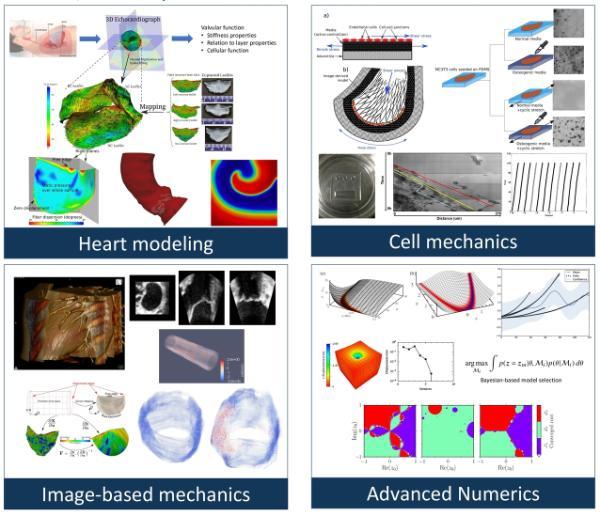
Dr. Ankush Aggarwal is a Senior Lecturer in Engineering at the University of Glasgow, affiliated with the Glasgow Computational Engineering Centre (GCEC). His research focuses on computational biomechanics applied to cardiovascular healthcare, particularly in understanding soft tissue mechanics, heart valve dynamics, and medical image analysis. He holds a PhD in Mechanical Engineering from UCLA and has held postdoctoral positions at the University of Texas and Swansea University. Education: Bachelor's in Aerospace Engineering (Indian Institute of Technology, Kharagpur) PhD in Mechanical Engineering (University of California, Los Angeles) Research Interests: Dr. Aggarwal's work integrates advanced computational methods with clinical data to address cardiovascular challenges. His projects span four key areas: Computational modeling of heart valve mechanics Image-based strain estimation using 4D echocardiography Stochastic finite element analysis for soft tissues Multi-scale vascular modeling linking molecular to organ-level behavior Recent research trends show focus on translational applications like drug-coated balloon modeling and open-source tools for cardiac image workflows. His team develops Python packages (e.g., pyMechT) to democratize biomechanical simulations. Grants and Collaborations: EPSRC Centre for Future PCI Planning (2024-2027) Chan Zuckerberg Initiative Essential Software Award (2020-2021) National Research Network Fellowship (Swansea University, 2015-2018) Labs/Teams: Active contributor to GCEC, leading interdisciplinary projects combining biomechanics, imaging, and clinical translation. Mentor for 20+ graduate students across PhD, masters, and undergraduate levels.
Andrés Cristi is a Tenure Track Assistant Professor at EPFL's College of Management of Technology and heads the Chair of Game Theory and Operations (GO). He is affiliated with the CDM (College of Management of Technology) and its subunits MTEI (Management and Technology Education Initiative) and GO (Game Theory & Operations). Current Position: Tenure Track Assistant Professor, EPFL Previous Roles: Postdoc at Center for Mathematical Modeling (CMM), Universidad de Chile; Research Member at Simons-Laufer Mathematical Sciences Institute Education: PhD in Engineering Systems (2023), Universidad de Chile MS in Operations Management, Universidad de Chile Mathematical Engineer, Universidad de Chile His research focuses on the intersection of Algorithmic Game Theory , Mechanism Design , and Sequential Decision-Making , studying how optimization interacts with strategic agent incentives in dynamic allocation problems. He employs data-driven approaches to analyze platforms like routing apps and online marketplaces. Recent work trends include Prophet Inequalities , Combinatorial Auctions , Online Resource Allocation , and Fairness in Algorithmic Systems , with applications to real-time decision-making and bias reduction. Scientific Awards: Meta Research PhD Fellowship (2021) EURO Excellence in Practice Award Finalist (2019) IFORS Prize for OR in Development Runner-up (2020) He advises PhD student Zhang Jiechen and has taught courses on Algorithmic Game Theory and Applied Probability & Stochastic Processes .
Prof. Friedrich Eisenbrand is a Professor at the Institute of Mathematics, EPFL, Lausanne, Switzerland. His research focuses on discrete optimization, algorithms and complexity, integer programming, and geometry of numbers. Heinz Maier-Leibnitz award (2004) Otto Hahn medal (2001) Alexander von Humboldt professorship (2011) His work includes efficient algorithms for integer programming in fixed dimension and the theory of cutting planes. Recent publications explore advancements in integer programming, discrete optimization algorithms, computational geometry, and machine learning applications. He leads the DISOPT laboratory at EPFL, mentoring a team of junior researchers.
Eshan Chattopadhyay is a prominent researcher in theoretical computer science, focusing on computational complexity, pseudorandomness, and cryptography. His work centers on the explicit construction of randomness extractors, condensers, pseudorandom generators, and non-malleable codes, often improving entropy requirements and error bounds. He has made significant contributions to derandomization, space-bounded computation, and tamper-resilient cryptography. His research is published extensively in the Electronic Colloquium on Computational Complexity (ECCC), indicating deep engagement with foundational aspects of computer science. Research Interests: Eshan's research spans randomness extraction from weak sources, including sumset sources, polynomial sources, and adversarial models. He investigates pseudorandomness for branching programs, linear threshold functions, and Fourier-based constructions. His work in cryptography includes non-malleable codes, leakage resilience, and secret sharing under bounded collusion. He also contributes to combinatorics through extremal hypergraphs and designs, and to complexity theory via lower bounds and derandomization techniques. The recent articles (2021–2025) show a continued focus on improving extractor and condenser constructions under challenging models such as number-on-forehead protocols, online adversaries, and interleaved or adversarial sources. There is a strong trend toward handling sources with very low entropy, achieving near-optimal parameters, and extending results to two-sided and unbalanced settings in expander graphs. His collaborations with leading researchers like Xin Li, David Zuckerman, and Jesse Goodman reflect his central role in the community. Scientific Awards: No specific awards mentioned in the provided text. Advising and Grants: While no formal students or grants are listed, the volume and depth of publications suggest active mentorship and likely grant funding in theoretical computer science. His work often involves junior collaborators, indicating a role in guiding emerging researchers. Labs and Teams: No specific lab or team affiliations are mentioned in the scraped content. However, his frequent co-authorship with researchers from institutions like UT Austin, CMU, and others implies participation in collaborative research networks focused on complexity and cryptography.
Pallavi Jain is an Assistant Professor in the Department of Computer Science and Engineering at the Indian Institute of Technology Jodhpur, a position she has held since 2020. Previously, she was a Postdoctoral Fellow at Ben-Gurion University of the Negev, Israel (2019–2020) and the Institute of Mathematical Sciences, Chennai (2017–2019). Ph.D., Dayalbagh Educational Institute, Agra (2012–2017) Postdoctoral Fellow, Ben-Gurion University of the Negev, Israel (2019–2020) Postdoctoral Fellow, Institute of Mathematical Sciences, Chennai (2017–2019) Her research focuses on theoretical computer science, particularly in Parameterized Complexity , Kernelization , Computational Social Choice Theory , and Graph Algorithms . She explores algorithmic aspects of voting, fair division, and combinatorial optimization under structural and parameterized paradigms. Her work often bridges theoretical foundations with real-world applications in multiagent systems and participatory decision-making. Her recent publications span top-tier journals and conferences including Algorithmica , ACM Transactions on Computation Theory , AAAI , AAMAS , ICALP , and IJCAI . The publications reflect a strong trend in parameterized algorithms, fairness in allocation, committee selection, and voting under complex constraints. She has also contributed to heuristic methods in graph optimization problems. Best Paper Runner-Up Award at EUMAS 2022 SERB National Postdoctoral Fellowship (2017–2019) Maulana Azad National Fellowship (2014–2016) Institute Seed Grant (2022–2025) Indo-German Project Grant (2023–2025) Pallavi Jain actively advises BTech and MTech students and has mentored numerous interns from institutions like CMI, University of Calcutta, and Aligarh Muslim University. She has secured research funding from SERB and other national and international bodies. She serves on the program committees of major conferences including IJCAI, AAAI, AAMAS, and ECAI, and has co-organized workshops such as the Winter School on Algorithms for Graphs and Games and COSCOE 2023. She teaches courses such as Advanced Data Structures and Algorithms , Graph Theoretic Algorithms , and Computational Microeconomics . She leads a vibrant research group focused on algorithms and computational social choice, collaborating with leading researchers like Saket Saurabh, Nimrod Talmon, and Sushmita Gupta. Her lab emphasizes theoretical rigor and practical relevance in solving complex computational problems in social systems.
Professor Sebastian Siebertz is a faculty member in the Department of Computer Science at the Faculty of Mathematics and Computer Science, University of Bremen. His research focuses on the intersection of graph theory and logic in computer science, particularly in the areas of sparse graph classes and algorithmic meta-theorems. His primary research interests include Algorithmic Graph Structure Theory (especially sparse and structurally sparse graphs), Logic in Computer Science (particularly first-order model-checking, query evaluation, enumeration, and counting), and Applications of stability theory in the finite. He has made significant contributions to the theory of bounded expansion and nowhere dense graph classes, which provide robust notions of uniform sparsity. Notably, in collaboration with Martin Grohe and Stephan Kreutzer, he proved that the first-order model-checking problem is fixed-parameter tractable on nowhere dense graph classes. His recent publications (2022-2024) demonstrate a strong focus on extending model-checking results to more general graph classes, exploring connections with stability theory, and developing efficient algorithms for graph problems, particularly in reconfiguration, connectivity, and structural graph theory. Professor Siebertz actively serves the academic community through program committee memberships for major conferences including LICS, IPEC, and Highlights of Logics, Games and Automata, and has organized Dagstuhl seminars on sparsity in algorithms, combinatorics and logic. He currently supervises several doctoral students and postdocs, including Dr. Alexandre Vigny, Mario Grobler, and Nikolas Mählmann, indicating an active research group focused on theoretical computer science problems at the University of Bremen.
Robert Krauthgamer is the Harry Weinrebe Professor of Computer Science and currently serves as Department Head in the Department of Computer Science & Applied Mathematics at the Weizmann Institute of Science , within the Faculty of Mathematics and Computer Science . He is a leading researcher in theoretical computer science, particularly in the analysis of algorithms. Research Interests: His research focuses on Analysis of Algorithms , with deep expertise in Data Analysis and Massive Data Sets , Combinatorial Optimization , Approximation Algorithms , Hardness of Approximation , Embeddings of Finite Metrics , and Routing and Peer to Peer Networks . He also maintains a broad interest in Discrete Mathematics and High-Dimensional Geometry . His recent publications highlight work in graph algorithms, parameterized complexity, streaming algorithms, and metric embeddings. Publication Trends: His most recent work, including papers from SODA 2016, demonstrates a strong trend in the design and analysis of efficient algorithms for fundamental problems in graph theory, optimization, and data streams. Key themes include kernelization and sampling techniques for dynamic graph streams, subexponential parameterized algorithms, deterministic derandomization of the polynomial method, and structural results for graph modification problems. His research often bridges theoretical insights with applications in computational biology and network science. Service and Recognition: Journal Editorial: Editor-in-Chief of SIAM Journal on Computing (2019–2025), Associate Editor (2012–2017); Managing Editor of Theory of Computing (2007–2018), and current Editorial Board Member. Conference Leadership: Program Committee Chair for SODA 2016 and HALG 2018; Steering Committee member for SODA, ESA, and HALG; and committee member for the Gödel Prize (2019–2021). Workshops: Organizer of numerous workshops on sublinear algorithms, fine-grained complexity, and high-dimensional data. Teaching and Mentorship: He regularly teaches advanced courses such as Randomized Algorithms and Sublinear Time and Space Algorithms . He advises a large group of MSc and PhD students and hosts postdoctoral researchers, demonstrating a strong commitment to training the next generation of computer scientists. His former students have gone on to successful academic and research careers. Laboratories and Research Groups: He is a key member of the Foundations of Computer Science (theory) seminar at Weizmann and has organized the TheoryLunch and Reading Group in Algorithms, fostering a vibrant research community within the department.
Dániel Marx is a tenured Professor at the CISPA Helmholtz Center for Information Security in Saarbrücken, Germany. He leads research in the area of Algorithmic Foundations and Cryptography, with a focus on parameterized algorithms and computational complexity. He has held previous positions at the Max Planck Institute for Informatics and the Institute for Computer Science and Control of the Hungarian Academy of Sciences (MTA SZTAKI). His work is highly theoretical, aiming to understand the precise complexity of algorithmic problems, especially on bounded-treewidth graphs and in parameterized settings. PhD: Budapest University of Technology and Economics, 2005 Postdoc: Tel Aviv University, Humboldt University Berlin Senior Research Fellow: MTA SZTAKI, 2012–2019 Senior Researcher: Max Planck Institute for Informatics, 2019–2020 Faculty: CISPA Helmholtz Center, 2020–present His research interests lie at the intersection of theoretical computer science and discrete mathematics. He is particularly known for his work on parameterized algorithms , fine-grained complexity , and lower bounds . His group investigates algorithmic graph theory problems, including domination, independence, homomorphism, and clustering, especially under structural constraints like bounded treewidth. He has pioneered techniques in dynamic programming, kernelization, and hardness proofs based on the Exponential Time Hypothesis. The recent publications of Dániel Marx reveal a consistent focus on establishing tight complexity bounds for fundamental algorithmic problems. His work spans from exact and parameterized algorithms to approximation and counting problems. A recurring theme is the analysis of problems on bounded-treewidth graphs, where he explores the boundary between tractable and intractable cases. He also contributes to network design (e.g., Steiner problems), clustering, and subgraph counting, often providing complete classifications of complexity based on parameters. European Research Council Starting Grant European Research Council Consolidator Grant Humboldt Research Fellowship for Experienced Researchers Dániel Marx has advised numerous researchers and collaborated widely across institutions. His research is supported by prestigious grants, including ERC grants that funded his group at MTA SZTAKI. He actively leads a research group at CISPA focused on parameterized algorithms and complexity. While specific PhD students are not listed in the provided text, his extensive co-authorship network indicates a strong mentoring and collaborative presence. His work has significant implications for the foundations of computer science and algorithm design. He leads the research group on Parameterized Algorithms and Complexity at CISPA, continuing his long-standing focus on theoretical algorithm design and analysis. His team works on foundational problems in graph algorithms and complexity theory, aiming to develop new algorithmic techniques and understand the limits of efficient computation.
Benedetta Peiretti Paradisi is a Fixed-term Assistant Professor at the Department of Energy (DENERG) at Politecnico di Torino. Her work focuses on fluid machinery and thermal systems, with a strong emphasis on sustainable energy technologies and combustion engineering. Academic rank: Assistant Professor Department: DENERG University: Politecnico di Torino Her research spans hydrogen-fueled powertrains, thermal management systems for electric vehicles, and advanced combustion modeling using computational fluid dynamics (CFD). She has contributed to understanding ducted fuel injection (DFI) and its soot mitigation potential through hybrid numerical approaches. Recent publications analyze hydrogen propulsion for urban buses, LES simulations for DFI, and thermal management innovations. Collaborations include projects with Federico Millo on battery electric vehicle systems and Luca Rolando on hydrogen infrastructure. She serves as a collaborator for multiple courses in Mechanical and Energetic Engineering, including Thermal Machines and Structural Mechanics, and is part of the E3 research group at DENERG.