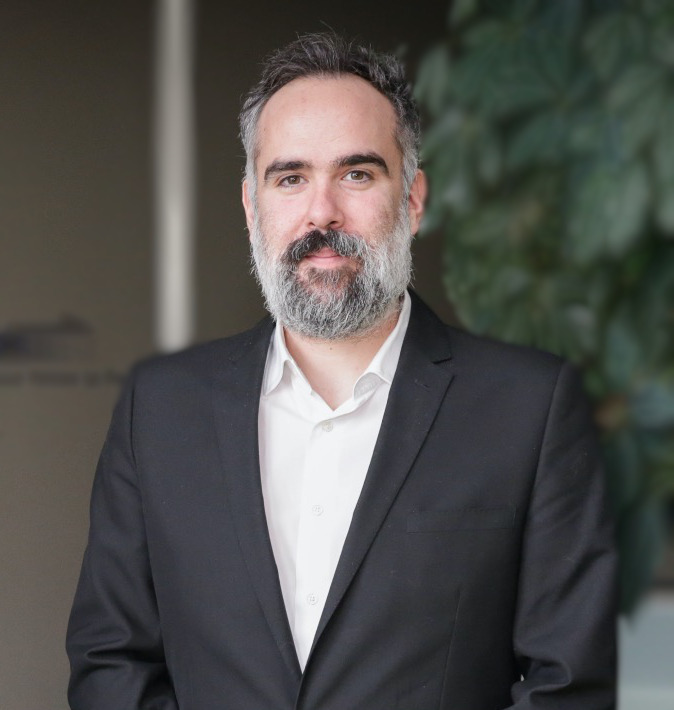
Manuel Pereiro is a Researcher at the Department of Physics and Astronomy; Materials Theory , Uppsala University , Sweden. His work bridges condensed matter physics , magnetic materials , and computational modeling , with a focus on atomistic spin dynamics and ab-initio methods. He is a key member of the Atomistic Spin Dynamics (ASD) team , contributing to the development of the UppASD simulation code used globally. PhD in Physics, University of Santiago de Compostela (Spain), with over 55 high-impact publications Recipient of the Best PhD Thesis 2010 in the Faculty of Physics, Santiago de Compostela Awarded a European Thesis during postdoctoral work Secured Knut and Alice Wallenberg Foundation Grant (2018) for research on time crystals and topological magnetic materials Research Focus : Manuel specializes in magnetic topological systems , including skyrmions in kagome magnets and B20 compounds . His work explores ultrafast demagnetization driven by spin-polarized currents , quantum spin dynamics (e.g., magnon-magnon entanglement ), and non-collinear magnetism in van der Waals magnets and chiral materials . He combines Landau-Lifshitz-Gilbert equations with density functional theory to model spin-lattice interactions and predict novel magnetic phenomena. Collaborations and Impact : He collaborates internationally with groups at IFW Dresden (Germany), Federal University of Pará (Brazil), and University of South Florida (USA). His research targets energy-efficient electronics via magnonic logic devices and quantum vacuum energy extraction . His 15 most recent publications highlight advancements in spin-lattice coupling , skyrmion dynamics , and quantum entanglement in antiferromagnets . Scientific Awards : Best PhD Thesis Award, 2010 (University of Santiago de Compostela) European Thesis Award (postdoctoral period) Knut and Alice Wallenberg Foundation Grant (2018) Technological Contributions : Developed the UppASD code , enabling global research on atomistic spin dynamics. His methods integrate first-principles calculations with spin models to study magnetic materials without prior assumptions. This includes modeling non-collinear systems , strongly correlated materials , and time-crystal analogs .