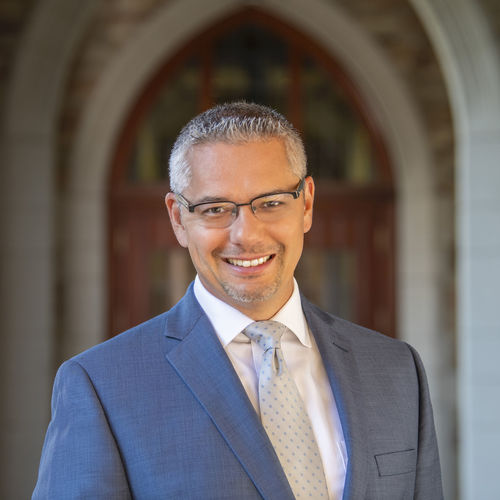
Susan Fino is a Professor at the College of Liberal Arts and Sciences, Wayne State University. Her research focuses on public law, American constitutional law, administrative law, and the role of state supreme courts. She holds a B.A. from Johns Hopkins University, an M.A. and Ph.D. from Rutgers University. She has received the President's Award for Excellence in Teaching. Her courses include American Government (PS1010) and Constitutional Law (PS5110/PS5120), taught across multiple terms from 2023 to 2025. Dr. Fino's research explores judicial federalism, state constitutional frameworks, and legal interpretations of rights. Her work analyzes topics like church-state relations, taxation provisions in state constitutions, and assisted suicide debates. She has written extensively on state supreme court dynamics, including landmark cases and institutional performance metrics. Her scholarship bridges legal theory with practical governance challenges at both state and federal levels. Her publications span over three decades, addressing evolving legal landscapes such as the Rehnquist Court’s federalism approach and technological impacts on criminal sentencing. She consistently engages with issues at the intersection of law, politics, and societal values.
Frederic Bloom is a Professor of Law at the University of Colorado College of Law, where he has taught since 2012. His scholarship focuses on structural, methodological, and design issues in modern federal courts. He earned his J.D. from Stanford Law School (Order of the Coif) and a B.A. from Washington University in St. Louis. Education: J.D., Stanford Law School (Order of the Coif) B.A., Washington University in St. Louis Bloom's research spans federal courts, constitutional law, jurisdictional design, and procedural frameworks. His work explores temporal dynamics in legal systems, judicial accountability mechanisms, and institutional constraints. Key publication themes include Judicial structure and supermajoritarianism Temporal analysis in adjudication Jurisdictional myths and realities Court litigation dynamics Awards: Order of the Coif (Stanford Law School) As a former clerk for Judge Sidney Thomas (9th Circuit) and Judge Marilyn Hall Patel (N.D. Cal), his academic practice integrates doctrinal analysis with institutional critique.
Jeffery A. Jenkins is a Provost Professor of Public Policy, Political Science, and Law at the University of Southern California’s Sol Price School of Public Policy, and holds the Maria B. Crutcher Professorship in Citizenship and Democratic Values. He directs the Political Institutions and Political Economy (PIPE) Collaborative and edits the Journal of Political Institutions and Political Economy and the Journal of Historical Political Economy . Previously, he served as Editor in Chief of The Journal of Politics (2015-2020) and founded the Southern California Political Institutions and Political Economy Working Group. His research focuses on American political history, particularly the development of congressional and partisan institutions, and the political economy of historical policy decisions. His major works include Republican Party Politics and the American South, 1865-1968 (Cambridge University Press, 2020), which won the 2021 V.O. Key Award and J. David Greenstone Prize, and Congress and the First Civil Rights Era, 1861-1918 (University of Chicago Press, 2021), awarded the 2023 V.O. Key Award. He co-edited The Oxford Handbook of Historical Political Economy (2024) and oversees a book series on historical political economy with Cambridge University Press. Roles: Editor in Chief of Broadstreet , a historical political economy blog, and host of the podcast P.S. You’re Interesting . Awards: Multiple book prizes recognizing contributions to political science and historical analysis. Research Themes: Reconstruction-era policies, civil rights legislation, Southern Republicanism, and institutional development. His recent articles explore topics such as presidential favoritism in grant allocation, historical disenfranchisement strategies, and the evolution of congressional partisan tactics. Jenkins’ work bridges historical analysis with modern political questions, emphasizing long-term institutional dynamics and their implications for contemporary governance.
Benjamin Justice is Distinguished Professor of Education at the Rutgers Graduate School of Education and an associate member of the History Department at Rutgers–New Brunswick. He holds a courtesy appointment as Senior Research Scholar at Yale Law School and serves as series editor for New Directions in History of Education at Rutgers University Press. His interdisciplinary work bridges education, history, law, and philosophy. Ph.D. in Education, Stanford University M.A. in History, Stanford University B.A. in History, Yale University Dr. Justice's research focuses on the history of education , civic education , religion in public schools , and the intersection of criminal justice and curriculum theory . He explores how experiences with police, courts, and detention shape civic identity, drawing on legitimacy and curriculum theories. His work spans educational policy, democratic ideals, race, and philosophical inquiry. His recent publications reflect a strong trend in interdisciplinary scholarship, combining historical analysis with contemporary policy critique. Key themes include school choice, settler colonialism in education, democratic civility, and the role of religion in public life. His articles appear in top journals across education, history, and social science, as well as in public forums like The Atlantic and theHumanist.com . Dr. Justice has received numerous honors, including: AESA Critics Choice Book Award AERA Outstanding Scholarly Publication on Justice in Education Award (2025) National Academy of Education/Spencer Post-Doctoral Fellowship Russell Sage Foundation Visiting Scholar (2023–24) CASE Circle of Excellence Gold Award He has held leadership roles as President of the History of Education Society (2021–2022) and member of the NAEP U.S. History Standing Committee (2011–2019). He has received multiple awards for teaching, research, and service at Rutgers. While no formal list of students is available, his collaborative works suggest mentorship and academic advising. He has led research projects supported by major foundations and institutions. Dr. Justice is affiliated with several scholarly organizations, including the History of Education Society, American Educational Research Association, American Educational Studies Association, Legal Studies Association, and Organization of American Historians. His work continues to influence both academic and public discourse on education and democracy.
Bruce Grohsgal serves as the Helen S. Balick Professor in Business Bankruptcy Law at Widener University Delaware Law School, where he joined the faculty in July 2014 after over 30 years of legal practice. His primary academic affiliation is with Widener University's Law School, where he teaches Bankruptcy, Contracts I and II, Secured Transactions, International Bankruptcy, and Financial Regulation. Prior to academia, he practiced at Pachulski Stang Ziehl & Jones, LLP in Wilmington, Delaware, representing major entities in high-profile bankruptcy cases including Solyndra, Global Home Products, and Trans World Airlines. Professor Grohsgal's research focuses on bankruptcy law with particular expertise in business restructuring, student loan dischargeability, and financial institution insolvency. His work critically examines the absolute priority rule, structured dismissals, and the legislative history behind student loan nondischargeability. He has extensively analyzed how bankruptcy courts handle debtor-creditor agreements, lease rejections, and the recharacterization of debt claims as equity. His scholarship consistently bridges theoretical legal analysis with practical restructuring challenges faced by practitioners. As Editor-in-Chief of the Norton Journal of Bankruptcy Law and Practice and the Norton Annual Survey of Bankruptcy Law, Grohsgal significantly influences bankruptcy scholarship. His recent publications (2020-2023) demonstrate a concentrated focus on student loan bankruptcy discharge mechanisms, evolving interpretations of the absolute priority rule, and procedural innovations in Chapter 11 cases. The articles reveal growing scholarly attention to consumer bankruptcy issues within traditionally corporate-focused bankruptcy scholarship. Professor Grohsgal actively engages with policy development through congressional testimony, including written submissions for H.R. 1667 (Financial Institution Bankruptcy Act of 2017). He directs the Institute of Delaware Corporate and Business Law and previously chaired the Delaware State Bar Association's Bankruptcy Section. His practical experience informs his academic work, particularly regarding first-day motions, asset sales in bankruptcy, and derivatives treatment in insolvency proceedings.
Mark Fenster is a Professor of Law at the University of Florida's Levin College of Law and holds the Marshall M. Criser Eminent Scholar Chair in Electronic Communications and Administrative Law. His scholarship focuses on government transparency, legal intellectual history, and constitutional limits on regulation. Education: J.D. from Yale Law School Ph.D. in Communications Research from University of Illinois at Urbana-Champaign M.A. in Radio-Television-Film from University of Texas at Austin B.A. from University of Virginia Fenster teaches courses in Contracts, Statutory Interpretation, and Incarceration Law. His research explores transparency in governance, secrecy, and theories of legal and political accountability. Scientific Awards: Marshall M. Criser Eminent Scholar Chair His publications include two influential books: The Transparency Fix (2017) and Conspiracy Theories (2008). His recent articles examine non-disclosure agreements, transparency during crises, and the institutional design for open government. He previously clerked for Judge Carlos F. Lucero (Tenth Circuit) and practiced environmental and land use law in San Francisco.
Elizabeth Pollman is a Professor of Law and Co-Director of the Institute for Law & Economics at the University of Pennsylvania Carey Law School. She specializes in corporate law, governance, and entrepreneurship, with a focus on venture capital-backed startups and dual-class structures. Her work examines issues such as CEO turnover, ESG integration, and regulatory frameworks in corporate law. Her research has been published in top-tier journals including the Harvard Law Review, Columbia Law Review, and Duke Law Journal. She co-authored *Business Organizations: A Contemporary Approach* and co-edited *Research Handbook on Corporate Purpose and Personhood*. Pollman has received teaching awards, including the Harvey Levin Memorial Award (2022) and LLM Prize (2021 & 2024). Before joining Penn, she taught at Loyola Law School and held visiting roles at UC Berkeley and the University of Sydney. She practiced at Latham & Watkins and clerked for the Ninth Circuit Court of Appeals. She earned her BA and JD from Stanford University, both with distinction. Her current projects include analyzing governance dynamics in dual-class firms and exploring the historical and modern evolution of corporate purpose clauses. She co-directs the Institute for Law & Economics, which focuses on interdisciplinary research at the intersection of law and economic analysis.
Reinier H. Kraakman is the Ezra Ripley Thayer Professor of Law at Harvard Law School, where he teaches corporate law, corporate finance, and organizational law. He previously served as a professor at Yale Law School and has held visiting positions at Georgetown University Law Center and New York University School of Law. His academic and policy work has influenced corporate governance reforms in countries such as Russia and Vietnam. Education: J.D., Yale Law School, 1979 Ph.D. in Sociology, Harvard University, 1973 B.A. in History and Science, Harvard College, 1971 Fulbright Fellowship, University of Frankfurt, 1971 His research focuses on corporate law, corporate governance, comparative corporate law, and the economic foundations of organizational law. Kraakman is renowned for identifying core agency problems in corporations—between managers and shareholders, controlling and minority shareholders, and shareholders and other stakeholders. His work emphasizes the functional and comparative analysis of legal institutions across jurisdictions. The recent publications of Professor Kraakman reflect a sustained focus on the intersection of law, economics, and institutional design. His articles and books analyze corporate governance structures, market efficiency, CEO turnover, and the historical evolution of business entities. He frequently collaborates with leading scholars such as Henry Hansmann, Lucian Bebchuk, and Ronald Gilson, producing influential interdisciplinary work that shapes both academic discourse and policy debates. Scientific Awards: Elected ECGI Research Associate (2006) Fulbright Fellowship (1971) Kraakman has advised on legal reforms and contributed to major amicus briefs before the U.S. Supreme Court, particularly in cases involving corporate political speech and shareholder rights. His work on compliance, executive compensation, and board accountability has informed regulatory thinking globally. He is a key figure in the academic network promoting empirical and theoretical rigor in corporate law. He is a co-author of the seminal treatise The Anatomy of Corporate Law , now in its third edition, and has published extensively in top law journals including the Yale Law Journal , Georgetown Law Journal , and Harvard Law Review . His scholarship continues to be central to understanding the convergence and divergence of corporate legal systems worldwide.
Genevieve Lakier is a Professor of Law at the University of Chicago Law School and Senior Visiting Research Scholar at the Knight First Amendment Institute at Columbia University. She holds a JD (cum laude) from New York University School of Law, an MA and PhD in Anthropology from the University of Chicago, and an AB in Anthropology from Princeton University. Previously, she served as an Assistant Professor of Law (2015–2021) and Bigelow Teaching Fellow (2013–2015) at the University of Chicago Law School. Her research focuses on the evolving interpretation of the First Amendment , particularly how social media platforms challenge traditional free speech doctrine. She analyzes the role of legislatures in safeguarding speech values, the rise of anti-classificatory theories , and the tension between laissez-faire constitutionalism and state intervention in digital speech regulation. Recent publications include critiques of platform moderation in the Journal of Free Speech Law and analyses of the First Amendment's Lochner problem . Her work often addresses the intersection of constitutional history and modern tech policy, as seen in contributions to the Harvard Law Review and Yale Law Journal Forum . Scientific Awards: Harry W. Stonecipher Award (2021) Faculty Hooder Teaching Award (2022, 2023) Class Award (2022) She has collaborated with scholars like Evelyn Douek on studies of platform governance and informal government coercion . Her clerkships include Judge Leonard Sand (Southern District of New York) and Judge Martha Daughtrey (Sixth Circuit Court of Appeals).
Thomas B. Metzloff is a Professor of Law at Duke University School of Law, where he has been teaching since 1985. His academic roles include teaching Civil Procedure , Ethics in Action , and specialized courses on the American legal system for international LLM students in Geneva, Hong Kong, and Beijing. He served as Senior Associate Dean for Academic Affairs (1998–2001) and currently sits on Duke University's Academic Council executive committee. Education: BA from Yale College (1976), JD from Harvard Law School (1979) Professional Background: Judicial clerkships (5th Circuit Court of Appeals, U.S. Supreme Court), private practice in Atlanta, and academic leadership roles. Research Interests span empirical studies of the litigation system, particularly medical malpractice disputes, legal ethics, constitutional law, and dispute resolution. He directs the Voices of American Law project, creating documentaries through interviews with key stakeholders in landmark Supreme Court cases, focusing on constitutional values like the First Amendment and privacy rights. Publications include extensive work on medical malpractice, attorney dynamics, mediation, and arbitration. His 2008 empirical study on attorney experience and case outcomes and the 2007 analysis of court-ordered mediation are notable. He has also explored constitutional law in Virginia v. Barry Black (2008) and edited symposia on mandatory arbitration (2004). Professional Activities include advisory roles with the North Carolina State Bar Ethics Committee and the North Carolina Supreme Court's Dispute Resolution Committee. His research has been funded by the Robert Wood Johnson Foundation, particularly for studies on court-ordered mediation in medical malpractice cases.
Dr. Vincent Phillip Muñoz is the Tocqueville Professor of Political Science and Concurrent Professor of Law at the University of Notre Dame, where he also serves as Founding Director of the Center for Citizenship & Constitutional Government. His research focuses on constitutional law, American politics, and political philosophy, particularly regarding religious liberty and the American Founding. He holds a B.A. from Claremont McKenna College, M.A. from Boston College, and Ph.D. from Claremont Graduate School. Education: B.A. Claremont McKenna College; M.A. Boston College; Ph.D. Claremont Graduate School His scholarship explores foundational questions about religious freedom, church-state relations, and constitutional interpretation. Key works include God and the Founders: Madison, Washington, and Jefferson (2009) and Religious Liberty and the American Founding (2022). His research has been cited in landmark Supreme Court cases like Fulton v. City of Philadelphia and Esipnoza v. Montana . He has secured over $20 million in grants/funding for the Center, edited leading constitutional law casebooks, and is a sought-after speaker on topics ranging from Madison's political thought to modern Supreme Court jurisprudence. Awards: Hubert Morken Award (2009-2010), NEH Fellowship (2022) His teaching spans undergraduate and graduate levels, with a focus on fostering critical engagement with constitutional principles. He advises students on historical and legal methodologies, including former advisee Kate Hardiman Rhodes. Current initiatives include exploring the modern Supreme Court’s reinterpretation of religious establishments and advancing interdisciplinary dialogue on citizenship education through the Center’s programs.
G. Edward White is the John B. Minor Professor of Law and Professor of History at the University of Virginia School of Law, where he has taught since 1972. Holding joint appointments in law and history, he is one of the nation’s leading scholars of American legal history, constitutional law, and torts. Education B.A., Amherst College, 1963 M.A., Yale University, 1964 Ph.D., Yale University, 1967 J.D., Harvard Law School, 1970 Research Interests White’s scholarship integrates doctrinal analysis with rich historical narrative, focusing on the evolution of American legal thought from the Founding to the present. His work interrogates how landmark Supreme Court decisions, tort doctrines, and constitutional principles have both reflected and shaped broader intellectual and cultural currents. He has produced foundational studies on the Marshall Court, the Warren Court, and the intellectual history of tort law. Recent projects explore the Suspension Clause and habeas corpus in wartime, the constitutionalization of tort liability under the First Amendment, and the historical development of dignitary torts. He frequently employs biographical approaches, examining the jurisprudential legacies of figures such as Oliver Wendell Holmes Jr., Earl Warren, and Learned Hand. Scholarly Output Over five decades, White has authored more than a dozen major monographs—including Law in American History (2012), Tort Law in America (1980, rev. 2003), and The American Judicial Tradition (1976, rev. 2007)—and scores of influential articles. His recent publications (2015–2019) evidence sustained attention to habeas corpus, the historical emergence of tort law, and the interplay between constitutional doctrine and intangible harm, demonstrating both continuity and innovation in his research agenda. Honors and Fellowships John Simon Guggenheim Memorial Fellowship (1984–85) National Endowment for the Humanities Senior Fellowship (1977–78, 1983–84) American Bar Association Gavel Award (1979, 1981, 1983) David and Mary Harrison Distinguished Professor of Law (1986) Advising & Institutional Service White has directed numerous doctoral dissertations and served on editorial boards for leading journals. His leadership roles include participation in the American Society for Legal History and the American Bar Foundation, fostering interdisciplinary dialogue between law and history. Laboratories & Research Groups While not laboratory-based, White’s intellectual home is the University of Virginia’s Program in Legal History, where he mentors graduate students and collaborates with colleagues in both the School of Law and the Corcoran Department of History.
Renita Coleman is an Associate Professor at the University of Texas at Austin's School of Journalism and Media, where she has taught since 2005 after achieving tenure in 2009. With expertise in agenda-setting theory, visual communication, and media ethics, she has authored over 30 peer-reviewed articles and two influential books: 'Designing Experiments for the Social Sciences' (2018) and 'The Moral Media' (2005). Her research examines how visual elements shape ethical reasoning and public perception in news media. Her academic credentials include: Ph.D. in Journalism, University of Missouri (2001) M.A. in Journalism, University of Missouri (1997) B.S. in Journalism, University of Florida (1979) Coleman's research program centers on the intersection of visual communication and moral decision-making in journalism. She investigates how photographs influence ethical reasoning among journalists, the framing of health news through visual elements, and racial dynamics in journalistic ethics. Her work employs experimental methods to analyze affective agenda-setting, where emotional responses to visual stimuli shape public priorities. This approach bridges communication theory with practical journalism ethics. Recent publications reveal intensifying focus on polarization mechanisms, climate change communication, and fact-checking efficacy. Coleman's scholarship increasingly examines how adaptive framing strategies overcome audience resistance, particularly regarding scientific consensus issues. Her methodological rigor in experimental design provides robust evidence for how visual and emotional elements drive media effects beyond traditional textual analysis. Professor Coleman has received extensive recognition for scholarly excellence: Multiple AEJMC top paper awards across divisions (2002-2014) Teacher of the Year at LSU (2002-2004) Ranked #1 for AEJMC convention productivity (1999-2008) She teaches doctoral seminars in qualitative methods and experimental design while mentoring graduate students in visual communication and ethics research. As associate editor of Journalism & Mass Communication Quarterly, she shapes scholarly discourse in the field. Though specific grant funding isn't detailed in available materials, her sustained publication record demonstrates consistent research activity. Coleman's background as a 15-year newspaper professional (including roles at the Raleigh News & Observer and Orlando Sentinel) informs her applied research perspective.
John C. Watson is a tenured Associate Professor in the Journalism Division at American University's School of Communication . He combines 21 years of professional journalism with academic credentials including a Ph.D. in Mass Communication (University of North Carolina - Chapel Hill) and a J.D. (Rutgers School of Law - Newark). Ph.D. in Mass Communication, University of North Carolina - Chapel Hill J.D. , Rutgers School of Law - Newark B.A. in Journalism, Rutgers University - New Brunswick His research focuses on media law , journalism ethics , and the legal frameworks shaping journalism . He advocates for professionalization and licensing of journalists to distinguish them from other content creators. Publications include a 2008 book, Journalism Ethics By Court Decree , and articles in law reviews and journals analyzing cases like New York Times v. Sullivan . Recent work explores newsroom diversity and justice system coverage . His scholarly output spans topics such as defamation , high-profile trials , libel tourism , and confidential sources , reflecting interdisciplinary engagement with constitutional law and ethical journalism . He received the Freedom Forum Ph.D. Fellowship (1996) . Watson teaches Communication Law (undergraduate and graduate) and has presented at the Association for Practical and Professional Ethics (2008). He is currently working on a book titled Emissary: The Roles and Missions of Journalists of Color in Post-Racial America .
Professor Megan Richardson is an Honorary Professor at the University of Melbourne's Law School, specializing in intellectual property, privacy rights, and legal theory. She has contributed significantly to privacy law reform through advisory roles with the Australian Law Reform Commission and NSW Law Reform Commission. Research focuses on: Evolution of privacy rights in digital contexts Intellectual property intersections with personality rights Data governance frameworks Legal responses to automated decision-making Historical development of privacy doctrines Publication trends show increasing engagement with technology-law interfaces, particularly algorithmic systems and data rights. Recent work examines AI's impact on privacy, blockchain applications, and pandemic surveillance technologies, often employing interdisciplinary approaches combining law with cultural studies. Scientific Awards: No awards mentioned in provided materials. Research Leadership: Serves as Coordinating Editor for Cambridge Elements Series: Data Rights and Wrongs. No specific student advising information available.