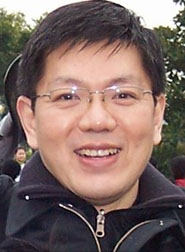
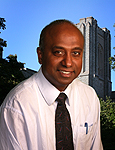
Matti Vilkko is a Professor in Control Engineering at Tampere University's Faculty of Engineering and Natural Sciences , specifically within the Automation Technology department. He serves as Head of the Automation and Mechanical Engineering Unit. Research Focus: Industrial process control, mathematical modeling, state estimation, and optimization of metallurgical and energy systems Key Projects: Future Electrified Mobile Machines (FEMMa), Circular Economy of Water (CEIWA), Social Energy Ecosystems (ProCem), Green Electrification (HYGCEL) His work combines control theory with industrial applications, particularly in copper smelting optimization, green hydrogen systems, and smart energy networks. Recent publications show expertise in: Machine learning for wind turbine cybersecurity ASM1 calibration for wastewater treatment EU regulatory impacts on hydrogen infrastructure Finite element analysis of paperboard mechanics Price-based coordination in metallurgical processes He leads interdisciplinary collaborations across Finland, integrating automation technology with energy systems, materials science, and industrial ecology.
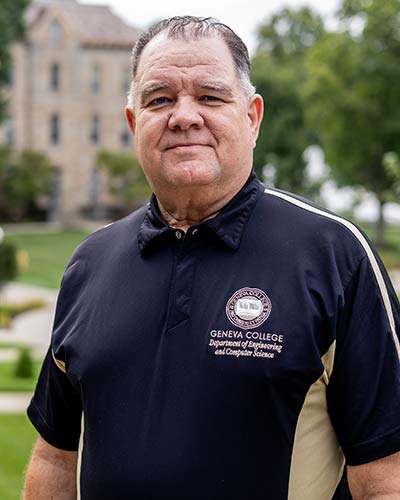
Christopher C. Jobes is a Professor in the Department of Mechanical Engineering at Geneva College, with a Ph.D. in Engineering from West Virginia University (1987). He also holds M.S. and B.S. degrees in Mechanical Engineering from West Virginia University (1985) and Geneva College (1983, 1982), respectively. Fields of Instruction: Mechanical Engineering & Engineering Mechanics Research Interests: Machine Component Design, Kinematics of Mechanisms, Finite Element Methods, Control Systems Design Professional Certification: Registered Professional Engineer (Pennsylvania) His recent work focuses on Mining Equipment Safety , including proximity detection systems, vibration control, and electromagnetic interference mitigation. He has collaborated extensively with NIOSH on safety protocols for underground mining machinery. Key awards include: Excellence in Scholarship Award, Geneva College (2020-2021) Silver Chairman’s Award (2014, Federal Executive Board of Pittsburgh) Outstanding Scientific Paper Nominee (2013, Charles C. Shepard Science Award) NIOSH/HHS Excellence in Communication (2012) Jobes serves as faculty advisor for Geneva College’s SAE Baja Racing Team and has over 69 publications with 35 first authorships in peer-reviewed journals and conferences.
Lenny Fukshansky is a Professor of Mathematics at Claremont McKenna College’s Department of Mathematical Sciences. His research focuses on Number Theory, Discrete and Convex Geometry, and Arithmetic Geometry. He holds a B.S. from UCLA and a Ph.D. from the University of Texas at Austin. Dr. Fukshansky has received significant grants including National Security Agency Young Investigator Grants (2012–2017) and multiple Simons Foundation Collaboration Grants (2011–2022). He has been an invited researcher at prestigious institutions like the Institut Mittag-Leffler (2013), Erwin Schrödinger Institute (2014), and Oberwolfach Research Institute (2017). His work bridges algebraic structures with geometric and analytic techniques, emphasizing lattice theory and Diophantine approximation. Recent publications explore sparse geometry of numbers, Frobenius problems in number fields, and applications of lattice theory in coding and signal processing. Key research themes include lattice-based constructions, minimal solutions to polynomial equations, and geometric interpretations of algebraic number theory. His grants have supported collaborations on topics ranging from cryptographic lattices to historical conjectures like Bateman-Horn.
Sabrina Vantadori is an Associate Professor in the Department of Engineering and Architecture at the University of Parma, Italy. Her academic role centers on structural mechanics, with leadership responsibilities as President of TC3 (Fatigue of Engineering Materials and Structures) in the European Structural Integrity Society (ESIS) and Vice Head of the 'Prove Materiali e Strutture' Laboratory at the University of Parma. Her research focuses on fatigue and fracture mechanics of both traditional and advanced materials across multiple length scales. Key areas include crack propagation, mechanical behavior of nanomaterials, numerical modeling of structural components, and sustainable construction materials like pervious and earthen concrete. She applies both experimental and computational methods to analyze structural integrity and failure mechanisms. The recent publications (2025) reflect a strong trend in multi-scale material modeling , nanocomposite behavior , and eco-friendly structural materials , with interdisciplinary applications in civil and mechanical engineering. Her work bridges theoretical mechanics with practical engineering solutions for material durability and sustainability. She teaches a range of courses including Advanced Structural Mechanics , Numerical Modelling of Advanced Structural Materials , and Theory of Construction across undergraduate and graduate programs in Civil Engineering and Architecture. Her teaching spans multiple academic years from 2013/2014 to 2025/2026, indicating sustained academic engagement. Leadership and Service: President, TC3 'Fatigue of Engineering Materials and Structures', ESIS (since October 2020) Vice Head, Laboratory 'Prove Materiali e Strutture', University of Parma (since February 2021) While no formal list of advisees or awards is provided, her co-authorship on numerous research papers suggests active mentorship and collaboration. There is no mention of grants, but her ongoing research output indicates active project involvement. Her laboratory role reinforces her experimental and technical expertise in materials testing and structural controls.
Dr. Donald L. Kunz is a Professor in the Department of Aeronautics and Astronautics at the Air Force Institute of Technology (AFIT), part of the Graduate School of Engineering and Management. He holds a PhD in Aerospace Engineering from the Georgia Institute of Technology and has extensive experience in both academic and military aerospace research environments. BS, Aerospace Engineering, Syracuse University, 1971 MS, Aerospace Engineering, Georgia Institute of Technology, 1972 PhD, Aerospace Engineering, Georgia Institute of Technology, 1976 Dr. Kunz’s research is centered on rotorcraft dynamics, structural dynamics, vibrations, aeroelasticity, multibody systems, smart structures, and computational structural mechanics . His work integrates advanced modeling and simulation techniques to solve complex problems in helicopter and tiltrotor systems. He has made significant contributions to understanding nonlinear vibrations, rotor fault detection, and active vibration control using smart materials. His recent publications show a strong trend in developing and applying high-fidelity computational models for rotorcraft components, with particular focus on vibration mitigation, dynamic balancing, and nonlinear structural behavior . The integration of numerical methods with experimental validation underscores his commitment to practical engineering solutions. Dr. Kunz has received numerous honors, including: Distinguished Service Award, AIAA (2006, 1998) Leadership Award, AIAA (2004) Gold Circle Award, American Helicopter Society (1999) NASA Tech Brief Award (1990) Multiple entries in Who's Who publications He has advised numerous graduate students through thesis research and collaborative projects, though specific names are not listed. His work has been supported by U.S. Air Force, NASA, and Army research programs. Dr. Kunz is also a licensed Professional Engineer in Virginia and maintains active affiliations with AIAA (Associate Fellow and Lifetime Member) and the American Helicopter Society (Lifetime Member). His research has contributed to major programs such as the Apache Longbow, CH-53E, and tiltrotor development, often involving experimental testbeds and simulation frameworks like GRASP (General Rotorcraft Aeromechanical Stability Program).
Dr. Osama A. Mohammed is a Distinguished Professor and Associate Dean of Research at the College of Engineering and Computing, Florida International University (FIU), where he also serves as Director of the Energy Systems Research Laboratory (ESRL) in the Department of Electrical and Computer Engineering. He has been a faculty member since 1983 and is internationally recognized for his pioneering work in power systems, smart grids, and energy cyber-physical systems. His educational background includes: B.S. in Electrical Engineering, Zagazig University, Egypt (1977) M.S. in Electrical Engineering, Virginia Tech (1981) Ph.D. in Electrical Engineering, Virginia Tech (1983) Dr. Mohammed's research is centered on advancing energy systems through innovation in power electronics, electric drives, computational electromagnetics, and smart grid technologies. He emphasizes real-world applications, student involvement, and interdisciplinary collaboration. His work bridges academia and industry, focusing on resilient, secure, and efficient energy infrastructure. His extensive publication record—over 750 papers—demonstrates a strong trend toward intelligent control, cybersecurity in energy systems, real-time simulation, and optimization of hybrid AC/DC microgrids. Many of his recent works integrate AI and machine learning for predictive maintenance, demand response, and digital twin applications in power systems. His scientific awards and recognitions include: Fellow of the National Academy of Inventors (2022) IEEE Fellow (1996) ACES Fellow (2006) IEEE PES Cyril Veinott Award (2010) Multiple Best Paper Awards in IEEE Transactions Top 2% Scientist Worldwide (Stanford, 2020) Dr. Mohammed is a dedicated mentor, having supervised 34 PhD graduates and over 60 master’s students, many of whom now hold prestigious positions in academia and industry. He has secured over $30 million in research funding from DoE, ONR, NSF, and industry. His leadership extends to major multi-university consortia, including the $12.2M DoE SEEDS Center. He has developed key research labs at FIU, such as the Smart Grid Test-Bed and Power Electronics Laboratory, providing unparalleled hands-on experience for students.
Andrew Winters is a Senior Associate Professor in the Department of Mathematics at Linköping University, Sweden. He is affiliated with the Division of Applied Mathematics (TIMA), where he conducts research in computational mathematics and numerical methods for partial differential equations. His research focuses on the design and analysis of high-order numerical schemes, particularly nodal discontinuous Galerkin (DG) methods with summation-by-parts (SBP) properties, for solving hyperbolic and mixed hyperbolic-parabolic PDEs such as shallow water, Euler, Navier-Stokes, and magnetohydrodynamic (MHD) equations. His work emphasizes conservation, entropy stability, and thermodynamic consistency in numerical approximations. The recent publications highlight a strong trend in developing robust, high-order, entropy-stable methods for nonlinear conservation laws, with applications in fluid dynamics and geophysical modeling. His work integrates theoretical analysis with high-performance computing, particularly through the development of the FLUXO and Trixi.jl simulation frameworks. Energy Bounds for Discontinuous Galerkin Spectral Element Approximations Entropy Stable Hydrostatic Reconstruction Efficient Implementation of Entropy Stable DG Methods Adaptive Simulations with Trixi.jl Subcell Finite Volume Shock Capturing Andrew Winters is actively involved in software development and scientific computing education, including an introductory Fortran course for MATLAB users. He contributes to international collaborations, such as a four-way research and exchange program between Linköping University and Washington State University. He has no listed scientific awards in the provided text. He advises students in computational mathematics, though specific names are not mentioned. He is a core developer of the FLUXO (Fortran/MPI), Trixi.jl (Julia), and HOHQMesh.jl projects, which support high-order simulations and mesh generation.
Antonis Stylianou is an Associate Professor in the Department of Mechanical Engineering at the University of Missouri - Kansas City (UMKC). He holds a Ph.D. in Mechanical Engineering from the University of Kansas (2004), along with multiple master's degrees in Mathematics (2012) and Mechanical Engineering (2000), and a B.S. in Mechanical Engineering (1998). His primary affiliation is within the School of Science and Engineering, where he focuses on computational biomechanics, musculoskeletal modeling, and multibody dynamics. Dr. Stylianou's research emphasizes Elbow joint mechanics and ligament deficiency modeling Virtual surgical simulators for pelvic surgery error prevention Pediatric knee anatomy and ACL injury risk analysis Musculoskeletal models of human motion Finite element analysis of cartilage contact pressures His work bridges computational methods with clinical applications, including developing tools for orthopedic surgeons and training paradigms for surgical techniques. Recent studies have explored surgeon kinematics during retropubic trocar insertion and posteromedial rotatory incongruity of the elbow. Teaching responsibilities include advanced dynamics, biomechanics, and experimental methods courses. His contributions underscore the integration of engineering principles with medical challenges, particularly in orthopedic and surgical contexts.
Dr. Bevan Smith is a Senior Lecturer at the School of Mechanical, Industrial & Aeronautical Engineering at the University of the Witwatersrand (Wits), where he also completed his BIng(Mech), MSc(Eng), and PhD. His research bridges machine learning and engineering systems, with a focus on optimization through simulation and AI. His research interests include: Machine Learning and Reinforcement Learning Causal Machine Learning and Causal Discovery Graph Neural Networks Explainable AI (XAI) Digital Twins Application of AI in Education and Industrial Systems His recent publications demonstrate a strong trajectory in applying causal inference and machine learning to both industrial optimization (e.g., inventory management, air quality monitoring) and educational challenges (e.g., at-risk student prediction, online video interventions). He utilizes simulation-based methods and counterfactual reasoning to evaluate treatment effects and improve decision-making. His work spans journals in industrial engineering, artificial intelligence in education, and computational applications. Notable scientific contributions include: Developing AI-driven solutions for low-cost air quality monitoring (AI_r) Evaluating X-Learner performance under confounding and non-linearity Applying Pearl’s counterfactual framework to assess explanation validity Designing personalized interventions for engineering students using model-agnostic explanations Dr. Smith has contributed to curriculum development through the creation of online educational videos and has explored structural design in mechanical engineering, notably in carbon fibre swingarm development. While no formal advising or grant information is available, his work reflects an interdisciplinary approach combining mechanical engineering principles with cutting-edge AI methodologies. He is actively publishing and remains engaged in both technical and educational research domains.
Dr. André Bénard is a Professor in the Department of Mechanical Engineering at Michigan State University (MSU), affiliated with the College of Engineering. His research focuses on sustainable manufacturing, multiphase flows, heat transfer, and technologies for a circular economy, including water treatment, recycling, and renewable energy systems. His current projects include ARPA-E-funded initiatives on heat exchanger design and solar desalination chimneys. Education: Ph.D., Mechanical Engineering (University of Delaware, 1996); M.Sc., Mechanical Engineering (École Polytechnique de Montréal, 1991); B.S., Mechanical Engineering (University of Sherbrooke, 1988). Postdoctoral research at Los Alamos National Laboratory. Research interests span clean energy, plastics recycling, chemical recycling via hydrolysis, and global water treatment systems with a geographic focus on India, Germany, and China. He advises SPARTA, a student organization retrofitting MSU’s campus for energy efficiency. Recent teaching includes courses on heat transfer, alternative energy systems, and finite element methods. His group includes 9 PhD students and postdocs working on projects like solar desalination, greenhouse integration, and advanced heat exchanger designs. Awards include a $961,954 ARPA-E grant (2021). Labs/Teams: Active in MSU’s sustainable engineering initiatives, leading projects on topology optimization for heat exchangers and solar-driven water solutions. Collaborates with industry and international partners on circular economy technologies.
Antonio Rodríguez-Ferran is a Professor at the School of Civil and Environmental Engineering at the Universitat Politècnica de Catalunya (UPC) in Barcelona, Spain. His research focuses on computational fracture mechanics, acoustics and vibration modeling, cell mechanics, and advanced numerical methods in applied sciences. He holds a B.Sc., M.Sc., and Ph.D. in Civil Engineering from UPC, completing his doctorate in 1996. His work emphasizes phase-field modeling for fracture propagation in layered and composite materials, with contributions to the shifted fracture method and adaptive numerical techniques. He also explores vibroacoustic systems, granular materials, and structural acoustics. Notable projects include modeling human towers (Castells) and cellular mechanics in biological systems. Research highlights include advancements in fracture mechanics using phase-field approaches, numerical methods for interface and material mismatch analysis, and interdisciplinary applications in engineering and biology. His work bridges computational methods with real-world industrial applications, such as bulk material characterization and structural noise reduction. Collaborations span academia and industry, with a focus on advancing computational tools for engineering challenges. Current open positions include MSc thesis topics in computational engineering and granular material modeling.
Dr. Song Yu is an Associate Professor at the Department of Engineering Mechanics , School of Civil Engineering , Shandong University , with expertise in rock mechanics, fracture mechanics, and numerical simulation techniques. Education: B.E. (1989), M.E. (1992) in Machine Building, Ph.D. (2004) in Mould & Die Engineering, Post-doctoral research (2005-07) in Die & Mold CAD at Shanghai Jiao Tong University, Visiting Scholar at UC San Diego (2008) Research focuses on rock and soil mechanics , fracture mechanics , nondestructive AE detection , and numerical simulation for rock-metal interaction. Pioneered 3D DDA method applications in rock mechanics and fluid-solid coupling models. Recent publications emphasize geotechnical stability analysis under seismic loads, coupled hydro-mechanical modeling , and hexahedral mesh algorithms in metal forming. His work bridges computational methods with practical geotechnical challenges. Notable grants: National Natural Science Foundation of China (51579140), State Key Laboratory of Geotechnical Mechanics projects Teaches advanced topics in Finite Element Method (FEM) , structural optimization, and ANSYS simulation techniques. Collaborated with institutions including Shanghai Jiao Tong University and UC San Diego.
Dr. Lluis Batet Miracle is a Professor at the Universitat Politècnica de Catalunya (UPC) with the Department of Physics . He leads the Advanced Nuclear Technologies Research Group (ANT) and has contributed extensively to nuclear fusion technology, thermal hydraulics, and liquid metal systems. His work spans reactor safety analysis, tritium processing, and magnetohydrodynamic modeling. Expertise : Nuclear Engineering, Plasma Physics, Computational Fluid Dynamics, Fusion Reactor Design, Tritium Management Notable Projects : CONSOLIDER TECNO-FUS (2009-2013), EURATOM collaborations, HCLL Breeding Blanket Systems for ITER Research Trends : Recent publications focus on helium solubility in liquid metals, bubble dynamics in fusion blankets, and MHD simulations under nuclear conditions. His work combines atomistic modeling, high-fidelity CFD, and experimental validation for tritium and hydrogen systems in fusion reactors. Collaborations : Regularly works with Luis Sedano, Eduardo Ríos, Jordi Martí, Francesc Reventos, and Elisabet Mas de les Valls Grants : Involved in Horizon Europe, EURATOM, and Spanish National Research programs
S.F. Asokanthan is a Professor in the Department of Mechanical and Materials Engineering at Western University, Canada. His research focuses on Dynamic Systems and Control with applications to Flexible Structures, Rotating/Axially Moving Systems, and MEMS/NEMS. Prior to Western, he held a faculty position at the University of Queensland, Australia, and worked as an NSERC industrial postdoctoral fellow in Canada. Research Interests: Dynamic Systems and Control Flexible Structures and Rotating Systems MEMS/NEMS for Inertial Sensing Energy Harvesting Systems Biological and Aerospace Applications Stochastic Stability Analysis Publication Trends: His recent work (2022-2017) emphasizes nonlinear dynamics of ring-based MEMS gyroscopes and energy harvesters, stochastic stability under random perturbations, and biomedical applications like magnetic seizure therapy. Keywords span Mechanical Engineering, Micro/Nano Systems, and Aerospace Engineering, with subfields including Vibratory Sensors, Uncertainty Quantification, and Nonlinear Modeling. Students: He has supervised numerous PhD and Master's students in topics such as MEMS design, dynamic stability, and biomedical devices.
Michael Kunzinger is a Professor at the Department of Mathematics, Faculty of Mathematics, University of Vienna. His research spans generalized functions, differential geometry, and mathematical physics, with a focus on Colombeau algebras, Lorentzian length spaces, and non-smooth geometric structures. His recent work includes stochastic PDEs on manifolds, synthetic curvature bounds, and causality in Lorentzian geometry. Articles highlight applications to conservation laws, sectional curvature analysis, and rigidity theorems. Notably, he explores connections between generalized functions and smooth manifold theory, advancing geometric regularization techniques. 2024: 9 publications on singular limits, Ricci curvature, and synthetic geometry. 2022: Studies on null distance and singularity theorems in low-regularity spacetimes.