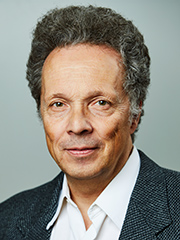
Prof. Joachim Schöberl is a faculty member at TU Wien's Faculty of Mathematics and Geoinformation, leading the Scientific Computing and Modelling research group. His academic career includes roles as a university professor (Univ.Prof.) with engineering and technical doctorates (Dipl.-Ing., Dr.techn.). Research focuses on advanced numerical methods, including finite element methods, computational fluid dynamics, and partial differential equations. He has pioneered high-order schemes for fluid-structure interaction, shell mechanics, and electromagnetic simulations. Notable contributions include the NGSolve finite element library and innovative approaches to curvature approximation in discrete geometry. Recent work emphasizes nonlinear elasticity modeling, fractional diffusion problems, and shape optimization for biomembranes. His team collaborates on projects like metascreen upscaling, micromorphic continuum models, and eddy current simulations in laminated materials. Prof. Schöberl advises PhD students researching mixed finite element methods, fractional operators, and computational mechanics. His lab develops open-source tools for high-performance scientific computing.
Professor Lehel Banjai is a faculty member at the School of Mathematical and Computer Sciences, Heriot-Watt University, where he has held the position of Professor in Mathematics since 2022. Previously, he served as Associate Professor (2015–2022) and Assistant Professor (2012–2015) at the same institution. Education: Habilitation (University of Dusseldorf, 2013), D.Phil. (Oxford, 2003), BA(Hons) in Mathematics and Computation (Oxford, 2000) His research spans numerical analysis and computational mathematics, focusing on boundary and finite element methods, space-time formulations, and convolution quadrature for time-domain problems. Key areas of interest include wave scattering (acoustic and electromagnetic), Schrödinger equations, fractional differential operators, and high-order numerical schemes. Recent publications highlight his work on Runge-Kutta convolution quadrature, fractional diffusion, nonlinear impedance boundary conditions, and efficient solvers for wave equations. He has collaborated with researchers at institutions such as Max Planck Institute, University of Zurich, and University of Dusseldorf. Students supervised include Brian Hennessy (joint with Emmanuil Georgoulis), Ebraheem Aldahham, Katherine Baker, Jeta Molla (joint with Gabriel Lord), and Oluwaseun Lijoka, among others.
Tyler Lawson is a Professor in the School of Mathematics at the University of Minnesota, holding the distinguished Albert and Dorothy Marden Professorship. His office is located in Vincent Hall 323 at 206 Church Street SE, Minneapolis, MN 55455, and he can be reached at tlawson@umn.edu or (612) 625-6802. Professor Lawson's research focuses on algebraic topology and K-theory, with significant contributions to homotopy theory, quandles, stable homotopy theory, and braided Hopf algebras. His work bridges abstract algebraic structures with topological applications, particularly exploring connections between category theory and homotopy-theoretic constructions. He has made notable advances in understanding filtrations and derived spaces, the generating hypothesis in stable homotopy theory, and the homotopy theory of quandles as they relate to knot invariants. Analysis of his recent publications reveals a strong emphasis on structural theorems in algebraic topology, with particular attention to equivariant phenomena, rational homotopy theory, and connections to arithmetic statistics. His research demonstrates sophisticated interplay between combinatorial structures and topological invariants, often revealing unexpected connections between seemingly disparate mathematical domains. Albert and Dorothy Marden Professor Professor Lawson actively advises graduate students and participates in the topology seminar series at the University of Minnesota, where he has presented on topics ranging from filtrations and derived spaces to the generating hypothesis. His research program includes collaborations with mathematicians across institutions, contributing to advancements in homotopy theory and its applications to other mathematical fields. He maintains an active research group focused on exploring the frontiers of algebraic topology and its connections to related disciplines.
Barbara Kaltenbacher is a Professor at the Institute of Mathematics, University of Klagenfurt. She serves as Deputy Head of the Institute and is actively involved in academic governance through roles in curricular commissions for Information Technology and Mathematics. Her research focuses on nonlinear acoustics , inverse problems , and partial differential equations , particularly in modeling wave propagation and parameter identification. Her work spans theoretical and applied domains, including Acoustic nonlinearity parameter tomography Fractional regularization techniques Optimization of imaging and ultrasound models Well-posedness of nonlinear PDEs Her recent publications address advanced mathematical challenges in nonlinear acoustics and inverse problems, with applications in medical imaging and materials science. She contributes to academic leadership through committee memberships and maintains active research collaborations across disciplines.
Dr. Daniel Perales Anaya is a Visiting Assistant Professor in the Department of Mathematics at Texas A&M University, affiliated with the College of Arts & Sciences. He completed his Ph.D. in 2022 at the University of Waterloo under the supervision of Alexandru Nica. His research focuses on Finite Free Probability, a field at the intersection of free probability, random matrices, combinatorics, and non-commutative probability. He also investigates infinitesimal freeness, hypergeometric polynomials, and cumulant theory. He organizes the Free Probability and Operators Seminar at Texas A&M University and maintains an active research profile with contributions to journals like Transactions of the American Mathematical Society and Constructive Approximation . His work bridges classical analysis, operator algebras, and combinatorial structures, often leveraging finite free convolutions and non-crossing partitions. Publications span topics including infinitesimal distributions, hypergeometric polynomial zeros, and S-transforms in finite free probability. His research has been supported by institutions such as the Simons Foundation and Birkhäuser.
Lina von Sydow is a Professor in Computational Science at Uppsala University's Department of Information Technology. She serves as Section Dean for the Mathematical-Computer Science Section since July 2023. Her academic journey includes becoming an Associate Professor in 2000, Senior Lecturer since 1997, and leading the Department of Information Technology from 2018 to 2023. PhD in Domain Decomposition Methods (1995, Uppsala University) Postdoctoral Fellow at Oxford University (1996-1997) Her research spans computational science with dual focuses on Computational Finance and Ice Sheet Modeling . In finance, she develops numerical methods for option pricing using PDEs, radial basis functions, and stochastic volatility models. In climate science, she contributes to ice sheet dynamics through full Stokes models and adaptive time-stepping approaches, particularly in simulating grounding line migration. Recent publications (2025) address gender disparities in IT education, including comparative analysis of admission trends and intervention studies to boost female enrollment. Earlier works (2020-2015) focus on high-order finite difference methods for financial derivatives, BENCHOP benchmarking projects, and preconditioning techniques for PDEs. Scientific awards include Excellent Teacher (2013) She actively collaborates on educational reforms, co-authoring studies like Gender-aware course reform in Scientific Computing (2013). Her leadership roles include Head of Department (2018-2023) and Section Dean (2023-present), influencing academic governance and interdisciplinary research. Labs and teams: Works with Uppsala University's Computational Science group, Elmer/ICE project collaborators (e.g., Per Lötstedt, Gong Cheng), and international partners in numerical finance and climate modeling.
Hong Wang is a Professor in the Department of Mathematics at the University of South Carolina, part of the McCausland College of Arts and Sciences. He specializes in numerical analysis and differential equations, with a focus on numerical methods for fractional and variable-order equations. His work addresses complex boundary conditions, optimal control, and scientific computing challenges in advection-diffusion systems. Education Ph.D. in Mathematics, University of Wyoming (1992) Research Interests His research emphasizes numerical approximation techniques for differential/integral equations, particularly fractional diffusion-wave equations, variable-order models, and stochastic systems. Key areas include finite element methods, spectral methods, and fast algorithms for solving high-dimensional and time-dependent problems. He explores applications in optimal control, viscoelasticity, and multi-scale modeling. Recent Work Trends Recent publications highlight advancements in fractional calculus applications, including variable-exponent diffusion, distributed-order equations, and stochastic fractional differential equations. His work often combines theoretical analysis with computational efficiency, addressing challenges like nonsmooth parameters and singular density functions. Grants and Advising No specific grants or advisees are listed, but his research collaborations span computational mathematics, applied physics, and engineering systems. Labs/Teams No dedicated lab or team is explicitly mentioned, though his research aligns with computational and applied mathematics groups at the University of South Carolina.
Andang Sunarto is an Associate Professor affiliated with the State Islamic Institute (IAIN) Bengkulu, Indonesia and the Lepage Research Institute, Slovakia . His work bridges Numerical Analysis , Computational Mathematics , and Algorithm Design with applications in Robotics , Image Processing , and Sharia-Compliant Systems . Research Focus: Fractional Calculus, Nonlinear PDEs, GPU-Accelerated Algorithms Collaborations: International institutions including Union of Czech Mathematicians and Physicists and University of Prešov His recent publications (2021–2025) emphasize Iterative Methods for solving Time-Fractional Diffusion Equations and Porous Medium Models . He also explores Digital Islamic Education and Halal Tourism Development . Despite no listed awards, his work spans diverse domains like Mobile Banking Evaluation , Environmental Pollution Analysis , and Ethnobotanical Applications . Andang actively designs EdTech tools (e.g., Wordwall-based modules) and contributes to computational methods in Climate Modeling and Nonlinear Diffusion .
David Renfrew is an Associate Professor in the Department of Mathematics and Statistics at SUNY Binghamton. His research focuses on probability theory, random matrix theory, and their applications to mathematical physics and biological systems. Primary research areas: Probability, Random Matrix Theory, Mathematical Physics Special interest in non-Hermitian matrices and free probability interplay Current work explores dynamics of coupled systems and spectral properties of structured matrices Recent publications analyze singularity degrees of random matrices (2025), fractional free convolutions (2024), and universality phenomena in elliptic random matrices (2023). His methodological work bridges abstract probability theory with concrete applications in network dynamics and differential equations.
Eric C.K. Cheung is an Associate Professor in the Department of Statistics and Actuarial Science at the University of New South Wales (UNSW), where he has worked since July 2017. Previously, he held positions at the University of Hong Kong (HKU) from 2010 to 2017, including Assistant Professor (2010–2016) and Associate Professor (2016–2017). He earned his BSc (Actuarial Science) from the University of Hong Kong and MMath and PhD in Actuarial Science from the University of Waterloo. His research focuses on insurance risk theory, ruin theory, stochastic processes, and financial mathematics. He has secured multiple grants, including from the Australian Research Council and the Society of Actuaries. Currently, he supervises PhD and Honours students in areas like risk analysis and financial modeling. Cheung teaches actuarial science courses at UNSW, HKU, and the University of Waterloo. His work appears in top journals like Insurance: Mathematics and Economics , and he is an Associate Editor of this journal. He has advised over 10 students at HKU and UNSW.
Patricia Cahn is Associate Professor of Mathematical Sciences and Codirector of the Postbaccalaureate Program at Smith College. Her research focuses on geometric and low-dimensional topology, including trisections of 4-manifolds, branched coverings of 3- and 4-manifolds, and contact topology. Supported by an NSF CAREER grant. Education: Ph.D. and M.A. in Mathematics, Dartmouth College A.B. in Mathematics, Smith College Research explores: Algebraic invariants for topological intersections Knot theory under geometric constraints Branched coverings and dihedral invariants Computational methods in topology Publications demonstrate consistent focus on knot invariants and manifolds, with recent work on trisected branched covers (2023) and dihedral linking invariants (2021). Computational projects include algorithms for topological invariants. Grants: Currently funded by NSF CAREER award for research on branched covers in dimensions three and four. Teaching: Courses include Multivariable Calculus (MTH 212) and Topology (MTH 370) for 2024-2025. Laboratory: Leads computational topology projects with code repositories available on GitHub.
Christoph Schweigert is full Professor (W3) of Mathematics at the University of Hamburg , based in the Department of Mathematics within the Faculty of Mathematics, Informatics and Natural Sciences (MIN-Fakultät). Since 2003 he has held this permanent chair, and he currently serves as a Principal Investigator and Area Coordinator for Quantum Theories in the Cluster of Excellence “Quantum Universe” . In addition he is a member of the Centre for Mathematical Physics , the DFG Collaborative Research Centre SFB 1624 and the Research Training Group 1670 “Mathematics inspired by string theory and quantum field theory” . Education & Career Path: 1987–1992: Degree in Physics, Universität Heidelberg 1995: PhD in Mathematics, University of Amsterdam (supervisor: Robbert Dijkgraaf) 1995–1996: Postdoc, IHÉS, Bures-sur-Yvette 1997–1998: Fellow, CERN, Geneva 1999–2002: Lecturer (tenured), LPTHE, Université Paris 6; Habilitation 2000 2002–2003: Professor (C3) for Physics, RWTH Aachen Since 2003: Professor (W3) for Mathematics, Universität Hamburg Research Interests: Schweigert’s work lies at the intersection of algebra, category theory, topology and mathematical physics . He focuses on tensor categories , Hopf algebras and quantum groups , topological and conformal field theories , string-net models , and modular functors . These structures find applications in quantum topology, knot theory, 3-manifold invariants, quantum codes and quantum information theory . Editorial & Service Roles: Editor, Communications in Mathematical Physics (since 2017) Editor, Letters in Mathematical Physics (since 2009) Editor, Journal of Mathematical Physics (since 2006) Editor, Springer book series Algebra and Applications (since 2005) Spokesperson/Deputy spokesperson, DFG-RTG 1670 Member, steering committee, DFG Priority Program “Representation theory” Henriette-Herz scout for the Humboldt Foundation (since 2020) Teaching & Supervision: Schweigert regularly teaches advanced courses in linear algebra, Hopf algebras, quantum groups and topological field theory at bachelor, master and graduate levels. He organises the research seminar Algebra and Mathematical Physics and the joint seminar Quantum Physics and Geometry . Office hours are by appointment via email. Laboratory & Research Group: He leads an active research group based in the Geomatikum building (Room 313), collaborating closely with PhD students, postdocs and visiting researchers on projects in tensor categories, TQFT and related areas.
Joscha Gedicke is a Professor at the Institute for Numerical Simulation (University of Bonn), specializing in Numerical Analysis , Finite Element Methods , and Scientific Computing . His research focuses on adaptive algorithms, error estimation, and computational methods for partial differential equations (PDEs) and optimal control problems. Contact: gedicke@ins.uni-bonn.de | +49 228 73-69835 Teaching: Lectures on Hybrid High-Order Methods (V5E1), Adaptive Finite Element Methods (S4E1), and Discontinuous Galerkin Methods (V5E5). Research Trends: Gedicke's work spans Numerical Methods for PDEs , Adaptive Finite Element Analysis , Mixed and Discontinuous Galerkin Formulations , and Error Estimation . His recent publications emphasize Virtual Element Methods and Robust Discretizations for magnetostatic and optimal control problems. Collaborative Networks: He collaborates with researchers in computational mathematics, including institutions like TU Munich, University of Milano-Bicocca, and the University of Bonn's research seminar on Mathematics of Computation .
Prof. Jens Markus Melenk is a Professor at TU Wien's Faculty of Mathematics and Geoinformation, leading the Computational Mathematics Research Group (E101-02-1). His research focuses on advanced numerical methods for partial differential equations, with a strong emphasis on hp-FEM (hp-Finite Element Method), fractional diffusion equations, and wave propagation problems. He has contributed significantly to the development of robust and efficient algorithms for complex domains and heterogeneous media. Key research interests include the application of hp-FEM to fractional operators (e.g., integral fractional Laplacian), boundary element methods (BEM), and the analysis of wavenumber-explicit convergence for Maxwell's equations and elastic wave equations. His work bridges theoretical analysis and computational implementation, addressing challenges in multiscale problems and singular perturbations. Notable contributions: Exponential convergence of hp-FEM for fractional Laplacian problems, wavenumber-explicit error estimates for wave equations in heterogeneous media. Collaborations: Active involvement with researchers like Markus Faustmann, Christoph Schwab, and Dirk Praetorius. Supervised theses: Includes works on hp-FEM for fractional operators, RBF interpolation, and error estimators for elliptic PDEs. His research group develops and analyzes numerical schemes for challenging PDE scenarios, with applications in electromagnetism, acoustics, and computational mechanics.
Maurice S. Fabien is an Assistant Professor in the Department of Mathematics at the University of Wisconsin-Madison and a SIAM-MGB Early Career Fellow. In 2025, he will join MIT's Schwarzman College of Computing as an MLK Assistant Professor while on leave from UW-Madison. His research focuses on computational mathematics with specialization in partial differential equations, high-performance computing, and numerical methods including discontinuous Galerkin formulations and multigrid solvers. Research interests span: Development of structure-preserving discretizations for hyperbolic systems GPU-accelerated computational algorithms Hybridizable discontinuous Galerkin (HDG) frameworks Multiscale modeling in porous media and biomechanics Numerical analysis of nonlinear PDEs Publications demonstrate strong focus on: High-order methods for conservation laws Efficient solvers for elliptic/parabolic systems Applications in fluid dynamics and materials science GPU-based performance optimization Error analysis of energy-stable schemes Awards & Honors: SIAM-MGB Early Career Fellowship (2025) Research Team: Austin Anyanwu (Undergraduate) - Finite precision arithmetic Alexis Liu (Alumni) - GPU-accelerated elliptic solvers Patrick Li (Undergraduate) - GPU-based mesh refinement Neer Mehta (Alumni) - Adaptive mesh refinement algorithms Significant involvement since 2007 in STEM diversity initiatives focused on recruitment/retention of underrepresented groups in academia.