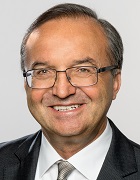
Prof. Dr. Martin Kronbichler is a faculty member at the Faculty of Mathematics , Ruhr University Bochum , leading the Numerics group. His research focuses on higher-order finite element methods, multigrid techniques, and high-performance computing for complex fluid and solid mechanics problems. Key Research Areas: Higher-order finite element methods, iterative solvers, multigrid algorithms, exascale mathematical software, and computational fluid dynamics. Notable Projects: EU-funded dealii-X (exascale digital twins), BMBF PDExa (optimized PDE solvers for exascale), and DFG grants for cut-discontinuous Galerkin methods and geometric multigrid. Publications Trends: Recent works emphasize matrix-free operators for hyperelasticity, diffuse-interface models for additive manufacturing, and multigrid smoothers for higher-order elements. Scientific Awards: Recipient of the Humboldt Research Award for his contributions to numerical methods and HPC. Team: Collaborates with researchers like Dr. Shubham Kumar Goswami, Dr. Richard Schussnig, and Natalia Nebulishvili.
Prof. Dr.-Ing. Gerhard Müller is a Full Professor at the Chair of Structural Mechanics within the TUM School of Engineering and Design at Technical University of Munich (TUM). Since 2004, he has held this distinguished position, and since 2014, he has served as Executive Vice President for Academic and Student Affairs at TUM. His research focuses on structural dynamics and vibroacoustics, with specific expertise in dynamic soil-structure interaction, sound radiation analysis, and seismic risk assessment. Professorship: Structural Mechanics University: Technical University of Munich School: TUM School of Engineering and Design Department: Chair of Structural Mechanics in Civil Engineering Prof. Müller's research spans multiple domains, including: Structural Dynamics : Examining building and vehicle vibrations, seismic soil-structure interaction, and advanced model order reduction techniques Vibroacoustics : Investigating sound radiation from vibrating structures and developing acoustic metamaterials for noise control Computational Methods : Pioneering hybrid deterministic-statistical approaches, Wave Based Methods (WBM) for saturated elastodynamic structures, and parametric model order reduction His recent publications demonstrate expertise in: Wave propagation analysis in poroelastic media Bayesian parameter updating for structural models Acoustic metamaterials for vibration control Advanced numerical methods for seismic risk assessment Hybrid ITM-FEM approaches for soil-structure interaction Energy flow analysis in timber structures Awarded the Spindler Prize in 1984 , Prof. Müller also holds significant academic leadership roles: President of European Association for Structural Dynamics (EASD) Chairman of Bavarian-French University Center (BayFrance) Active member of ASIIN accreditation agency and Bavarian Chamber of Engineers Previously served as Dean of Civil Engineering and Surveying at TUM (2010-2014) He leads the Structural Dynamic Lab (formerly Vibroacoustics Lab) and has developed interactive web apps for engineering education. His work bridges theoretical advancements with practical applications in construction acoustics, transportation noise control, and geothermal energy infrastructure analysis.
Kuanshi Zhong is an Assistant Professor in the Department of Civil and Architectural Engineering and Construction Management at the University of Cincinnati. He holds a PhD from Stanford University (2021) in Civil and Environmental Engineering, with prior degrees from Stanford (Master, 2017) and Tongji University (Bachelor, 2015). His research focuses on earthquake engineering, structural resilience, and advanced computational methods for infrastructure safety. Key research interests include seismic design of tall buildings, probabilistic modeling of structural response (e.g., using Probabilistic Learning on Manifolds), and material failure mechanisms in reinforced concrete. He also explores multi-hazard resilience, regional risk assessment, and software tools for disaster simulation (e.g., R2DTool and EE-UQ). Dr. Zhong has secured grant funding as PI/Co-PI, including a National Science Foundation grant (2023-2026) for equitable building decarbonization strategies and a Concrete Reinforcing Steel Institute grant (2024-2025) for bar performance improvements. He teaches graduate/undergraduate courses on concrete design and structural mechanics. His work spans collaborations with institutions like Stanford University and the SimCenter, contributing to open-source tools for regional loss assessments and hurricane impact modeling. Current projects address cascading hazards, steel reinforcement durability, and high-resolution seismic risk evaluation.
Kyle DeMars is an Associate Professor and Associate Department Head for Theoretical and Computational Research in the Department of Aerospace Engineering at Texas A&M University. He holds a Ph.D. from The University of Texas at Austin (2010) and has expertise in space situational awareness, navigation systems, Bayesian filtering, and information theory. His work focuses on advanced estimation techniques for spacecraft autonomy and space surveillance. Dr. DeMars' research emphasizes robust nonlinear filtering, multitarget tracking, and information-theoretic approaches to orbital dynamics. He has developed innovative methods for spacecraft navigation, including terrain-relative systems and anonymous feature processing. His contributions address challenges in uncertainty quantification, sensor fusion, and cislunar space domain awareness. Education: Ph.D./M.S.E./B.S. in Aerospace Engineering (UT Austin, 2004–2010) Awards: AIAA Young Professional Award (2017), NASA Innovation Award (2014), and multiple teaching/research recognitions Labs/Teams: Active in space situational awareness, guidance & control, and probabilistic navigation systems Key trends in his publications include: Advances in particle flow and Gaussian mixture methods for nonlinear estimation Cislunar trajectory analysis and resonance-based surveillance strategies Development of fault-resistant and anonymous navigation frameworks Integration of information theory into sensor tasking and uncertainty management His work bridges theoretical developments with practical applications in planetary landing navigation, space traffic management, and autonomous spacecraft systems.
Andreas Müller is a Lecturer at ETH Zürich's Department of Civil, Environmental, and Geomatic Engineering. He holds a Master of Science in Civil Engineering from the Technical University Munich (TUM, 2015) and has worked as a bridge engineer at BUNG Ingenieure AG in Munich (2016–2017). Since 2017, he has been pursuing a PhD under Prof. Taras, initially at Bundeswehr University Munich (UniBw) and later continuing at ETH Zürich's Chair of Steel and Composite Structures. His research focuses on structural stability, particularly the buckling behavior of high-strength steel hollow sections, post-buckling rotation capacity, and the influence of initial imperfections analyzed via 3D surface scans (Reverse Engineering). He also investigates spiral-welded tubes' imperfection assessment and strain hardening effects on aluminum structural sections. Education: Master of Science in Civil Engineering, Technical University Munich (2015) Research interests emphasize bridging experimental and computational methods in structural engineering. He employs machine/deep learning for predictive modeling of buckling phenomena, particularly leveraging Deep Neural Networks (DNN) to enhance accuracy in structural analysis. His work addresses practical challenges in steel and composite structures, including standard compliance (e.g., prEN1993-1-1 updates) and real-world geometry imperfections' impact on load capacities. Advising and grants: As a current PhD candidate, he is supervised by Prof. Taras but has not yet listed advisees. His research is supported by institutional resources at ETH Zürich's Chair of Steel and Composite Structures. Labs/Teams: Active member of the Chair of Steel and Composite Structures at ETH Zürich, contributing to advanced structural mechanics research and engineering innovation initiatives.
Babak Moaveni is a Professor in the Department of Civil and Environmental Engineering at Tufts University, serving as the Associate Chair since September 2024. He also holds a joint appointment as a Professor in Electrical and Computer Engineering. His research focuses on structural health monitoring, Bayesian inference, earthquake engineering, and offshore wind energy systems. Moaveni earned his Ph.D. in Structural Engineering from the University of California San Diego (2007), following an M.S. (2001) and B.S. (1999) from Sharif University of Technology in Tehran, Iran. His research interests span probabilistic system identification, signal processing, uncertainty quantification, and verification/validation of computational models. Notable grants include leadership in the PIRE project on offshore wind energy digital twins and the Coastal Virginia Offshore Wind Pilot Project. He has supervised multiple Ph.D. and M.S. students, with current advisees including Mehdi Akhlaghi and Nasim Partovi-Mehr. Moaveni has received the Best Presentation Award at the 2022 EDGE Symposium and serves on editorial boards for journals like Structural Health Monitoring and Frontiers in Built Environment . His lab, the Structural Health Monitoring Lab, specializes in infrastructure management and offshore wind energy systems. Key professional activities include membership in the American Society of Civil Engineers (ASCE) and roles on Tufts' Tenure and Promotion Committee. His teaching includes courses on structural health monitoring, numerical methods, and structural reliability.
Gaetano Miraglia is a Fixed-term Assistant Professor in the Department of Structural, Building and Geotechnical Engineering (DISEG) at Politecnico di Torino, where he conducts research in structural health monitoring, seismic analysis, and computational modeling. He is a member of the Interdepartmental Center R3C – Responsible Risk Resilience Centre, contributing to interdisciplinary efforts in risk mitigation and infrastructure resilience. His work spans both theoretical and applied domains, with strong emphasis on heritage preservation and sustainable urban development. His research interests include Bayesian calibration of nonlinear models, hybrid simulation, peridynamics, masonry structures, and the integration of satellite interferometric (InSAR) data with in-situ measurements for structural monitoring. He applies advanced computational and machine learning techniques to improve the accuracy and reliability of structural assessments, particularly in historical and monumental buildings. His work supports UN Sustainable Development Goals 9, 11, and 13. His recent publications demonstrate a consistent focus on data fusion, digital twinning, domain adaptation, and real-time damage detection. He frequently collaborates with researchers such as Rosario Ceravolo and Erica Lenticchia, publishing in high-impact journals like Computer-Aided Civil and Infrastructure Engineering , Structures , and Scientific Reports , as well as at major conferences including EWSHM, SAHC, and EVACES. His research is applied in projects such as the monitoring of the Vicoforte Sanctuary and the development of the CAMELOT and HY-LEARN toolboxes. Research Projects: MONITORAGGIO VICOFORTE (2024–2026) – Member of Research Group CAMELOT – PoC Transition (2023–2024) – Member of Research Group HY-LEARN – Model Calibration via Hybrid Simulation and ML (2022–2024) – Scientific Manager (PNRR Mission 4) He teaches in various programs, including as a course collaborator in PhD, Master’s, and Bachelor’s level courses such as Earthquake Engineering , Structural Consolidation , and Seismic Risk of Cultural Heritage . He is also an inventor on national and international patents and software related to the CAMELOT toolbox, highlighting the translational impact of his research. He has no listed scientific awards or formal advisees in the provided text.
Erin Bell is a Professor in the Department of Civil and Environmental Engineering at the University of New Hampshire . She holds a Ph.D. in Structural Engineering from Tufts University and has extensive experience in structural health monitoring, finite element modeling, and infrastructure sustainability. B.C.E., Georgia Institute of Technology M.S., Civil Engineering, Tufts University Ph.D., Structural Engineering, Tufts University Her research focuses on structural health monitoring, bridge condition assessment, and integrating AI techniques like artificial neural networks and deep reinforcement learning for infrastructure asset management. Recent work includes equitable maintenance strategies for aging bridges in flood-prone zones and tidal energy conversion for sustainable bridge monitoring systems. Key trends in her publications include the application of machine learning to structural analysis, finite element model calibration, and climate change adaptation in transportation infrastructure. She has led projects on deep reinforcement learning for bridge scour maintenance, modal-based uncertainty quantification, and multi-scale modeling of steel bridges. Grants and Collaborations : Erin Bell has secured funding from the National Science Foundation (NSF) , US Department of Energy (DOE) , and New Hampshire Department of Transportation . Notable projects include the Living Bridge initiative for tidal energy-powered smart infrastructure and statewide data exchange systems for bridge condition assessment.
Dr. Andy Nguyen is a Senior Lecturer in the School of Engineering at the University of Southern Queensland. He holds a PhD from Queensland University of Technology (QUT), an MEng from the National University of Civil Engineering (NUCE), and a BEng from NUCE. His research focuses on structural health monitoring, integrating machine learning and deep learning techniques to assess infrastructure integrity. Key areas include damage detection in bridges, pavements, and buildings, as well as sustainable construction materials like bamboo. Nguyen leads projects such as the 'Next Generation Living Laboratory for Engineering Education and Engagement,' emphasizing real-world applications of technology in civil infrastructure. His work spans crack detection algorithms, finite element model updating, and vibration-based structural analysis. He collaborates on AI-driven solutions for autonomous vehicle object detection and smart maintenance planning. Nguyen’s contributions include over 50 peer-reviewed publications and active supervision of postgraduate research in composite materials and transport infrastructure. His research outputs highlight advancements in computational mechanics, sensor technologies, and data-driven methods for infrastructure resilience. Nguyen’s expertise bridges civil engineering challenges with cutting-edge machine learning, advancing both theoretical and applied solutions for sustainable and safe structures.
Dr. Andy Nguyen is a Senior Lecturer in Structural Engineering at the University of Southern Queensland, within the School of Engineering. He is an active researcher and educator, specializing in the Structural Health Monitoring (SHM) of critical civil infrastructure such as bridges, buildings, and transport tunnels. Bachelor of Engineering (BEng), NUCE, 1999 Master of Engineering (MEng), NUCE, 2003 Doctor of Philosophy (PhD), Queensland University of Technology (QUT), 2014 Dr. Nguyen's research is at the forefront of integrating advanced technologies into civil engineering. His primary focus is on developing and deploying sophisticated SHM systems that utilize sensors, data analytics, and machine learning to provide real-time insights into the structural integrity of ageing infrastructure. His work aims to enable proactive maintenance, extend the lifespan of structures, and enhance public safety. He has successfully implemented monitoring systems on major bridges and high-rise buildings in Queensland and New South Wales, with systems capable of even detecting distant earthquake events. His research interests span Structural Health Monitoring, Machine Learning for Engineering, Damage Detection, Finite Element Model Updating, Sustainable Building Materials like bamboo, and the application of AI for automated condition assessment of transport infrastructure. The analysis of his recent publications reveals a strong and consistent research trajectory centered on the application of data-driven and AI methods to solve practical problems in civil infrastructure. His work frequently combines signal processing techniques (like Stockwell Transform) with deep learning models for tasks such as crack detection in concrete and pavement. He also conducts significant research on model updating for complex structures like cable-stayed and arch bridges, using vibration data and optimization algorithms. The integration of machine learning for overload classification and the development of cost-effective, automated monitoring systems are key trends in his recent output. Advanced Queensland Fellow (2024-2027) Dr. Nguyen is actively involved in research supervision and collaboration. He is currently supervising several postgraduate students on projects related to AI-powered condition assessment, bamboo as a sustainable building material, and railway track design. He receives research funding from the Queensland Government through his Advanced Queensland Fellowship. His research has direct practical applications, as evidenced by his public engagement, such as writing for The Conversation on safeguarding ageing bridges, and his work with the Australian Network of Structural Health Monitoring. Dr. Nguyen's work embodies the development of a next-generation 'Living' Laboratory for engineering education, where research, teaching, and real-world infrastructure monitoring are integrated. His current projects involve creating smart, automated fault detection systems and advancing 'digital twin'-based monitoring platforms for infrastructure.
Jyoti Sinha is a Professor of Condition Monitoring and Plant Maintenance in the Mechanical and Aerospace Engineering department. He has extensive experience in vibration analysis, structural dynamics, and plant reliability. His research focuses on experimental and analytical techniques for fault diagnosis, rotating machinery health monitoring, and maintenance optimization. He has authored over 300 technical papers and serves as Editor-in-Chief of Maintenance, Reliability and Condition Monitoring (MARC) . Education: Ph.D. (Rotor Dynamics), University of Wales Swansea (2002) M.Tech. (Aerospace Engineering), IIT Bombay (1998) B.Sc. (Mechanical Engineering), Ranchi University (1988) Research Interests: Vibration-based condition monitoring Rotors and bearings fault detection Finite element modeling and model updating Asset management and Industry 4.0 integration Structural health monitoring Awards: Boyscast Fellowship (1999) Excellence awards for supervision (2012, 2014) 3rd Best Paper Award (2024) Advising & Grants: Supervising 10 PhD and 2 DProf students Completed 17 PhD and 325+ PG projects Secured £3M+ in research grants Labs & Teams: Head of Dynamics Laboratory Chair of International Conference on Maintenance Engineering (IncoME)
Barbara Kaltenbacher is a Professor at the Institute of Mathematics, University of Klagenfurt. She serves as Deputy Head of the Institute and is actively involved in academic governance through roles in curricular commissions for Information Technology and Mathematics. Her research focuses on nonlinear acoustics , inverse problems , and partial differential equations , particularly in modeling wave propagation and parameter identification. Her work spans theoretical and applied domains, including Acoustic nonlinearity parameter tomography Fractional regularization techniques Optimization of imaging and ultrasound models Well-posedness of nonlinear PDEs Her recent publications address advanced mathematical challenges in nonlinear acoustics and inverse problems, with applications in medical imaging and materials science. She contributes to academic leadership through committee memberships and maintains active research collaborations across disciplines.
Zia Javanbakht is a Senior Lecturer at the School of Engineering and Built Environment , Griffith University , specializing in Mechanical Engineering and Industrial Design . As a chartered engineer with a PhD in Mechanical Engineering, he contributes to research in Continuum Mechanics , Material Modelling (composites and metamaterials), and Computational Modelling . He is affiliated with the Australian Centre for Precision Health and Technology (PRECISE) and has been involved in projects related to additive manufacturing, auxetic materials, and composite structures. Research Interests include the development of advanced computational models for material behavior, with a focus on auxetic structures , triply periodic minimal surfaces (TPMS) , and additively manufactured composites . His work addresses challenges in residual stress analysis , multiscale modelling , and machine learning applications in material deformation mechanisms. Scientific Awards Fellow (FHEA) of Higher Education Authority, Dublin, Ireland (since 2021) Key Funded Projects span collaborations with Gilmour Space Technologies (CRC-P grant for rocket fuel tanks), Bond University (concrete sensor testing), and internal Griffith University grants for equipment like the Transient Plane Source Thermal Conductivity Analyser . He actively supervises PhD and Master’s students in topics such as polymer-matrix composites , auxetic timber structures , and additive manufacturing failure models . Collaboration Networks include the AuxeticsLab and partnerships with industry leaders like Stoddart Group Pty Ltd and ATL Composites . His teaching portfolio covers Constitutive Material Modelling (7015ENG) and Computational Statics and Dynamics (7252ENG), reflecting his expertise in computational techniques and structural analysis.
Colby C. Swan is a Professor in the Department of Civil and Environmental Engineering at the University of Iowa's College of Engineering, where he has been a faculty member since 1993. He leads the Swan Research Lab and maintains active memberships in ASCE, ASME, ISSMO, and USACM, contributing to computational mechanics and digital human modeling research. His educational background includes a PhD in Civil Engineering from Princeton University (1993), an MS in Ocean Engineering from the University of Miami (1985), and a BS in Civil Engineering from the University of Maine (1983). Professor Swan's research spans Computational Mechanics , Topology Optimization , and Biomechanics , with pioneering work on multi-scale computational clothing models for digital humans and structural topology optimization of compliant mechanisms. His lab develops physics-based simulation frameworks for applications in civil infrastructure, protective clothing design, and bone adaptation phenomena, integrating advanced computational methods with real-world engineering challenges. His publication trends reveal a sustained focus on digital human modeling (notably the Santos virtual human environment) and topology optimization, with significant contributions to continuum structural optimization, woven fabric mechanics, and human locomotion analysis. Recent work emphasizes virtual prototyping for protective systems and computational morphogenesis for structural design. American Society of Civil Engineers (ASCE) American Society of Mechanical Engineers (ASME) The Fiber Society International Society for Structural & Multidisciplinary Optimization (ISSMO) United States Association for Computational Mechanics (USACM) Professor Swan directs the Swan Research Lab, which collaborates on interdisciplinary projects involving computational modeling for engineering design and human performance analysis. His work bridges civil engineering with biomechanics through digital human simulation, particularly in protective gear development and structural optimization applications.
Dr. Colin Caprani is an Associate Professor and Head of Structural Engineering at Monash University's Department of Civil and Environmental Engineering. His research focuses on bridge traffic loading, structural reliability, vibration serviceability, and Intelligent Transportation Systems. He holds qualifications including a PhD, BSc(Eng), and DipEng, and is a Chartered Professional Engineer (CPEng) and Chartered Structural Engineer (CEng). He has contributed to editorial roles for journals like Advances in Structural Engineering and Computers & Concrete , and led community initiatives such as mini-symposiums on bridge loading and maintenance. His professional affiliations include the Institution of Structural Engineers and the International Association for Bridge and Structural Engineers. Recent projects include the ARC Research Hub for Nanoscience-based Construction Materials and studies on pavement behavior. Awards include the 2017 Best Paper Award and 2021 Institution of Structural Engineers Research Award. Teaching commitments span courses like CIV2226 and CIV4210, emphasizing structural analysis and bridge engineering.