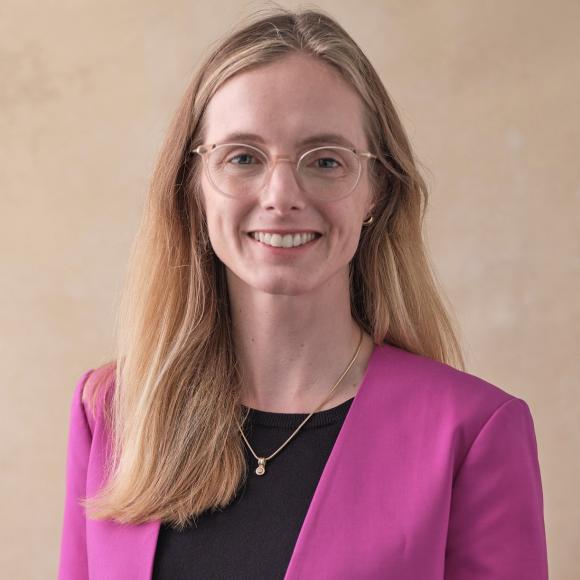
Carolin Pflueger is an Associate Professor at the Harris School of Public Policy , University of Chicago, and holds affiliations as a NBER Faculty Research Fellow and CEPR Research Affiliate . Her work bridges macroeconomics and finance, focusing on inflation dynamics, monetary policy impacts, and financial market risk perception. University: University of Chicago School: Harris School of Public Policy Affiliations: NBER, CEPR Role: Associate Professor Her research explores how inflation and monetary policy influence financial markets, including models connecting Treasury bond risk to stagflation drivers and analyzing economic agents' perceptions of policy uncertainty. Recent work leverages cross-sectional data of stock prices and economic forecasts to quantify macrofinancial linkages. Notable scientific recognitions include the Fama DFA Prize (2023), AQR Insight Award Finalist (2018), and the Arthur Warga Award (2014). She has received NSF Grant 2149193 for macrofinance research. Contact: cpflueger@uchicago.edu | GitHub Code Repositories
Assoc Prof Ying Chen is an Associate Professor at the National University of Singapore , affiliated with the Department of Mathematics, Asian Institute of Digital Finance (as Academic Director of PhD Program in Digital FinTech 2022–2024), Risk Management Institute (2019–2023), Department of Statistics and Data Science (2019–2023), and Department of Economics (2018–2023). She also contributes to NUS Graduate School for Integrative Sciences and Engineering since 2016. Research Interests include: AI forecasting and quantum computing for finance Nonstationary time series and functional data analysis Energy data analytics and precision medicine Network autoregression and spatial-temporal modeling Explainable AI and citation metrics Portfolio liquidation and market-making algorithms Article Trends demonstrate expertise in: Adaptive forecasting for gas flows and electricity prices Blockchain network influence detection Quantum computing applications in finance Functional autoregression with mixed predictors Credit rating fairness and explainability High-resolution implied volatility modeling Scientific Awards include: ISI Elected Member (2016–) International Statistical Institute Council (2023–2027) IASC Scientific Secretary (2017–2019, 2023–2025) Advisory roles for EU FIN-TECH and xAIM projects
John Cotter is a Full Professor of Finance and Chair in Quantitative Finance at University College Dublin's Smurfit School of Business. He holds a PhD from Queen's University Belfast and prior academic roles include Associate Professor (2006-2012) and Senior Lecturer (2004-2006). His research focuses on volatility modeling, risk management, and asset pricing with applications in equity, real estate, and derivative markets. Cotter directs the Centre for Financial Markets and the Financial Mathematics Computation Cluster (FMC2), a multi-university research initiative funded by Science Foundation Ireland. Education: BComm and MEconSc from University College Cork, PhD in Finance from Queen's University Belfast. Research interests span asset pricing, volatility modeling, risk management, and financial market integration. His work has been published in top journals like Journal of Banking and Finance and Journal of International Money and Finance . He has secured grants including the ADAPT Phase 2 project (2021-2026). Cotter advises the European Securities Markets Authority (ESMA) and has consulted for numerous organizations globally. Notable awards include the UCD Outstanding Educator Teaching Award and UCD School of Business Research Contribution Award. He serves as Associate Editor for three journals and has supervised numerous PhD students through FMC2.
Dr. IKM Mokhtarul Wadud is a Senior Lecturer in the Department of Economics at The University of Sydney, Australia. Previously, he held roles as Senior Lecturer at Deakin University, Lecturer at Monash University Malaysia, and Assistant Professor at the University of Rajshahi, Bangladesh. He earned his PhD in Economics from the University of Wollongong in 2001. His research focuses on productivity analysis, macroeconomic policy, energy economics, and applied econometric modeling. Notable contributions include co-authoring the Asia Pacific edition of Introductory Econometrics (Cengage Learning) and publishing in journals like Economic Modelling and Energy Policy . His recent work addresses financial sustainability strategies in higher education during the pandemic and the impact of economic policy uncertainty on property prices in Australia. Dr. Wadud has presented at international conferences and served as a reviewer for multiple journals. His research spans diverse regions, including Australia, Thailand, Malaysia, and Bangladesh, with analyses of oil price volatility, monetary policy effects, and industrial competitiveness.
Professor Ben Goldys is a distinguished academic at The University of Sydney's School of Mathematics and Statistics, where he conducts research at the intersection of pure mathematics and applied sciences. His work spans multiple disciplines including stochastic analysis, partial differential equations, and financial mathematics, with significant contributions to both theoretical frameworks and practical applications in science and finance. Goldys' research interests center on stochastic (ordinary and partial) differential equations and their applications. His specific focus areas include stochastic partial differential equations, stochastic geometric PDEs, stochastic boundary value problems, stochastic fluid dynamics, ergodic theory of infinite-dimensional diffusions, and applications in financial mathematics such as interest rate derivatives, credit risk, and stochastic volatility. His work bridges pure mathematical theory (Functional Analysis, PDEs, Ergodic Theory) with complex real-world problems across multiple domains. His research aligns with the University of Sydney Faculty of Science Research Strengths including Understanding the Universe, Fundamental Laws of Nature, Complex Systems, and Next Generation Materials. Professor Goldys has secured multiple significant research grants from the Australian Research Council, including recent projects such as 'Mathematics for future magnetic devices' (2024), 'Mathematics for breaking limits of speed and density in magnetic memories' (2019), and 'Novel Approaches for Problems with Uncertainties' (2015). His current research projects focus on geometric stochastic partial differential equations and applications in micromagnetism, mean field games in finance, stochastic boundary value problems, and stochastic Navier-Stokes equations on the rotating sphere. He maintains extensive international collaborations with institutions in Germany (University of Tuebingen), Italy (LUISS University), Poland (Institute of Mathematics Polish Academy of Sciences), and the United Kingdom (University of York), working on projects involving optimal control, stochastic systems with memory, and geometric stochastic PDEs. Goldys is an active member of the Applied Mathematics Research Group and The University of Sydney Nano Institute, contributing to interdisciplinary research initiatives that connect mathematical theory with cutting-edge technological applications.
Hakan Berument is a Professor in the Department of Economics at Bilkent University, Ankara, Turkey, where he has been teaching since 1995. His academic career spans over 25 years with progressive appointments from Assistant Professor to full Professor. He has also served as Director of the Bilkent Energy Policy Research Center (2018-2019) and Advisor/Director of Energy Studies at the Center for Middle Eastern Studies (2020-2022). Berument received his PhD in Economics from the University of North Carolina at Chapel Hill in 1994, following an M.S. in Economics from the University of Kentucky (1989) and a B.S. in Economics from Middle East Technical University (1987). His research focuses on Monetary Economics, Macroeconomics, Time Series Analysis, and Econometrics, with particular emphasis on energy economics, oil price dynamics, and monetary policy effectiveness. Berument has made significant contributions to understanding the relationships between oil prices, exchange rates, and economic performance, especially in emerging markets and Turkey. His work frequently examines asymmetric price effects, market structures, and policy impacts across various energy sectors. Berument's recent publications reveal a strong focus on energy economics, particularly oil and electricity markets. His research employs advanced econometric techniques to analyze time series data, with growing attention to cross-border energy trade, price transmission mechanisms, and the interplay between financial markets and energy commodities. The breadth of his work spans from micro-level consumer behavior to macroeconomic policy implications. Ranked #1 among Turkish academic economists on supervising PhD dissertations (1990-2011) Ranked #4 among Turkish academic economists based on international publications (1999-2003) Parlar Foundation Young Investigator Award (2003) Turkish Social Sciences Association Young Social Scientist Promotion Award (2002) Research Fellow to Economic Research Forum (2005-Present) Vice-president, Econometric Research Association (2005-Present) Berument has supervised numerous graduate students, including over 15 Master's theses and several PhD dissertations. His research has been supported by various funding agencies including TUBITAK and the Economic Research Forum. He has served on editorial boards of multiple economics journals and contributed to policy discussions through his work with the Central Bank of the Republic of Turkey and other institutions. He has advised on energy policy through his directorship roles and frequent participation in policy discussions. While not explicitly mentioned as leading a specific research lab, Berument has been instrumental in establishing academic initiatives including Pazar11 meetings among economists. His contributions to energy policy research through the Bilkent Energy Policy Research Center have shaped discussions on Turkish energy markets and policy frameworks.
Olivier David Zerbib is an Assistant Professor of Sustainable Finance at CREST, ENSAE, Institut Polytechnique de Paris, and serves as an Associate Editor for the Review of Finance. His research bridges financial theory with environmental sustainability, focusing on market mechanisms for ecological challenges. His primary research areas include sustainable finance, environmental finance, and asset pricing, with specific expertise in green bonds, biodiversity valuation, and climate impact investing. He investigates how pro-environmental preferences influence pricing mechanisms, develops sustainable asset pricing models, and examines shareholder engagement strategies to curb greenwashing through quantitative methodologies. Analysis of his publications reveals a cohesive trajectory toward integrating environmental metrics into core financial frameworks, with significant contributions spanning green bond markets, sustainable CAPM development, and biodiversity economics. His work demonstrates methodological rigor through score-driven conditional betas and empirical validation across global markets. Dr. Zerbib's scientific recognition includes: #1 most cited article in the Journal of Banking and Finance over 3 and 5 years (2019) SUERF/UniCredit Research Prize (2018) Multiple Best Paper Awards at international finance conferences (2017-2020) European Investment Forum Research Prize Finalist (2021) He co-organizes the CMAP-CREST Quantitative Sustainable Economics and Finance seminar series with Patricia Crifo, Emmanuel Gobet, Peter Tankov, and Gauthier Vermandel, fostering collaboration between Ecole Polytechnique and ENSAE on quantitative approaches to sustainability challenges. His presentation record spans elite institutions including LSE, Yale, and the European Commission Joint Research Center.
Conor Ryan is a Professor in the Department of Computer Science & Information Systems at the University of Limerick. He is a Science Foundation Ireland-funded Investigator since 2002 and a member of multiple research centres including Lero – the Irish Software Research Centre and the Limerick Digital Cancer Research Centre. His research focuses on Genetic Programming, Grammatical Evolution, and their applications in domains like healthcare analytics, digital circuit design, and financial modeling. He has authored over 250 publications, with recent work emphasizing automated feature selection in medical diagnostics, neural architecture search, and blockchain ecosystems. Teaching includes courses on Foundations of Computer Science and Computer Games Programming. Research interests span evolutionary computation, machine learning, and interdisciplinary applications. Collaborations involve global institutions, reflecting his work's impact across computer science, engineering, and healthcare. His research has addressed challenges in breast cancer diagnosis via genetic algorithms, cryptocurrency volatility prediction using random forests, and automated generation of digital circuits. Ongoing projects explore interpretability in AI, energy-efficient computing, and sustainable transport systems through predictive analytics. Professional memberships include roles in the Centre for Research Training in Foundations of Data Science and the Data-Driven Computer Engineering Research Centre, underscoring his commitment to interdisciplinary innovation.
Roles and Affiliations: Tien Foo Sing is the Provost's Chair Professor in the Department of Real Estate at the NUS Business School, National University of Singapore. He serves on the Management Board of the Institute of Real Estate and Urban Studies (IREUS) and was its former Director (2017–2022). He has held leadership roles including Head of the Department of Real Estate (2020–2022) and past President of the Asian Real Estate Society (AsRES). He is a CLC Fellow (2024–2026), Fellow of AsRES, and a Fellow of the Weimer School of Advanced Studies. He edits the International Real Estate Review and serves on editorial boards of journals like Real Estate Economics and Journal of Real Estate Finance and Economics. Education: PhD (Land Economy) and MPhil (Land Economy) from the University of Cambridge, UK; BSc (Estate Management) from NUS. Research Interests: Focuses on urban planning, real estate economics, housing markets, climate finance, transport economics, and environmental policy. His work bridges theory and policy, addressing issues like urban resilience, intergenerational mobility, and environmental externalities. Recent studies include impacts of sea level rise on housing prices, ESG-REIT linkages, and PropTech adoption. Awards: Recognized with the Outstanding Referee Award (2017) for Real Estate Economics, Fellowships from AsRES and the Weimer School, and book awards for his 'Kiasunomics' series. Professional Activities: Serves on government boards (e.g., Valuation Review Board, Singapore Chapter of APREA) and advises organizations like the PropTech Association of Singapore. His work influences policy on housing, transportation, and sustainable development. Labs/Teams: Leads research initiatives through IREUS and collaborates with institutions like the Sustainable & Green Finance Institute (SGFIN). His projects often involve large-scale data analysis (e.g., smart card transit data, housing transactions).
Jiang Wang is the Mizuho Financial Group Professor at the MIT Sloan School of Management, where he has been a faculty member since 1990, progressing from Assistant Professor to his current named professorship. He holds appointments in the Finance department and maintains an active research program in financial economics. Massachusetts Institute of Technology, Sloan School of Management (2005-present) MIT Sloan School of Management: Assistant Professor (1990-1994), Associate Professor (1994-1998), Professor (1998-1999), NTU Professor (1999-2005) Wang's research focuses on financial economics, asset pricing, market liquidity, trading volume, and financial market microstructure , with significant contributions to understanding information dynamics in markets. His work bridges theoretical models with empirical analysis, particularly in Chinese capital markets. Wang has developed influential theories on liquidity, trading volume, and market efficiency that have shaped modern financial economics. His recent publications demonstrate continued scholarly productivity, with research spanning market uncertainty, circuit breakers, repo markets, and Chinese financial markets. Wang's work integrates theoretical modeling with empirical validation, maintaining relevance to both academic discourse and practical market concerns. China Economics Prizes (2018) Smith Breeden Prize (2007, 2006) New York Stock Exchange Award FAME Research Prize (2004) Trefftz Award, Western Finance Association (1990) Wang has advised numerous doctoral students and supervised significant research projects, though specific student names aren't listed in the available materials. His extensive grant history includes multiple NSF awards and industry-sponsored research. Wang has held leadership positions including President of the Western Finance Association (2017-2018) and Director of the China Center for Financial Research at Tsinghua University (2002-2014). His academic service includes editorial roles for major finance journals and advisory positions with institutions including the Federal Reserve Bank of New York, Nasdaq Stock Market, and China Securities Regulatory Commission.
Dr Isik Akin is a Senior Lecturer in Accounting and Finance at Bath Spa University and leads the Accounting Pathway. He teaches undergraduate and postgraduate modules including Financial Accounting, Management Accounting, Corporate Financial Management, and Quantitative Research Methods. Education: PhD in Accounting and Finance (Bath Spa University), PhD in Economics and Finance (Istanbul Gelisim University), MSc in Finance (University of the West of England), BSc in Mathematics (Trakya University) Professional Qualifications: Fellowship in Higher Education Academy, Chartered Institute for Securities & Investment (CISI) His research focuses on Behavioral Finance , FinTech , Credit Risk Management , and Sustainable Finance . Recent publications analyze: Enterprise valuation dynamics (FTSE 100) Metaverse asset valuation frameworks Interconnected financial markets (stocks, commodities, crypto) Green investments in real estate He has secured significant international funding including the Connect4Innovation UK-Turkey partnership grant (2021-2022, £50,000) and coordinated EU projects like the Life-Long Learning Programme (2016-2017). Scientific Awards & Roles: Chartered Institute for Securities & Investment (CISI) certified Fellow of the Higher Education Academy Advisory Board Member: Izlek Academic Journal, Metropolitan Business Review Editorial Board Member: International Journal of Economics and Financial Research His career spans multiple institutions including Worcester University and University of Arts London, with expertise in international finance, quantitative methods, and financial globalization.
Scientia Professor Robert Kohn is a distinguished academic at the University of New South Wales, holding a position in the School of Economics within the UNSW Business School. With a career spanning several decades, Professor Kohn has established himself as a leading expert in statistical methodology and econometric modeling. His research has significantly contributed to Bayesian statistics and computational methods for complex data analysis. Professor Kohn's research focuses on advanced statistical methodologies including Bayesian methodology, variable selection and model averaging, nonparametric regression models, time series modeling, multivariate Gaussian and non-Gaussian regression, and Markov chain Monte Carlo simulation algorithms. His work bridges theoretical statistics with practical applications across economics, finance, and cognitive science. His research demonstrates a consistent trajectory toward developing more efficient computational methods for complex statistical models, with recent work emphasizing variational Bayesian methods, particle filtering techniques, and applications to time series analysis. Analysis of his recent publications (2022-2025) reveals a strong focus on advancing computational statistical methods, particularly in Bayesian inference for complex models. His work shows increasing integration of machine learning techniques with traditional statistical methods, especially in handling high-dimensional data and complex time series structures. Professor Kohn has made significant contributions to variational inference methods, particle-based computational techniques, and applications to financial time series and cognitive modeling. Professor Kohn has maintained an exceptionally productive research career with continuous publication output since the 1970s, demonstrating remarkable longevity and adaptability in his research focus as statistical methodologies have evolved. His work shows strong international collaboration, particularly with researchers in Australia, the United States, and Europe, reflecting his standing in the global statistical community.
Ronnie Sircar is the Eugene Higgins Professor of Operations Research and Financial Engineering at Princeton University , where he contributes to the Department of Operations Research and Financial Engineering (ORFE). His work spans financial mathematics, stochastic modeling, and applied probability, with a focus on market volatility, optimal investment strategies, and dynamic game theory. Email: sircar@princeton.edu Office: Sherrerd Hall, Room 208, Princeton, NJ 08544 His research interests include: Stochastic Volatility: Asymptotic analysis, calibration, and impact on option pricing and portfolio optimization. Mean Field Games: Applications to cryptocurrency mining, energy markets, and interbank network formation. Portfolio Theory: Forward performance processes, drawdown constraints, and risk-averse strategies. Credit Risk: Multi-name credit derivatives, CDO valuation, and risk measures. Energy Systems: Renewable reliability, unit commitment, and electricity market design. Recent publications emphasize mean field games in energy and blockchain, stochastic volatility in portfolio optimization, and machine learning applications for financial engineering. He has advised graduate students such as Giulia Crippa, Nicolas Garcia, and Burak Aydin, often collaborating with researchers including M. Soner, P. Chan, and A.M. Reppen.
Rama Cont is Statutory Professor of Mathematics at the University of Oxford and Head of the Oxford Mathematical and Computational Finance Group. He holds additional positions as Senior Research Fellow at the Institute for New Economic Thinking and Director of the Oxford Martin Programme on Systemic Resilience. Cont's research focuses on stochastic analysis and mathematical finance, particularly modeling extreme market risks, systemic risk, and developing pathwise approaches in stochastic analysis. His recent work explores causal functional calculus, fractional Ito calculus, and analysis of deep neural networks. His publications demonstrate consistent development of mathematical frameworks for financial risk analysis, including recent advances in causal transport theory and market microstructure modeling. Cont received the Louis Bachelier Prize in 2010 and was elected SIAM Fellow in 2017 for contributions to stochastic analysis and financial modeling.
Prof. Dr. Peter Gomber is Chair of e-Finance at the Faculty of Economics and Business, Goethe University of Frankfurt, Germany. He serves as Co-Chairman and member of the Board of the 'efl – the Data Science Institute', an industry-academic partnership between Frankfurt and Darmstadt Universities and leading industry partners. Additionally, he is a member of the Exchange Council of the Frankfurt Stock Exchange, Supervisory Board of Clearstream Banking AG, and Research Fellow at the Leibniz Institute for Financial Research SAFE in Frankfurt. Prof. Gomber received his Ph.D. at the Institute of Information Systems at the University of Giessen in 1999 after graduating in Business Administration. Before joining Goethe University in 2004, he worked for five years as Director, Head of Market Development Cash Markets and Xetra Research at Deutsche Börse AG, where he developed new market models and products for cash market trading on Xetra. His research focuses on market microstructure theory, digital finance and fintech, regulatory impact on financial markets, and electronic trading systems. With over 150 publications in leading international journals, his work has significantly influenced the field, particularly his highly cited papers on the Fintech Revolution. His recent research examines market fragmentation, circuit breakers, research unbundling under MiFID II, and the application of AI in financial markets. Prof. Gomber's extensive publication record shows a clear evolution from traditional market microstructure and electronic trading systems toward digital finance, fintech innovations, and regulatory impact analysis. His work bridges technical aspects of financial markets with regulatory considerations, demonstrating how technological innovations interact with market structure and regulation. His scientific recognition includes: IBM Shared University Research Grant (2007) Reuters Innovation Award (2000) Best Paper Award of the Journal of the Association for Information Systems (2020) Best Information Systems Publications Award (2020) Top 1 and Top 3 most cited articles in Fintech research (2025 bibliometric analysis) Prof. Gomber has successfully supervised numerous PhD students, including Tino Cestonaro who won the Best PhD Paper Award 2025. He has acquired significant research funds from both public institutions and the private sector. Notably, a market model invention by Prof. Gomber was granted a patent by the United States Patent and Trademark Office, with two additional market model inventions filed for patent in Europe and the US. He leads an active research team at the Chair of e-Finance, including researchers like Benjamin Clapham, Micha Bender, and Tino Cestonaro. The team collaborates closely with the efl – the Data Science Institute and the Leibniz Institute for Financial Research SAFE, bridging academic research with practical applications in financial markets.







-726x726.jpg)