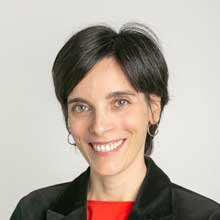
Caterina Cruciani is an Associate Professor at the Department of Management , Venice School of Management , Ca' Foscari University of Venice. She serves as a member of the University Scientific Instrumentation Service Center (CSA) Management Committee and is affiliated with the Research Institute for Social Innovation . Research Interests Trust dynamics in financial advisory Behavioral finance and investor decision-making Sustainability disclosure and ESG integration Digital transformation in financial services Regional economic development and SME financing Agent-based modeling of cooperative behavior Key Article Trends (2009-2024): Span 15 years of research on financial trust (12 publications), behavioral economics (10), sustainability (6), and digital finance (5). Methodologically combines experimental economics , structural equation modeling , and Supervised Topic Modeling for ESG discourse analysis.
Ying Dou is an Associate Professor in Finance at the Department of Banking and Finance, Monash University . He completed his PhD in Finance at the University of New South Wales (2017) and holds a Master of Finance and Bachelor of Commerce from the Australian National University. Research Focus: Empirical corporate finance, boards of directors, and managerial incentives. Teaching: Undergraduate (BFC2140, BFC3140), Postgraduate (BFC5280), Honours (BFX4002), and PhD (BEX6012) courses. Key Collaborations: Worked with scholars like Y. Merkoulova, B. Wu, and R.W. Masulis on projects related to investment banking, corporate governance, and financial markets. Research Trends: His recent articles (2019–2025) address corporate governance mechanisms, including board dynamics, director reputation, M&A-related audit risks, and investment banking networks. These works bridge finance, accounting, and strategic management. Scientific Awards: Best Paper Award in Corporate Finance (2018) Professional Engagement: Presented research at major conferences (EFA, FIRS, WFA) and contributed to media outlets like the Financial Times and Harvard Law School Forum. Collaborates with global researchers on topics such as shareholder wealth effects, institutional asset management, and director incentives.
Jeffrey NG is The Hong Kong Jockey Club Professor in Accounting and Associate Director of the HKU Jockey Club Enterprise Sustainability Global Research Institute at The University of Hong Kong's Department of Accounting and Law. He holds a PhD from The Wharton School (University of Pennsylvania) and undergraduate degrees from Nanyang Technological University and University of Central England, all earned with First Class Honors. His research focuses on interdisciplinary accounting topics including: Accounting standards/regulations Corporate disclosure and governance Banking and financial institutions Financial reporting in capital markets Credit information systems Taxation impacts on corporate behavior He has published extensively in premier journals exploring how regulatory frameworks and market mechanisms influence financial decision-making. Professor NG's recent publications (2022-2024) demonstrate strong focus on: Disclosure effectiveness in sustainability and supply chains Credit market innovations and regulatory impacts Information asymmetry in capital markets Corporate tax strategies and reporting His work consistently examines real-world applications of accounting principles in global financial systems. Awards recognizing his contributions include: Research Excellence awards from Hong Kong Polytechnic University (2017-2020) Teaching Excellence honors from Singapore Management University (2014-2016) Best Paper Award at Review of Accounting Studies Conference (2013) Multiple doctoral and undergraduate fellowships He serves as Associate Editor for European Accounting Review and Editorial Board member of The Accounting Review, while contributing to Hong Kong's Research Grants Council.
David Lozinski is an Associate Professor in the Department of Mathematics and Statistics at McMaster University, Faculty of Science. His research spans combustion science, fluid dynamics, and financial mathematics. He has published extensively on topics like smoldering combustion, flame stability, and quantitative risk modeling. Teaching responsibilities include courses on risk management, actuarial mathematics, financial markets, and applied statistics. Research interests combine theoretical and applied mathematics with practical applications in combustion engineering and financial systems. Key contributions include studies on reverse smoldering mechanisms (1995), vapor diffusion flames (1995), and modern financial risk models (2024). Teaching spans undergraduate and graduate programs, covering mathematical finance, probability, and statistical inference. No scientific awards are listed in the profile. Active in curriculum development for financial mathematics programs, instructing courses like MFM 714 (Risk Management) since 2025 and STATS 3G03 (Actuarial Mathematics I) since 2024.
Maria Loumioti serves as Associate Professor of Accounting at the University of Texas at Dallas' Naveen Jindal School of Management. Previously holding faculty positions at University of Southern California and MIT Sloan, she holds a DBA from Harvard Business School (2012) and BBA from Athens University of Economics and Business (2005). Her academic credentials include: Doctorate in Business Administration, Harvard Business School, 2012 Bachelor of Business Administration, Athens University of Economics and Business, 2005 Professor Loumioti's research centers on financial intermediation with expertise in non-bank lending, securitization, and credit markets. She examines ESG debt instruments, banking transparency, and soft information in loan quality assessment. Her work bridges accounting, finance, and sustainability policy through rigorous empirical analysis of debt markets and regulatory impacts. Analysis of her publication trajectory reveals growing emphasis on sustainable finance since 2020, particularly examining ESG investor behavior in debt markets and discrepancies between banks' environmental disclosures versus actual lending practices. Her recent work investigates sustainability-linked loan structures while earlier research established foundational insights on intangible asset collateralization and short-termism in capital markets. Her honors include the European Central Bank Lamfalussy Fellowship (2018) and Outstanding Reviewer Award from The Accounting Review (2020). Key recognitions feature: Naveen Jindal School of Management Outstanding Graduate Teaching Award (2020) Swedish House of Finance Visiting Scholar (2019) Best Paper in Management Accounting Award, MAS Annual Meeting (2015) Harvard Business School Doctoral Fellowship (2007-2012) Supported by visiting scholar appointments at European Central Bank and Banque de France, her research informs financial regulation through central bank collaborations. Media outlets including Bloomberg and Harvard Business Review regularly cite her findings on banking practices and sustainable finance.
David K. Musto serves as the Ronald O. Perelman Professor in Finance at the Wharton School of the University of Pennsylvania, where he has held faculty positions since 1995 and currently directs the Stevens Center for Innovation in Finance. His career includes a significant tenure as Senior Financial Economist at the Securities and Exchange Commission (2005-2007) and prior industry experience at Roll & Ross Asset Management. His academic credentials include a BA from Yale University (1987) and a PhD from the University of Chicago (1995). Professional development encompasses systems consulting and programming roles prior to doctoral studies. Professor Musto's research centers on capital markets, consumer credit, and financial intermediation , with substantial contributions to understanding consumer financial services, mutual funds, and crisis dynamics. His work uniquely bridges theoretical models with empirical analysis of market behaviors, particularly examining how social objectives integrate with financial mechanisms in impact investing and how liquidity constraints propagate during systemic stress. Recent publication trends reveal a strategic shift toward interdisciplinary finance, connecting traditional market analysis with social impact frameworks. His studies demonstrate how private contracts adapt to dual financial-social goals and how liquidity feedback loops amplify during crises - insights directly applicable to regulatory design and financial innovation. While no specific individual awards are documented, his endowed professorship and leadership of the Stevens Center represent significant institutional recognition of scholarly impact. Through the Stevens Center, Musto actively mentors students via initiatives like Philadelphia high school partnerships and teen-developed financial literacy apps. His teaching spans undergraduate, MBA, and executive programs including Capital Markets, Strategic Equity Finance, and the Fintech Revolution certificate he directs. The Stevens Center operates as a nexus for financial innovation under Musto's direction, developing practical tools for underserved communities while advancing research on fintech, financial literacy, and inclusive market structures through industry-academia collaborations.
Daniela Gabor is a Professor in the Department of Economics at SOAS University of London. Her research focuses on macrofinancial regimes, climate policy integration into monetary systems, and critiques of central banking practices related to decarbonization. Key affiliations: Department of Economics (ECO), SOAS University of London Associated research clusters: Centre for Financial and Management Studies (CeFiMS), Centre for Sustainable Structural Transformation (CSST) Her work explores the intersection of climate finance, macroeconomic policy, and institutional dynamics, particularly in the context of global central banks like the European Central Bank (ECB) and the Bank of England. Recent publications analyze challenges in aligning quantitative easing programs with climate goals, the role of collateral frameworks in decarbonization, and the dominance of the Wall Street Consensus in sustainable development discourse. Collaborative research with colleagues such as Y. Dafermos and M. Nikolaidi has produced influential reports and journal articles on green finance strategies for the G20 and UK. Daniela Gabor's scholarship emphasizes the need for systemic financial reforms to address climate change, advocating for active central bank participation in decarbonization efforts. Contact: dg24@soas.ac.uk
José Paulo Afonso Esperança is a Full Professor of Finance at ISCTE Business School, ISCTE - University Institute of Lisbon. He previously served as Pro-Rector for International Relations and Entrepreneurship (2010-2013), Dean of ISCTE Business School, and Vice-President of FCT (Foundation for Science and Technology). He co-founded Building Global Innovators (BGI), a MIT Portugal technology transfer accelerator, and chaired AUDAX-ISCTE, an entrepreneurship center focused on family business. His educational background includes: Agregação (2003) from ISCTE-Instituto Universitário de Lisboa PhD in Economics (1993) from the European University Institute, Florence Licenciatura in Organization and Business Management (1980) from ISCTE-IUL Professor Esperança's research centers on entrepreneurship and small business financing , corporate governance , and language commonality in international business . His work bridges theoretical frameworks with empirical analyses of emerging economies, examining financial inclusion mechanisms, SME credit constraints, and linguistic influences on foreign direct investment. He has published extensively in top-tier journals including Annals of Operations Research and Journal of Business Finance and Accounting. His publication trends reveal increasing focus on financial technology applications, behavioral aspects of lending, and Lusophone economic integration. Recent work analyzes prosocial crowdlending dynamics and socio-technical credit evaluation frameworks, reflecting interdisciplinary approaches to financial inclusion challenges. Key recognitions include: Best IBS Case for the FAE-MOVVO Competition: Location-Based Big Data Marketing (2015) Best IBS Case for the FAE-Science 4You Competition (2014) He secured significant research funding as Principal Investigator for the project 'Corporate Governance in Medium Income Countries: The Case of Portugal' (2007-2011). His leadership extends to entrepreneurship initiatives through AUDAX-ISCTE and BGI, where he developed technology transfer frameworks. Since 2014, he has served as National Delegate for the H2020 SME Instrument at FCT, advising on European innovation funding. Professor Esperança maintains active involvement in Lusophone economic networks through the New Atlas of the Portuguese Language project and CPADA (Portuguese Federation of Environmental Associations), where he serves on the board.
Piero Gottardi is a Full Professor at the Department of Economics , Ca' Foscari University of Venice , with a secondary appointment at the Department of Economics , University of Essex . His research focuses on economic theory, finance, and macroeconomics with incomplete markets, collateral constraints, asymmetric information, and optimal taxation. Education: Laurea in Economics (1985, Universita di Venezia), M.Phil. (1987) and Ph.D. (1991) from University of Cambridge Research interests include equilibrium corporate finance, firms' investment and financing in dynamic economies, risk sharing and contagion in networks, and information markets. His work has been funded by MIUR and explores themes like market design, financial policy relevance, and non-neutrality of money. Selected recent publications analyze decentralized markets with adverse selection, risk classification heterogeneity, tax wedges with financial frictions, and Gale's bargaining contributions. He also serves as Associate Editor for Journal of Economic Theory and Journal of Public Economic Theory . Teaching includes graduate courses in Advanced Macro and Financial Theory and undergraduate/political economics courses at Ca' Foscari University.
Peter Ritchken is a Professor of Banking & Finance at the Weatherhead School of Management, Case Western Reserve University, where he holds the Mario J. Gabelli Distinguished Professorship in Finance. He joined the faculty in 1981 after completing his PhD at Case Western Reserve University and has established himself as a leading scholar in finance, particularly in derivatives, risk management, and fixed income markets. His research interests span several key areas in finance: Fixed Income and Term Structure Models Risk Management in Financial Markets Contingent Claims Valuation Real Options Risk Management in Supply Chains Credit Risk Management Capital Structure Ritchken's scholarly work focuses on understanding price determination in capital markets, risk management strategies for firms across various dimensions (market risk, interest rate risk, credit risk, and operational risk), and the rationale for derivative usage. His research employs sophisticated mathematical finance techniques to address practical financial problems, with applications in banking regulation and supply chain management. He has developed influential models for pricing interest rate claims, implementing stochastic volatility option models, and solving real option problems. His publications appear in top finance journals including the Review of Financial Studies, Management Science, Journal of Finance, and Mathematical Finance. His recent work has increasingly focused on the intersection of operations management and finance, particularly examining how supply chain dynamics interact with financial decision-making. Ritchken has received significant recognition for his contributions: 2014 University Research Award, Weatherhead School of Management Weatherhead Excellence in Teaching Award, 2011 As an educator, Ritchken has made substantial contributions to finance education. He is the founder and director of the Weatherhead School of Management Master of Science in Management-Finance (MSM-Finance) program. He teaches across multiple programs including the MBA, executive MBA, MSM-Finance, and PhD of Finance and Operations Research. His courses cover Risk Management, Derivatives, Fixed Income, Mortgage and Credit Markets, Mathematical Finance, Investment Management, Real Options, and Quantitative Finance. He has also conducted executive education programs worldwide, including in the United States, Europe, Asia, and Australia. Ritchken serves as a research scholar for the Research Department at the Federal Reserve Bank in Cleveland and acts as Faculty Advisor for GARP (Global Association of Risk Professionals). He has consulted with large investment banks and brokerage firms, bridging academic research with practical industry applications.
David Miles is a Professor of Financial Economics at Imperial College Business School, affiliated with the Department of Finance. He serves on the Budget Responsibility Committee of the Office for Budget Responsibility and the Commission of the Irish Central Bank. Previously, he was a member of the Bank of England's Monetary Policy Committee (2009–2015). His research focuses on fiscal sustainability, financial stability, monetary policy, and demographic change. He has also contributed to analyses of housing markets, mortgage dynamics, and the impact of remote work on urban economies. Education & Professional Background: Academic roles at Birkbeck College, London and Oxford University Industry experience with Morgan Stanley and Merrill Lynch Research Interests: Fiscal policy challenges and long-term sustainability Monetary policy design and implementation Demographic shifts and their macroeconomic implications Pension system reform and risk management Housing market dynamics and mortgage market innovation Key Publications Trends (2021–2024): Recent work emphasizes pension fund sustainability (e.g., USS pension scheme analysis), post-pandemic economic recovery strategies, and the macroeconomic impacts of demographic changes. He explores policy trade-offs between health safety and economic activity during the pandemic, as well as long-term structural issues in financial systems. Awards: CBE (2016 Queen's New Year’s Honours) Advisory & Grants: Active in policy advisory roles across UK and EU institutions. His work often bridges academic research with practical policymaking, particularly in fiscal and monetary domains. Labs/Teams: Collaborates with cross-disciplinary teams at Imperial College and external institutions on topics like pension systems, macroeconomic modeling, and public health policy.
Laurie Ciaramella is an Assistant Professor in Economics at Institut Polytechnique de Paris (Télécom Paris) and an Affiliated Research Fellow at the Max Planck Institute for Innovation and Competition. She also serves as an adjunct Associate Professor at the Norwegian School of Economics (NHH) and holds the ANR JCJC TaxIP grant as principal investigator. Her educational background includes a BSc in Economics from Université Paris Dauphine, an MSc in Economics of Markets and Organizations from Toulouse School of Economics, and a PhD in Economics from MINES ParisTech. Her doctoral thesis, 'Trade and Relocation of Intellectual Property: Essays on the Markets for Patents,' was supervised by Yann Ménière and Catalina Martinez and earned recognition as a Best Dissertation Award Finalist at the Academy of Management. Ciaramella's research centers on the economics of innovation, with specific expertise in intellectual property systems, tax policy implications for innovation, markets for technology, and innovation financing. She employs advanced econometric methods to investigate how firms manage intellectual property assets, how taxation affects patent relocation decisions, and how geographical constraints impact technology markets. Her work demonstrates how patent boxes influence corporate tax strategies and how intellectual property can serve as loan collateral, particularly benefiting small and financially constrained firms. Her publications reveal consistent focus on European patent systems, international knowledge flows, and the intersection of tax policy with innovation strategies. Key trends show increasing empirical sophistication in analyzing firm-level patent data, with growing attention to policy implications for international tax coordination and innovation financing mechanisms. Best Dissertation Award Finalist, Technology and Innovation Management Division, Academy of Management (2018) Best PhD Paper (Bent Dalum) Award, DRUID 17 Academy (2017) Presentation at Rising Star Session, EARIE (2017) As principal investigator of the ANR JCJC TaxIP grant, Ciaramella leads significant research on taxation and intellectual property. Her research visits to Northwestern University's Searle Center and EPFL's College of Management demonstrate international scholarly engagement. Her work bridges theoretical economics with practical policy considerations, particularly regarding how tax regimes affect corporate innovation strategies and intellectual property management. Current projects include 'Intellectual Property as Loan Collateral,' investigating how firms use IP assets to secure financing. Ciaramella maintains active research collaborations with institutions including Max Planck Institute for Innovation and Competition, CREST research center, and various European patent offices. Her methodological approach combines microeconomic analysis with legal and tax system insights to examine real-world innovation dynamics.
Prof. Dr. Metin Topcuoğlu is a full-time Professor at Ankara Social Sciences University, Faculty of Law, Department of Commercial Law. He holds a PhD in Private Law from Marmara University (1999) and a Master's in Public Law from Istanbul University (1995). Previously, he served Süleyman Demirel University as a Research Assistant (1994-2000), Lecturer (2009-2017), and Head of the Private Law Department (2012-2015). PhD: Marmara University, Social Sciences Institute, Private Law (1999) Master's: Istanbul University, Social Sciences Institute, Public Law (1995) Bachelor's: Istanbul University, Faculty of Law (1993) His research focuses on Commercial Enterprise Law, Corporate Law, Negotiable Instruments Law, and Competition Law, with secondary interests in Consumer Law, Judicial Analysis, and Legal Compliance. His recent publications emphasize regulatory frameworks in Turkish Commercial Code, Halal certification ethics, and antitrust mechanisms in mergers. He has advised 8 Master's students since 2010, including Numan Tekelioğlu (2016) and Selman Yavuz Gökce (2016). His work includes 22 articles and 5 books, with 3 key publications on forensic accounting and market ethics. 1995: Third place in Environmental Law at Milliyet Newspaper Traditional Awards He has served on 15 scientific missions, including editorial boards for Süleyman Demirel University Law Journal (2015) and Turkey Justice Academy Journal (2016-2017). He participated in 1 international conference and 4 national conferences from 2009-2015.
Giulio Trigilia is an Assistant Professor of Finance at the Simon School of Business, University of Rochester. He holds a PhD in Economics from the University of Warwick, alongside earlier degrees from the University of Bologna and Collegio Carlo Alberto. His research focuses on financial economics, information economics, contracts and securities design, and the history of finance with a 19th-century emphasis. Trigilia is a member of the Finance Theory Group (FTG) and teaches courses on corporate restructuring, investments, and agency theory. Education: BSc & MA in Political Science (University of Bologna), MSc Economics (Collegio Carlo Alberto), PhD Economics (University of Warwick) Research Interests: Financial Contract Design, Moral Hazard, Political Uncertainty, Debt Maturity Effects, and Historical Financial Markets Labs/Teams: Finance Theory Group (FTG) His recent work explores topics like voluntary corporate disclosure impacts, Brexit’s influence on exchange rates, and the dynamics of short-term debt overhang. He frequently examines how information asymmetries shape financial instruments and corporate policies. Trigilia’s research bridges theoretical models with historical market analysis, such as his study of 19th-century London Stock Exchange momentum effects. Notable contributions include resolving theoretical debates on pledgeability’s role in firm value and demonstrating how lender competition affects creditor rights’ real-world impact. His articles often propose novel mechanisms to address financing constraints and moral hazard challenges in corporate settings.
Prof. Dr. Uwe Walz is a full Professor of Economics at Goethe University Frankfurt , holding the Chair of Industrial Organization since 2002. He serves as Dean of Studies for the Faculty of Economics and Business Administration and Deputy Scientific Director of the Leibniz Institute SAFE (Sustainable Architecture of Finance in Europe). His academic career includes professorships at the University of Bochum (1995-1997) and University of Tübingen (1997-2002), with visiting appointments at LSE and UC Berkeley. Doctorate (1991) and Habilitation (1995) in Economics Current roles: Professor, Dean of Studies, Deputy Director of SAFE His research focuses on private equity , startup finance , and innovation economics , with recent publications analyzing buyer group dynamics (2025), PE spillovers (2024), and venture capital networks (2023). Articles span corporate governance, financial regulation, and technology transfer. The 15 most recent articles (2020-2025) demonstrate consistent focus on private equity (5 papers), venture capital (4), corporate governance (3), and innovation economics (3). Key methodological themes include empirical analysis of financial data and institutional economics. Current advisees include doctoral candidate Ella-Maria Schirra . His team at Goethe University Frankfurt comprises research assistants Leo Leitzinger (since 2020) and Olaf Kehne . The Chair of Industrial Organization collaborates with the Leibniz Institute SAFE on sustainable financial architecture research.