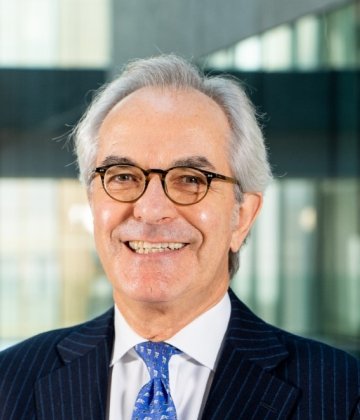
Konstantinos Drakos is a Professor at the Department of Accounting and Finance, Athens University of Economics and Business (AUEB). Previously, he served as Assistant Professor at AUEB (2009–2012), Assistant Professor at the University of Patras (2003–2008), and Lecturer at the University of Essex (2001–2002). He holds a PhD in Economics from the University of Essex, preceded by an MSc and undergraduate studies in Economics at the University of Athens. His research focuses on Applied Financial Economics and the Economics of Security, with recent work analyzing hedge fund leverage, geopolitical risk impacts, cryptocurrency markets, and green banking. Teaching responsibilities include Macroeconomic Theory, Finance for Banking, and Risk Management at both undergraduate and postgraduate levels. Drakos' publications span over two decades, addressing topics such as terrorism's economic effects, bank lending behavior, and investment under uncertainty. His recent articles (2022–2025) emphasize cryptocurrency dynamics, geopolitical risk interactions, and financial stability in green banking. Notable themes include market volatility, capital allocation under uncertainty, and policy responses to systemic risks. No scientific awards are listed in the provided materials. His research has explored structural shifts in financial risk, macroeconomic sentiment, and cross-market linkages following major global events like 9/11 and the 2008 crisis. Drakos has advised on policy-related topics related to financial markets and regulatory frameworks, though specific grants or lab affiliations are not detailed here.
Huamin Qu is a Chair Professor in the Department of Computer Science and Engineering at the Hong Kong University of Science and Technology (HKUST). He serves as the Founding Dean of the Academy of Interdisciplinary Studies (AIS), Founding Head of the Division of Emerging Interdisciplinary Areas (EMIA), and was the Founding Acting Head of Computational Media and Arts (CMA) at HKUST(GZ). Qu directs the VisLab and coordinates the Human-Computer Interaction (HCI) group. He obtained his BS in Mathematics from Xi'an Jiaotong University and MS/PhD in Computer Science from Stony Brook University. Qu's research integrates Data Visualization , Human-Computer Interaction , and Human-Centered AI , with applications in urban informatics, social networks, and explainable AI. His work focuses on developing interactive systems for big data analytics, visual storytelling, and AI-driven decision support. Research extends to multimodal communication, fintech, and augmented reality applications. His publications emphasize visual analytics for complex datasets (mobility, social media, financial), interaction techniques for immersive environments, and AI-enhanced visualization tools. Recent works explore explainable AI interfaces and large-scale data communication frameworks. IEEE Visualization Academy (2020) IEEE VGTC Technical Achievement Award AI 2000 Most Influential Scholar (2019, 2023, 2024) 21 Best Paper/Honorable Mention awards IBM Faculty Award (2009) APICTA Merit Award (2015) Yelp Dataset Grand Prize (2018) Qu has advised 48 PhD graduates (21 now faculty at institutions like UC Davis, University of Minnesota, Texas A&M) and 30 MPhil students. He secured major grants including RGC theme-based projects (digital citizenship, air pollution), UGC AoE (slope safety), and China's 973 Program. As VisLab director, he leads 20+ researchers in visualization/HCI projects adopted by Microsoft, IBM, Huawei, and Tencent.
Arno De Caigny is an Associate Professor at IÉSEG School of Management in France, specializing in Marketing Analytics. He holds a Ph.D. in Sales and Marketing from the University of Lille and Masters in Economics/Mathematics and Finance from Ghent University. His professional experience includes work as a Business Analyst at Deloitte. His primary research interests include customer churn prediction, AI applications in marketing, explainable AI for business, and life event-based marketing. He develops advanced machine learning models for customer behavior prediction and retention strategies. De Caigny's recent publications demonstrate strong focus on developing interpretable machine learning models for business applications, particularly in customer churn prediction and financial decision support. His work increasingly incorporates deep learning and natural language processing techniques.
Daniel Adelman is the Charles I. Clough, Jr. Professor of Operations Management at the University of Chicago Booth School of Business. He joined the faculty in 1997 after completing his PhD in industrial engineering and operations research at Georgia Tech. Adelman is a leading expert in Business Analytics and Management Analytics, helping companies deploy data and decision analysis to build world-class strategic and tactical management capabilities. Adelman received his PhD in industrial engineering and operations research in 1997, along with a bachelor's degree in industrial engineering and a master's degree in operations research, all from the School of Industrial and Systems Engineering at the Georgia Institute of Technology. Daniel Adelman's research focuses on applying analytical models to solve complex business problems across multiple industries. He has worked with firms from diverse sectors including internet services, chemical distribution, airlines, third party logistics, fiber-optics manufacturing, semiconductor manufacturing, oil, and healthcare. His research integrates real-world data with analytical models to bring structure and discipline to decision and control processes, enabling firms to achieve higher profits with lower risk. Adelman's recent work has concentrated heavily on healthcare analytics, where he leads the Healthcare Analytics Laboratory at Chicago Booth. This lab works with teams of doctoral and MBA students on projects with major healthcare institutions to optimize clinical, operational, and financial outcomes. His research spans foundational operations research including approximate dynamic programming, inventory theory/supply chain management, and revenue management/pricing optimization, as well as examining the linkage between operational performance metrics and financial performance of firms. Adelman's publications show a clear trend toward increasing focus on healthcare applications while maintaining strong theoretical foundations in operations research. His earlier work focused more on general operations management problems like inventory control and supply chain optimization, while his recent publications demonstrate a strategic shift toward healthcare analytics, particularly examining surgical team dynamics, hospital performance metrics, and resource allocation during public health emergencies like the COVID-19 pandemic. George B. Dantzig Prize (1998) for the best dissertation in operations research and management sciences that is innovative and relevant to practice Adelman regularly advises doctoral and MBA students through the Healthcare Analytics Laboratory at Chicago Booth. He has served as Associate Editor for Management Science, currently serves as Associate Editor for Manufacturing and Service Operations Management, and is the Area Editor for Operations and Supply Chain at Operations Research. His industry collaborations include significant projects with Akamai on internet pricing, with GE Global Research Labs on the electricity smart grid, with BP on gasoline supply contract portfolio optimization, and with Symantec on software release planning. Adelman leads the Healthcare Analytics Laboratory at Chicago Booth, which brings together interdisciplinary teams of doctoral and MBA students to work on a portfolio of projects with major healthcare institutions. The lab focuses on optimizing clinical, operational, and financial outcomes through advanced analytics and decision modeling.
Professor Ernest Foo is a distinguished academic at Griffith University's School of Information and Communication Technology, specializing in cybersecurity with a focus on industrial control systems and cryptographic protocols. With over 15 years of experience in computer networking, he has established himself as a leading expert in SCADA security and smart grid cybersecurity. His research has significant practical applications in critical infrastructure protection, and he has developed hands-on security training programs that have trained professionals from major Australian utilities and government agencies. Professor Foo's educational background includes: Bachelor of Engineering with Honours in Electronic and Computer Engineering from University of Queensland Doctor of Philosophy from Queensland University of Technology Professor Foo's research interests center around secure cryptographic protocols with specific applications in industrial control system security and cyber physical systems. His work spans SCADA security, smart grid protection, wireless sensor network security, and post-quantum cryptography. He has made significant contributions to understanding vulnerabilities in industrial protocols like Modbus and DNP3, and has pioneered the application of process mining and data mining techniques for attack detection in critical infrastructure systems. His research bridges theoretical security concepts with practical implementations in real-world industrial environments. Professor Foo's recent publications demonstrate a clear trajectory toward increasingly sophisticated security frameworks for critical infrastructure. His work shows a progression from foundational SCADA security research to advanced applications of artificial intelligence, machine learning, and formal methods in cybersecurity. A notable trend is the integration of zero trust principles with industrial control systems, alongside growing emphasis on post-quantum cryptographic solutions. His publications span high-impact journals and conferences in cybersecurity, with increasing focus on anomaly detection in cyber-physical systems and the application of graph-based machine learning techniques to network security challenges. Professor Foo's notable scientific achievements include: Best paper award at the 2nd International Cyber Resilience Conference for "Gap analysis of Intrusion Detection in Smart Grids" Professor Foo has secured significant research funding including an ARC Linkage grant with Powerlink Queensland focused on cyber security for electricity sub-stations. He currently leads multiple research projects including Westpac Micro-Credentials in Financial Crime Investigation, Digital Banking Micro-credentials with ANZ, and research on quantum-safe cryptography. As a dedicated educator, he serves as Program Director for multiple cybersecurity programs including the Master of Cyber Security, and has supervised numerous doctoral and masters students. His Cyber Security: Industrial Control System course, conducted annually from 2013-2018, featured innovative hands-on training with real-world participants from major Australian utilities. Professor Foo has been instrumental in establishing the SCADA security research laboratory with multiple vendor system miniatures running industrial PLCs. His work bridges theoretical security concepts with practical implementations, making significant contributions to the security of industrial control systems and critical infrastructure worldwide.
Na Du is an Assistant Professor in the Department of Informatics and Networked Systems at the University of Pittsburgh's School of Computing and Information. She holds a PhD in Industrial & Operations Engineering from the University of Michigan (2021) and a Graduate Certificate in Data Science. Her research focuses on human factors in smart cities, human-centered computing, and user experience design. She is affiliated with the Intelligent Systems Program, Pitt Cyber, and the Center for Governance and Markets. Education: PhD in Industrial & Operations Engineering (University of Michigan, 2021); Undergraduate in Psychology (Zhejiang University). Research emphasizes explainable AI, human-AI teaming, and smart technologies. Recent grants include funding from Honda Research Institute and Pitt Cyber Accelerator for projects on emotions in Human-AI interaction and Metaverse privacy awareness. Her work has been recognized with awards like the HFES Best Paper Award and the IOE Outstanding Student Award. Advising includes PhD students and researchers in human factors and UX design. The HAT Lab under her leadership explores interdisciplinary challenges in human-computer interaction and smart systems.
Maurizio Dallocchio is a Full Professor of Corporate Finance at Bocconi University and SDA Bocconi School of Management. He served as Dean of SDA Bocconi (2003–2007) and has held leadership roles in academic and professional institutions, including Chair of the Audit Committee of the European Investment Bank (EIB). His research focuses on corporate valuation, mergers & acquisitions (M&A), and sustainable finance. Dallocchio founded DGPA & Co., a corporate finance consultancy, and advises public and private entities globally. He has taught at leading institutions like London Business School and NYU Stern School of Business. Educational Background: Ph.D. in Business Administration, Bocconi University Advanced studies at London Business School and New York University Stern School of Business Research Interests: Prof. Dallocchio’s work emphasizes corporate restructuring, ESG integration in finance, and strategic valuation methodologies . Recent studies explore environmental performance in emerging markets and the resilience of conglomerates during economic crises. He advocates for sustainable investment strategies that balance financial returns with societal impact. Professional Engagements: Board member roles at Klepierre Management, General Finance, and Podravska Banka Past Director of the Master in Corporate Finance program at SDA Bocconi Labs/Teams: Leads research initiatives at Bocconi’s Corporate Finance and Real Estate Department, collaborating with global institutions on projects involving corporate governance, M&A analytics, and sustainable development.
Dr. Euijin (Alley) Choo is an Assistant Professor in the Department of Computer Science at the University of Alberta, specializing in data-driven cybersecurity and big data analytics. Her research focuses on AI-based cybersecurity solutions, anomaly detection in network traffic, and adversarial attacks on federated learning systems. She holds a Ph.D. from North Carolina State University and has held roles at Qatar Computing Research Institute, Korea University, and the University of Missouri-Rolla. Education: Ph.D., Computer Science, North Carolina State University (2015) M.S., Computer Science & Engineering, Korea University (2008) B.S. Dual Degree in Computer Science & Mathematics, Korea University (2006) Research Interests: Security and big data analysis intersections Federated learning security and privacy Anomaly detection in network logs and enterprise systems Malware/phishing detection using graph inference AI-driven threat intelligence aggregation Recent Grants: Mitacs Accelerate Program Grant: Fraud Detection in Financial Graphs ($60,000, 2025) National CyberSecurity Consortium Grant: IntruderInsight ($2M, 2025-2027) NSERC Discovery Grant: Threat Detection Framework ($180,000, 2025-2031) Awards: Best Paper Award at DBSEC 2015 NSERC Early Career Researcher Award (2025) Provost Fellowship (NC State, 2009-2010) Labs/Teams: Leads the Data-driven Network and Cyber Security (DANS) Lab, focusing on federated learning defenses, compromised entity detection, and malicious domain analysis.
Prasanna (Sonny) Tambe is a Professor at the Wharton School of the University of Pennsylvania, specializing in the economics of technology and labor markets. His research explores AI’s impact on workforce dynamics, HR algorithms, and the gender wage gap in tech industries. Education: Ph.D. in Managerial Science and Applied Economics (Wharton, UPenn); S.B. and M.Eng. in Electrical Engineering and Computer Science (MIT). His work leverages internet-scale data from job platforms and patent databases to analyze trends in skill acquisition, remote work diversity, and algorithmic bias in hiring. Recent studies examine AI’s role in HR decision-making, the economics of emerging technologies, and labor market responses to IT innovation. Scientific Awards: Best Undergraduate Professors (Poets & Quants, 2020) Best Paper Awards (Management Science, Information Systems Research) ISS Sandra A. Slaughter Early Career Award (2016) Tambe co-directs Wharton Human-AI Research, focusing on ethical AI integration in organizations. His teaching includes award-winning courses on AI’s societal implications and data-driven business strategies.
Patricia Wellmeyer is an Associate Professor of Teaching and Academic Director of the Master of Professional Accountancy (MPAc) program at the Paul Merage School of Business, University of California, Irvine. She plays a key leadership role in shaping accounting education and curriculum innovation. Her educational background includes: PhD in Management, Accounting – NHH School of Economics, 2016 Master of Science in Accounting – CSU Fullerton, 2002 BS in Business – UC Riverside, 1996 Her research focuses on audit quality, financial reporting standards, and the evolving role of accounting in the digital age. She has pioneered the integration of data analytics and ESG (Environmental, Social, and Governance) topics into the accounting curriculum, reflecting current industry transformations. Her work bridges academic rigor with practical application, informed by over a decade of experience as a practicing CPA. She is actively engaged in professional service, founding the annual UCI Audit Committee Summit and maintaining membership in prominent organizations including the American Accounting Association (AAA), American Institute of CPAs (AICPA), California Society of CPAs (CalCPA), and National Association of Corporate Directors (NACD). As a dedicated educator and program leader, she has developed numerous courses across undergraduate and graduate levels, significantly contributing to the academic mission of the Merage School. Patricia has no listed scientific awards in the provided text. She advises and leads academic programs, notably serving as the academic director of the MPAc program, which she helped co-found. She has developed key electives including the accounting data analytics and ESG curriculum tracks. There is no mention of grant funding in the provided material. She founded and chairs the UCI Audit Committee Summit, an initiative that brings together professionals and academics to discuss governance and audit practices, serving as a platform for knowledge exchange and industry engagement.
Ward Whitt is the Wai T. Chang Professor in the Department of Industrial Engineering and Operations Research (IEOR) at Columbia University's Fu Foundation School of Engineering and Applied Science. He joined Columbia in 2002 after a 25-year research career at AT&T, including positions at Bell Labs and AT&T Labs, where he was named an AT&T Fellow. He is also an Affiliated Member of the Financial and Business Analytics center. Professor Whitt's research focuses on stochastic processes and their applications in real-world systems. His primary areas of interest include queueing theory, stochastic-process limits, numerical transform inversion, and modeling of customer contact centers and telecommunications networks. His work bridges theoretical probability with practical engineering solutions, particularly in large-scale service systems. The available publication indicates a strong emphasis on stochastic-process limits and their use in approximating complex queueing systems. His research trends show a consistent focus on asymptotic methods, diffusion approximations, and performance analysis of stochastic models over decades. Elected to the National Academy of Engineering (1996) Professor Whitt has advised numerous graduate students and postdoctoral researchers throughout his career, though specific names are not listed in the provided text. He has led multiple research projects funded by industry and federal agencies, particularly in the domains of telecommunications and service operations, leveraging his expertise in applied probability and performance modeling. He is affiliated with research initiatives in financial and business analytics at Columbia, contributing methodological advances in stochastic modeling to data-driven decision-making systems.
Lauren M.E. Goodlad is a Professor of English and Comparative Literature at Rutgers University, serving as Chair of Critical AI @ Rutgers and Editor of the journal Critical AI . She holds affiliations with the Center for Cultural Analysis (CCA), Rutgers British Studies Center, and Rutgers Center for Cognitive Science. Her research bridges 19th-century studies and critical AI, emphasizing 'critical AI literacies' and ethical AI development. Goodlad has held roles like Associate Chair of English and membership in Rutgers' AI Advisory Council and CASS (Cyberinfrastructure for Science, Engineering & Society). Her education includes a BSILR from Cornell University, MA in English from NYU, and PhD in English from Columbia University. Notable grants include NEH funding for global AI workshops ('Unboxing AI'), an NSF planning grant on teaching writing with AI, and an upcoming Global Humanities Institute on Design Justice AI. Research interests span Victorian literature, genre theory, television studies, and AI's sociocultural impacts. Awards include University of Illinois' Kathryn Paul Professorial Scholar and Provost Fellow for Undergraduate Education. Current projects include a book on 19th-century fiction's ontological influence and collaborations on AI ethics frameworks. Publications include The Victorian Geopolitical Aesthetic (Oxford, 2015), co-edited special issues on Mad Men and Victorian Internationalisms , and recent critical AI essays in Critical AI and New Literary History . She advocates for AI development aligned with public interest through pedagogical innovation and interdisciplinary collaboration.
Professor Michael C.L. CHAU serves as Professor and Deputy Area Head of Innovation and Information Management at The University of Hong Kong's Faculty of Business and Economics. He also holds the position of Associate Director at the HKU HKJC Centre for Suicide Research and Prevention, and serves on the HKU Senate and Court. His academic journey includes a Ph.D. in Management Information Systems from the University of Arizona and a B.Sc. in Computer Science (Information Systems) from the University of Hong Kong. Dr. Chau's research spans business analytics, artificial intelligence, web mining, fintech, smart health, and security informatics. His work focuses on applying data/text/web mining techniques to business, education, and social domains. He leads the Artificial Intelligence Research Group at HKU Business School, which has secured significant funding from the Hong Kong Research Grants Council, Food and Health Bureau, and other agencies for projects including 'The Invisible Hand in Crowdfunding' and 'Factors Moderating the Predictive Power of Social Media Sentiment on Stock Returns'. His publication portfolio includes over 150 articles in premier journals like MIS Quarterly, JMIS, and IEEE Transactions, with recent work exploring large language models, hate speech detection, and disaster-related social media analysis. His research demonstrates strong interdisciplinary connections across computer science, information systems, and business applications. INFORMS ISS Design Science Award (2020) IEEE ITSS Leadership Award in Intelligence and Security Informatics (2020) AIS Sandra Slaughter Service Award (2016) HKU Outstanding Young Researcher Award (2014) Faculty Research Postgraduate Supervision Award (2020 & 2025) Cited over 9,400 times (h-index = 47) Dr. Chau actively mentors doctoral students and has supervised numerous PhD graduates who now hold academic positions at institutions including Fudan University, Xi'an Jiaotong-Liverpool University, and the University of Maryland. His research grants portfolio demonstrates sustained funding success across diverse areas including blockchain, mental health applications, and social media analytics. The Artificial Intelligence Research Group he leads maintains strong industry connections through projects with Hong Kong Red Cross and the Hospital Authority.
Assoc Prof Ying Chen is an Associate Professor at the National University of Singapore , affiliated with the Department of Mathematics, Asian Institute of Digital Finance (as Academic Director of PhD Program in Digital FinTech 2022–2024), Risk Management Institute (2019–2023), Department of Statistics and Data Science (2019–2023), and Department of Economics (2018–2023). She also contributes to NUS Graduate School for Integrative Sciences and Engineering since 2016. Research Interests include: AI forecasting and quantum computing for finance Nonstationary time series and functional data analysis Energy data analytics and precision medicine Network autoregression and spatial-temporal modeling Explainable AI and citation metrics Portfolio liquidation and market-making algorithms Article Trends demonstrate expertise in: Adaptive forecasting for gas flows and electricity prices Blockchain network influence detection Quantum computing applications in finance Functional autoregression with mixed predictors Credit rating fairness and explainability High-resolution implied volatility modeling Scientific Awards include: ISI Elected Member (2016–) International Statistical Institute Council (2023–2027) IASC Scientific Secretary (2017–2019, 2023–2025) Advisory roles for EU FIN-TECH and xAIM projects
Witold J. Henisz serves as Vice Dean and Faculty Director of the Impact, Value, and Sustainable Business Initiative at The Wharton School, University of Pennsylvania, holding the Deloitte & Touche Professorship in Management. His research centers on political and social risk identification, ESG impact materiality, and corporate diplomacy frameworks that transform stakeholder relationships into strategic assets. His educational background includes a Ph.D. in Business and Public Policy from UC Berkeley's Haas School and an M.A. in International Relations from Johns Hopkins SAIS. Henisz has served as Departmental Editor at Journal of International Business Studies and Associate Editor at Strategic Management Journal , reflecting his scholarly influence. Research interests converge on geopolitical risk quantification, stakeholder engagement optimization, and sustainable business model innovation. His work demonstrates how political hazards materially impact firm valuation and how corporate diplomacy can mitigate conflict through strategic stakeholder alignment. Recent publications leverage massive media datasets (4+ billion articles) to model populism dynamics, indigenous land conflicts, and ESG-credit risk linkages. Award highlights include the Aspen Institute Ideas Worth Teaching Award (2020), Iron Prof recognition (2019), and Academy of International Business Fellowship. His geostrategy framework Geostrategy by Design (2024) provides executives with actionable methods for navigating geopolitical volatility. Aspen Institute Ideas Worth Teaching Award (2020) Iron Prof recognition (2019) Academy of International Business Fellow (2014-present) Multiple Wharton Excellence in Teaching Awards (2006-2021) Industry Studies Association Best Paper Award (2019) Henisz consults through PRIMA LLC for multinational firms (Rio Tinto, Shell), financial institutions (Eaton Vance, World Bank), and NGOs. His executive education programs train leaders in ESG integration and geopolitical risk management, while his KEROVKA crisis simulation develops real-time strategic response capabilities. Media frequently cites his expertise on ESG controversies, with 50+ major publications featuring his analysis since 2022 including Financial Times , Bloomberg , and Wall Street Journal .