Larry Davis is a Professor affiliated with the University of Maryland, College Park. His research focuses on advanced topics in Computer Vision, Machine Learning, and Pattern Recognition, with a particular emphasis on video analysis, deep learning architectures, and applications in surveillance systems. His work spans multiple domains including adversarial machine learning, efficient video recognition frameworks, and object detection techniques. Key research areas include: Development of scalable video analysis models Advances in deep learning for computer vision tasks Optimization of neural network architectures Multi-camera person re-identification systems His publications reflect contributions to both foundational methods (e.g., truncated Cauchy matrix factorization) and applied systems (e.g., adversarial attack mitigation on video transformers). Collaborations with researchers like Zuxuan Wu and Ramani Duraiswami highlight his interdisciplinary approach to solving complex visual recognition challenges.
Yiwen Zhang is a researcher affiliated with Anhui University in Hefei, China, with a focus on Recommender Systems , Machine Learning , and Graph Neural Networks . Their work spans Data Mining , Imbalanced Data challenges, and Big Data optimization. Recent publications highlight advancements in robust recommendation via heterogeneous graphs, causal feature selection , and anomaly detection in time series. Key research areas: Recommender Systems, Machine Learning, Graph Neural Networks, Data Mining, Edge Computing. Notable applications: Imbalanced Data Classification, Social Recommendation, Edge Server Placement, Causal Discovery. Their 2025 and 2024 contributions include 15+ papers on topics like parameter-free sampling , graph attention networks , and causal inference . These works emphasize robustness , uniformity , and low-cost optimization in complex scenarios. Collaborations: Lei Sang, Dengcheng Yan, Qiang He, Yun Yang, Zhaolong Ling. Published in journals: Applied Intelligence , IEEE Transactions on Knowledge and Data Engineering , Expert Systems with Applications .
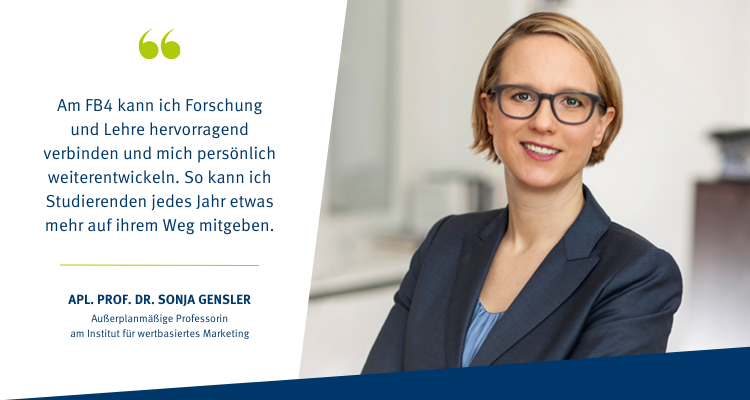
apl. Prof. Dr. Sonja Gensler is an Associate Professor at the Institute for Value-Based Marketing, affiliated with FB4. She specializes in bridging research and teaching to foster student development, emphasizing practical insights for their professional journeys. Her work focuses on digital marketing innovation, consumer behavior analysis, and multichannel strategies. She explores regulatory impacts on the sharing economy and employs advanced empirical methods like conjoint analysis and regression modeling. Key themes in her research include market trends, customer engagement, and the integration of technology in marketing practices. Her research interests span digital marketing strategies, consumer decision-making processes, and the application of statistical techniques to analyze complex datasets. Prof. Gensler’s contributions include studies on sharing economy governance, multichannel management, and the effects of social media on brand relationships. She has published extensively on methodologies such as finite mixture models, contingency analysis, and discriminant analysis, highlighting their practical relevance in marketing and economics. Prof. Gensler’s recent work reflects a trend toward addressing contemporary challenges like AI’s role in customer relationship management and the evolving dynamics of online-offline consumer interactions. Her empirical focus ensures her research remains grounded in real-world applications, benefiting both academic and industry stakeholders.
Dr. Xin Lin is a Professor at the School of Computer Science and Technology, University of Science and Technology of China in Hefei. With an extensive publication record spanning computer vision, machine learning, and artificial intelligence, Dr. Lin leads a research group focused on solving challenging problems in image processing, robotics, and wireless communications. His work bridges theoretical advancements with practical applications across healthcare, autonomous systems, and industrial manufacturing. Dr. Lin's research interests encompass computer vision, machine learning, image processing, and artificial intelligence, with particular expertise in image restoration, 3D object detection, and human pose estimation. His laboratory develops innovative approaches to handle multiple image degradations simultaneously and create lightweight, efficient vision systems suitable for real-world deployment. The research demonstrates strong interdisciplinary connections, applying computer vision techniques to medical imaging, satellite communications, and industrial IoT applications. Analysis of Dr. Lin's recent publications reveals a strong focus on multi-task learning approaches that address multiple image degradation problems simultaneously. His work shows increasing sophistication in handling complex real-world scenarios, from low-light conditions to rain interference, while maintaining computational efficiency. The research trajectory demonstrates a clear path from fundamental image processing techniques to practical applications in autonomous driving, healthcare, and industrial systems. Dr. Lin has received recognition for his contributions to the field through numerous publications in top-tier venues including CVPR, IEEE Transactions, and ACL. His work on image restoration, particularly the Dual Degradation Representation framework, has gained significant attention in the computer vision community. Dr. Lin actively supervises graduate students and collaborates with researchers worldwide. His laboratory works on cutting-edge projects involving digital twins for manufacturing, satellite communications, and medical imaging applications. Current research directions include developing more robust and efficient models for real-world deployment scenarios, with particular attention to resource-constrained environments.
Jörg Bialas is a Senior Scientist in the Marine Geodynamics Research Unit at GEOMAR | Helmholtz Centre for Ocean Research Kiel, Germany. He has been a key figure in marine geophysics research since joining the institution in 1995, with a long-standing focus on ocean floor dynamics, fluid migration, and marine resources. His primary research interests lie in marine geophysics, particularly high-resolution seismics, gas hydrates, cold seeps, submarine landslides, and the development of advanced geophysical equipment such as tiltmeters and deep-towed streamers. He has led and coordinated major projects like PERBAS (CO2 storage in basalt) and SAFAtor (smart cables), demonstrating leadership in both academic and applied marine science. His work integrates seismic, electromagnetic, and geoacoustic methods to study fluid flow systems in diverse settings including the Black Sea, New Zealand’s Hikurangi Margin, and the Chilean continental margin. The 15 most recent publications reflect a strong trend in gas hydrate systems, fluid migration pathways, and seafloor deformation, with significant contributions to understanding gas chimney dynamics, slope stability, and the interplay between tectonics and fluid flow. His research often employs 3D seismic imaging and multi-method geophysical integration, particularly in the Danube deep-sea fan and accretionary complexes. Senior Scientist, GEOMAR (1995–present) Scientific Associate, IFM-GEOMAR (1993–1995) Diploma in Geophysics (1987) Doctorate (1993) He has extensive experience mentoring and collaborating on international expeditions and scientific parties, though no formal advisees are listed. He participates in major research cruises and leads data acquisition efforts, contributing to both academic knowledge and potential energy resource applications. Bialas is actively involved in laboratory and field-based research, working within teams focused on gas hydrate monitoring, seafloor imaging, and geohazard assessment. His lab work emphasizes data interpretation from ocean-bottom seismometers and controlled source electromagnetics, often in coordination with international partners.
Prof. Dr. Gjergji Kasneci is a Professor of Responsible Data Science at the Technical University of Munich (TUM), leading the Chair of Responsible Data Science. He holds affiliations with the TUM School of Social Sciences and Technology and the TUM School of Computation, Information and Technology. His research focuses on ethical, legal, and societal aspects of AI, emphasizing transparency, fairness, and robustness in machine learning algorithms. Prof. Kasneci’s academic journey includes a PhD in Computer Science from the University of Marburg (2009), postdoctoral research at Microsoft Research Cambridge, and leadership roles at the Hasso Plattner Institute and SCHUFA Holding AG. He was an Honorary Professor at the University of Tübingen (2018–2023) and currently serves as Vice Dean and Information Officer at TUM. Key awards include the Seoul Test of Time Award (2018) and an Honorary Professorship from the University of Tübingen (2019). He leads initiatives like the AI in Finance Lab and contributes to AI policy through projects such as the EU-funded AI4POL initiative.
Dr.-Ing. Anna Krause is a researcher at the Chair of Data Science (Informatik X) within the Faculty of Mathematics and Computer Science at the University of Würzburg. She leads the Deep Learning for Dynamical Systems Group and has been actively involved in teaching at the university since 2019, including courses on Machine Learning for Time Series Analysis and Data Mining. Doctoral degree in Electrical Engineering (2019), University of Hannover Diploma in Electrical Engineering (2009), Technical University Dresden Her research focuses on Environmental Sensing and Time Series Analysis , particularly on enhancing physics-based models using machine learning techniques for meteorological applications and sparse sensor networks. She has made significant contributions to explainable AI, climate modeling, and fraud detection systems. Anna's recent publications demonstrate expertise in climate modeling (ConvMOS, ICLR 2024-2025), physics-informed neural networks (TaylorPDENet, ECMLPKDD 2023), and fraud detection (MIDAS workshops, ECMLPKDD 2020-2023). She actively contributes to conferences as organizer and PC member, including ECMLPKDD and ICLR workshops. Scientific Awards Best ML Innovation Award (2020) for Deep Learning in Climate Modeling Best Student Paper Award (2020) for Multi-Task Land Use Regression Best Paper Award (2020) for Financial Fraud Detection with INALU The DynaBench dataset introduced in 2023 provides benchmark tools for learning dynamical systems from low-resolution data. Her work combines theoretical advancements with practical implementations, including edge computing applications for beekeeping monitoring systems.
Osbert Bastani serves as an Associate Professor in the Department of Computer and Information Science at the University of Pennsylvania. He leads the trustml@Penn research group and holds affiliations with the ASSET, PRECISE, and PRiML research centers, as well as PLClub. His academic work centers on developing reliable and interpretable artificial intelligence systems through interdisciplinary approaches combining programming languages, formal methods, and machine learning. He earned his Ph.D. in Computer Science from Stanford University under the guidance of Alex Aiken, followed by a postdoctoral position at MIT working with Armando Solar-Lezama. This foundation in both theoretical computer science and practical systems has shaped his research trajectory. Bastani's primary research areas include Trustworthy Machine Learning (focusing on robustness against adversarial attacks, fairness in algorithmic decision-making, and explainable AI), program synthesis, and formal verification. His recent publications address critical challenges in large language models, such as defending against jailbreaking attacks and ensuring trustworthy retrieval-augmented generation. He also develops methods for conformal prediction under distribution shifts and neurosymbolic program synthesis for complex tasks like web question answering. His teaching portfolio features advanced courses including CIS 7000: Trustworthy Machine Learning and CIS 4190/5190: Applied Machine Learning, where he integrates cutting-edge research into the curriculum. Through his research group, he mentors graduate students on projects spanning neurosymbolic programming, uncertainty quantification, and fairness in sequential decision-making. As an active member of Penn's research ecosystem, Bastani contributes to the ASSET center's mission of building secure systems, PRECISE's work on cyber-physical systems, and PRiML's machine learning initiatives, while collaborating with PLClub on programming language innovations.
Ronan McAdam is a PostDoc researcher at the Euro-Mediterranean Center on Climate Change (CMCC) in the Ocean Modelling & Data Assimilation department. He specializes in predictions of essential variables for tracking ocean climate and variability, with a particular focus on seasonal forecasting and marine heat waves in the Mediterranean Sea. His research interests span several critical areas of ocean and climate science: Ocean Climate Modeling and Prediction Seasonal Forecasting Systems Marine Heat Waves and Extreme Events Machine Learning Applications in Oceanography Climate Change Impacts on Marine Ecosystems Mediterranean Sea Dynamics McAdam's recent publication trends show a strong focus on marine heatwaves in the Mediterranean Sea, with increasing integration of machine learning techniques for ocean forecasting. His work bridges traditional ocean modeling approaches with innovative data-driven methods to improve prediction capabilities for climate extremes, particularly through projects like MedFormer and feature selection for seasonal forecasts. As an active researcher in the climate science community, McAdam has contributed to the Copernicus Ocean State Report and collaborates with numerous international institutions on ocean monitoring and prediction initiatives. His research has practical applications for understanding and predicting climate extremes that impact marine ecosystems and coastal communities, particularly in the vulnerable Mediterranean region which serves as a climate change hotspot.