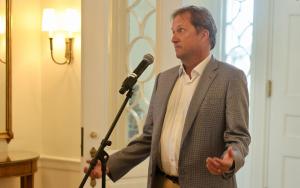
Scott T. Acton is the Lawrence R. Quarles Professor and Chair of Electrical and Computer Engineering at the University of Virginia, with a courtesy appointment in Biomedical Engineering. He leads the VIVA lab, specializing in biological image analysis, machine learning, and AI for education. His research spans medical imaging, signal processing, and computer vision. Professor Acton holds a B.S. (Virginia Tech, 1988), M.S. (UT Austin, 1990), and Ph.D. (UT Austin, 1993) in Electrical Engineering. He has authored over 325 publications and served as Editor-in-Chief of IEEE Transactions on Image Processing and General Co-Chair of the IEEE International Symposium on Biomedical Imaging. His research interests include bioimage analysis, machine learning applications, and medical imaging technologies. The VIVA lab focuses on problems like cell tracking in bacterial biofilms, gait recognition using LiDAR, and AI-driven classroom activity analysis. Awards: IEEE Fellow (2013), All-University Teaching Award (2009), Outstanding Young Electrical Engineer (1996). Courses Taught: How the iPhone Works, Digital Image Processing, Signals and Systems. Labs/Teams: VIVA - Virginia Image and Video Analysis lab. Recent work emphasizes AI for education (e.g., automated classroom activity classification) and medical imaging advancements like 3D biofilm segmentation and LiDAR-based human identification. His contributions bridge engineering and healthcare, with applications in neuroscience and clinical decision support.
Remko Van Hoek serves as Professor of Practice in the Department of Supply Chain Management at the Sam M. Walton College of Business, University of Arkansas. He teaches Sourcing and Procurement courses across undergraduate, master's, and doctoral programs. Prior to joining the University of Arkansas, Dr. Van Hoek held academic positions in Europe and served as a visiting professor at Cranfield School of Management, complemented by extensive industry experience as a supply chain and procurement executive at global corporations including Nike, PwC, and The Walt Disney Company. He currently serves on the Council of Supply Chain Management Professionals (CSCMP) Board of Directors and acts as executive director of the CSCMP Supply Chain Hall of Fame hosted by the Walton College. Dr. Van Hoek's research centers on digital transformation in procurement and supply chain management, with particular focus on blockchain implementation, artificial intelligence applications, and sustainable sourcing practices. His work investigates how emerging technologies reshape procurement processes, supplier relationship management, and risk mitigation strategies. He explores innovative approaches to supplier diversity programs, ethical sourcing frameworks, and the strategic evolution of procurement from cost reduction to value creation. His research consistently bridges academic theory with industry practice through case studies from major corporations, developing actionable frameworks for practitioners facing digital disruption and sustainability challenges. Analysis of his 15 most recent publications (2023-2025) reveals dominant themes in AI-driven supply chain risk prevention, blockchain implementation for transparency, and sustainable supplier engagement. His work demonstrates consistent industry collaboration, drawing from case studies at Walmart, Moet Hennessy, and Bayer to address post-pandemic resilience challenges. A significant portion examines procurement's strategic evolution beyond transactional functions, with recurring emphasis on ethical considerations in digital transformation and the practical implementation barriers for emerging technologies in global supply networks. As a Professor of Practice, Dr. Van Hoek integrates executive-level industry experience into curriculum development and student mentorship. His industry-engaged teaching model includes guest lecturer programs connecting students with supply chain practitioners, as evidenced by his co-authored work on integrating industry insights into supply chain education. While specific grant funding details are not publicly documented, his leadership in the CSCMP Supply Chain Hall of Fame demonstrates commitment to professional development and industry-academia knowledge transfer. Dr. Van Hoek directs the CSCMP Supply Chain Hall of Fame initiative, which documents transformative contributions to supply chain management through interviews with industry pioneers and historical case studies. This platform serves as both an educational resource for Walton College students and a professional development tool for supply chain practitioners globally. The Hall of Fame preserves critical industry knowledge while highlighting contemporary innovations in supply chain strategy and technology implementation.
Dr. Robin Laycock is a Senior Lecturer in the Department of Health and Biomedical Sciences at RMIT University. He leads the Social and Cognitive Neuroscience (SoCoNeuro) Lab, focusing on behavioral and neural mechanisms of social perception in neurotypical and neurodivergent populations, including autism spectrum disorders and the neurocognitive effects of concussion. His research integrates methodologies such as eye-tracking, EEG, and fNIRS to study visual perception, face processing, and the impact of stress/anxiety on cognition. Dr. Laycock holds a PhD from La Trobe University, where he investigated visual processing pathways. His work also includes the BabyFace study, exploring social perception in pre-term infants using fNIRS. He is affiliated with RMIT’s Healthy Foundations Research Group and supervises research projects on topics like concussion neurocognition and social media’s neurobiological effects. Research interests span visual neuroscience, social neuroscience, and clinical applications of neuroimaging. He teaches undergraduate courses in Biological Psychology and supervises postgraduate research in vision science, neuropsychology, and affective neuroscience. His lab’s recent studies examine sex differences in sports-related concussion neuroimaging and the role of deepfakes in emotion perception research. He actively collaborates on projects addressing autism traits, stress effects on visual processing, and neuroimaging advancements.
Professor Dirk Bernhardt-Walther is an academic at the University of Toronto, serving as Program Director of the Cognitive Science Program and Department of Psychology . He investigates neural and computational mechanisms underlying high-level sensory perception, focusing on real-world scenes, mid-level vision, and visual aesthetics. Education: PhD in Computation and Neural Systems (Caltech, 2006), M.Phil (University of Cambridge) Research Focus: His lab employs fMRI, MEG, EEG , and GAN-generated stimuli to study scene categorization, perceptual organization, and aesthetic processing. Recent work explores curvature perception, emotion representation in scenes, and neural dissociations between computational and subjective visual metrics. Laboratory Members: The Bernhardt-Walther Lab includes PhD students like Gaeun Son (scene perception), Charlotte Leferink (scene representation), and Dela Farzanfar (aesthetic processing), alongside postdocs and collaborators. Advising: Supervises graduate students in projects combining computational modeling, psychophysics, and neuroimaging, particularly those with backgrounds in computer science or cognitive neuroscience.
James T. Enns is a Professor and Distinguished University Scholar in the Department of Psychology within the Faculty of Arts at the University of British Columbia. His research primarily focuses on the role of attention in human vision, with secondary interests in developmental psychology and human-machine interaction. Dr. Enns' research interests span perception, attention, vision, cognition, development, and human-machine interaction. His work explores how the human mind selects information, with particular emphasis on visual attention mechanisms. His laboratory research investigates the fundamental processes of visual perception and how attention modulates these processes across different contexts and developmental stages. Analysis of Dr. Enns' publication record reveals consistent engagement with visual perception, attentional mechanisms, and cognitive processing. His research demonstrates expertise in both theoretical frameworks and experimental methodologies related to visual attention, with applications spanning basic cognitive science to potential implementations in human-computer interaction systems. His work often bridges theoretical cognitive psychology with practical applications. Canadian Society for Brain, Behaviour and Cognitive Science Donald O. Hebb Distinguished Contribution Award (2013) Distinguished University Scholar, UBC (2004) Robert E. Knox Master Teaching Award (2004) Royal Society of Canada Fellow (2002) Killam Faculty Research Prize (1994) Killam Faculty Research Fellowship (1993) Society of Experimental Psychology Fellow Dr. Enns has served as Editor for the Journal of Experimental Psychology: Human Perception and Performance, and as Associate Editor for Psychological Science, Consciousness and Cognition, and Visual Cognition. His research has been supported by grants from NSERC, the Canadian Foundation for Innovation, the Australian Research Council, BC Health, and Nissan. He has authored textbooks on perception, edited research volumes on the Development of Attention, and published numerous scientific articles on vision, attention, and cognitive science. Dr. Enns is currently accepting graduate students and continues to mentor the next generation of cognitive scientists. Dr. Enns leads the UBC Vision Lab, which focuses on how the human mind selects information. The lab conducts research on visual attention, perception, and cognitive processes using a variety of experimental methodologies.
Prof. Dr. Birgit Eickelmann is a Professor of School Pedagogy at the Institute of Educational Science within the Faculty of Arts and Humanities at Paderborn University. She has held this position since October 2012, initially as a W2 professor until January 2014, and then as a W3 professor (full professor) from February 2014 onward. Her research focuses on school and lesson development in the digital age, school pedagogy under digital transformation conditions, empirical school research, teacher education, and school leadership with emphasis on digital learning leadership. Her educational background includes a habilitation in Educational Science in May 2012, a PhD in Educational Science with summa cum laude in July 2009, and state examinations for teaching Mathematics and Physics in December 1996 and January 1999. Prof. Eickelmann's research centers on the digital transformation of educational systems, particularly examining how schools develop digital competencies among students and teachers. Her work emphasizes equitable access to digital learning opportunities, the role of school leadership in digital transformation, and the development of computational thinking skills. She investigates how schools can become resilient in the face of digital challenges, with special attention to organizational factors that support successful digital integration. Her publication record reveals a strong focus on international comparative studies, particularly the IEA's ICILS (International Computer and Information Literacy Study) across multiple cycles (2013, 2018, 2023). Her research spans digital literacy assessment, school-level factors influencing digital competence development, and policy implications for educational systems undergoing digital transformation. Prof. Eickelmann leads several major research initiatives including the National Research Center for the IEA Study ICILS 2023 (2021-2026), the German coordination of the Horizon-2020 project 'DigiGen' (2019-2022), and previous leadership of ICILS 2018 (2015-2021) and ICILS 2013 (2012-2015). She is actively involved in policy advising regarding digital education in Germany. She is a member of numerous scholarly organizations including the World Educational Research Association (since 2021), the Society for Empirical Educational Research (since 2016), and the German Society for Educational Science (since 2014), among others. Her work bridges academic research with practical implementation in schools through projects like 'Navigator Bildung Digitalisierung' and 'schultransformNEXT'.
Matthieu Cord is a Professor at Sorbonne University and Scientific Director of valeo.ai, leading research in computer vision, deep learning, and computational cooking. He heads the MLIA team at ISIR Lab, focusing on multimodal models, transformers, and efficient architectures. Research areas include computer vision, large language models with vision, and AI-driven food analytics. Key projects: VISA-DEEP AI chair, Foundation VaViM models, and SmolVLA collaboration with Hugging Face. His recent work examines scalable multimodal models , trajectory prediction , and diffusion-based segmentation , with studies on in-context learning and biased shortcut learning in visual question answering. Articles highlight DeiT variants , fishr for OoD generalization , and STEEX for counterfactual explanations . Scientific awards include IUF Honorary Membership (2009), BMVC 2017 Best Paper, and ICIP 2018 Best Paper. As an advisor, he supervised PhD theses on topics like GAN editing , semantic segmentation , and multimodal retrieval . Current roles involve mentoring the 'Research Band' at MLIA and leading EU-funded initiatives like SCAPE. His work bridges theoretical AI exploration with practical applications in autonomous driving and food technology.
Dr. İsmail ÖZTEL serves as an Assistant Professor in the Department of Computer Engineering at Sakarya University's Faculty of Computer and Information Sciences. He has been a faculty member since 2019, following his tenure as a Research Assistant from 2012-2019 at the same institution. His educational background includes: Doctorate in Computer and Information Engineering (2014-2018) from Sakarya University with thesis on "Facial expression detection on partial and full face images using machine learning methods" Master's Degree in Computer and Information Engineering (2012-2014) from Sakarya University with thesis on "Driver simulator for educational purposes" Bachelor's Degree in Computer Engineering (2007-2011) from Sakarya University Dr. ÖZTEL's research focuses on artificial intelligence, deep learning, and computer vision with significant applications in healthcare, mobile technology, and public safety. His work has evolved from foundational facial expression recognition to sophisticated medical applications including skin disease classification using smartphones, monkeypox detection from skin lesions, and pandemic response systems for face mask detection. His research demonstrates strong interdisciplinary connections between computer science and healthcare. An analysis of his publication trends reveals a clear progression toward increasingly complex deep learning architectures applied to real-world problems, with recent work emphasizing medical applications using mobile technology and public health safety systems. His 2023-2025 publications show particular focus on skin disease classification, intelligent vehicle systems, and hybrid feature extraction methods for pandemic response. Dr. ÖZTEL has served as a reviewer for numerous prestigious journals including Expert Systems With Applications (multiple years), World Wide Web, Multimedia Tools and Applications, and Journal of King Saud University - Computer and Information Sciences, demonstrating his recognition in the academic community across multiple domains. His research projects include work on facial expression detection in open scientific databases (2020), performance evaluation of transfer learning approaches (2019), and current projects on brain tumor classification systems and earthquake safety education for individuals with developmental disabilities. His international research experience includes collaboration with Filiz Bunyak in 2017, indicating global engagement in his field.
Nick Abel is an Honorary Associate Professor at the Fenner School of Environment & Society, Australian National University. With a distinguished international career spanning Africa and Australia, he has worked in Zimbabwe, Kenya, Ethiopia, Botswana, Somalia, Swaziland, Zambia, and Australia. His academic credentials include a Ph.D., M.Sc., and B.Sc.(Hons.), reflecting a strong foundation in environmental sciences and complex systems thinking. Abel's research program centers on the critical challenge of human adaptation to climate change, with particular focus on why adaptation efforts are insufficient to prevent environmental and social tipping points. He critically examines Australia's role as the world's third largest exporter of fossil fuels while facing escalating climate impacts, investigating how fossil fuel companies have maintained influence over public policy. His work integrates social-ecological systems theory, resilience thinking, and practical governance frameworks to address climate adaptation challenges. His publication record demonstrates a clear evolution from foundational work in rangeland management and complex adaptive systems toward urgent climate policy interventions. Early research established theoretical frameworks for understanding resilience in dryland ecosystems, while recent work focuses on transformation pathways, Indigenous engagement, and community-based adaptation strategies. A consistent thread throughout his career is the integration of diverse knowledge systems and the development of practical approaches for environmental governance in rapidly changing conditions. Abel has registered to supervise research students at ANU and participates in significant collaborative projects, including the current 'Partnering with local communities in regional Australia to increase resilience to flood events' (2022-2025). His high-impact publications, including the highly cited 'Resilience management in social-ecological systems' (1,120 Scopus citations) and 'From Metaphor to Measurement: Resilience of What to What?' (2,596 Scopus citations), demonstrate his foundational contributions to the field. Through his work with various research groups and projects, Abel has helped establish frameworks for understanding social-ecological systems and climate adaptation. His contributions to the Fenner School include advancing methodologies for integrating scientific and Indigenous knowledge systems, developing practical approaches to environmental governance, and critically examining the political economy of climate policy in Australia.
Cara Keifer, PhD, is an Assistant Professor of Child Psychology in the Child Study Center at Yale University's Yale School of Medicine. Her research focuses on autism spectrum disorder (ASD), particularly social cognition, electrophysiological measures of face processing, and neurodevelopmental outcomes. She holds a PhD in Clinical Psychology from Stony Brook University (2021), an MA from the same institution (2017), and a BA in Psychology from Haverford College (2013). Her work integrates behavioral and neural methodologies to understand social perception deficits in ASD. Key studies include investigations into face inversion effects, emotional face recognition biases, and EEG correlates of anxiety treatment responses. She collaborates with the McPartland Lab and contributes to translational research initiatives. Recent publications highlight advancements in phenotypic classification of ASD using machine learning and exploration of social motivation constructs. Her interdisciplinary approach bridges clinical, cognitive, and neuroscientific perspectives to advance ASD diagnosis and intervention strategies.
Dr. Divya Jayakumar Nair serves as Senior Lecturer in the School of Civil and Environmental Engineering at the University of New South Wales (UNSW), where she also holds the position of Associate Dean International – South Asia for UNSW Engineering. Her academic work is centered at the Research Centre for Integrated Transport Innovation (rCITI), focusing on transportation systems, network optimization, and disaster management applications. Dr. Nair's research interests span transportation engineering, disaster management, and urban mobility systems. Her work investigates complex network design problems, particularly in pre-disaster evacuation planning, transportation resilience, and food rescue logistics. She employs advanced analytical methods including traffic equilibrium modeling, network optimization techniques, and data-driven approaches to solve real-world transportation challenges with significant societal impact. Her recent publications demonstrate a strong focus on transportation resilience during disasters, with particular attention to equity considerations in pre-event planning. Dr. Nair's research shows how transportation networks can be optimized to improve emergency response while ensuring equitable access to safety for all population segments. Her work bridges theoretical network optimization with practical applications in urban environments facing climate-related challenges. Dr. Nair collaborates extensively with leading researchers in transportation including S. Travis Waller, Vinay V. Dixit, David Rey, and Taha Rashidi. Her collaborative approach spans multiple institutions and addresses pressing challenges in urban transportation systems worldwide.
Satish Nambisan is the Nancy and Joseph Keithley Professor of Technology Management at the Weatherhead School of Management, Case Western Reserve University, where he also serves as Faculty Director of the Online MBA in Product Management. His academic leadership spans innovation management, entrepreneurship, and digital globalization research. Doctor of Philosophy, Syracuse University (1997) Master of Business Administration, XLRI - Xavier School of Management (1989) Bachelor of Technology, Calicut University (1987) Nambisan's research focuses on how digital technologies shape innovation and value creation in global business contexts. His work examines digital entrepreneurship, innovation ecosystems, and the transformation of multinational corporations in the digital age. He investigates how AI and other digital technologies are reshaping global innovation processes and value creation mechanisms across diverse organizational settings. His recent publications reveal a strong emphasis on digital globalization, AI's role in innovation, entrepreneurial ecosystems, and the strategic challenges facing multinational corporations in a digitally connected world. The research demonstrates interdisciplinary connections between technology management, international business, and entrepreneurship literature. Scientific Awards: Axiom 2023 Business Book Award (Gold Medal) for 'The Digital Multinational: Navigating the New Normal in Global Business' Web of Science-Clarivate Highly Cited Researcher for cross-field impact (2022) Web of Science-Clarivate Highly Cited Researcher for economics & business (2023) Martin J. Whitman Distinguished Ph.D. Alumni Award from Syracuse University (2006) Nambisan actively engages with the business community as a sought-after speaker and consultant, having advised major organizations including Microsoft, 3M, P&G, SAP, and the Federal Reserve Bank of St. Louis. His editorial leadership includes serving as Field Editor at the Journal of Business Venturing and Department Editor at Management and Business Review, reflecting his significant influence in academic publishing.
Jaime S. Cardoso is an Associate Professor with Habilitation at the Faculty of Engineering of the University of Porto (FEUP) and a Senior Researcher in the 'Information Processing and Pattern Recognition' Area at INESC TEC's Telecommunications and Multimedia Unit. He has been serving as Research Coordinator since September 15, 1998, and is a Senior Member of IEEE as well as co-founder of ClusterMedia Labs. His educational background includes a Licenciatura in Electrical and Computer Engineering (1999), an MSc in Mathematical Engineering (2005), and a Ph.D. in Computer Vision (2006), all from the University of Porto. Cardoso's research focuses on three major areas: computer vision, machine learning, and decision support systems. His work spans medical image analysis, explainable AI, semantic audio-visual analysis, and pattern recognition. He has co-authored over 150 papers, with more than 50 published in international journals, and has accumulated over 6,500 citations. His recent publications demonstrate expertise in cell nuclei segmentation, ordinal regression for CNNs, semantic segmentation with ordinal relationships, face recognition using synthetic data, and explainable vision language models for medical applications. Honorable Mention in the Exame Informática Award 2011 for 'Semantic PACS' First Place in the ICDAR 2013 Music Scores Competition Cardoso has supervised numerous graduate students at UP-FEUP, with recent theses focusing on multimodal explanations, autonomous driving, medical diagnosis, and explainable AI. His research group works at the intersection of computer vision, machine learning, and practical applications in healthcare and autonomous systems.
David Whitney is a Professor of Psychology at the University of California, Berkeley , with affiliations in Cognitive Science and Neuroscience . His research focuses on visual perception, particularly how humans process information in cluttered environments through mechanisms like ensemble perception , serial dependence , and perceptual crowding . He employs techniques such as psychophysics, fMRI, and TMS to study these phenomena. Whitney's recent work examines serial dependence in schizophrenia, emotion perception in crowds , and medical image analysis for dermatology and radiology. His studies reveal how the brain uses dynamic predictive templates and motion cues to stabilize perception despite neural processing delays. Publications span Current Biology , Nature Reviews Psychology , and PLoS ONE , with a strong emphasis on interdisciplinary applications of perceptual science. Scientific contributions include foundational studies on visuomotor control , blind spot filling-in , and holistic face processing . His lab investigates perceptual stability across eye movements, spatial localization, and cross-modal interactions. Whitney has received grants such as NIH EY018216 to support his research on motion-dependent visual coding. Detailed information about his work is available on the Whitney Lab website .
Hanbyul Joo is an Assistant Professor in the Department of Computer Science and Engineering at Seoul National University (SNU). Prior to joining SNU, he was a Research Scientist at Facebook AI Research (FAIR) in Menlo Park. He completed his Ph.D. in the Robotics Institute at Carnegie Mellon University, working with Yaser Sheikh, and received his M.S. in Electrical Engineering and B.S. in Computer Science from KAIST, Korea. Dr. Joo's educational journey began at KAIST, where he earned both his Bachelor's and Master's degrees. He then pursued his Ph.D. at Carnegie Mellon University's Robotics Institute, completing his dissertation titled "Sensing, Measuring, and Modeling Social Signals in Nonverbal Communication." His doctoral work focused on developing the Panoptic Studio, a unique sensing system with over 500 synchronized cameras for capturing social interactions. Dr. Joo's research primarily focuses on endowing machines and robots with the ability to perceive and understand human behaviors in 3D . His goal is to build "social Artificial Intelligence" that can interact with humans using social signals (body languages). He pursues this direction using data-driven methods where data is collected by measuring the wide spectrum of social signals transmitted during interpersonal social interaction. His research spans computer vision, machine learning, computer graphics, and robotics , with particular emphasis on 3D human pose estimation, human-object interaction, and social signal processing. His recent publications demonstrate a clear trend toward leveraging diffusion models for 3D reconstruction and generation tasks, with a focus on human-centric applications. His work bridges the gap between 2D image understanding and 3D scene reconstruction, often utilizing pre-trained models to overcome data limitations. The research consistently addresses fundamental challenges in understanding human behavior, interaction with objects, and social dynamics in 3D space. Dr. Joo is a recipient of several prestigious awards including the Samsung Scholarship and the CVPR Best Student Paper Award in 2018 . His paper "Total Capture: A 3D Deformation Model for Tracking Faces, Hands, and Bodies" received this honor at CVPR 2018. His research has been widely recognized in top computer vision and AI conferences, with multiple oral presentations at venues like CVPR, ICCV, and ECCV. Dr. Joo actively mentors a large group of students, with approximately 15 current students working toward MS/PhD degrees under his supervision. His lab, the SNU VCLab, focuses on cutting-edge research in computer vision and graphics. He has secured significant research funding through his work, though specific grant details aren't provided on his website. Dr. Joo frequently serves as an area chair for major conferences including CVPR, ICCV, and NeurIPS, demonstrating his standing in the academic community. Dr. Joo leads the SNU VCLab, which has developed several notable datasets and tools including SNU ParaHome, FrankMocap, and the CMU Panoptic Studio Dataset. His lab maintains strong industry connections, with students interning at leading companies like Meta. The lab's research focuses on building the infrastructure and algorithms needed for social AI, with an emphasis on practical applications that can be deployed in real-world settings.