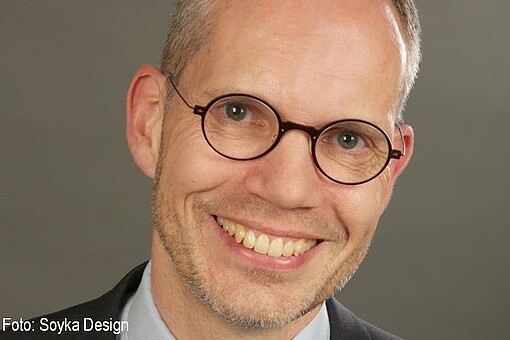
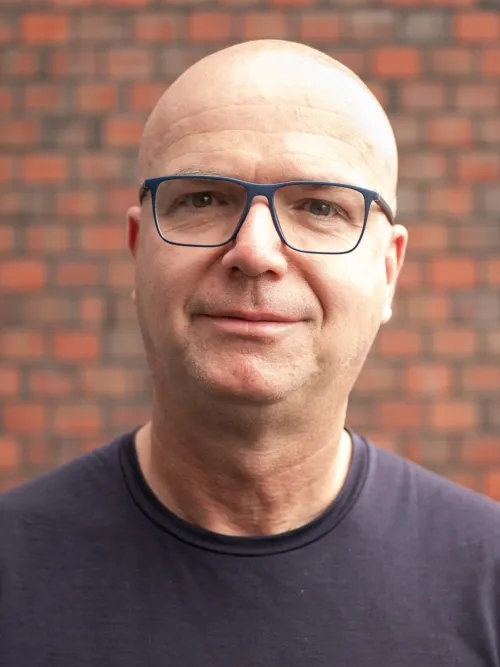
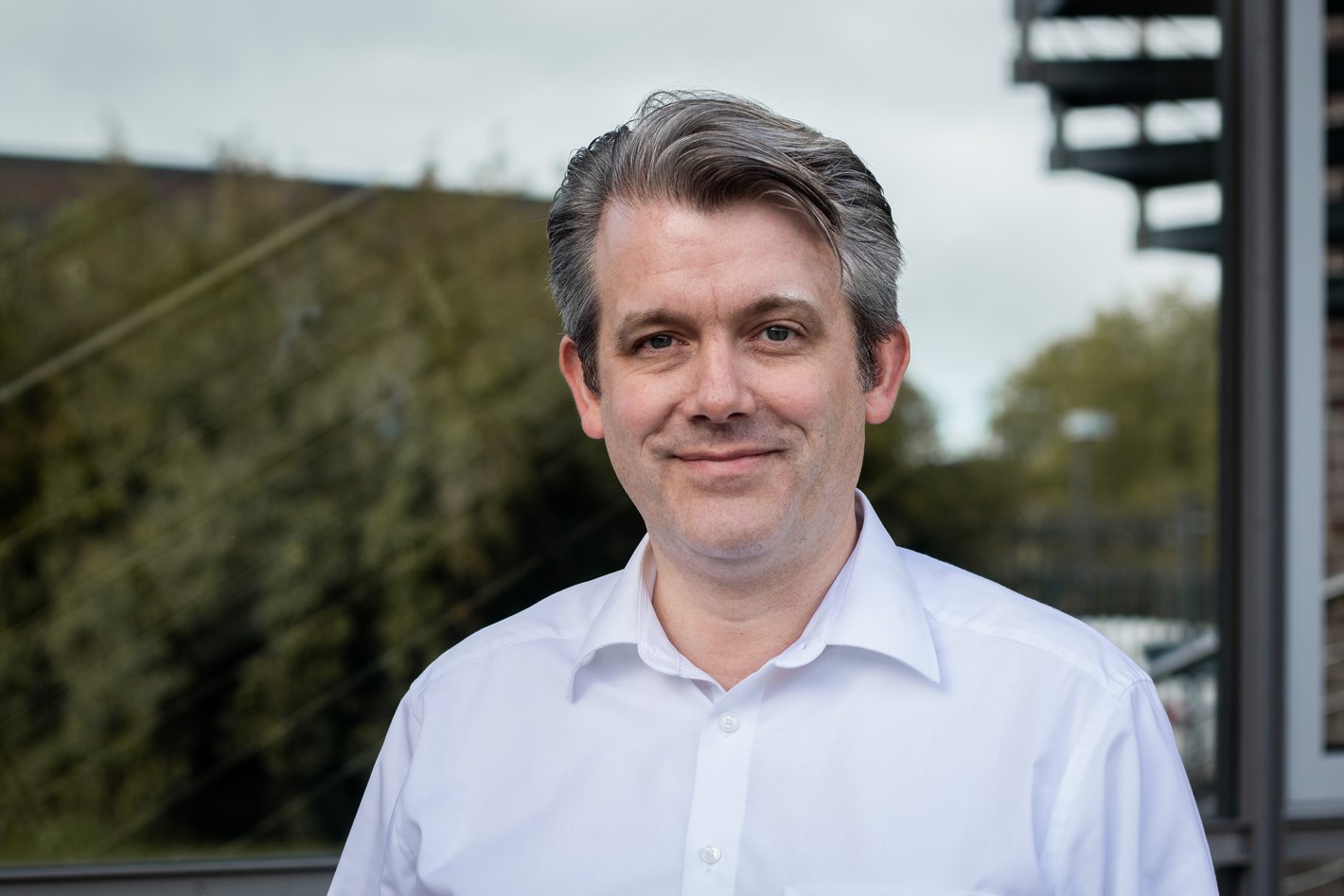
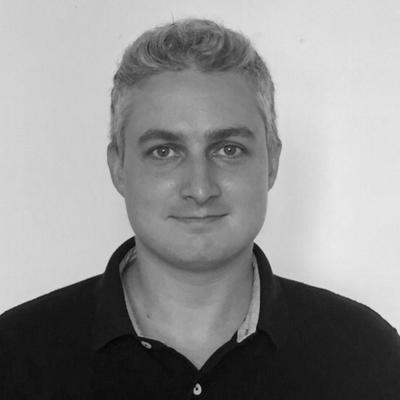
Thorleif Harder is a Researcher at the Technical University of Applied Sciences Lübeck , affiliated with the Institute of Interactive Systems. Since 2023, he has focused on human-computer interaction and user-centered design in online learning environments , particularly through the development of learner dashboards and digital nudges to enhance self-regulation and educational outcomes .
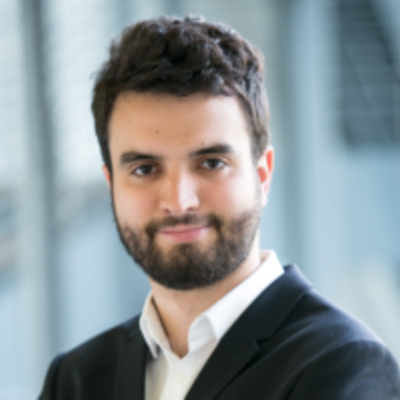
Dr. Alexander Pastukhov is an Assistant Professor at the Department of General Psychology and Methodology, University of Bamberg. His research focuses on multi-stable perception , perceptual inference , and the interplay between attention and microsaccades . He develops open-source tools like saccadr , eyelinkReader , and bistablehistory for analyzing eye movements and perceptual dynamics. Research Interests : Multi-level mechanisms of perception and memory History effects in bistable perception Attentional allocation via microsaccade analysis Bayesian modeling of perceptual decision-making Scientific Awards : 2013 'Best of the Year' award from the Psychonomic Society for work on sensory memory and adaptation in structure-from-motion displays His recent software development includes probabilistic programming tools for 2D/3D transformations and eye-tracking analysis. He also contributes to applied data analysis teaching materials using R and Python. Collaborative projects with industry partners (e.g., BMW) and institutions (e.g., Fraunhofer, Orange Labs) highlight his research transfer efforts.
Oliver Baumann serves as Professor of Mathematics and Physics at the Department of Industrial Engineering within the Faculty of Engineering and Computer Science at Hamburg University of Applied Sciences (HAW Hamburg). His office is located in Room 0.17b at Ulmenliet 20, 21033 Hamburg, with office hours held Wednesdays 10:00–11:00 by email appointment. His academic background includes a physics diploma from CAU Kiel, a diploma thesis in applied optics at JGU Mainz, and a doctorate in astronomy from MPIA Heidelberg. Prior to his professorship, he worked as a scientific employee at Carl Zeiss AG in Oberkochen. Baumann's research spans applied and technical optics , experimental physics , and scientific image processing , with emphasis on optical measurement technology and precision mechanical-optical systems. His work bridges theoretical physics with industrial applications in aerospace, medical technology, and optical instrumentation. Key projects include radar system optimization for field mouse detection, fluorescence imaging evaluation in medical contexts, and photovoltaic-heat transport system design. His publications reveal strong focus on optical engineering (75% of works), instrumentation patents (60%), and educational methodologies (20%). Recent trends show increasing specialization in medical optics applications since 2016, alongside consistent contributions to astronomical instrumentation. Graduates' award for particularly dedicated teachers: 'Golden Duck' 2023 Graduates' award for particularly dedicated teachers: 'Golden Duck' 2019 Graduates' award for particularly dedicated teachers: 'Golden Duck' 2018 Graduates' award for particularly dedicated teachers: 'Golden Duck' 2017 Graduates' award for particularly dedicated teachers: 'Golden Duck' 2016 Baumann actively supervises graduate theses while serving as Chairman of the Examination Board for HWI bachelor's and master's programs. He holds multiple institutional roles including BAFöG representative, Deputy member of Faculty Council LS, and DAAD reviewer for Nigeria (PTDF). His professional affiliations include the European Optical Society (EOS), German Society for Applied Optics (DGaO), German Physical Society (DPG), and University Teachers' Association (hlb). His research activities center around precision mechanical-optical systems development, with emphasis on imaging technologies and measurement instrumentation. Current projects focus on optical metrology applications in aerospace and medical technology sectors.
Frank Heidmann is a Research Professor for Design of Software Interfaces at the University of Applied Sciences Potsdam, where he serves as Program Director for the Master's degree program in Design. He leads the Interaction Design Lab (IDL) and holds leadership roles including membership in the Research and Transfer Commission and Ethics Committee of FH Potsdam, and serves as Ombudsperson for good scientific practice. His educational background includes: PhD in Applied Physical Geography (1999, University of Trier) Studies in Applied Physical Geography with cartography focus (1988-1994, University of Trier) Heidmann's research spans human-computer interaction, usability engineering, and interface design, with evolving focus from cartographic communication to XR interfaces and mental health applications. His work integrates eye-tracking, tangible interfaces, and user-centered design methods, particularly addressing aging society needs and social anxiety disorders. Recent projects emphasize collaborative XR learning and neurofeedback systems. His publication trends reveal consistent contributions to HCI conferences (CHI, DIS, NordiCHI) with growing emphasis on: Immersive technologies (XR/VR) Mental health applications Collaborative interaction paradigms Critical design approaches Heidmann actively supervises design education initiatives and leads significant projects including DISA (Digital Inclusion for Social Anxiety), FUX-XR@FH:P (Extended Reality), and international partnerships with National Taipei University of Technology. As project manager at IDL, he implements research on human-technology interaction, interface design for aging populations, and user-centered design integration. His leadership extends to curriculum development projects like Design '0815' for adapting design education to digital workplaces.
Prof. Thies Pfeiffer holds a professorship in Computer Science with a specialization in Human-Machine Interaction at the University of Applied Sciences Emden/Leer. His work focuses on Mixed Reality technologies (AR/VR) applied to healthcare training, industrial assistance systems, and educational innovation. He leads the research group exploring immersive learning environments and has developed tools like TrainAR for procedural training. Key areas include: Eyetracking for interaction design XR accessibility standards Multi-user VR simulations for nursing training Virtual patient avatars in psychiatry education Research initiatives include the DiViFaG project for digital health training frameworks and the Mixality platform showcasing current projects. He serves on the COGAIN Association board, advancing assistive technology research. His work bridges human factors engineering with practical applications across healthcare, education, and industry.
Heinrich Hußmann is a Professor at Ludwig Maximilian University of Munich with an extensive research career spanning from 1985 to present. His work primarily focuses on Human-Computer Interaction, with significant contributions to Virtual Reality, Tangible User Interfaces, and intelligent systems. Over his career, he has published nearly 250 papers in top-tier conferences and journals. His research interests center around understanding and improving human interaction with emerging technologies. Key focus areas include cinematic virtual reality experiences, tangible interfaces for education and collaboration, privacy in mobile contexts, and user understanding of intelligent systems. His work often bridges theoretical HCI principles with practical applications that address real-world user needs. Analysis of his recent publications (2020-2023) reveals a strong emphasis on tangible interaction for educational contexts, particularly for children's learning. He has also made significant contributions to understanding social aspects of cinematic virtual reality and developing frameworks for user understanding of AI systems. His work consistently demonstrates a user-centered approach that considers psychological, social, and technical dimensions of interaction. Professor Hußmann has mentored numerous students who have become active researchers in the HCI field, including Sarah Theres Völkel, Malin Eiband, and Daniel Buschek, among others. His collaborative network spans multiple institutions and disciplines, reflecting the interdisciplinary nature of modern HCI research. His research has practical implications for the design of more intuitive, privacy-respecting, and educationally effective interactive systems. Current projects suggest continued exploration of how physical and digital elements can be integrated to create meaningful user experiences that support learning, collaboration, and mindful technology use.
Sascha Weber is a researcher affiliated with the Institute of Psychology III at Dresden University of Technology. He specializes in engineering psychology and cognitive ergonomics, focusing on advanced eye-tracking technologies in both real-world and virtual environments. Current research emphasizes algorithms for determining eye movements in 3D space. Develops applications for visual attention analysis using stereoscopic visualization systems. Collaborates on projects like FAIR and COGAIN, integrating eye-tracking with augmented reality and communication technologies. His work bridges cognitive science with technological innovation, particularly in virtual and augmented reality systems. Key projects include FSGazeTrack for driving simulators and 3D software prototypes for strabismus treatment. Selected Collaborations: FAIR: Hands-free augmented reality applications with TU-Dresden, Interactive Minds GmbH, and others COGAIN: European Commission-funded network for gaze interaction communication
Vita Kraft is a Research Fellow at the Institute of German Philology , University of Würzburg, focusing on German linguistics and language variation. Since 2021, she has contributed to empirical studies on revising speech activity and grammatical variation, with her dissertation work titled "Revidierende Sprachtätigkeit kompetenter Sprecher. Eine empirische Untersuchung". PhD in German Linguistics (ongoing, based on dissertation theme) M.A. in German as a Foreign Language (University of Würzburg, 2020) Magister in Philology (German/English, Kyiv National Linguistic University, 2008) Master in International Financial Management (Kyiv National Hetman Vyhovsky University, 2011) Her research explores revision mechanisms in language, dialectal variation, and digital humanities applications through projects like the Würzburg Dialect Database . She teaches courses on German language structure, orthography, and variation, and contributes to the organization of academic events like the "Was prägt die deutsche Sprache" conference. Scientific Recognition Eberhard Schöck Scholarship
Michael Malschützky is a Researcher at the Center for Innovation and Development in Teaching (ZIEL) within the Department of Economics at Bonn-Rhein-Sieg University of Applied Sciences. He specializes in evidence-based teaching practices, STEM/Engineering Education Research, and fostering a failure culture in higher education. His work bridges empirical studies and digital learning tools, particularly in web-conferencing systems like Zoom. Education : Master of Science in Business Psychology (2023), Bachelor of Science in Business Psychology (2017), Diplom-Ingenieur in Mechanical Engineering (2005) Responsibilities : University didactic consulting, empirical study advisory, and management of lab equipment such as Eye-Tracking systems. His research focuses on innovative teaching methods, including peer teaching frameworks and global collaboration strategies. Publications highlight digital learning trends, resilience through failure, and pedagogical efficacy. He actively contributes to conferences like IEEE EDUCON and ASEE Annual Conference. Michael is affiliated with the American Society for Engineering Education (ASEE) and has developed open-source tools like jSumTTest for statistical analysis in education.
Morakot Choetkiertikul is a Lecturer at the Faculty of ICT, Mahidol University, Thailand, where he co-founded the SERU research group. He earned his Ph.D. in computer science from the School of Computing and Information Technology, Faculty of Engineering and Information Sciences (EIS) at the University of Wollongong (UOW), Australia, where he worked in the Decision Support Lab (DSL). His research focuses on AI-Driven Software Engineering , particularly in defect prediction, code quality assessment, and security vulnerability analysis. His work bridges artificial intelligence with practical software development challenges, creating tools that address real-world problems in software engineering processes. The SERU research group he co-founded demonstrates a strong commitment to developing practical solutions for the software industry. Morakot's publication record from 2020-2025 shows a clear evolution from foundational defect prediction research to comprehensive tool development across multiple aspects of the software lifecycle. His work spans code proficiency analysis (PyGress, jscefr), vulnerability detection (V-Achilles, DEV-EYE), and AI applications in development processes (Autorepairability studies), with increasing emphasis on empirical validation in real-world settings. Examiners' Commendation for Outstanding Thesis Best thesis award from University of Wollongong Dr. Choetkiertikul actively contributes to the software engineering community through program committee roles at major conferences including ASE, APSEC, ICSE, and ICSME. His leadership roles have expanded from committee member to track chair and early research achievements co-chair, reflecting his growing recognition in the field. His research on autorepairability, bus factor monitoring, and code proficiency assessment demonstrates a commitment to improving both software quality and developer productivity through data-driven approaches.
Dr. Maurice Rekrut is an Associated Member at the German Research Center for Artificial Intelligence (DFKI) in Saarbrücken, Germany, and part of the Ubiquitous Media Technology Lab (UMTL) at Saarland University. Based at the Saarland Informatics Campus, he conducts cutting-edge research at the intersection of neural engineering and interactive systems, with a focus on translating EEG-based discoveries into practical human-machine interfaces across diverse domains including autonomous vehicles and medical technology. His research centers on Human-Computer Interaction, Brain-Computer Interfaces, Neural Engineering, and Applied Machine Learning, with specialized expertise in silent speech recognition, intent detection, and adaptive interface design. He pioneers techniques for electrode reduction in EEG systems, transfer learning from overt to silent speech, and multimodal integration of physiological signals to overcome current BCI limitations. His work bridges theoretical neuroscience with real-world applications in neurosurgery, virtual reality, and public transport accessibility, emphasizing user-centered design to enhance system robustness and usability. Analysis of his 15 most recent publications (2020-2024) reveals a strategic shift toward deployable BCI solutions, characterized by three key trends: optimization of silent speech recognition through gamified training and transfer learning, hardware constraint reduction via electrode minimization, and multimodal data fusion (EEG/eye-tracking) for context-aware interaction. This trajectory demonstrates increasing focus on practical implementation challenges across autonomous driving, surgical robotics, and VR environments, moving beyond proof-of-concept toward clinically and industrially viable systems. Dr. Rekrut has mentored 14 graduate students through thesis supervision, guiding research on silent speech BCIs, EEG-based intent recognition, and VR neurofeedback applications. His advisees have produced significant work including automated BCI training frameworks, electrode reduction methodologies, and surgical microscope control systems. While specific grant details aren't provided, his research is institutionally supported by DFKI and Saarland University, with notable contributions to the Mobia project for inclusive public transport and collaborations on autonomous systems development. As a core member of the Ubiquitous Media Technology Lab within DFKI's Cognitive Assistants department, he collaborates in a multidisciplinary team exploring human factors in interactive systems. The lab's research ecosystem spans virtual reality illusions, haptic feedback systems, and sports technology, with recent achievements including IEEE VR best paper awards and novel toolkits for psychophysical experimentation. Current initiatives focus on perceptual detection thresholds for VR hand redirection and GPU-accelerated reinforcement learning frameworks.
Dr. Nico Herbig is a researcher at the Ubiquitous Media Technology Lab (UMTL) at Saarland University, holding a Dr.-Ing. degree awarded in 2022 for his PhD thesis on multi-modal post-editing of machine translation. His work bridges human-computer interaction and language technologies, focusing on enhancing translator productivity through innovative interface design. Herbig's primary research explores Machine Translation and Human-Computer Interaction , with specific expertise in multi-modal post-editing systems that reduce cognitive load. His investigations into gesture-based interfaces, handwriting recognition, and speech commands for translation workflows represent significant contributions to the field. Recent work extends into E-Learning applications where multi-modal cognitive load detection improves adaptive learning systems, and Retail Technology focusing on sustainable food systems and intelligent shopping interfaces. Analysis of his 15 most recent publications (2018-2022) reveals a consistent focus on multi-modal translation interfaces, with 70% dedicated to post-editing enhancement. His work increasingly integrates physiological sensors for cognitive load measurement (2019-2021) and expands into cross-domain applications like e-learning (2020) and retail (2017-2018). The publications demonstrate strong industry relevance through collaborations with professional translators and practical implementations in CAT tools. As an academic advisor, Herbig has supervised 7 Master's theses and 3 Bachelor's theses between 2017-2020. Key projects include ImpoWord MTQE (2020), IPE visualization (2020), and tangible AR systems for retail (2018). His teaching portfolio includes Web Development courses (2017-2018) and the 'Livestreaming Meets HCI' seminar (2017), reflecting his interdisciplinary approach. Herbig operates within the Ubiquitous Media Technology Lab led by Prof. Dr. Antonio Krüger, collaborating on projects including MMPE (Multi-Modal Post-Editing), VICAR, HyperCOG, and KOALA. The lab's research spans intelligent retail systems (e.g., 'intelligent fruit stand'), factory layout planning (DEPlata), and sports technology (OmniSports), with Herbig contributing core expertise in human-centered translation interfaces and cognitive load optimization.
Dr. Steffen Remus is a postdoctoral researcher at the University of Hamburg , affiliated with the Department of Informatics and the Language Technology Group (LT) . He holds a Ph.D. in 2023 from the University of Hamburg under Prof. Dr. Chris Biemann and earned his MA in 2012 at Technische Universität Darmstadt. Research Interests : Unsupervised methods, computational linguistics, distributional semantics, information extraction, knowledge induction, and focused web crawling. Projects : JOIN-T2, BIMDANUBE, WebAnno-MM, KDSL, AIPHES. Scientific Awards : KDSL scholarship holder (2017), Best Mentoring award (2015) for Algorithms of Language Technology course. Academic Contributions : Co-lecturer in Research Software Engineering at University of Hamburg (2024), teaching assistant in multiple NLP and software engineering courses since 2014. Supervised over 20 B.A./M.A. theses and independent studies. Active reviewer for major conferences (ACL, EMNLP, AAAI, EACL, COLING) and organizer for GermEval shared tasks.
Maria Wirzberger is an Assistant Professor at the University of Stuttgart, specializing in Teaching and Learning with Intelligent Systems (LLiS). She serves as Spokesperson of the Stuttgart Research Focus IRIS and Co-Director of the AI Software Academy, focusing on adaptive teaching systems, cognitive modeling, and human-AI interaction. Her work bridges cognitive psychology, educational technology, and human-computer interaction, with a strong emphasis on self-regulation and attention control. Research Interests: Modeling human cognition, statistical analysis of behavioral data, distraction/interruption handling in digital environments, development of AI-driven educational tools, multimodal cognitive load assessment, and trust in AI systems. Scientific Contributions: 15 recent articles explore topics like AI feedback mechanisms for focus, emotion-performance dynamics in tutoring systems, sustainable behavior cognition, and neuroergonomic approaches to workload analysis. Grants & Collaborations: Involved in projects like the AI Software Academy and interdisciplinary studies on sustainability personas and cognitive pathways. Labs & Teams: Affiliated with the Stuttgart Research Focus IRIS and University of Stuttgart's LLiS department.
Wolfgang Einhäuser-Treyer is a Full Professor of Physics of Cognition at the Chemnitz University of Technology , Germany, since 2015. His research focuses on understanding how the human brain extracts behaviorally relevant information from complex, ambiguous signals through studies on attention, eye movements, binocular rivalry, and their interactions with motivational and cognitive processes in naturalistic settings. Key research areas: Attentional selection in natural scenes Perceptual decision-making and binocular rivalry Age-related changes in visual processing Motivational salience and gaze control Current projects: B1: Interaction of visual and motivational salience B4: Information value effects in associative learning B5: Value-based perception-action modulation during aging He contributes to software development for ethics review boards and serves on multiple academic committees including the CRC1410 Hybrid Societies and Center for Sensing and Cognition (CeSeCo) . His work involves psychophysics, eye-tracking, neural imaging, and pharmacological interventions. As an Editorial Board member of the Journal of Vision (since 2018) and Academic Editor for PLoS Computational Biology (since 2022), he actively participates in academic publishing. His research has been funded by collaborative research centers and grants targeting cognition, perception, and aging. Collaborations span institutions like Justus Liebig University Giessen , Philipps-University Marburg , and international teams in Switzerland, USA, and Israel. Students and employees in his group include Sabine Grimm, Patricia Müller, and others working on cognitive neuroscience and perception.