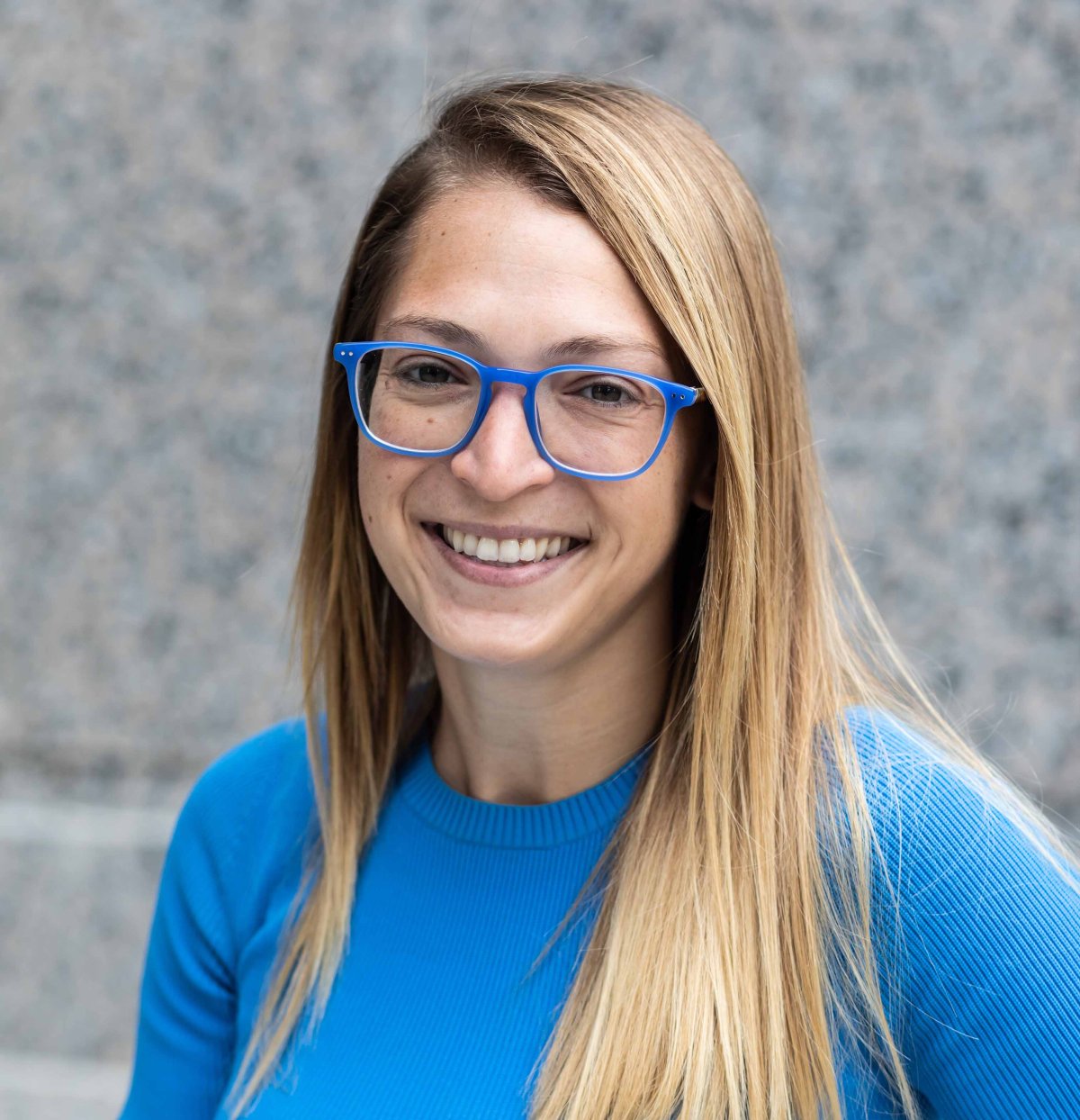
Michelle Calabrese is an Assistant Professor in the Department of Polymer Science & Engineering at the University of Minnesota (College of Science and Engineering). Her research focuses on designing novel soft materials using advanced rheological and neutron scattering techniques, alongside developing new scattering instruments and analysis methods. Key application areas include drug delivery, energy, and sustainable materials. She holds a B.S. from the University of Pennsylvania (2012), a Ph.D. from the University of Delaware (2017), and postdoctoral training at MIT (2017-2019). Research interests include rheology of complex fluids, biomaterials, and flow-induced material behavior. Notable awards include the McKnight Presidential Fellow (2025), Marion Milligan Mason Award (2025), and NSF CAREER Award (2021). Her lab has developed scalable biomass-derived microbeads and magnetic-field responsive polymers. Current projects involve hydrogel design for ear infection treatments and advanced scattering techniques. Advising includes graduate students such as Dr. Kathleen Lauser (now at Bristol-Myers Squibb) and Dr. Benjamin Robertson (now at PPG). Collaborations include NIST and ILL scattering facilities. Lab members actively pursue diversity, equity, and inclusion initiatives within STEM.
Professor Shuichi Iwata is a distinguished faculty member at Nagoya Institute of Technology, where he serves in the Department of Life and Applied Chemistry within the Graduate School of Engineering. His research focuses on fluid dynamics, rheology, and polymer processing, with particular expertise in bubble dynamics in non-Newtonian fluids and pressure-oscillation defoaming techniques. He has established himself as a leading researcher in transport phenomena and unit operations within chemical engineering. Dr. Iwata's educational background includes: Doctor of Engineering from Kyoto University Master of Engineering from Nagoya Institute of Technology Bachelor's degree from Nagoya Institute of Technology, Faculty of Engineering, Department of Applied Chemistry Professor Iwata's research interests span multiple domains of chemical and mechanical engineering with a strong emphasis on practical applications. His primary focus is on fluid engineering and rheology , particularly examining bubble dynamics in viscoelastic and shear-thinning fluids. He has pioneered innovative pressure-oscillation defoaming techniques for non-Newtonian fluids, addressing significant industrial challenges in polymer processing and chemical manufacturing. His work bridges fundamental fluid mechanics with practical engineering solutions, with applications in environmental load reduction and remediation. Recent research has expanded into biomaterials science , particularly examining polymer-water interactions for CO 2 capture membranes and antifouling surfaces. Analysis of Professor Iwata's publication record reveals a consistent research trajectory focused on fluid dynamics in complex systems. His work demonstrates a progression from fundamental numerical methods for viscoelastic fluid flow to increasingly sophisticated experimental and computational approaches examining bubble behavior under various conditions. A significant portion of his research involves molecular dynamics simulations to understand polymer-surface interactions at the microscopic level, while maintaining strong connections to industrial applications in chemical processing, membrane technology, and biomedical engineering. His interdisciplinary approach connects chemical engineering principles with materials science, biophysics, and environmental engineering. Professor Iwata has received numerous prestigious awards recognizing his contributions to engineering science: Japan Society of Rheology Paper Award (2021) Nagoya Institute of Technology Faculty Evaluation Outstanding Award (multiple years: 2010-2018) 28th Nagai Academic Prize (2011) Society of Chemical Engineering of Japan Frontier Award (2009) As an active researcher, Professor Iwata has secured substantial competitive funding, including multiple Japanese Ministry of Education, Culture, Sports, Science and Technology (MEXT) Grants-in-Aid for Scientific Research. His current projects focus on pressure-oscillation techniques for bubble removal in complex fluids, with applications spanning chemical processing, biomedical engineering, and environmental technology. He has successfully translated research into practical applications, evidenced by multiple patents related to continuous bubble removal methods and devices. Professor Iwata actively contributes to the academic community through editorial roles, including as Editor of the Journal of Chemical Engineering of Japan, and regularly organizes sessions at major conferences on non-Newtonian fluid dynamics. Professor Iwata leads a dynamic research group at Nagoya Institute of Technology focused on advanced fluid mechanics and transport phenomena. His laboratory combines experimental, computational, and theoretical approaches to study complex fluid behaviors, with particular emphasis on bubble dynamics in non-Newtonian systems. The research team collaborates extensively with both academic institutions and industry partners, applying fundamental fluid mechanics principles to solve practical engineering challenges in chemical processing, polymer manufacturing, and environmental technology.
Japan Trivedi, PhD, P.Eng is a Professor in the Civil and Environmental Engineering Department at the University of Alberta . His research focuses on Enhanced Oil Recovery (EOR) , CO2 Sequestration , Unconventional Reservoirs , and integration of Machine Learning in reservoir simulation. His lab operates at the Natural Resources Engineering Facility (NREF) under the School of Mining and Petroleum Engineering . Research Areas: Chemical EOR (polymers, surfactants, nanofluids) CO2 utilization for EOR and storage Reinforcement Learning for SAGD optimization Extensional rheology of complex fluids Techniques: Reservoir simulation Machine learning integration Micromodel experiments Field-scale modeling Key Projects: Include CO2 EOR/sequestration, Tight Oil EOR, ASP polymer characterization, and real-time SAGD optimization. His group collaborates on underground coal gasification and fracture reservoir characterization . Teaching: Offers courses like PET E 377 - Modelling in Petroleum Engineering and PET E 649 - Advanced Reservoir Simulation , emphasizing numerical methods, EOR processes, and simulation tools.
Patrick Anderson is Dean of the Department of Mechanical Engineering and full professor specializing in structure and rheology of complex fluids at Eindhoven University of Technology (TU/e). He chairs the Polymer Technology group within the Institute for Complex Molecular Systems. His academic career spans over two decades since completing his PhD in Mechanical Engineering in 1999, with a one-year industry stint at Océ Technologies before joining TU/e. Professor Anderson's research focuses on: Structure development during flow of complex fluids Interfacial phenomena in polymer processing Additive manufacturing technologies Computational methods for analyzing interfacial flows Rheology of polymer blends and composites His recent publications reveal a strong interdisciplinary approach combining polymer science, rheology, and advanced manufacturing. The research shows increasing focus on sustainable materials like polylactic acid (PLA), 3D food printing applications, and electromagnetic interference shielding solutions using polymer nanocomposites. His methodology consistently integrates computational modeling with sophisticated experimental techniques such as in-situ X-ray and light scattering measurements across multiple length scales. Professional recognition includes: Chairmanship of the Dutch Society of Rheology Editorial Board membership for Macromolecular Materials Engineering International Advisory Board participation for polymer science journals Prestigious visiting professorships at UCSB, Stanford, and ETHZ Professor Anderson has developed educational materials including an interactive textbook for first-year mechanical engineering students published in 2024. His research group collaborates extensively with industry partners through projects like the Dutch Polymer Institute initiative ANGLE, demonstrating his commitment to translating fundamental understanding into practical applications across multiple sectors. He leads the Processing and Performance research group within the ICMS Core at TU/e, focusing on advancing quantitative predictive capability in polymer product design and manufacturing processes.
Professor Nathan Daczko is a distinguished metamorphic petrologist at Macquarie University's School of Natural Sciences, Department of Earth and Planetary Sciences, and a key member of the ARC Centre of Excellence for Core to Crust Fluid Systems. With a BSc in Computer Science and PhD in Geology from the University of Sydney, he has established himself as a leading researcher in crustal evolution and metamorphic processes. His work spans multiple scales from microstructure to large orogenic systems, with fieldwork conducted in New Zealand, Central Australia, Italy, and Antarctica. Professor Daczko's research focuses on the microstructural and microchemical changes that occur during melt-rock interaction, examining how mass transfer occurs through the deep crust. His work crosses discipline boundaries to explore igneous/structural mechanisms of melt migration and metamorphic processes. Field aspects of his research explore exposed lower crustal plumbing systems in ancient magmatic arcs (Fiordland, New Zealand), intracontinental orogens (Central Australia), extensional periods of the New England Orogen, and the Italian Alps (Ivrea-Verbano Zone). His publication record shows consistent high productivity, with numerous articles in top journals like Journal of Metamorphic Geology , Lithos , and Geology . His recent work demonstrates increasing focus on experimental approaches to melt-rock interaction and expanding geographical scope to include Antarctic research. The research themes consistently center on understanding melt migration pathways, deformation mechanisms in the deep crust, and the tectonic implications of these processes. 2022 – VC's Learning and Teaching Awards, Educational Leader Award 2021 – Faculty of Science and Engineering Awards, Excellence in Learning Innovation 2020 – Stillwell Award (Geological Society of Australia) 2018 – Earth and Planetary Sciences HDR Supervision Award 2010 – E.S. Hills Medal (Geological Society of Australia) 2006 – Australian Institute of Political Science NSW/ACT Young Tall Poppy Award Professor Daczko has supervised over 40 research students including PhD, Master's, and Honors candidates, with many completing their theses on topics related to melt-rock interaction, crustal deformation, and metamorphic processes. His research has been supported by more than 40 grants totaling millions of dollars from ARC, Macquarie University, Australian Antarctic Division, and other funding bodies. His work often involves collaboration with international researchers and utilizes advanced analytical facilities including synchrotron radiation and laser ablation systems. He maintains active involvement in professional societies including the Geological Society of Australia (1997-current), Geological Society of America, and American Geophysical Union (2002-current), as well as the Australasian University Geoscience Educators Network. His research continues to advance understanding of crustal evolution through innovative field and laboratory approaches to studying metamorphic processes.
Christopher John Ness is a Reader in Chemical Engineering at the University of Edinburgh's School of Engineering, where he serves as Deputy Director of Research. His research focuses on soft matter, particularly suspension rheology and granular materials. He leads an active research group investigating particle-based systems and their applications in industrial processes. His educational background includes a PhD in Engineering from the University of Edinburgh (2012-2016) and a BA, MEng in Chemical Engineering from Clare College, University of Cambridge (2007-2011). Prior to his current position, he held a Royal Academy of Engineering Research Fellow position at Edinburgh (2019-2025) and a Maudslay-Butler Research Fellowship at Pembroke College, Cambridge (2016-2019). Ness's research interests center on rheology, soft matter, granular materials, and particle-based simulation. His work explores the relationship between particle characteristics (shape, size, surface details) and flow behavior, with applications in industrial processes like wet milling and extrusion. His group develops computational models to understand fundamental flows in suspension systems. His recent publications show a strong trend toward understanding complex suspension behaviors, particularly in dense systems. His work spans both theoretical modeling and practical applications, with growing interest in the connections between microstructure and macroscopic rheological properties. Recent papers focus on homogeneous and inhomogeneous rheology, absorbing-state transitions, and nonmonotonic constitutive curves in granular flows. Fellow of the Higher Education Academy (2022) Royal Society RAMP Award (2021) RSC Inspirational Committee Award (2021) European Federation of Chemical Engineering Award (2016) Leverhulme Research Project Grant (2022) Royal Academy of Engineering Research Fellow (2019-2025) Ness actively supervises PhD and Master's students, with a current group of eight researchers. His research is supported by multiple grants including a Leverhulme Research Project Grant and previously a Royal Academy of Engineering Research Fellowship. He is recruiting PhD students for 2025 with potential funding available. His group collaborates with researchers across disciplines, including work with G. Melaugh, C. MacPhee, and S. Haeri on various projects. The Ness research group operates within the Chemical Engineering department at the University of Edinburgh, maintaining active collaborations with other institutions and participating in major conferences including the Granular GRC and IWNMNNF meetings. The group has produced numerous publications in high-impact journals and maintains a strong presence in the rheology and soft matter research communities.
Markus Hütter is an Associate Professor in the Department of Mechanical Engineering at Eindhoven University of Technology (TU/e), where he serves as Chair of Multiscale Analysis of Polymer Systems. His research is conducted within the Processing and Performance group and he is affiliated with the Institute for Complex Molecular Systems (ICMS). Dr. Hütter holds a PhD in Materials from ETH Zurich (1999), completed a postdoctoral fellowship at MIT's Department of Chemical Engineering, and earned his Habilitation from ETH in 2006 before joining TU/e in 2010. His academic journey began with Theoretical Physics studies at ETH Zurich. Hütter's research focuses on the mechanics and thermodynamics of materials, particularly the mechanical behavior of complex fluids and solids. His expertise spans nonequilibrium thermodynamics, statistical mechanics, multiscale modeling, and coarse graining techniques. His group investigates structure-property relations, elasto-viscoplasticity of solids, damage mechanics, deformation-induced phase transitions, and kinetic theories for complex materials. A significant portion of his recent work centers on polymer glasses, including anisotropic viscoplastic deformation and microstructure-based modeling of aging and deformation processes. His publication record demonstrates a consistent focus on bridging molecular-scale phenomena with macroscopic material behavior, with recent articles emphasizing computational approaches to glassy states, polymer crystallization, and deformation mechanisms. His work often combines theoretical frameworks with molecular simulations to address challenges in polymer mechanics. Hütter teaches courses including Multiscale Modelling for Polymer Mechanics, Strength and Structure, Experimental and Numerical Skills, and Material Models, reflecting his expertise in connecting theoretical principles with practical engineering applications. His research is conducted through Group Hütter within the Processing and Performance group at TU/e, which maintains strong affiliations with the Institute for Complex Molecular Systems, enabling interdisciplinary collaboration on complex material systems.
Dr. hab. inż. Sylwia RÓŻAŃSKA is an Associate Professor at the Poznań University of Technology, Faculty of Chemical Technology, Institute of Chemical Technology and Engineering, Department of Chemical Engineering and Equipment. She holds a Doctor of Technical Sciences degree (2004) and a Habilitation degree (2019) in chemical engineering. Her educational background includes: Master of Science in Chemical Technology (2000), Poznań University of Technology, Faculty of Chemical Technology Doctor of Technical Sciences in Chemical Technology (2004), Poznań University of Technology, Faculty of Chemical Technology Habilitation degree in Technical Sciences, discipline: chemical engineering (2019), West Pomeranian University of Technology in Szczecin Dr. RÓŻAŃSKA's research focuses on the rheology of non-Newtonian fluids , particularly in longitudinal and shear flow. Her work extensively covers emulsions, polymer solutions, and surfactant systems , with special emphasis on their behavior in porous media. She has made significant contributions to understanding extensional rheology, which has applications in food processing, pharmaceuticals, and chemical engineering processes. Her recent publications demonstrate a strong focus on the rheological properties of complex fluid systems, particularly examining how additives like cellulose derivatives, surfactants, and salts affect fluid behavior. A significant portion of her work investigates the relationship between microstructure and rheological properties, with growing interest in applications for biomedical and pharmaceutical systems as evidenced by her 2024 publication on thermosensitive hydrogels for dental applications. She is actively involved in scientific cooperation with the Department of Chemical Engineering, Division of Soft Matter Rheology and Technology at KU Leuven, Belgium. Dr. RÓŻAŃSKA teaches courses in Chemical Engineering, Engineering of selected processing processes, Technical rheology, Process kinetics, and Chemical engineering and mixture separation processes. She serves on the Faculty Examination Committee for second-cycle studies in chemical and process engineering and is a member of the team for the quality of education.
Nick O. Jaensson is an Assistant Professor (tenure track) in the Processing and Performance of Materials group at Eindhoven University of Technology (TU/e). He holds affiliations with the ICMS and is part of the Mechanical Engineering department. His research focuses on numerical methods for soft materials, including complex fluids like suspensions, emulsions, and polymeric liquids. He collaborates with industry on optimizing processes such as microfluidics and material processing. Academic Background: Master's in Biomedical Engineering (2012) and PhD in Polymer Technology (2016), both from TU/e. Postdoc at ETH Zürich (2018) before joining TU/e in 2020. Research Interests: Non-Newtonian fluid mechanics, interfacial rheology, uncertainty quantification, and physics-informed machine learning. His work bridges fundamental insights into material microstructure and industrial applications. Award: Walters Prize (2018) for contributions to non-Newtonian fluid mechanics. Teaching & Courses: Advanced computational continuum mechanics, interfacial transport phenomena, and design/programming principles. Supervised 19 students (no names listed). Projects: Leads the DAMOCLES project (2021–2025), focusing on data-augmented modeling for engineering systems. Labs/Teams: Head of the Processing and Performance of Materials group, collaborating with experimental and computational teams.
Dr. Gemma Houston is a Teaching Professor in the Mechanical & Aerospace Engineering department at the University of Strathclyde , part of the Faculty of Engineering. She holds an Associate Fellowship of the Higher Education Academy (AFHEA) recognizing her commitment to teaching excellence. Her research focuses on fluid mechanics and microfluidics, particularly viscoelastic fluid behavior in complex geometries. She has received multiple teaching awards, including the Strathclyde Union's Teaching Excellence Awards in 2018 and 2023, and was nominated for the Celebrate HER Women+ in Leadership Award in 2024. Education: PhD in Engineering (2023) - University of Strathclyde (Thesis: 'Newtonian and viscoelastic fluid flows in extensional microfluidic devices with multiple fluid streams') Research Interests: Microfluidic device design and analysis Viscoelastic flow instabilities Multiphase flow dynamics Engineering education and student resilience Her recent work explores flow focusing phenomena and stabilization strategies in microfluidic systems, with applications in rheology and industrial fluid processing. Collaborative projects include EPSRC-funded research on microfluidic device optimization. Grants: EPSRC National Productivity Investment Fund (NPIF) Innovation Placements (2019) Doctoral Training Partnership (DTP) 2016-2017 (Research Co-investigator) Labs/Teams: Active in the Mechanical & Aerospace Engineering research group at Strathclyde, focusing on fluid dynamics and engineering education initiatives.
Dr Vedad Dzanic is a Postdoctoral Research Fellow at Queensland University of Technology (QUT), working within the Faculty of Engineering, specifically the School of Mechanical, Medical & Process Engineering. His research focuses on complex fluid dynamics with particular emphasis on viscoelastic fluids, elastic turbulence, and computational modeling approaches. Dr Dzanic completed both his PhD and Bachelor of Mechanical Engineering at Queensland University of Technology, establishing a strong foundation in engineering principles and computational methods that inform his current research. His research interests span multiple areas of fluid mechanics, with particular focus on viscoelastic fluid behavior , elastic turbulence phenomena , porous media flow , and computational fluid dynamics . His work bridges theoretical fluid mechanics with practical applications in areas such as enhanced oil recovery, multiphase flows, and non-Newtonian fluid processing. Dr Dzanic employs advanced numerical techniques, particularly lattice Boltzmann methods, to investigate complex fluid phenomena that are challenging to study experimentally. Analysis of his recent publications reveals a clear trajectory of research focused on understanding and modeling viscoelastic instabilities across various flow regimes. His work spans from fundamental investigations of droplet deformation in shear flows to practical applications in porous media systems relevant to petroleum engineering. A consistent theme is the development and refinement of computational methods to accurately capture the complex physics of viscoelastic fluids, with increasing sophistication in handling electrohydrodynamic effects, crystallization phenomena, and plasticity influences. Dr Dzanic has established a productive research collaboration with Professor Sauret and colleagues From and Gupta, resulting in numerous high-impact publications in leading fluid dynamics journals including Physics of Fluids, Journal of Fluid Mechanics, and Physical Review Fluids. His research demonstrates strong methodological development alongside application-focused investigations. His work is centered within QUT's fluid dynamics research group, which appears to have strong capabilities in computational modeling of complex fluids, with particular expertise in lattice Boltzmann methods applied to non-Newtonian fluid systems.
Marc Jaeger is a Professor at Aix-Marseille University, affiliated with the M2P2 Institute (Institut de Mécanique des Fluides et des Solides de Marseille, UMR 7340). He leads the Small-scale Processes and Mechanics research team, focusing on fundamental fluid dynamics with applications in nuclear energy and biomedical engineering. His research spans: Microscale and nanoscale fluid dynamics Multiphase flows with separated phases Thermal hydraulics in nuclear systems Vesicle, capsule, and red blood cell mechanics Computational methods (boundary element, isogeometric analysis) Jaeger integrates theoretical modeling, numerical simulation, and experimental validation to address complex fluid-structure interactions in confined and multiphase environments. Analysis of his 2014-2024 publications reveals a dominant focus on deformable particle dynamics in flow. Key trends include vesicle/capsule behavior under shear/extensional flows, surfactant effects on droplet stability, and computational advances for biological flows. Recent work (2023-2024) emphasizes biomedical applications like red blood cell modeling and nuclear safety through thermal hydraulics. The Small-scale Processes and Mechanics team under Jaeger investigates microscale fluid phenomena using interdisciplinary approaches that bridge fluid mechanics, computational science, and biophysics for energy and healthcare solutions.
Dr. Monica Oliveira is a Senior Lecturer in the Department of Mechanical & Aerospace Engineering at the University of Strathclyde. She holds a PhD in Chemical & Process Engineering from Heriot-Watt University and a degree in Chemical Engineering from the University of Porto. Her research focuses on fluid flows and transport phenomena, particularly the rheology of complex fluids and microfluidics. She has been affiliated with institutions like MIT and CEFT, and her work appears in journals such as Physical Review Letters and Journal of Fluid Mechanics. Her expertise includes computational fluid dynamics, microdevice design, and rheology (shear and extension). Key projects include designing microfluidic components for extensional rheometry and developing biofluid analogues. She leads several research projects, including the DTP 2224 and KTP collaborations. Awards include the Chaires Paris-Science 2024 Invited Professorship and FEUP Scientific Incentive Prize. Her research integrates fundamental flow physics with biomedical applications, such as ophthalmic viscosurgical devices and blood flow dynamics in aneurysms. Recent publications address topics like ferrofluid emulsions, viscoelastic instabilities, and microscale mixing. She actively participates in international conferences and serves roles in professional societies like the European Society of Rheology. Her lab focuses on optimizing microfluidic geometries for precise fluid characterization and biomedical applications.
Barbara E. John is a Professor in the Department of Geology and Geophysics at the University of Wyoming, specializing in Structural Geology, Tectonics, and Igneous Processes. Her research focuses on deformation processes in oceanic and continental lithosphere, with emphasis on oceanic core complexes, detachment fault systems, and magmatic accretion at mid-ocean ridges. Research utilizes field geology, geochronology, petrology, and geophysical methods to study lower oceanic crust evolution. Major projects include IODP drilling at Atlantis Bank (SW Indian Ridge) and Pito Deep. Awards include the 2018 U.C. Santa Barbara Distinguished Alumnus Award and 2018 IPGP Directors' Fellowship.
Dr. Jacinta C. Conrad is the Frank M. Tiller Professor of Chemical Engineering at the University of Houston's Cullen College of Engineering, within the William A. Brookshire Department of Chemical and Biomolecular Engineering. She is an Executive Editor at ACS Applied Nano Materials and holds prestigious fellowships from the American Physical Society and the Society of Rheology. Education: Ph.D. & M.A. in Physics, Harvard University (2005, 2002) S.B. in Mathematics, University of Chicago (1999) Postdoctoral Research in Materials Science at University of Illinois (2005–2009) Research Focus: Her group investigates transport dynamics in soft materials and complex matrices, including colloids, nanoparticles, bacteria, and proteins. Key areas include: Microscale particle behavior in confined environments Biofilm formation and bacterial motility Nanoparticle dispersion in porous media Development of antifouling materials and medical diagnostics Publications & Impact: Over 100 peer-reviewed articles span interdisciplinary topics like nanoparticle dynamics, polymer brush functionality, and viral diagnostic tools. Recent work emphasizes ultrasensitive biosensors and environmental remediation strategies. Labs & Collaborations: The Conrad Lab integrates microscopy, microfluidics, and computational modeling. Key collaborations include projects with Megan Robertson (UH ChBE) on bacterial adhesion, and Patrick Cirino (UH ChBE) on synthetic biology. Research has practical applications in bioremediation, medical diagnostics, and advanced materials.