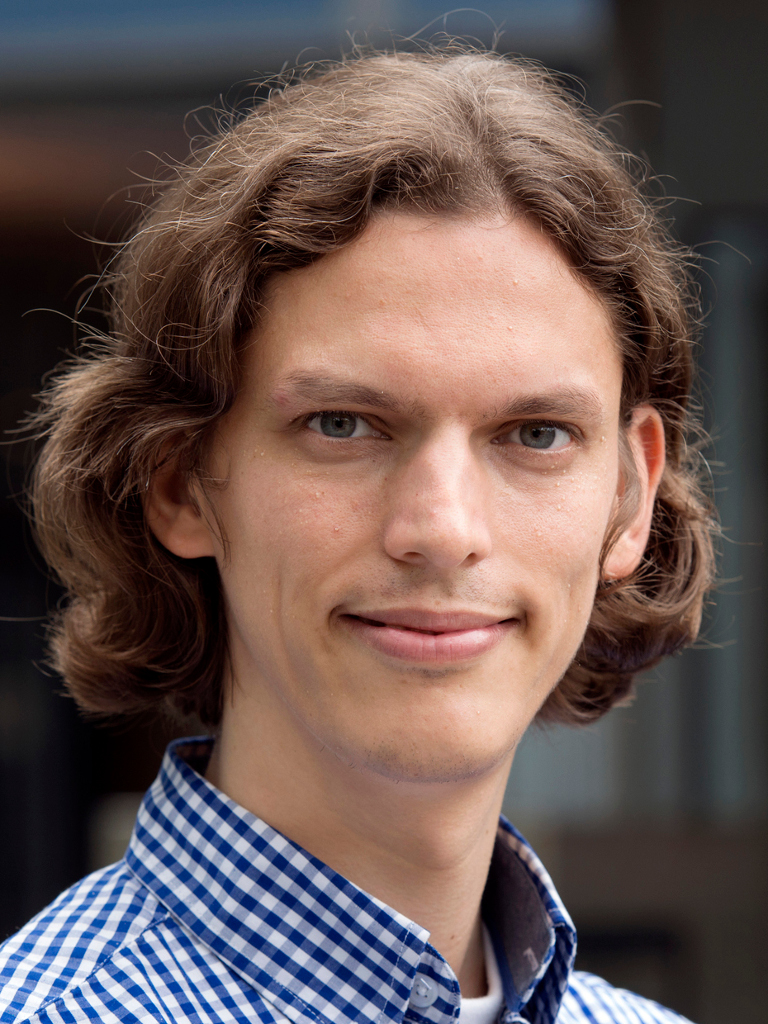
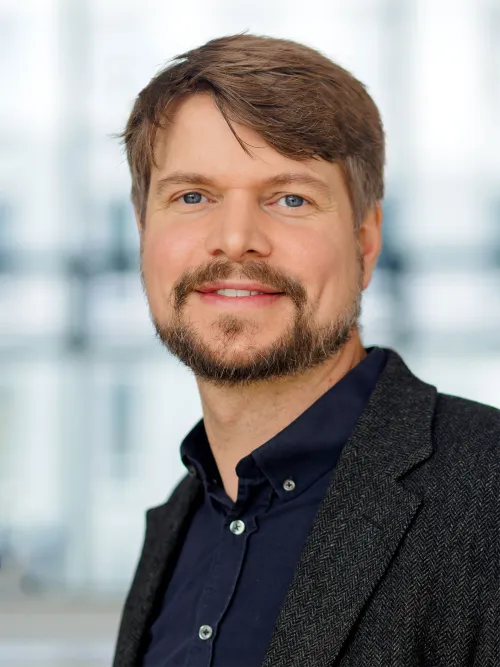
Siegfried Nijssen is an Assistant Professor of Data Mining and Artificial Intelligence at the Catholic University of Louvain (UCLouvain) in Belgium, working within the ICTEAM research institute's Artificial Intelligence and Algorithms group. He has been at UCLouvain since 2016, previously serving as an Assistant Professor at University Leiden (2012-2016) and completing postdoctoral work at KU Leuven (2006-2015). He earned his PhD in Computer Science from University Leiden in 2006. His research focuses on making data analysis simpler through intersections between pattern mining, exploratory data analysis, and programming paradigms in Artificial Intelligence, particularly constraint programming and probabilistic programming. He has developed techniques for analyzing diverse data types including graphs, networks, and multi-relational data. His work bridges theoretical foundations with practical applications in decision tree learning, probabilistic networks, and source code analysis. Nijssen's recent publications demonstrate a strong focus on optimal decision trees, constraint-based pattern mining, and applications in bioinformatics and education. His research shows consistent evolution from foundational graph mining work (including the Gaston algorithm developed in 2004) to current work integrating machine learning with constraint programming for interpretable AI solutions. As an educator, he teaches courses including Mining Patterns in Data, Databases, and Artificial Intelligence and Machine Learning seminars at UCLouvain. He has advised numerous PhD students and postdocs, primarily in collaboration with Pierre Schaus, with former students like Tias Guns now holding professorships.
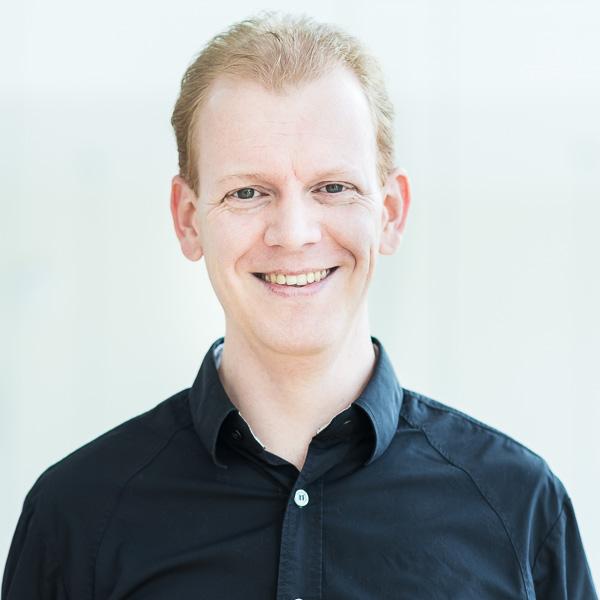
Patrick Pollok serves as Assistant Professor at the Institute for Technology and Innovation Management (TIM) at RWTH Aachen University, where he leads the Business Transformation Lab. His research focuses on leveraging external actors—particularly crowds and communities—for corporate innovation and analyzing organizational change processes driven by digitalization and sustainability. Pollok's primary research interests include Open Innovation, Crowdsourcing Platforms, Digital Transformation, and Business Model Innovation. His work investigates how firms effectively harness external creativity and navigate transformation challenges, with recent studies examining knowledge diversity in teams, platform strategies, and managerial attention allocation in innovation ecosystems. He emphasizes practical applications through industry collaborations. His publication record demonstrates consistent high-impact output since 2011, with accelerating contributions from 2019-2025. The 15 most recent articles reveal evolving focus areas: early work centered on crowdsourcing mechanics (2015-2019), while recent publications (2021-2025) expand into platform ecosystems, CEO decision-making in cleantech, and attention dynamics in exploratory innovation. Key journals include Research Policy and Journal of Product Innovation Management. Pollok actively partners with industry to implement innovation methods and develop new business models, translating theoretical insights into practical frameworks. His collaborations with Dirk Lüttgens, Frank Piller, and international researchers highlight strong interdisciplinary networks. He directs the Business Transformation Lab, which serves as an experimental hub for studying digital and sustainable innovation processes. The lab facilitates industry-academia knowledge exchange through applied projects on crowdsourcing implementation, platform strategy development, and business model transformation.
Prof. Dr. Jilles Vreeken is tenured faculty at the CISPA Helmholtz Center for Information Security , where he leads the Exploratory Data Analysis group. He also serves as an Honorary Professor at Saarland University . Research focuses on causal inference, machine learning, and data mining Develops unsupervised methods for robust, interpretable models PI on grants like HAICU's Neuro-Explicit Models and Crushing Antimicrobial Resistance His recent work spans causal discovery in non-stationary time series ( SPACETIME ), federated binary matrix factorization, interpretable neural search patterns, and data modification rule mining from event logs. He applies information-theoretic approaches to address hidden confounding, selection bias, and multi-environment causal modeling. Key trends in his publications include: Integrating causal inference with machine learning via algorithmic Markov conditions Advancing federated learning for privacy-preserving causal discovery Creating interpretable pattern mining frameworks for graphs, sequences, and high-dimensional data Developing MDL-based methods for reliable dependency and rule discovery Scientific Recognition: 2018 - IEEE ICDM Tao Li Award 2018 - IEEE ICDM Best Paper 2015 - UdS-CS Busy Beaver Teaching Award 2011 - ACM SIGKDD Best Student Paper 2010 - ACM SIGKDD Doctoral Dissertation Runner-Up 2009 - ECML PKDD Best Student Paper As an educator, he has supervised 15+ PhD/MSc students and taught courses like Topics in Algorithmic Data Analysis and Information-Theoretic Machine Learning . His research group pioneers methods for trustworthy information processing and causal anomaly detection , with applications in materials science, epidemiology, and cybersecurity.
Joseph Chee Chang is a researcher at Carnegie Mellon University's Human-Computer Interaction Institute. His work focuses on Human-Computer Interaction Artificial Intelligence Natural Language Processing He develops tools for scholarly synthesis, literature review, and research ideation. Research Highlights Chang designs mixed-initiative systems like IdeaSynth for research idea development and Social-RAG for socially grounded AI generation. His PaperWeaver system recontextualizes academic recommendations, while Qlarify offers hierarchical paper summaries. Current projects include SciArena (2025) for evaluating scientific foundation models and PaperMage (2023) for document processing.
Jaap Kamps is a Professor at the University of Amsterdam, Netherlands , with a focus on information retrieval , natural language processing , and machine learning . His work spans theoretical and applied research, including contributions to neural ranking models domain adaptation scientific text simplification exploratory search digital libraries for enhanced user access. Recent research highlights include revisiting bag-of-words representations for transformers, context embeddings for retrieval-augmented generation, and positional bias analysis in generative systems. He actively contributes to the CLEF SimpleText Track , promoting simplified scientific communication for diverse audiences. His collaborations involve co-authors like David Rau , Mostafa Dehghani , and Hosein Azarbonyad , with publications in venues such as ACM Transactions on Information Systems and ECIR . He mentors students and participates in conferences like ICTIR and SIGIR , driving advancements in efficient text ranking and user-centric search.
Prof. Dr. Heike Trautmann is a leading researcher in statistics and optimization at the University of Twente (2021-2026) and former Professor at WWU Münster (2013-2016). Her work bridges computational statistics, evolutionary optimization, and social media analytics. She has held visiting positions at TU Dortmund, Leiden University, and RWTH Aachen. Current affiliation: University of Twente (Data Science: Statistics and Optimization) Previous roles: WWU Münster (Professor for Information Systems and Statistics), TU Dortmund (Postdoctoral researcher) Research Focus: Multi-criteria optimization, automated algorithm selection, data stream mining, and disinformation detection in social media. Her methodological innovations in exploratory landscape analysis and evolutionary computation have transformed algorithm configuration practices. Developed COSEAL consortium for algorithm selection Co-founder of Benchmarking Network (2019) Principal investigator in projects like PropStop and MODERAT! Academic Contributions: Over 150 publications in top venues like GECCO, PPSN, and Evolutionary Computation journal. Pioneered feature-based landscape analysis tools (flacco, pflacco) and stream clustering frameworks.
Max Planck Institute for Security and PrivacyGermany
Gordon Fraser is a Professor at the University of Passau, where he leads the Chair of Software Engineering II. His research focuses on software testing, automated test generation, and software engineering education, with particular emphasis on gamification techniques to improve testing practices and educational approaches for novice programmers. His research interests span multiple areas of software engineering, with a strong focus on practical testing solutions. He has made significant contributions to automated test generation, particularly for Android applications and block-based programming environments like Scratch. His work on gamification in software testing has led to innovative educational tools that engage students and professional developers alike. Fraser's research also addresses challenges in continuous integration, mutation testing, and flaky test detection, contributing to more reliable software development processes. Fraser has received recognition through his extensive publication record in top software engineering venues including ASE, ICSE, ISSTA, and ESEC/FSE. His work on tools like Pynguin (for Python test generation), Gamekins (for gamifying testing in Jenkins), and Code Critters (for teaching testing through games) demonstrates his commitment to bridging research and practical applications. Extensive research on automated test generation techniques Pioneering work in gamification of software testing education Significant contributions to testing block-based programming environments Active development of practical testing tools used by researchers and practitioners As an educator, Fraser has developed innovative approaches to teaching software testing concepts, particularly to young learners and novice programmers. His work integrates game design principles with software engineering education to create engaging learning experiences that improve comprehension and retention of testing concepts.
Pascal Kerschke is a researcher at TU Dresden, Germany, with extensive contributions to evolutionary computation, continuous optimization, and exploratory landscape analysis. He actively collaborates with leading researchers in automated algorithm selection and metaheuristics. Research Interests: Automated Algorithm Selection using machine learning and landscape features Exploratory Landscape Analysis (ELA) for characterizing optimization problems Multi-objective and multimodal optimization Traveling Salesperson Problem (TSP) and local search heuristics Development of benchmark problems and performance indicators Integration of deep learning in optimization analysis Recent Publication Trends: His recent work (2022–2025) emphasizes deep learning for landscape analysis (e.g., Deep-ELA), rigorous benchmarking of optimization algorithms, visualization of multi-objective landscapes, and improving automated algorithm selection through better feature engineering and instance selection. He also investigates theoretical aspects of performance indicators like the R2 indicator. Scientific Awards: No specific awards are mentioned in the provided data. Advising and Grants: While no formal grants are listed, his frequent co-authorship with junior researchers such as Lennart Schäpermeier, Moritz Vinzent Seiler, and Jonathan Heins suggests an active mentoring or supervisory role. He contributes to collaborative projects like the Dagstuhl Seminar on benchmarking challenges and works with tools such as OpenML and FLACCO, indicating involvement in community-driven research initiatives. Labs and Teams: He is part of a vibrant research group at TU Dresden focused on evolutionary algorithms and optimization, collaborating closely with Heike Trautmann, Mike Preuss, and Christian Grimme. His work is integrated into larger efforts in automated machine learning and benchmarking, including participation in workshops and tutorials at major conferences like GECCO and PPSN.
Gianmaria Silvello is a researcher at the University of Padua , Department of Information Engineering. His work spans data science, biomedical informatics, algorithmic fairness, and digital libraries. Research Interests : Knowledge Graph Accuracy Estimation Ethical AI & Data Governance Biomedical Data Curation Algorithmic Fairness & Bias Auditing Digital Library Systems Provenance Tracking in Research Notable Contributions : Co-developer of the CoreKB medical knowledge base platform, TBGA gene-disease dataset, and MedTAG biomedical annotation tools. His 2025 work on database impact metrics with Buneman et al. redefines data citation analysis. Collaborative Networks : Partnerships with institutions across Italy, Switzerland, and Spain, including projects like BRAINTEASER for ALS/MS patient data and iDPP@CLEF for disease progression prediction challenges.
Róbert Móro is a Senior Researcher at the Kempelen Institute of Intelligent Technologies (KInIT), focusing on artificial intelligence, machine learning, and misinformation detection. He holds a PhD in Intelligent Software Systems from the Slovak University of Technology (2017), where he also served as an Assistant Professor (2017–2020), teaching Intelligent Data Analysis. His work emphasizes user modeling, personalization, and ethical AI applications. Professional affiliations include membership in ACM (Slovak Chapter Secretary) and Slovak.AI. He has contributed to over 10 national/international research projects, including Horizon Europe initiatives like VIGILANT (disinformation crime analysis) and Eyes4ICU (eye-tracking research). Key research interests span misinformation detection in healthcare, algorithmic auditing, and eye-tracking biomarkers for cognitive states. His publications address YouTube recommendation algorithms, EU disinformation policies, and confusion detection through multimodal data. Supervised students have explored topics like fake news detection and user skill identification via eye-tracking. Current research integrates AI ethics, regulatory frameworks, and adaptive systems for combating online misinformation.
Hiba Arnaout is a postdoctoral researcher at the Ubiquitous Knowledge Processing (UKP) Lab, Department of Computer Science, TU Darmstadt, where she also served as a part-time lecturer from April to July 2024. She earned her PhD from the Max Planck Institute for Informatics under the supervision of Prof. Gerhard Weikum and Prof. Simon Razniewski, and her Master's and Bachelor's degrees from the American University of Beirut and Haigazian University, respectively. Education: PhD in Computer Science, Max Planck Institute for Informatics, Saarbrücken, Germany (Feb 2018 – Oct 2023) Master of Computer Science, American University of Beirut, Lebanon (Feb 2014 – Feb 2017) Bachelor of Computer Science, Haigazian University, Beirut, Lebanon (Feb 2010 – Jun 2013) Research Interests: Hiba's work lies at the intersection of Artificial Intelligence, Natural Language Processing, and Knowledge Graphs . She specializes in discovering and utilizing negative knowledge in open-world knowledge bases like Wikidata. Her current research extends into AI for mental health , research impact analysis , and culturally-aware NLP . She has pioneered methods for enriching knowledge graphs with informative negative statements, leading to interactive systems like UnCommonSense and Wikinegata . Publication Trends: Her recent publications (2023–2025) reflect a clear trajectory from foundational work on negation in knowledge bases toward broader applications in research evaluation and mental health. She increasingly employs large language models and temporal analysis, demonstrating a shift toward impact-driven and human-centric AI research. Her work spans journals, conferences, demos, and books, showcasing both technical depth and dissemination excellence. Scientific Awards: Semantic Web Science Association (SWSA) Distinguished Dissertation Award (2024) Bosch Reward for invention: Knowledge Graph Repair Using Ontologies and LMs (2022) Audience-choice Best Paper Award at AKBC (2020) Best Student Paper Award Nominee at IC3K'17 (2017) Full Graduate Assistantship at AUB (2014) Participation in DFG grant discussion (2021) Advising and Grants: Hiba actively supervises students, currently guiding multiple BSc and MSc theses on topics like mental health trend tracking, culturally-aware emotional support, and therapy session annotation. While no direct grant leadership is mentioned, she contributed to a DFG grant proposal on negative knowledge and has received recognition from Bosch for her inventive work, indicating strong industry and academic collaboration. Labs and Teams: She is a core member of the Ubiquitous Knowledge Processing (UKP) Lab at TU Darmstadt, led by Prof. Iryna Gurevych. Previously, she was affiliated with the Databases and Information Systems Group at Max Planck Institute for Informatics and collaborated with researchers at The University of Edinburgh and Bosch Center for Artificial Intelligence.
Professor Heike Trautmann is a distinguished academic at Paderborn University, where she serves as Professor of Machine Learning and Optimisation in the Department of Computer Science within the Faculty of Computer Science, Electrical Engineering and Mathematics. Since April 1, 2025, she also holds the position of Vice President for International Relations at the university. Her academic career spans prestigious institutions including the University of Münster, where she was Professor of Data Science: Statistics and Optimization from 2013 to 2023, and the University of Twente, where she serves as Guest Professor of Data Science until February 2026. Dr. Trautmann's educational background includes: University Studies in Statistics (Diploma), TU Dortmund, Germany (1997-2000) University Studies in Economic Mathematics (First Diploma), TU Dortmund, Germany (1996-1998) PhD student at Graduate School of Production Engineering and Logistics, TU Dortmund University (2002-2004) Habilitation in Statistics, TU Dortmund University, Germany (April 15, 2013) Professor Trautmann's research program centers on cutting-edge topics in artificial intelligence and optimization. Her primary research interests include (Trustworthy) Artificial Intelligence, Machine Learning, Data Science, Automated Algorithm Selection and Configuration, Exploratory Landscape Analysis, (Multiobjective) Evolutionary Optimisation, and Data Stream Mining. She leads the Machine Learning and Optimisation research group at Paderborn University, which develops innovative approaches for understanding and improving optimization algorithms through landscape analysis and automated configuration techniques. Her work bridges theoretical foundations with practical applications, particularly in the domains of trustworthy AI and algorithm selection. Her extensive publication record reveals a clear trajectory toward increasingly sophisticated integration of deep learning with traditional optimization techniques. Recent work demonstrates a strong focus on multi-objective optimization problems, exploratory landscape analysis using deep learning methods, and the development of automated algorithm configuration systems. A notable trend is the application of transformer architectures to landscape analysis, as seen in her Deep-ELA work, which represents a significant innovation in the field. Her research consistently addresses the challenge of characterizing complex optimization problems to enable better algorithm selection and configuration. Professor Trautmann has received notable recognition for her scholarly contributions, including: GECCO Best Paper Award for "Deep reinforcement learning for instance-specific algorithm configuration" As an academic leader, Professor Trautmann has secured significant research funding for projects including "Towards Robustness of Disinformation Campaign Detection Algorithms in Open Online Media in the Context of Trustworthy AI" and "Automated rail transport as a backbone for sustainable, networked mobility in rural areas." She actively mentors students through her teaching of advanced courses in machine learning, optimization, and data science. Her industry connections, stemming from her previous work as an Analytics Consultant at Roland Berger Strategy Consulting, enable her to bridge academic research with practical applications. Professor Trautmann leads the Machine Learning and Optimisation research group at Paderborn University, which collaborates extensively with international partners. She is a key supporter of the Confederation of Laboratories for Artificial Intelligence Research in Europe (CLAIRE) and a member of the European Research Center for Information Systems (ERCIS). Her group maintains strong connections with research centers across Europe, particularly through her involvement with the Transregional Collaborative Research Centre 318.
Pascal Kerschke is a Professor at the Chair of Big Data Analytics in Transportation at TU Dresden, Germany. Previously, he held positions at the University of Münster, including Head of the Research Group for Machine Learning and Data Science. His research focuses on Exploratory Landscape Analysis, Black-Box Optimization, Algorithm Selection, and Multi-Objective Optimization. He earned his PhD in Information Systems from the University of Münster (2013–2017), and Master's and Bachelor's degrees in Data Science and Management from TU Dortmund. Education: PhD in Information Systems, University of Münster (2013–2017) MSc in Data Science, TU Dortmund (2010–2013) BSc in Data Analysis and Management, TU Dortmund (2007–2010) His research interests span algorithm selection, multi-objective optimization, and the application of machine learning in optimization problems. He has contributed to the development of the R package flacco for landscape analysis and co-organized conferences like EMO 2017. Awards include the Dissertation Prize (2018) and PPSN XIV Best Paper Award (2016). He has supervised over 15 students and actively participates in initiatives like the Benchmarking Network and COSEAL. Key projects include work on automated algorithm selection, multimodal optimization, and benchmarking frameworks for iterative heuristics.
Prof. Dr. Ben Heuwing is a Part-time Professor for Usability and User Experience at the University of Applied Sciences Potsdam and concurrently serves as Unit Manager at ]init[ AG in Berlin, specializing in administration digitization and process automation. His academic work focuses on bridging industry practices with research in human-computer interaction. Education: 2015: Doctorate (Dr. phil.) in Information Science from University of Hildesheim, dissertation: Usability results as a knowledge resource in organisations 2008: Master's degree in International Information Management from University of Hildesheim, thesis: Tagging for personal and collaborative information management 2005: Semester abroad at Dublin City University Research focuses on practical applications of user-centered design across multiple domains. Primary interests include web accessibility frameworks, agile development methodologies for public sector digitization, information architecture optimization, and gesture-based interface design. His work emphasizes empirical validation of usability methodologies in real-world organizational contexts. Publications demonstrate strong cross-disciplinary trends, with recent work converging on public administration digitization (33% of post-2018 publications) and historical text analysis tools (40% of 2016-2017 outputs). Earlier research established foundations in mobile interaction patterns and usability knowledge management systems, showing consistent focus on practical implementation of HCI theories. Professional activities include establishing and managing the Usability Lab at University of Hildesheim (2008-2017) and keynote presentations like Nutzerzentrierte Bürger-Services at BITKOM 2019. Industry contributions feature digitalization labs for governmental transformation at ]init[ AG.
GESIS – Leibniz Institute for the Social SciencesGermany
Dr. Simon Knight is a Lecturer at the University of Technology Sydney , specializing in epistemic cognition , learning analytics , and educational technology . His work bridges philosophy, psychology, and digital education to examine how individuals conceptualize knowledge and navigate information in the age of search. Key Research Areas : Epistemic literacy, source evaluation, collaborative learning tools, and analytics-driven pedagogy. Recent Projects : Development of performance assessments for multiple-document processing, analysis of epistemic commitments in online tasks, and integration of writing analytics with epistemic features. Methodologies : Mixed-method studies combining chat logs, pageview tracking, and discourse analysis to map learner cognition. Selected Publications explore epistemic uncertainty, search engine tasks, and science communication challenges. Knight emphasizes meta-discourse (e.g., source critiques, date considerations) and exploratory talk as critical for modern learners.