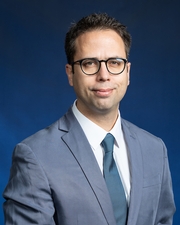
Dr. Laxima Niure Kandel is an Assistant Professor in the Department of Computer, Electrical, and Software Engineering at Embry–Riddle Aeronautical University. Her research spans wireless security, UAV detection, and cybersecurity, with a strong focus on AI-driven solutions for aviation and IoT systems. Her core research interests include: Wireless sensing and localization Machine learning applications in cybersecurity GPS spoofing detection for aviation RF fingerprinting for device authentication Adversarial resilience in deep learning models Recent publications (2025) demonstrate a dominant focus on transformer-based security models, UAV protection systems, and explainable AI. Over 80% of her latest work involves deep learning techniques applied to real-world threats like GPS spoofing, ADS-B attacks, and adversarial patches in autonomous vehicles.
Dr. Michael Dietz is a Researcher at the Chair of Human-Centered Artificial Intelligence ( University of Augsburg , Faculty of Applied Informatics, Institute of Informatics). His work focuses on Human-Computer Interaction , Mobile Assistive Systems , and Signal Processing with Machine Learning applications. Key research trends include: Development of mobile frameworks for real-time affective feedback (SSJ Framework, SenseEmotion) Augmented reality applications for public spaces and ambient media Privacy-preserving machine learning on mobile devices Physiological signal analysis for stress detection in older adults Eye-tracking innovations for visual search detection Explainable AI techniques in facial expression recognition Projects: EmmA (Emotional mobile Avatar) Glassistant (Smart Glasses for MCI patients) SenseEmotion (Multisensorial emotion recognition) SSJ Framework (Social Signal Processing)
Dr. Ilhan Akbas is an Associate Professor in the Electrical Engineering and Computer Science Department within the College of Engineering at Embry-Riddle Aeronautical University. He serves as Director of the Flexible & Intelligent Complex Systems (FICS) Research Group, Co-director of the Wireless Devices and Electromagnetics (WIDE) Lab, and holds leadership positions in the Center for Aerospace Resilient Systems (CARS) and the Advanced Air Mobility Research and Innovation Lab (AAMRIL). With over 20 years of experience in machine learning, complex systems, and modeling & simulation, Dr. Akbas's research focuses on validation and verification of autonomous systems, particularly in aerospace applications. His work develops methods for decision-making in high-dimensional, probabilistic scenarios with applications in autonomous vehicles, cybersecurity for unmanned aerial systems, and cyber-physical systems operating in dynamic/uncertain environments. Dr. Akbas's research has secured funding through grants from the National Science Foundation, Federal Aviation Administration, U.S. Air Force, Office of Naval Research, and industry partners. His publication record includes more than 30 journal and 80 conference papers in IEEE, ACM and AIAA venues, with recent work focusing on AI validation frameworks, autonomous vehicle safety testing, and cybersecurity for unmanned systems. His scientific contributions are recognized through his status as a Senior Member of IEEE and membership in several professional organizations including ACM, AIAA, SAE, the International Alliance for Mobility Testing and Standardization, the Complex Systems Society, and the Cyber Safety Commercial Aviation Team. Dr. Akbas actively mentors students through research projects and teaches courses including Computer Science Capstone Design, Digital Communications, and graduate thesis supervision. His research group utilizes advanced tools including Python, Julia, Rust, simulation environments like AirSim and CARLA, and hardware platforms including NVIDIA Jetson for edge computing applications.
Dr. Simon David Hirsbrunner serves as a team leader at the International Center for Ethics in Science and Technology (IZEW) at the University of Tübingen. As a media and social scientist, his research focuses on AI ethics, particularly examining the relationship between AI, ethics, and sustainability ("Sustainability in AI"), alongside high-risk applications of AI in education, police investigations, and personnel selection. His research interests span multiple critical domains: Application-oriented ethics and AI Ethics and Governance Data ethics and AI in educational contexts Open Science practices and Science & Technology Studies Technology Assessment and Digital media research Social science sustainability research Currently leading a Frontiers Research Topic on "AI contestability," Dr. Hirsbrunner investigates how AI systems can incorporate meaningful contestation mechanisms, especially in high-stakes decision contexts. His interdisciplinary approach bridges media studies, social science, and technical systems analysis. His publication record demonstrates consistent contributions to understanding algorithmic fairness across security applications, personnel systems, and educational technologies. He has made significant methodological contributions to climate change frame analysis using computational approaches and has explored openness challenges in digital media research. Professional recognition includes: Founding and board member of 'stsing - Science & Technology Studies in and through Germany' Co-spokesperson of the Open Science working group of the Society for Media Science Goethe Institute scholarship holder Expert consultant for multiple German government institutions including the Federal Foreign Office, DAAD, and environmental ministries With prior research positions at Freie Universität Berlin's Human-Centered Computing group, PIK, Wikimedia Deutschland, and adelphi think tank, Dr. Hirsbrunner brings extensive interdisciplinary experience to his work. His educational background includes MA degrees in International Relations (Geneva) and European Media Studies (Potsdam), plus a PhD in Media Ethnography from the University of Siegen. He actively engages in science communication through television discussions on AI in education and interviews exploring the cultural dimensions of climate change and digital media research methodologies.