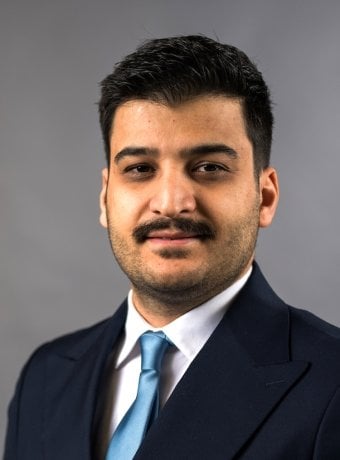
Sven Mayer is a Professor at TU Dortmund University’s Faculty of Computer Science and leads the Chair for Human-AI Interaction. He previously held a postdoctoral position at LMU Munich’s Media Informatics group and completed his PhD at Carnegie Mellon University (2014–2018). His research focuses on Human-AI/Robot Interaction , machine learning for touch systems , and sensor fusion . Recent work includes super-resolution capacitive touchscreens, pose estimation via smartphones, and city-scale sensing using retroreflective markers. The 15 most recent publications highlight trends in AI-driven interaction design , robot expressions , and smartphone-based sensing , with keywords spanning robotics, machine learning, and smart cities. Subdomains include contextual awareness, ergonomic constraints, and novel touch input paradigms. Scientific contributions recognized with Honorable Mention for 'Flyables' (2022) Honorable Mention for ISS piano learning paper (2022) . He has supervised projects in augmented reality and human-robot interaction courses , and frequently contributes to conferences like CHI, UIST, and MobileHCI as both author and organizational leader (e.g., Publications Chair at CHI 2022).
Stefan Decker is a full University Professor (Universitätsprofessor) at RWTH Aachen University, Germany, where he heads the Chair of Information Systems and Databases (Informatik 5) within the Faculty of Mathematics, Computer Science and Natural Sciences. He is actively involved in teaching, research, and the supervision of numerous ongoing and completed doctoral, master’s, and bachelor theses. Education & Academic Background Doctorate (Dr. rer. pol.) – field of Information Systems or related (exact institution/year not stated in text). Appointed as University Professor and Chair of Information Systems and Databases at RWTH Aachen University. Research Interests Prof. Decker’s work lies at the intersection of databases, knowledge graphs, semantic web technologies, data science, and cybersecurity . He investigates architectures and algorithms for large-scale, privacy-preserving, decentralized data analytics , develops ontology-driven information systems , and explores the use of large language models (LLMs) for educational technology, anomaly detection, and incident-response playbooks. Additional focal areas include smart energy systems, mixed-reality learning environments, FAIR data principles, and federated machine learning . Scientific Contributions & Trends His recent publications (2022-2025) demonstrate a clear trend toward explainable AI, LLM-enhanced systems, secure data spaces, and semantic interoperability . Key contributions include novel anomaly-detection frameworks for encrypted power-grid communications, knowledge-graph-driven chatbots for higher-education support, and methodological advances in decentralized analytics and FAIR data sharing. These works are disseminated in top-tier venues such as AAAI, IEEE ISGT Europe, ESWC, IDEAL, and various Springer LNCS and IEEE Transactions. Supervision & Grants Doctoral Theses Advised: A. T. Neumann – “Chatbots as professional companions in large-scale community information systems” (2024) S. M. Welten – “Methods for practical data sharing and decentralized analytics” (2025) Master’s Theses Co-Advised: A. R. Küsters – “Object-centric process constraints using variable bindings” (2025) Additionally supervising more than 30 ongoing bachelor, master, and doctoral projects covering topics such as LLM-driven cybersecurity playbooks, knowledge-graph construction for German law, privacy-preserving analytics in smart grids, and mixed-reality learning agents. Principal investigator or senior researcher in large collaborative projects including NFDI4DS, WestAI, champI4.0ns and several EU/national initiatives on sovereign data spaces and AI services. Labs & Teams Prof. Decker leads the Information Systems & Databases (DBIS) Research Group . The group operates well-equipped laboratories for knowledge-graph engineering, mixed-reality applications, privacy-enhancing technologies, and secure distributed analytics . Current team size exceeds 30 researchers including PhD candidates, postdocs, and scientific programmers, supported by national and EU funding streams.
Sanjay Modgil is a Professor of Artificial Intelligence at King's College London's School of Informatics, specializing in argumentation theory, non-monotonic logic, and AI applications in medicine. He contributes to ethical AI research aligned with UN Sustainable Development Goals. Research Interests Argumentation Theory Non-monotonic Logic Normative Reasoning Agent Reasoning AI in Healthcare Human-AI Collaboration His recent publications focus on depth-bounded reasoning, ethical debates, and large language models. He leads EPSRC-funded projects like CONSULT and RESPECT, emphasizing responsible AI technologies and multimorbidity management systems.
Haoyu Wang is a Researcher in the Computer and Information Science department at the University of Pennsylvania . He previously held research positions at Shanghai Jiao Tong University and interned at Google DeepMind , Amazon AWS , ByteDance , AI2 , Tencent AI Lab , and Goldman Sachs . Education : PhD in Computer and Information Science (2021–Present), MS in Computer and Information Science (2019–2021), BS in Computer Science (2015–2019). His research focuses on Event-Centric NLP/NLU , LLM Reasoning and Planning , Knowledge Graph , and Pose Estimation in Computer Vision . His work includes event causality identification, semantic classification in context, and synthetic control for temporal reasoning. He has contributed to multimodal hallucination analysis and safety in reasoning models through projects like RESIN-11 and Devil's Advocate . His publications span venues like EMNLP , EACL , and ACL . His recent articles analyze LLM limitations in NP-hard problems , clinical trial prediction , event causality , and hallucination in vision-language models . He has served as PC Member for conferences including ACL , NAACL , NeurIPS , and EMNLP since 2019.
Didier Meuwly is a Full Professor of Forensic Biometrics at the University of Twente (since 2013) and Principal Scientist at the Netherlands Forensic Institute (NFI). His work focuses on automating and validating probabilistic evaluation of forensic evidence, particularly biometric traces. He has contributed to international standards via ISO Technical Committee 272 and served as Associate Editor for Forensic Science International . PhD in Forensic Speaker Recognition (University of Lausanne, 2000) Research spans forensic biometrics, likelihood ratios, AI validation, and gait/body analysis from surveillance footage. Recent work addresses ISO standards (21043), forensic AI explainability, and multimodal evidence evaluation. His publications emphasize empirical validation and statistical rigor. Key awards include: ENFSI Distinguished Forensic Scientist Award (2022) University of Lausanne Law Faculty Prize (2002) Active in global forensic networks, he chairs the ENFSI R&D Committee and collaborates across disciplines on digital evidence, biometric security, and forensic methodology.
Erich Schweighofer serves as Associate Professor at the University of Vienna within the Institute for European, International and Comparative Law, specifically affiliated with the Department of International Law and International Relations. His research activities are centered at the Juridicum building (Schottenbastei 10-16, 1010 Vienna), where he maintains an active office presence with scheduled consultation hours. His scholarly focus spans Legal Informatics , Artificial Intelligence and Law , Data Protection , and Legal Knowledge Representation , with particular emphasis on explainable AI systems for legal contexts and formal methodologies for translating legal norms into computational frameworks. This interdisciplinary work bridges jurisprudence and computer science through projects examining biometric regulation, autonomous vehicle governance, and natural language processing applications in legal domains. Analysis of his 2021-2024 publications reveals consistent thematic progression toward operationalizing legal principles in AI systems, with increasing focus on transparency mechanisms, temporal logic for dynamic regulations, and cross-jurisdictional compliance challenges. His work predominantly appears in the International Legal Informatics Symposium (IRIS) proceedings and JURIX conferences, reflecting deep engagement with the legal informatics community. Professor Schweighofer leads a dedicated research team including project assistants Mag. Jessica Fleisch, Mag. Jonas Pfister, Felix Schmautzer, and Mag. Jakob Zanol, while actively participating in the University of Vienna's Working Group on Legal Informatics (Arbeitsgruppe Rechtsinformatik). His collaborative approach extends to organizing the biennial IRIS symposium, which has established itself as a cornerstone event for European legal informatics scholarship since 1998.
Chris Reed is a Professor of Electronic Commerce Law at Queen Mary University of London's School of Law, affiliated with the Centre for Commercial Law Studies (CCLS). He holds a BA from Keele University and an LLM from the University of London. His research focuses on AI regulation, blockchain governance, cloud computing law, and cyber law. He has contributed to EU directives on electronic signatures and commerce and advised parliamentary committees. Notable roles include Academic Dean of the Faculty of Law & Social Sciences (2004–2009) and Director of CCLS. His work bridges legal theory and digital innovation, addressing challenges in cross-border regulation, accountability in AI, and data governance. **Research Interests:** Artificial intelligence liability, blockchain applications in sustainability, cloud computing law, cross-border cyber regulation, and electronic commerce frameworks. His interdisciplinary approach addresses legal gaps in emerging technologies, emphasizing ethical and policy dimensions. **Professional Contributions:** Advised UK government on Hague Conference and OECD/G8 initiatives, participated in EU digital signature hearings, and contributed to international conferences. His publications span over decades, focusing on cyberspace jurisprudence, AI governance, and data trusts. He teaches postgraduate courses on e-commerce transactions and regulation. **Labs/Teams:** Active within CCLS, leading projects like the Cloud Legal Project’s Coursera specialization on cloud computing law. Collaborates globally on AI and blockchain governance.
Amin Mesmoudi serves as Associate Professor in Data Engineering at the University of Poitiers' IUT (Institut Universitaire de Technologie), with dual laboratory affiliations at LIAS-ENSIP (Poitiers campus) and LIAS-ISAE-ENSMA (Chasseneuil campus). His research bridges theoretical database systems with practical large-scale data engineering challenges, particularly in semantic web technologies and machine learning applications. The laboratory maintains physical presences at both ENSIP's Bâtiment B25 in Poitiers and ISAE-ENSMA's Téléport 2 facility in Chasseneuil, facilitating cross-institutional collaboration. Mesmoudi's research program centers on scalable data management systems, with three interconnected pillars: (1) RDF and graph-based query optimization techniques for billion-triple datasets, (2) machine learning integration for spatial query performance and anomaly detection, and (3) explainability frameworks for complex black-box models. His work demonstrates consistent evolution from foundational database systems (2011-2016) toward contemporary AI-driven data engineering, particularly evident in his 2023-2025 publications on temporal dependency preservation and co-selection explainability. The Data Engineering team within LIAS laboratory provides the primary research context for these investigations. Publication analysis reveals strong methodological continuity in addressing scalability bottlenecks across database paradigms. Early work focused on SQL-on-MapReduce benchmarking for astronomy databases (2015-2016), transitioning to specialized RDF processing frameworks (2019-2021), and culminating in current hybrid approaches combining temporal modeling with machine learning (2023-2025). Key technical themes include fragmentation strategies for distributed data, optimizer feedback mechanisms, and graph-based query acceleration - all targeting real-world performance constraints in big data environments. As a core member of LIAS laboratory's Data Engineering team, Mesmoudi contributes to France's national research infrastructure in computer science and automation systems. The laboratory's dual-university structure enables unique cross-pollination between University of Poitiers' academic programs and ISAE-ENSMA's engineering specialization, with Mesmoudi's work exemplifying this synergy through applications spanning astronomy databases to wireless sensor networks.
Jürgen Cito is an Associate Professor with tenure at Vienna University of Technology (TU Wien), specializing in software engineering, explainable AI, and performance engineering. He leads research at the IPA Lab (as indicated by his personal website) and maintains a visiting researcher position at Google. His academic journey began with joining TU Wien as an Assistant Professor in Spring 2020, with promotion to Associate Professor announced in April 2024. His research interests span multiple critical areas of modern software development, with particular focus on developer experience, program comprehension, and the intersection of AI with software engineering practices. His work bridges theoretical foundations with practical industrial applications, as evidenced by collaborations with major technology companies. Analysis of his recent publications reveals a strong emphasis on practical tools and methodologies that enhance software quality, performance, and security. His research trajectory shows increasing focus on explainable AI techniques applied to software engineering problems, performance prediction from source code, and automated security testing approaches that leverage large language models. best teaching award for distance learning for Web Engineering (2020) Cito actively contributes to the software engineering community through numerous conference committee roles, including program committee positions at ASE, ICSE, ESEC/FSE, and other major venues. His lab appears to focus on developer tools, program analysis, and AI-assisted software engineering, with connections to both academic and industrial research environments.
Shin Yoo is a tenured Full Professor in the School of Computing at Korea Advanced Institute of Science and Technology (KAIST), where he leads the Computational Intelligence for Software Engineering (COINSE) research group. He received his PhD from King's College London in 2009 under the supervision of Prof. Mark Harman. Currently, he serves as the General Chair for ASE 2025, which will be held in Seoul, Korea. Professor Yoo earned his PhD in Computer Science from King's College London (2009), following an MSc in Software Engineering with Distinction from the same institution (2006). His academic journey includes positions as Tenured Associate Professor (2021-2025), Associate Professor (2018-2021), and Assistant Professor (2015-2018) at KAIST, as well as Lecturer and Research Associate positions at University College London and King's College London. His research focuses on the intersection of software engineering and artificial intelligence, particularly in search-based software engineering, software testing, automated debugging, SE4AI (Software Engineering for AI), and AI4SE (AI for Software Engineering). Professor Yoo's work bridges theoretical foundations with practical applications, developing innovative techniques for fault localization, test case generation, and debugging using machine learning and genetic programming approaches. His research has significant implications for improving software reliability and development efficiency in both traditional software systems and AI-powered applications. Professor Yoo's recent publications demonstrate a clear trend toward leveraging large language models and deep learning techniques for software engineering tasks. His work spans fault localization, automated debugging, GUI testing, and program analysis, with increasing focus on the challenges and opportunities presented by AI systems. His research shows a consistent evolution from traditional search-based software engineering to AI/ML-enhanced approaches, reflecting the broader trends in the field. ACM SIGEVO HUMIES Silver Medal (2017) for human competitive application of genetic programming to fault localization research IEEE TCSE Most Influential Paper Award (ICST 2024) for work on mutation-based fault localization Professor Yoo has supervised five PhD students to completion, with his former students now holding positions as assistant professors, post-doctoral researchers, and software engineers at institutions including Kyoungpook National University, Max-Planck Institute Security & Privacy, Università della Svizzera Italiana, Roku Korea, and NUS. He currently serves as an associate editor for the Journal of Empirical Software Engineering and ACM Transactions on Software Engineering and Methodology, and has held significant leadership roles in major software engineering conferences including Program Co-chair for SSBSE (2014), ICST (2018), and ICSE NIER track (2020), General Chair for SSBSE (2022), and Testing & Analysis Area Chair for ICSE (2024). As leader of the Computational Intelligence for Software Engineering (COINSE) group at KAIST, Professor Yoo directs research that combines computational intelligence techniques with software engineering challenges. The group focuses on developing novel approaches to software testing, debugging, and analysis using search-based and AI-driven methods. Their work spans both theoretical foundations and practical implementations, with strong connections to industry challenges and applications.
Sheng Li is an Associate Professor of Cancer Biology at the University of Southern California's Keck School of Medicine. She co-leads the Epigenetic Regulation in Cancer Program at the Norris Comprehensive Cancer Center. Her research integrates multi-omics and computational approaches to study epigenetic heterogeneity in blood cancers, aging, and clonal hematopoiesis. Her lab focuses on single-cell spatial multi-omics, 3D epigenomics, and long-read sequencing to map epigenetic drivers of leukemogenesis. Awards include the Leukemia & Lymphoma Society Scholar Award and AACR NextGen Star recognition. She mentors PhD students and postdocs, with her team publishing extensively in high-impact journals. Her publications demonstrate a strong emphasis on computational epigenetics, cancer systems biology, and geroscience. Recent work includes developing tools for spatial transcriptomics interpretation and modeling IDH-mutant AML gene networks.
Ti John is a Research Fellow at Aalto University's Department of Computer Science within the School of Science. He is affiliated with Professor Marttinen's research group and the Probabilistic Machine Learning group led by Professor Samuel Kaski. His work connects with the Finnish Center for Artificial Intelligence (FCAI) and the Helsinki Institute for Information Technology (HIIT). Dr. John's research focuses on machine learning, particularly Bayesian optimization, Gaussian processes, and point process models. His work spans theoretical developments in neural processes and practical applications in healthcare analytics and large language models. He has made significant contributions to equivariant neural processes, causal mediation analysis in healthcare, and interpretability of additive models. His publication record shows consistent output with 17 publications between 2021-2024, including multiple papers at top AI conferences like NeurIPS, ICML, and ICLR. His research demonstrates strong interdisciplinary connections between statistical modeling, artificial intelligence, and healthcare applications. Active reviewer for NeurIPS, ICLR, AISTATS Reviewer for Journal of Machine Learning Research Member of Finnish Center for Artificial Intelligence project Dr. John has been actively contributing to the machine learning community through peer review and conference participation, demonstrating expertise across multiple subfields of artificial intelligence and statistical modeling.
Nigel Bosch is an Assistant Professor in the School of Information Sciences (iSchool) at the University of Illinois Urbana-Champaign, with a joint appointment in the Department of Educational Psychology. He is also a faculty affiliate at the National Center for Supercomputing Applications (NCSA) and Illinois Informatics. His primary research focuses on machine learning and human-computer interaction applications in education, with particular emphasis on affective computing, metacognition, and online learning environments. Bosch holds a PhD in Computer Science from the University of Notre Dame, followed by a postdoctoral research position at the National Center for Supercomputing Applications. His research explores machine learning applications in education, including automatic emotion measurement in programming education, metacognition analysis through natural language processing, and ethical implications of AI in learning. He also investigates wearable technologies for health monitoring and algorithmic bias mitigation in educational data. Bosch’s work is supported by grants from the National Science Foundation (NSF), the Institute of Education Sciences (IES), and the University of Illinois. He leads the (Human + Machine) Learning lab, which develops innovative technologies for educational analytics, AI ethics, and human-centered computing.
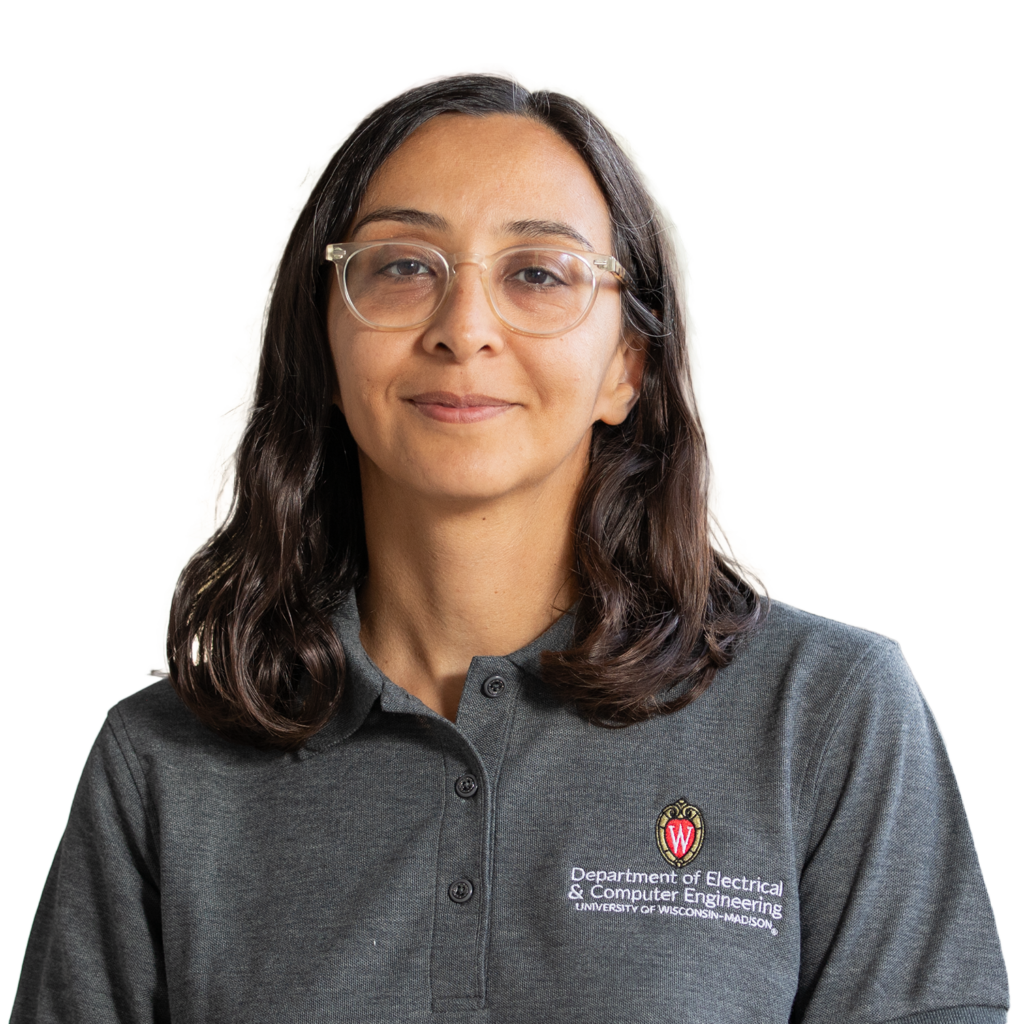
Azadeh Davoodi is a Vilas Distinguished Achievement Professor and Associate Chair of Undergraduate Studies in the Department of Electrical and Computer Engineering at the University of Wisconsin-Madison. Her research focuses on Electronic Design Automation (EDA), integrated circuit debug, and machine learning applications in VLSI design. She holds editorial roles in journals like IEEE TCAD and ACM TRETS, and has chaired major conferences such as ISPD 2015 and served on technical program committees for DAC, ICCAD, and others. Education: PhD in Electrical Engineering, University of Maryland-College Park (2006) Research Interests: Machine learning for VLSI chip design VLSI design automation for machine learning IC-CAD for emerging nanotechnologies Hardware security Recent Research Trends: Her work bridges machine learning and hardware design, with publications on neural network optimization, distributed inference, and explainable AI for circuit design. She emphasizes energy-efficient CNNs, latency reduction in edge computing, and security in split manufacturing. Awards: 2025 DATE Best Paper Candidate 2024 Vilas Distinguished Achievement Professor 2015 ACM Best Paper Award 2011 NSF CAREER Award Service and Grants: Leads NSF-funded projects on explainable ML for CAD and holds grants for distributed neural network synthesis. Her service includes roles as IEEE HKN member and editorial board positions. Labs/Teams: Engages in interdisciplinary research teams at UW-Madison, focusing on EDA innovation and hardware-software co-design.
Dr. Abdolmajid Erfani is an Assistant Professor in the Department of Civil, Environmental, and Geospatial Engineering at Michigan Technological University. He holds a PhD in Civil Engineering from the University of Maryland, College Park (2023), an MSc in Construction Engineering and Management from the University of Tehran (2019), and a BSc in Civil Engineering from the same university (2017). His research focuses on construction economics, smart construction technologies, data-driven infrastructure management, workforce development, and AI applications in project delivery. Dr. Erfani leads studies on workforce equity in transportation and construction industries, leveraging big data and natural language processing. He has published over 30 peer-reviewed papers and received prestigious ASCE awards including the 2024 Arthur M. Wellington Prize and Thomas Fitch Rowland Prize. He serves on the editorial board of the ASCE Journal of Management in Engineering. His recent grants include a National Cooperative Highway Research Program project (PI, 2024–2027) on price adjustment clauses for construction risk sharing and a Minnesota DOT-funded initiative (PI, 2025–2027) on leveraging transportation investments for economic equity. He also co-leads a Federal Railway Administration project (Co-PI, 2025–2028) aimed at promoting railroading careers. Research interests span equity analysis, AI modeling, and predictive analytics for infrastructure resilience. He integrates LinkedIn data and machine learning to study gender disparities in career progression, achieving groundbreaking insights in leadership dynamics within construction sectors.