Vijolė Satkauskienė is a Lecturer and CEO of UAB „Verslo barometras“. She specializes in applied research and experimental development activities conducted between 2020–2023, with a focus on science popularization. Conducted 8-hour accounting and tax training for non-profit accountants (Contract No. ST-6 2020-12-02) Active member of Utena City Board Local Action Group, Lithuanian Engineers Union (Utena Civil Engineers Club), and Chairperson of Utena Accountants Club Her research interests emphasize practical applications in financial governance and regulatory compliance for non-profit organizations.
Rimantas Plungė is a Professor at the Department of Contemporary Arts, Faculty of Arts, Vytautas Magnus University. His academic career spans over a decade, with significant contributions to media education and digital art research. Doctor of Sciences (2010) Professor (2020) Department of Contemporary Arts Faculty of Arts Plungė's research focuses on interdisciplinary art and media education , particularly how computer animation and artificial intelligence transform artistic creation. His work bridges digital culture with traditional media, exploring the evolution of visual storytelling in contemporary films and documentaries. His students' recent theses demonstrate applications of AI in filmmaking, data visualization in photography, and experimental documentary techniques. The research trends highlight digital humanities and ethical implications of technology in art. Plungė supervises advisees across diverse media projects, including: Dovydas Bučas - Documentary narrative authenticity Kajus Jurevičius - AI-algorithm collaboration in video art Ugnė Lisauskaitė - AI portrayal in cinema His work continues to shape modern media culture and creative education in Lithuania.
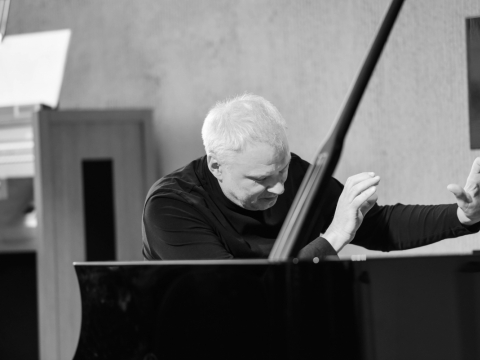
Tomas Kutavičius is an Associate Professor at the Jazz Department of Vytautas Magnus University. As both a jazz pianist/composer and a creator of academic music , he bridges improvisational spontaneity with rigorous compositional frameworks. His work spans theater scores , symphonic pieces , and chamber works , often reflecting nature-inspired metaphors and existential themes . His research focuses on the intersections of jazz and classical traditions , improvisation as a creative act , and music as therapy . He emphasizes emotional authenticity and structural purity , drawing parallels between natural rhythms and musical dramaturgy . Kutavičius' compositional trends reveal a shift from jazz ensembles to large-scale symphonic works , with a recurring interest in theatrical collaborations and symbolic motifs . His 2023 solo album Lake epitomizes his improvisational philosophy , while older works like Dieviškas šėlas (2013) showcase his mastery of orchestral dynamics . He teaches jazz improvisation and contemporary composition at Vytautas Magnus University, having previously taught at the M.K. Čiurlionis Art Gymnasium and Vilnius Choral Singing School. His pedagogical approach mirrors his artistic ethos: "shake off dirt to reveal the core" .
Liu Jintao is an Associate Professor at the Department of Piano within the Music Academy of Vytautas Magnus University. He holds a doctorate degree and has been actively engaged in piano performance and education since 2007. His career spans institutions in China and Belarus, culminating in his current role at VMU. Education: Central Conservatoire, Beijing, China (2007); Belarusian National Music Academy, Minsk, Belarus (Doctorate). His research interests focus on piano performance, classical music interpretation, and music pedagogy. He has participated in numerous concerts and international events, showcasing expertise in solo piano , repertoire development , and contemporary compositions . Scientific achievements include winning The International Piano Competition. His publications reflect live concert performance practices and collaborative projects within the piano field, with a strong emphasis on interdisciplinary and cross-cultural musical experiences.
Kristupas Sabolius is Professor at Vilnius University's Philosophy Institute and affiliated researcher at MIT. His research examines imagination and creativity in Western culture, with focus on visuality, cinema philosophy, and media theories. Work explores pedagogical approaches to creativity development, challenging traditional educational models through experimental teaching methods. Collaborates with Šviesa publishing to integrate creative thinking into textbooks. Publications address queer history integration in curricula and Lithuania's cultural future. Professional activities include directing theater performances and contributing to national cultural discourse through media commentary.
Habil. dr. Gediminas Gaigalas serves as Chief Researcher at the Institute of Theoretical Physics and Astronomy (ITPA) within Vilnius University's Faculty of Physics. His work bridges theoretical atomic physics with astrophysical applications, particularly in understanding heavy element spectroscopy for neutron star merger events. Gaigalas maintains active international collaborations, including the Lithuanian-Japanese project on gravitational wave sources, and contributes to major computational atomic physics initiatives. His research focuses on multi-electron atomic theory , relativistic atomic structure calculations , and computational methods for atomic spectroscopy. Specializing in spin-angular integration techniques and configuration interaction methods, Gaigalas has developed advanced computational approaches for modeling heavy elements. His work with the GRASP (General Relativistic Atomic Structure Package) computational framework has been particularly influential in the field, enabling precise calculations of atomic properties for elements critical to understanding kilonova phenomena. Analysis of Gaigalas's recent publications reveals a strong emphasis on astrophysical applications of atomic data , particularly for neutron star merger events (kilonovae). His work spans both theoretical development of computational methods and practical applications to spectroscopic problems, with particular focus on lanthanides and other heavy elements. The research demonstrates increasing sophistication in handling relativistic effects and electron correlations in complex atomic systems. Adolfas Jucys Award of the Lithuanian Academy of Sciences (2022) for series of works 'Second quantization and additional symmetries in atomic physics: theory and applications' Vilnius University Rector's science award (2018) Research Award of the Lithuanian Academy of Sciences (2014) Guest Professor of Lanzhou Northwest Normal University (2007) Letter of Appreciation from the President of Lithuania (2005) Gaigalas has supervised numerous doctoral students including L. Radžiūtė, J. Grumer, P. Rynkun, O. Sharf, and T. Žalandauskas, with postdoctoral supervision of L. Radžiūtė and P. Rynkun. He leads the Lithuanian-Japanese project 'Theoretical Studies of Structure and Properties of Heavy Elements Toward Identification of Gravitational Wave Sources' funded by the Research Council of Lithuania. His teaching spans all academic levels, from BSc courses in atomic and nuclear physics to PhD-level courses on symbolic programming and atomic theory. As an active member of the international atomic physics community, Gaigalas participates in the 'International Collaboration on Computational Atomic Structure' and serves on the editorial board of the journal Atoms. His research group focuses on developing computational methods for atomic structure calculations with applications to astrophysics, particularly in providing accurate atomic data for modeling kilonova emissions from neutron star mergers.
Joana Katina is an Assistant Professor at the Faculty of Mathematics and Informatics, Vilnius University, Lithuania, teaching Internet Technologies and Algorithms and Data Structures continuously from 2016/2017 through 2025/2026 academic terms across multiple course formats including lectures, exercises, and subgroup sessions. Her research bridges computer science with energy systems and financial engineering, focusing on household energy behavior in Lithuania/Morocco, cryptocurrency forecasting using neural networks, Industrial Control Systems cybersecurity, and queueing theory. She integrates computational modeling with socio-technical analysis to address sustainability challenges and market prediction problems. Analysis of her 2023-2025 publications reveals a dominant trend toward renewable energy transitions (particularly waste-to-energy systems and cross-regional green strategies) combined with machine learning applications in finance. This evolution from earlier virtual stock exchange simulations demonstrates increasing interdisciplinary scope while maintaining core expertise in stochastic modeling and predictive analytics.
Jonas Dagys serves as an Associate Professor in the Department of History of Philosophy and Analytical Philosophy at Vilnius University, where his research centers on contemporary analytic philosophy, logic, and the historical development of analytic thought. His scholarly profile reflects deep engagement with methodological implications of psychophysical reductionism and antireductionism, as well as critical examinations of temporal metaphysics through comparative studies of philosophers like McTaggart and Mellor. His research trajectory demonstrates evolving specialization: early work (2006-2012) established foundations in consciousness studies and mind-body problems, while recent publications (2019-2022) reveal intensified focus on medieval logic—particularly Buridan's modal propositions—and intersections between analytic philosophy and early Christian thought. Additional interests include Fregean semantics, university management during crises, and Wittgensteinian philosophy, indicating both historical depth and contemporary relevance in his analytical approach. Analysis of his 15 most recent publications shows a clear methodological pattern: rigorous logical formalization of historical philosophical concepts combined with empirical considerations in identity studies. The 2020-2022 output particularly highlights adaptation to contemporary academic challenges, including pandemic-era educational management alongside sustained exploration of foundational philosophical questions through medieval and modern lenses. No scientific awards were documented in the provided sources. Information regarding student supervision, research grants, laboratory affiliations, or collaborative research teams was not present in the available materials, suggesting either omission in the source texts or primary focus on independent scholarly publication rather than team-based research activities.
Artūras Dambrauskas is a Professor and Head of the Department of Music Theory and Practice at the Music Academy of Vytautas Magnus University in Kaunas, Lithuania. With a distinguished career spanning several decades, he has established himself as a leading figure in Lithuanian choral music and conducting pedagogy. His research interests focus on choir conducting techniques and conducting pedagogy, bridging traditional Lithuanian choral traditions with modern educational approaches. Professor Dambrauskas has developed innovative methodologies for teaching conducting that have influenced a generation of Lithuanian choral directors, with particular emphasis on how musical expression connects to national identity and cultural memory. Professor Dambrauskas has produced an impressive body of work with 224 documented musical compositions, including 54 publications from 2020-2024. His recent compositions demonstrate thematic consistency around national commemoration, cultural heritage, and European integration, often blending traditional Lithuanian musical elements with contemporary approaches. His creative output spans memorial requiems, festival concerts, and experimental works like "Cantus in 5D" that explore new dimensions of choral performance. As a prominent cultural figure, he has organized major events including the XVIII Chorus Festival "Lietuva brnga" and the "Shalom Culture & Music Festival" which celebrates Jewish cultural heritage in Lithuania. His leadership extends through the Lithuanian Union of Musicians (Lietuvos muzikų sąjunga) where he contributes to national music policy and professional standards. Professor Dambrauskas is fluent in Lithuanian (native), Russian (very good), German (very good), and English (good), facilitating international collaborations across Europe. His work consistently addresses themes of freedom, historical memory, and national identity through the medium of choral music, making significant contributions to Lithuania's cultural landscape.
Raimondas Butvila is a Professor at Vytautas Magnus University Music Academy, where he serves as head of the Instrumental Department. An accomplished violinist and educator, he has shaped music education both in Lithuania and internationally through his extensive teaching career and artistic performances. Professor Butvila's research interests focus on violin performance, music education, and chamber music. His scholarly work centers on violin pedagogy, particularly the preparation of young violinists in music and art schools. He has developed innovative teaching methods and training appliances to enhance the musical development of students in grades 1-2, addressing the critical early years of violin education that form the foundation for advanced musical development. His recent publications reveal a strong focus on interpreting classical repertoire, with particular emphasis on works by Schubert, Strauss, Bach, Beethoven, and Brahms. Butvila has established significant artistic collaborations, most notably with pianist Alexander Paley since 2013, resulting in numerous festival performances across Europe. Their partnership has produced monographic programs featuring complete chamber works of Prokofiev, Grieg, and Brahms, demonstrating Butvila's commitment to comprehensive artistic exploration. Honored Artist of Lithuania (awarded 1990) Artist status granted by Order No. ĮV-494 of the Minister of Culture of Lithuania (2022) As an educator, Professor Butvila has mentored numerous students throughout his career, including at the Lithuanian Academy of Music, the National Experimental University of Arts in Caracas, and currently at Vytautas Magnus University. His international collaborations, particularly with Dr. Zecharia Plavin since 2007 and Alexander Paley since 2013, have expanded his pedagogical influence across continents. Butvila's artistic leadership extends to his role as Music Director of the Emilio Friedman College in Caracas and his participation in prestigious festivals including the Festival de musique de chambre du Moulin d'Andé in France.
Aušrinė Diržinskaitė-Kazlauskienė serves as a Lecturer and PhD candidate at Vilnius University's Institute of International Relations and Political Sciences (TSPMI), affiliated with the Center of Political Economy. She coordinates the political watchdog network 'Žinau, ką renku', which monitors elected officials and organizes pre-election debates to enhance political accountability in Lithuania. Education Bachelor’s degree in Political Science (2017), Vilnius University Institute of International Relations and Political Sciences Master’s degree in Public Policy Analysis (2022), Vilnius University Institute of International Relations and Political Sciences Research Focus Her work bridges Comparative Politics, Political Sociology, and Behavioral Public Policy, with specialized expertise in climate taxation acceptability and political representation. She investigates how information framing affects public perceptions of carbon tax fairness through experimental methodologies, while analyzing youth political disengagement and pledge fulfillment by elected officials. Publication Trends Her research output examines Lithuanian socio-political dynamics through two key lenses: regional economic disparities (2021) and generational political behavior (2018). The publications reveal consistent focus on empirical analysis of domestic policy challenges, combining regional development theory with political behavior studies to address representation gaps. Professional Engagement As coordinator of 'Žinau, ką renku', she drives civic initiatives that directly impact electoral transparency. Her PhD dissertation 'Will Taxes Save the Planet?' (supervised by Assoc. Prof. Vytautas Kuokštis) extends this applied approach to climate policy, testing behavioral interventions for improving carbon tax acceptance. The 2021 research report for the Research Council of Lithuania demonstrates her capacity for policy-relevant academic work. Research Infrastructure She operates within TSPMI's Center of Political Economy framework while leading the independent 'Žinau, ką renku' network, which functions as a practical extension of her academic work through real-time political monitoring and public debate facilitation.
Dr. Fabio Sgarbossa is a Full Professor of Industrial Logistics at NTNU's Department of Mechanical and Industrial Engineering (MTP), leading the Production Management Research Group and overseeing the Logistics 4.0 Lab. He holds a PhD in Industrial Engineering from the University of Padova (2010) and previously served as an Associate Professor there. His research focuses on industrial logistics design, supply chain management, digitalization in logistics, and human factors in production systems, with contributions to over 150 international publications. He is an Associate Editor for the International Journal of Production Research and actively involved in organizing international conferences. His work integrates advanced technologies like Industry 4.0, additive manufacturing, and AI to address challenges in supply chain resilience, sustainable production, and ergonomic system design. Notable projects include optimizing warehouse systems, evaluating assistive technologies for worker well-being, and developing decision frameworks for spare parts management. His research bridges theoretical models with practical applications, emphasizing human-centered design and circular economy principles. Dr. Sgarbossa’s contributions extend to strategic frameworks for disassembly systems, collaborative logistics in rural contexts, and the mitigation of Lean implementation barriers through digitalization. His Logistics 4.0 Lab serves as a platform for experimental research and education, fostering innovation in smart manufacturing and logistics solutions. He collaborates extensively on EU-funded projects and guides industry partnerships to translate academic insights into actionable strategies.
Titas Petrikis is a Professor at the Department of Contemporary Arts, Faculty of Arts, Vytautas Magnus University. He is renowned for his work in film music composition, electronic music production, and interdisciplinary sound research. His academic and creative activities span supervising theses on topics such as football chants, hip hop culture, Christian music, and audiovisual storytelling. Education: Doctor of Sciences (2014), Professor (2019) Key Collaborations: Regularly works with filmmakers, festivals, and academic institutions on projects like the film Gardutė and the Y93.J exhibition. His research interests focus on the intersection of sound design, film, and narrative, with a particular emphasis on how music shapes cultural identity and emotional resonance. He has supervised numerous bachelor’s theses exploring topics like: Football songs and community identity Orchestral reinterpretation of electronic music Sociocultural aspects of dance music festivals Role of communication in artist recognition Genre fusion in contemporary music production His recent articles highlight trends in: Cinematic soundtracks and intercultural dialogue Electronic music’s adaptation to classical instruments Interdisciplinary approaches to audiovisual storytelling Evolution of hip hop and dance cultures He has received recognition for his film compositions, including a 2025 nomination for Best Composer in Lithuanian Film Awards. His work often involves collaborations with students and professionals on projects that bridge academic research with creative practice.
Kristina Jonutytė is a Lecturer at the Department of Sociology , Vytautas Magnus University . She is affiliated with the Vytautas Kavolis Interdisciplinary Research Institute , where she contributes to transdisciplinary research groups addressing societal challenges in the humanities and social sciences. Research Focus : Anthropology of Buddhism, Political and Economic Anthropology, Urban Anthropology, and North Asia (Siberia). Languages : Lithuanian (native), English, Russian, and German. Her recent publications explore themes such as post-Soviet religious revival , ethnographic methodologies , and minority perspectives in geopolitical conflicts . Notably, she investigates Buddhist counseling practices, shamanic traditions, and spatialized belonging in Siberian cities like Ulan-Ude. She also critiques economic imaginaries in remote regions through ethnographic analysis. Projects : Participated in the SOCMTEP project, strengthening experimental development in transdisciplinary humanities and social sciences.
Prof. Dr. Rasa Janulevičiūtė is a Professor at the Department of Design, Vilnius Academy of Arts, and an active member of the Lithuanian Artists’ Association. Her interdisciplinary work bridges academic research, artistic practice, and design history. Education: Master's in Book Graphics, Vilnius Academy of Arts (1999) Ph.D. in Art History and Theory, Vilnius Academy of Arts (2004), dissertation: Lithuanian Artist's Book: Aspects of Tradition and Modernity Research Focus: Her scholarship centers on Lithuanian design history, particularly industrial furniture design and institutional evolution of design education. She explores the interplay between tradition and modernity in artists' books, examining materiality, symbolism, and cultural identity. Her artistic practice incorporates calligraphy, exlibris, and experimental book forms. Publications: Her scholarly output includes monographs on Lithuanian design history and peer-reviewed articles analyzing book art, design processes, and cultural representation. Recent works focus on Soviet-era design legacies and contemporary reinterpretations of Lithuanian material culture. Awards & Recognition: Multiple international ex libris competition prizes (2021, 2022, 2024) Lithuanian Post Philately Competition awards (2025) Research grants from Lithuanian Council for Culture Projects & Grants: She has led significant research initiatives including: Industrial furniture design studies (2020, 2022) Monographs on designers Tadas Baginskas (2020) and design narratives (2018) Documentation of Vilnius Academy's Design Department history